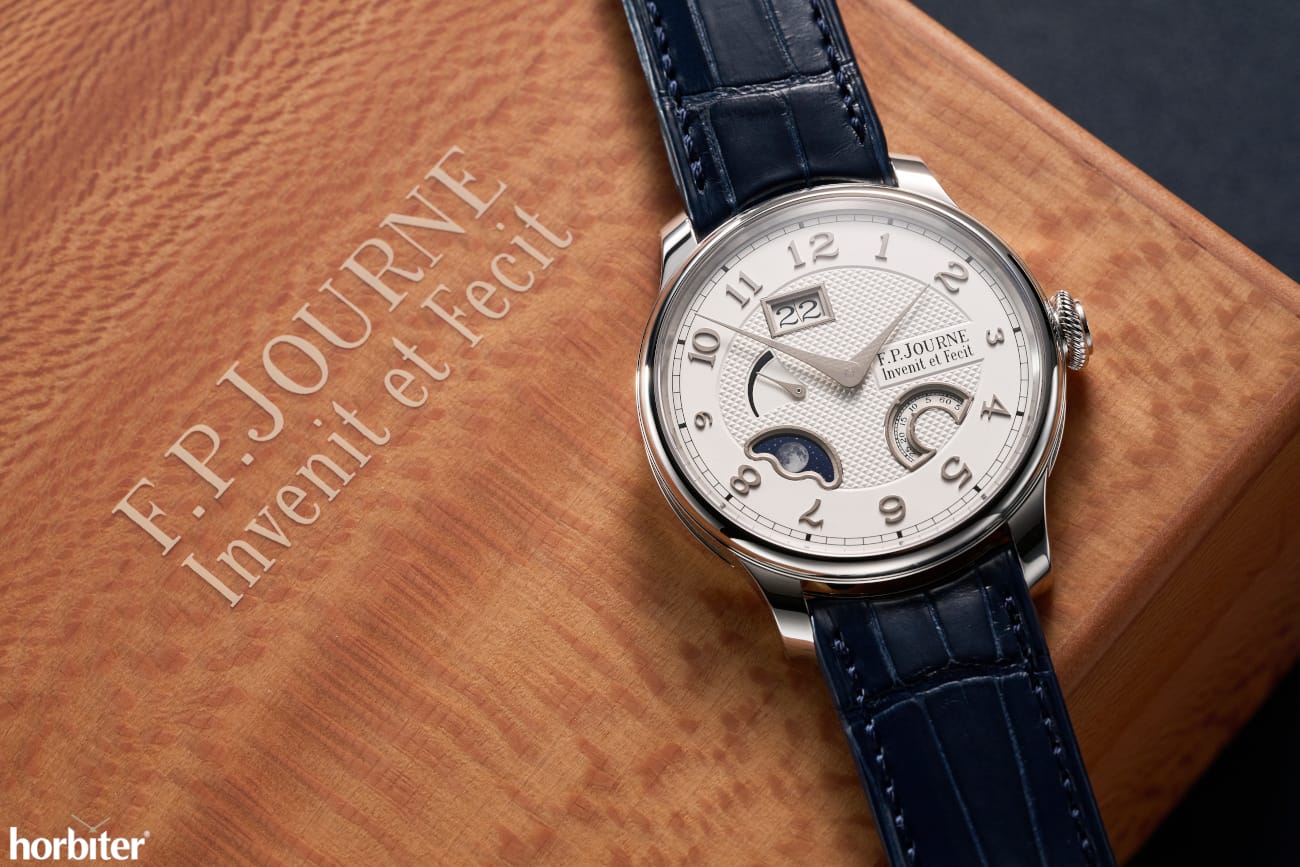
After reviewing the high-end quartz-powered F.P.Journe watch last year, the Classique Divine Calibre 1300.3 brings us back to high-end mechanical watchmaking.
F.P. Journe is universally respected for his classic approach to watchmaking; indeed, he made a quintessentially classic watch popular again, challenging mainstream brands at their own game while pushing them to raise their standard.
In his quest to combine pure classicism with ingenious technical solutions, François-Paul embodies, in my opinion, a contemporary Breguet.
The F.P.Journe Classique Divine Calibre 1300.3 stands out as a manifesto of long-gone classicism and exquisite engineering. It is a mid-range offering in terms of price and mechanical complication across the whole portfolio.
Born Octa, turned Classique.
It once was an Octa. The Classique collection is a landing destination for a timepiece introduced in 2003 and finally revised in 2023, with upgrades across aesthetic and technical aspects, migrating from Octa Divine to Octa Divine Nouvelle (2016), and, finally, Classique Divine (2023).
An Octa Divine’s first technical update occurred in 2004, when the original calibre 1300 became the 1300.2 to welcome a full-gold build and house a bidirectional winding rotor. Finally, it became the 1300.3, powered by a unidirectional-winding rotor (2007).
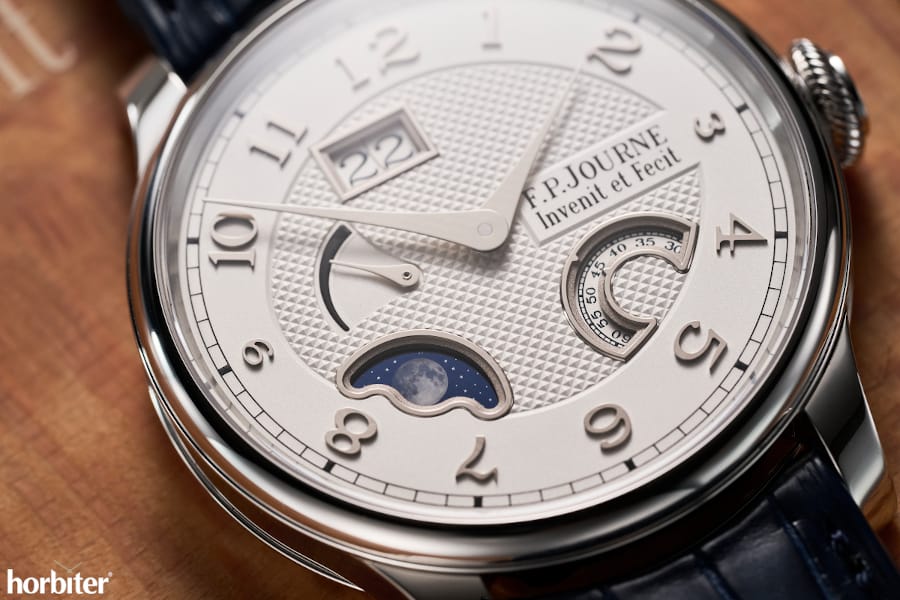
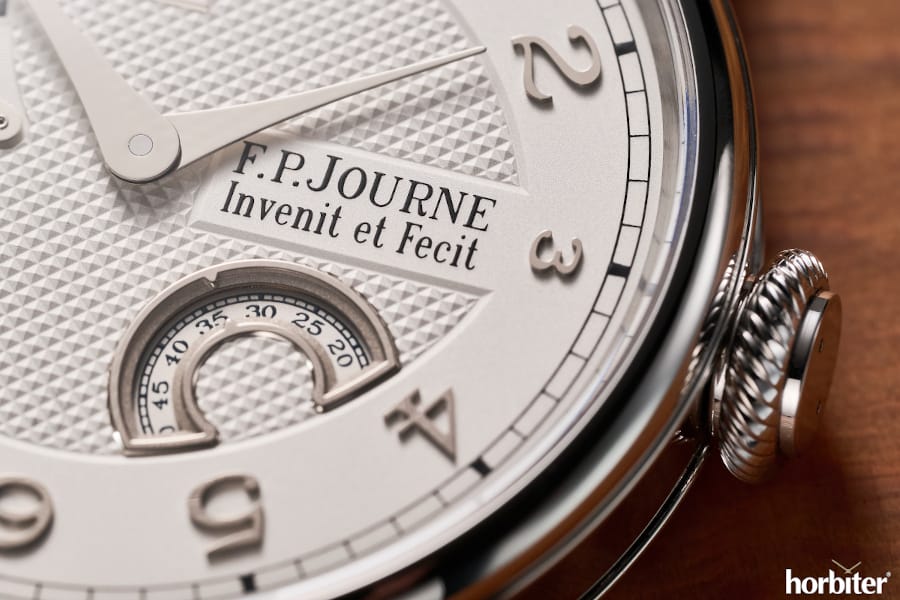
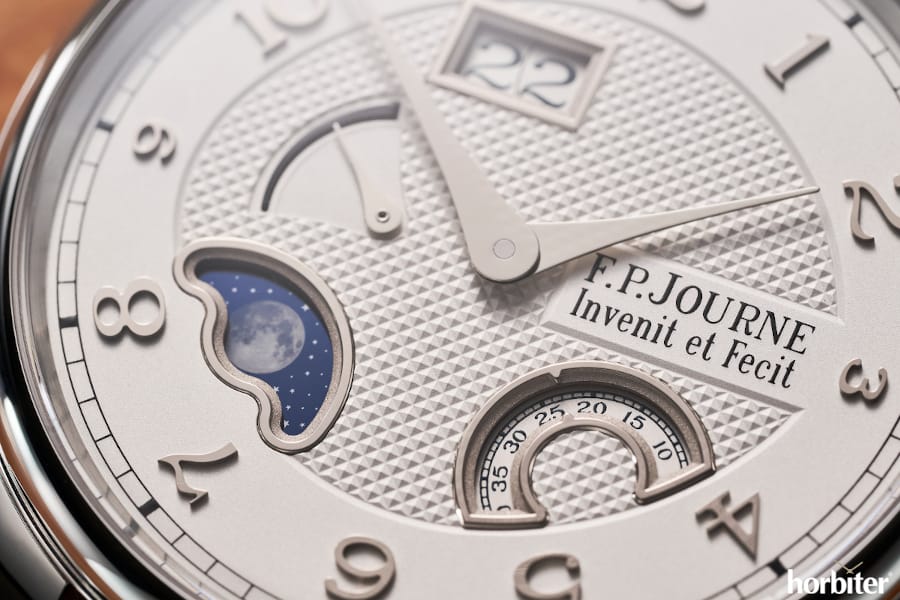
Octa belongs to the past, and Classique has taken over, adding a classic-oriented treatment to the Divine Calibre 1300.3, exemplified by a Clous de Paris pattern, with a moon phase and running seconds displays framed by thick white gold edges, and applied white gold Arabic numerals, with downsized 3 and 9 ones.
Also, a white gold frame surrounds the Big Date display, atop the long power reserve indicator.
You can still see some Octa vibes in the vague mid-dial’s elliptical sketch; the outcome is still pretty attractive, yet quintessentially F.P.Journe from any angle.
The whole scenario combines classic traits and exquisite craftsmanship, provided by extensive guillochage that helps quickly read the various displays.
A Divine Calibre 1300.3 is available in 40.0 or 42.0 mm sizes with a standard thickness of 10.7 mm. It is not an ultra-thin watch per se, but the proportions do justice to each size, and you won’t search for a discontinued (2015) 38 mm model any longer.
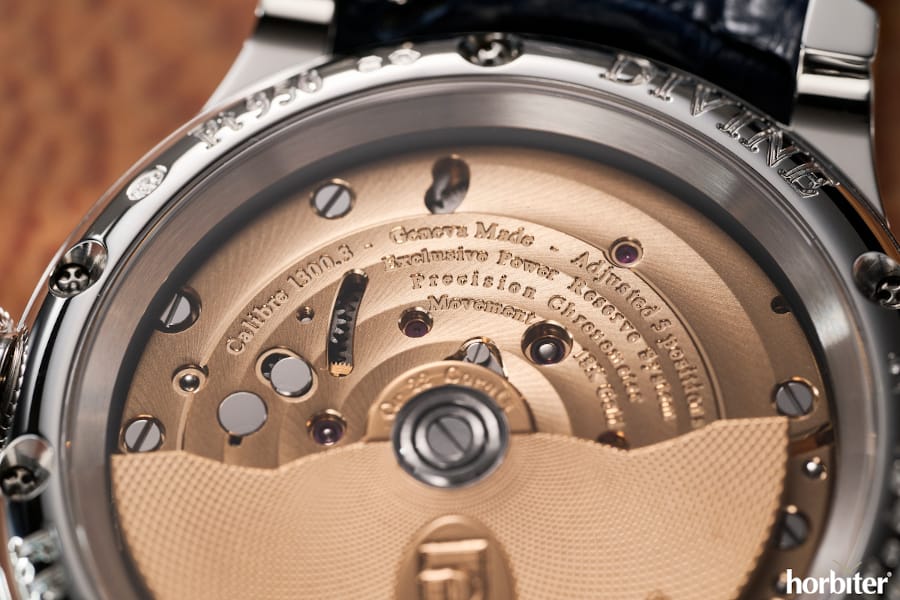
Showcasing a platinum case featuring a prominent bezel and slim lugs to help comfortably wrap it around the wrist, the Divine Calibre 1300.3’s main talking topic is, as always, a stand-out mechanical movement.
The F.P.Journe Calibre 1300.3
F.P.Journe is the benchmark in this area across the Haute Horlogerie circle. It has indeed pushed the envelope, becoming a benchmark for the industry, forcing major mainstream brands to raise their standards.
The brand’s movements are a joy to watch as much as to praise, for their technical prowess and ingenuity, where nothing was left to chance. They’re worth every penny and jaw-dropping in execution and attention to detail.
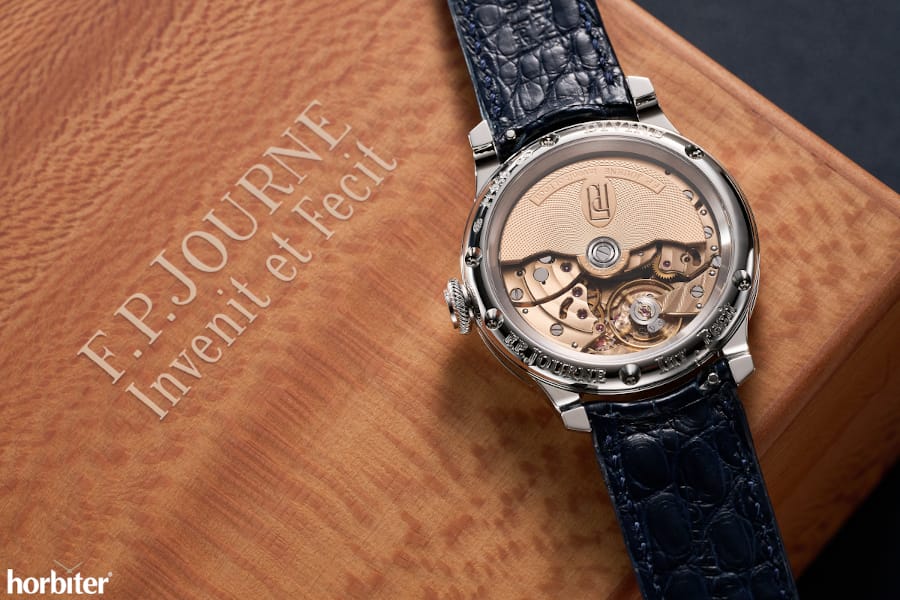
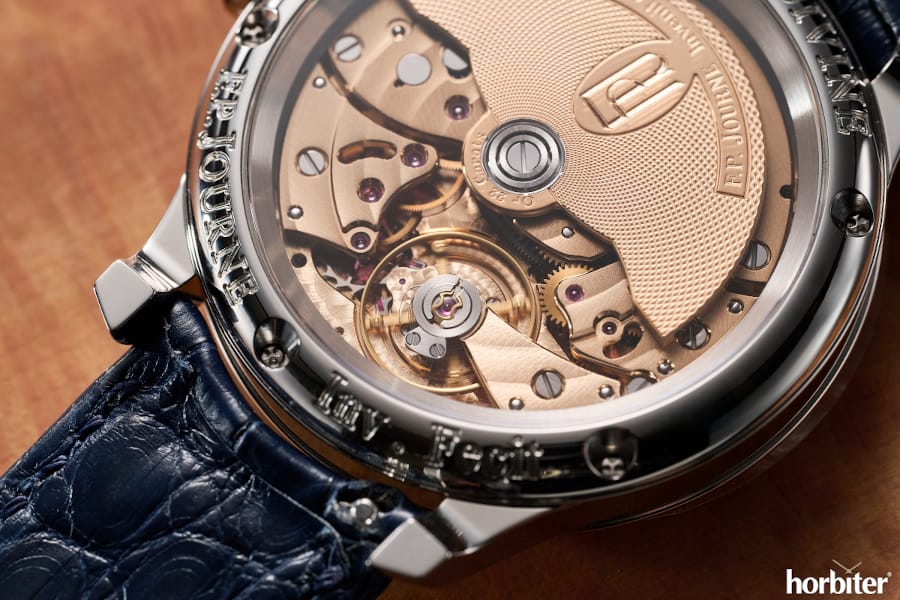
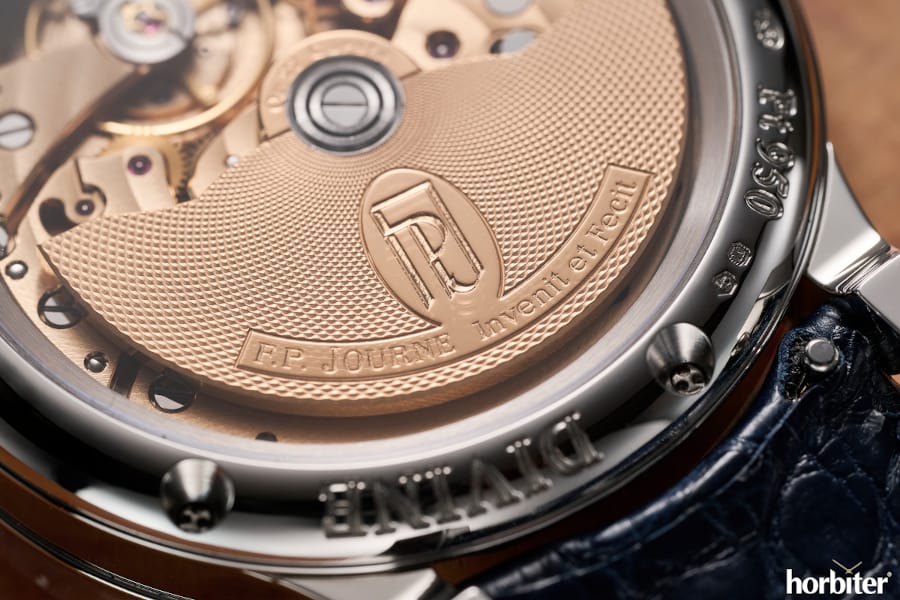
The guilloché on the oscillating weight, for instance, reveals a forgotten Haute Horlogerie craftsmanship that a handful of master watchmakers can manage today.
From our macros, you’ll appreciate the circular Côtes de Genève decorations and the hand-bevelled, then polished, angles. It’s a feast for the eyes, and the platinum case to gold calibre makes it as sophisticated as timeless.
It’s no wonder that the most seasoned collectors strive to add an F.P. Journe watch to their collection; they know they’re acquiring an out-of-this-world wristwatch whose artistry and technical execution are second to none.
Ingenuity comes standard with superb decoration. The large 10.1 mm free-sprung balance wheel, running at 3 Hz, features four tiny gold masses to adjust its inertia finely.
It houses an Anachron flat spring and an in-line escapement. According to F.P.Journe, the outcome is a timepiece capable of running with chronometric precision for up to 120 hours from a total power reserve of circa 7 days.
Concluding thoughts
The €CHF 51.400 + taxes sticker price (and the long waiting list) for a 40 or a 42mm F.P.Journe Classique Divine Calibre 1300.3 is well deserved, and the market price shows that demand far exceeds production capacity.
While I won’t discuss investment topics here, it nonetheless underscores how exclusive an F.P.Journe watch is, given the time and dedication required to assemble, decorate, and fine-tune a Divine, as with any other F.P.Journe.
I am more into the brand’s most complicated models, like the Centigraphe. Still, a Divine belongs to the F.P.Journe’s foundations and stands as one of the most attractive, if not the most, executions of haute horlogerie a connoisseur’s money can buy in this price and product category.
(Photo credit: Horbiter®)
Gaetano C @Horbiter®
In this article:
Calibre
A calibre is the type of watch movement encased in an assigned timepiece. Its name is usually associated with the manufacturer's name and a standard code, e.g., ETA 2824.
Complication
The addition of any mechanical complication to a movement that usually displays the time.
Rotor
Part of an automatic watch that winds the mainspring by constantly rotating. Depending on the watch's winding capability, movement design, and value, it comes in various geometries, sizes, and materials.…
Power Reserve
A mechanical watch feature displays, on the dial or the case back, the remaining power in a watch movement, showing the length of time until the timepiece must be rewound.
Date
It indicates the date of the month. There are different types of display: via a window or a pointer, where an additional hand is usually placed centrally or on a…
Case
It encases the mechanical movement and is crafted in one or more parts. It can also be a single piece, as with some professional diving watches, or made of unconventional…
Bezel
The bezel is particularly useful on diving watches, allowing you to check dive times. In this case, it unidirectionally rotates and usually comes in two parts: a metal (or ceramic,…
Balance wheel
A part of a mechanical watch that oscillates, dividing time into equal portions.
Line
It is the measurement unit that identifies the size of a movement. According to this measurement system, one line corresponds to 2,255mm.