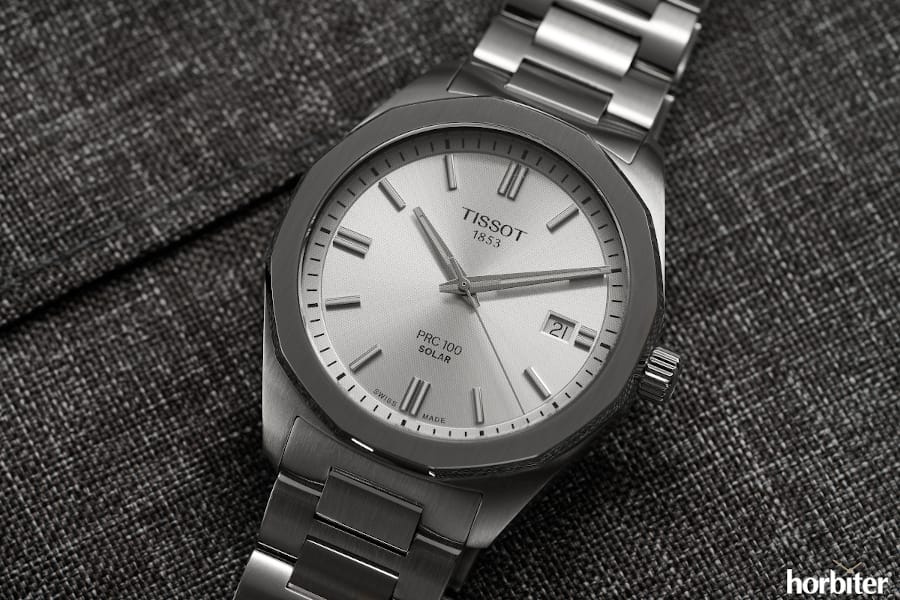
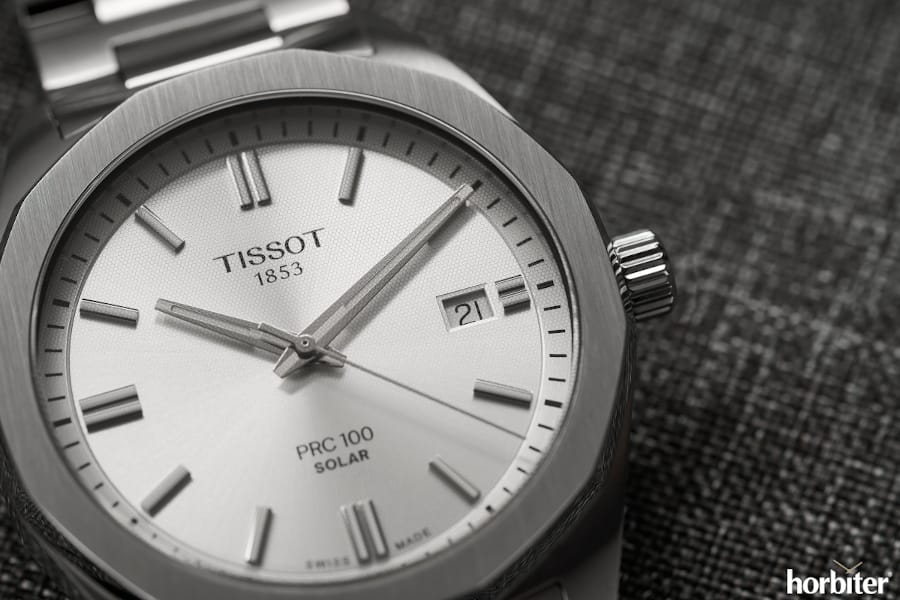
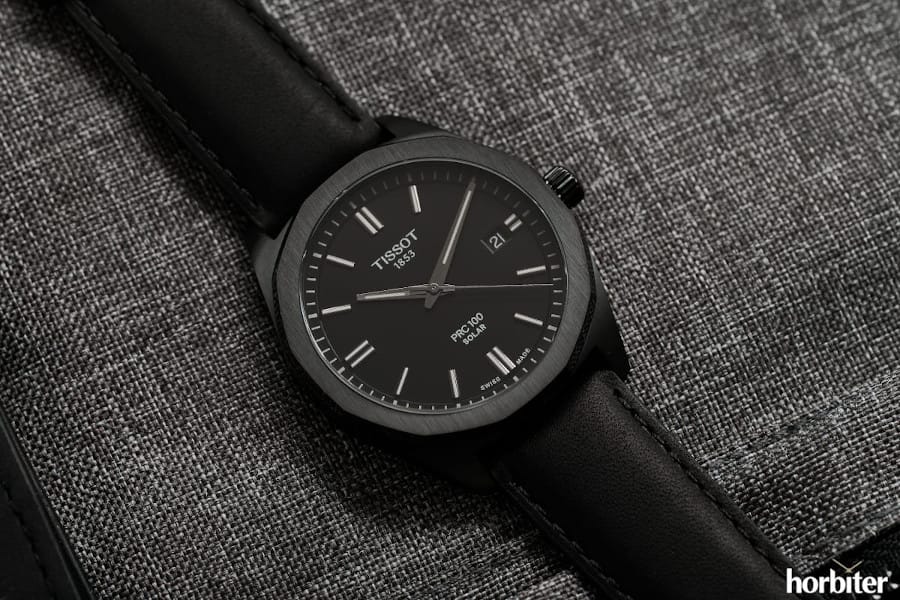
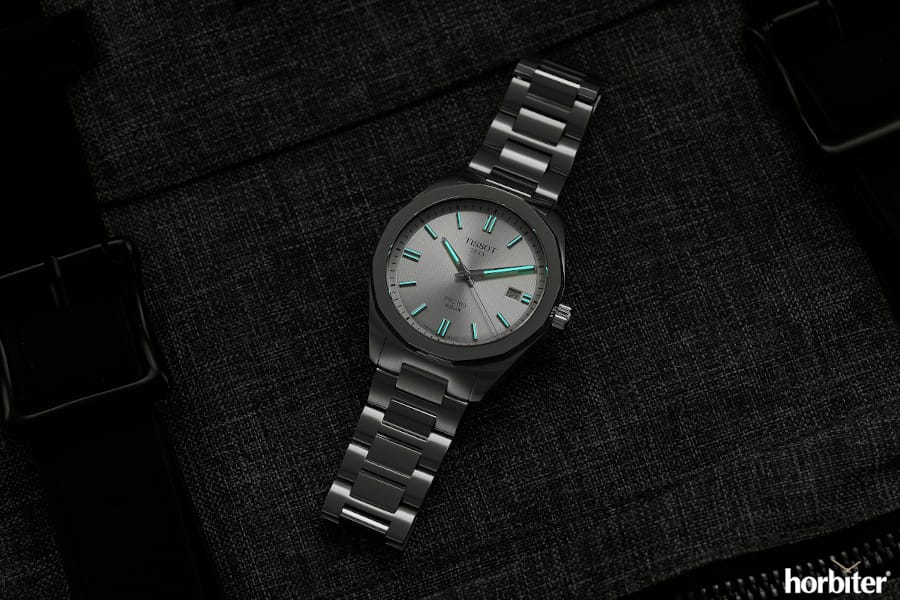
Tissot is among the most versatile Swiss watch brands, whose expertise includes the development of excellent mechanical watches as well as digital and tactile technology-equipped instruments like T-Touch. They recently revealed a new range of light-powered analogue watches adopting a new approach: the PRC 100 Solar captures the energy of light through the glass, unlike most of its siblings, where the dial usually triggers the process. Keep reading, and we will guide you through the PRC 100 Solar’s story and forerunner, how it works, its pros and why Tissot decided, in our opinion, to develop such a product family.
The PRC acronym is not new to watch enthusiasts.
In 2005, Tissot introduced a three-hander with a dodecagonal bezel and an integrated multi-link bracelet named PRC, standing for “Precise, Robust, and Classic”. Thus, the new PRC 100 Solar celebrates the collection’s 20th anniversary with a first-ever solar-powered watch for the collection.
The brand’s designers tried to faithfully mimic the original lines into a contemporary, sleeker, and sportier version of the original model. According to the specs sheet, the watch measures 39.0 mm by 9.2 mm thick and has a 20 mm lug width. It also has a convenient 100-meter water resistance. So far, here is another classic three-hand sports quartz watch in steel unless you look under the hood.
How is a PRC 100 Solar made, and how it works
What makes a PRC 100 Solar a class apart is how it captures the light from any source. Tissot is the first watch brand to adopt a technology known as Lightmaster Technology, which was already adopted by some smartwatches on an analogue three-hand watch with a dial. The working principle builds on photovoltaic glass technology. Thus, the glass is active since it captures light and converts it into electrical energy.
The build process starts with a raw mineral glass panel covered with a thin amorphous silicon layer, which is then acid-treated to create a dense honeycomb pattern that massively improves light absorption. A laser cut helps shape the final shape before covering it with a protective film, except for a tiny area housing a zebra-type connector. Mineral glass is commonly used in microelectronics for its efficiency, robustness, seamless integration, and low cost.
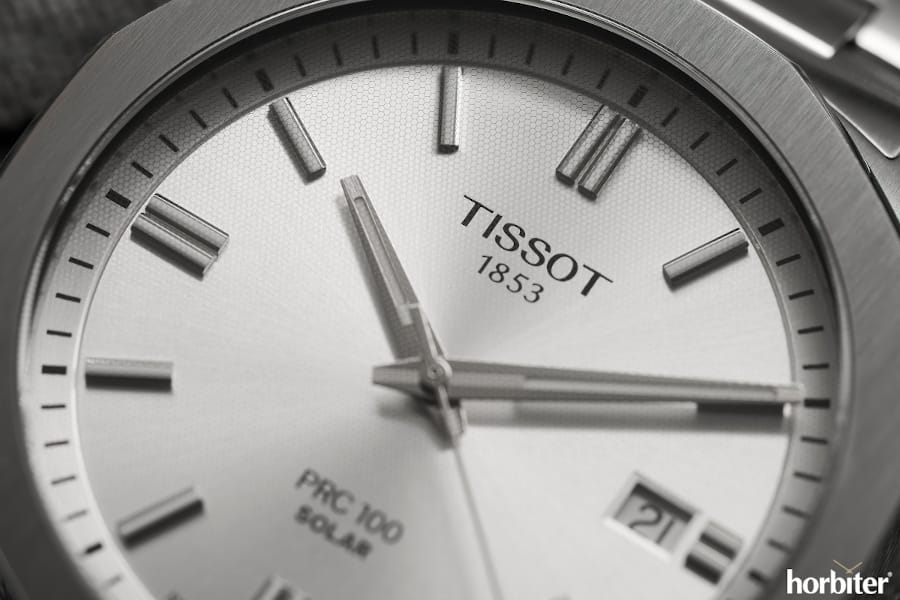
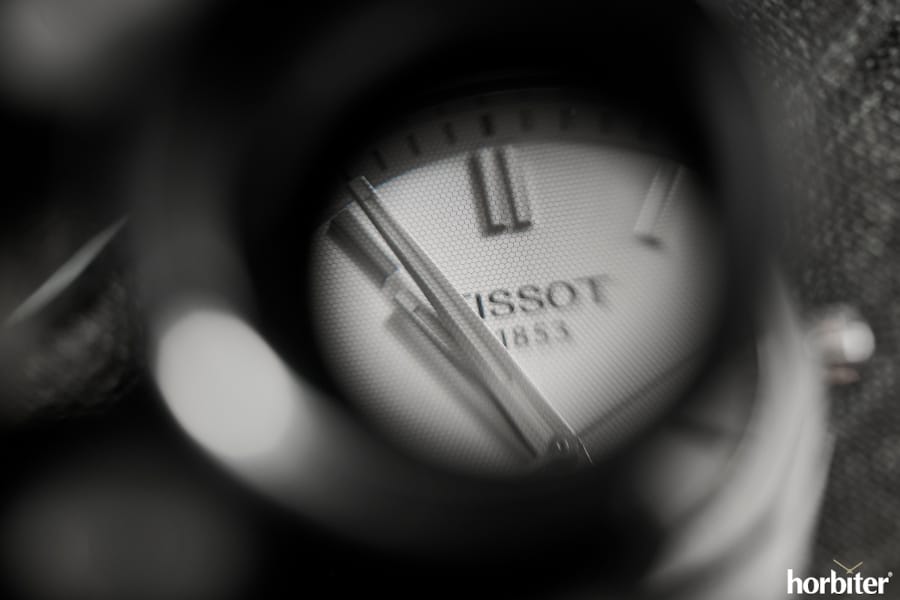
The honeycomb glass, whose pattern is visible up close, is joined to the outer sapphire glass through a lamination process. Such final assembly protects the dial (and the electrically active glass) from the outside while increasing efficiency since the cells are placed between two glasses, finally locked via a ring to the case. The zebra connection closes the electrical circuit on a battery whose life is approximately 12 years and is so efficient that one minute of exposure to the sun or ten minutes of dim light guarantees a 24-hour power reserve.
Once fully charged, the watch can run for at least 14 months without any further charge. As the watch is close to running out of energy, an analogue E.O.E. (End of Energy) procedure advises the wearer to look for a light source; the second’s hand jumps in four-unit increments. Tissot guarantees the PRC 100 Solar for three years, providing a one-year additional warranty.
Why did Tissot engineer the PRC 100 Solar?
The solar-powered watch product category has vast potential, to the extent that luxury brands like TAG Heuer have joined, too. The audience includes people searching for easy-to-use analogue three-hand watches with virtually unstoppable energy and low maintenance and management costs in the long term. Also, the price range sets the business volume; a 500 euro average selling price means high market volumes, an opportunity Tissot couldn’t miss.
Final thoughts
The PRC 100 Solar is Tissot’s take on a much more popular formula. Lightmaster Technology ensures freedom to design any case shape, ease of use and low maintenance or repair costs. By gathering all the working elements into the glass assembly, designers can easily and quickly change from one design to another by adapting the glass’ shape, thus reducing development time and cost.
From a commercial perspective, Tissot enters a super competitive category where Japanese watch brands rule. Tissot’s proposition is an original Swiss-made, designed, and manufactured opponent that builds on a clean, yet too much, style, soon opening to upcoming range extenders. For example, a 34 mm size sub-collection will launch in the spring.
Moving forward, I would extend the product’s accessories anytime soon. A rubber strap, for example, and optional, more vivid dial colours are welcome. A PRC 100 Solar retails between €475 and €545 needed to buy a black PVD-treated bracelet and case model. Finally, the watch weighs 64 grams on a strap and 128 grams on a steel bracelet.
(Photo credit: Horbiter®)
Giovanni Maria Di Biase @Horbiter®
In this article:
Bezel
The bezel is particularly useful on diving watches, allowing you to check dive times. In this case, it unidirectionally rotates and usually comes in two parts: a metal (or ceramic,…
Power Reserve
A mechanical watch feature displays, on the dial or the case back, the remaining power in a watch movement, showing the length of time until the timepiece must be rewound.
Case
It encases the mechanical movement and is crafted in one or more parts. It can also be a single piece, as with some professional diving watches, or made of unconventional…
Strap
A leather, rubber or other material band that secures the watch to the wearer's wrist.
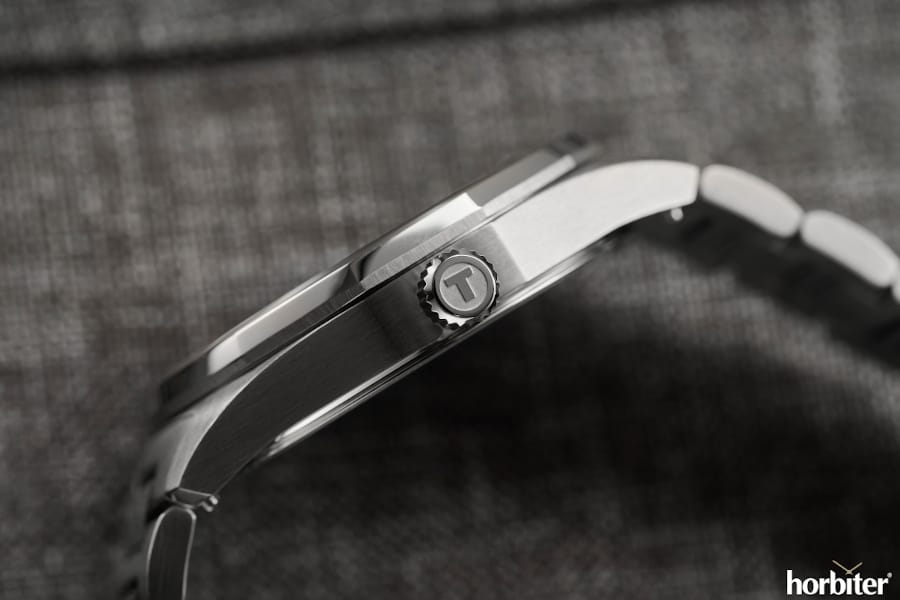
With the PRC 100 Solar, Tissot took an original approach to designing a solar-powered watch. It adopts the Lightmaster technology, which first appeared on some smartwatches. This technology, which essentially uses a miniature photovoltaic glass, allows for great design flexibility. It also adopts a zebra connection, which the brand has used since the first T-Touch. As stated in our “Final thoughts” section, we suggest Tissot add new dial variations soon. Finally, please consider it is a 100-meter watch, but the crown is not screwed-in. Pay attention when swimming, for instance, and ensure the crown is securely closed.