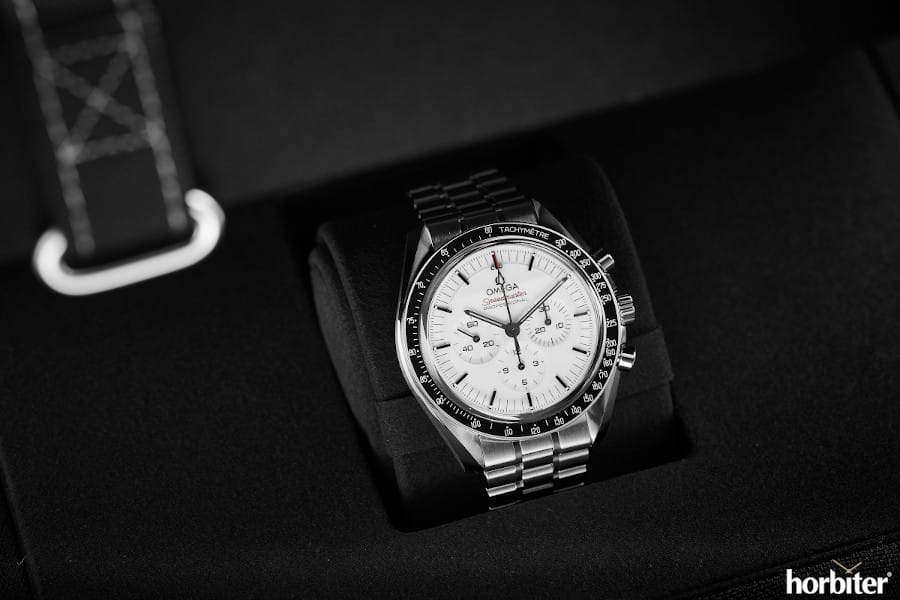
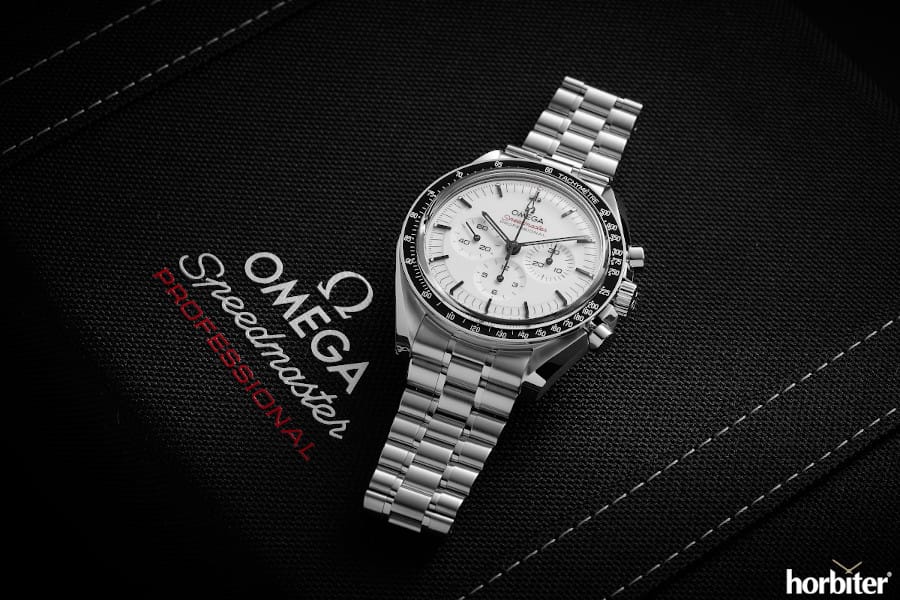
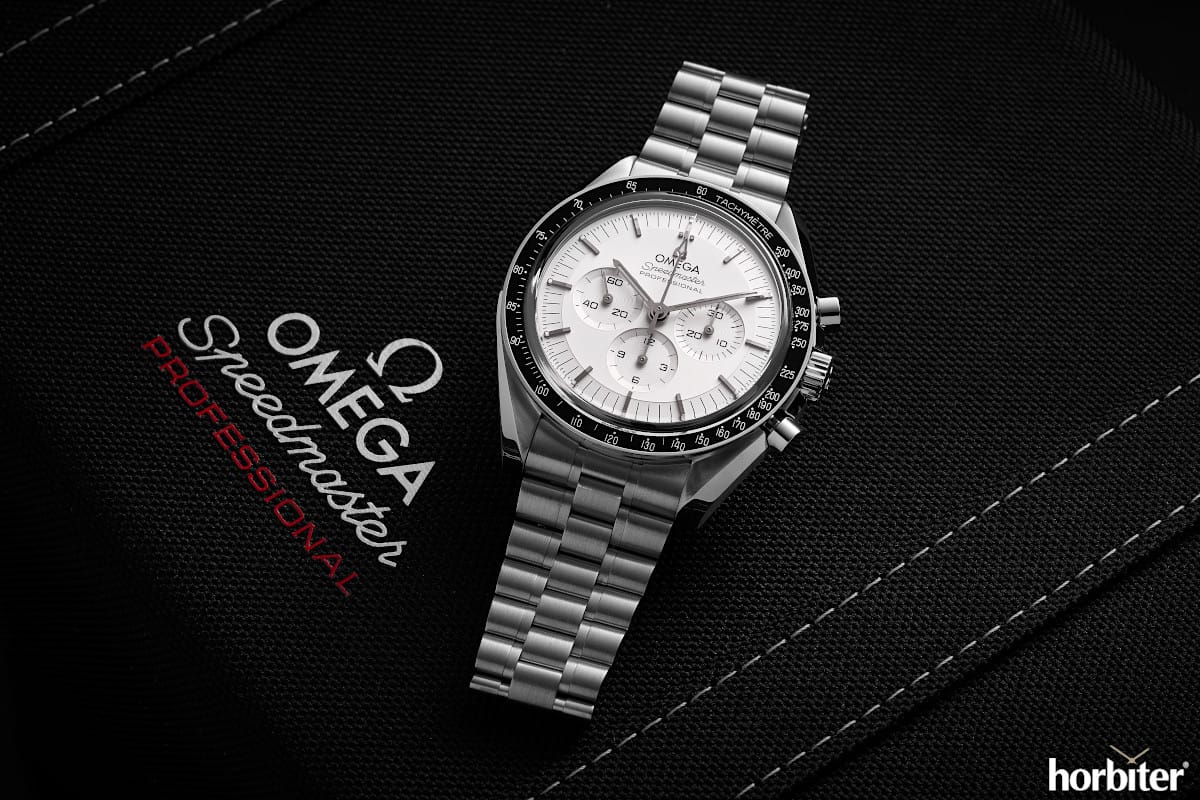
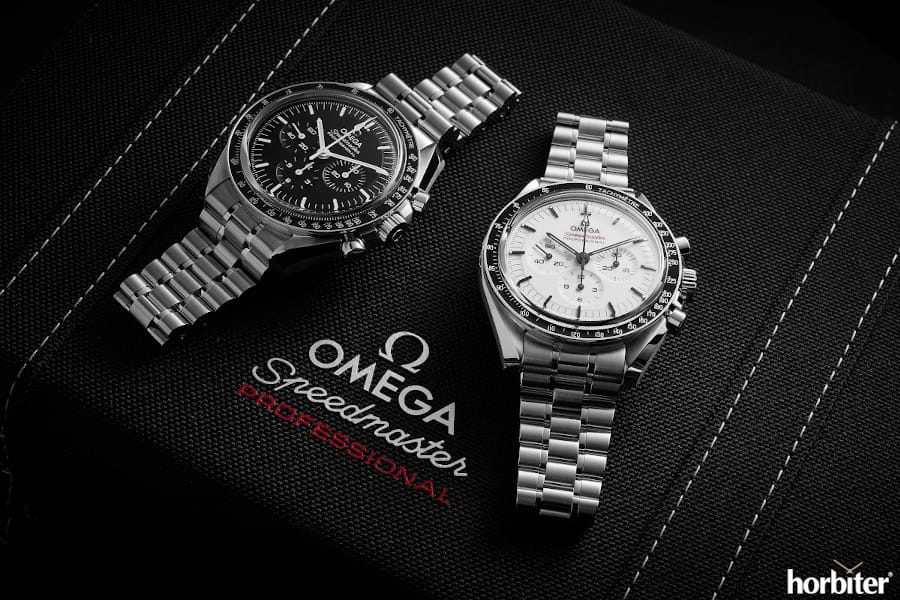
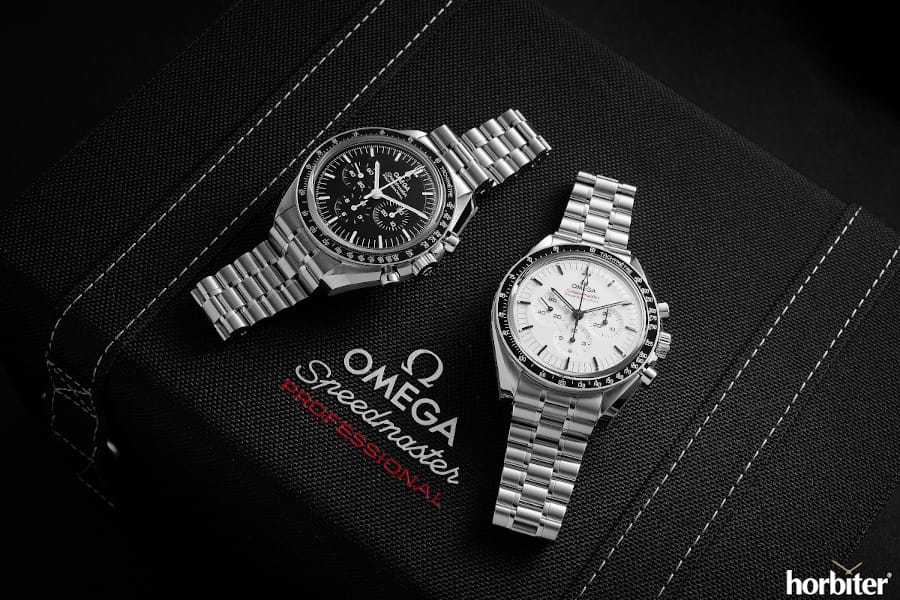
The new Moonwatch with a white lacquered dial is Omega’s hot piece, released in the first quarter of 2024. It is a range extender that brings the Speedmaster Professional to new heights.
After exploring several materials and variations on the Moonwatch, the new model proves its full potential has yet to be fulfilled. The new iteration also connects to the age of space exploration.
White was the dial of the legendary Moonwatch Alaska, a timepiece topping the enthusiasts’ wish list. White is also the much-coveted Snoopy’s dial. Last, let’s not forget the cream-white dial of the Speedmaster Albino reference 3593.20.00, another collector’s piece.
Why did Omega craft a white Moonwatch?
Spotted on Daniel Craig’s wrist last November in New York, the timepiece hit the spot on social media and suggested a new Omega Speedmaster with a white dial to be unveiled anytime soon.
The reveal was the headline news in the watchmaking’s industry for some time and grabbed the attention of enthusiasts and the press, which covered it extensively. Overall, there is a new white dial option for the standard Speedy.
Same, yet different
The watch hasn’t changed; it adopts the well-known specs and proportions of the latest-generation Moonwatch. However, the white lacquered dial exceeds expectations, and discussing a product variation is a letdown.
Also, it is a product overhaul you cannot perform on any original moon-landing Professional. The white lacquered dial adds a nice decorative touch and brightens things up more than any white dial unless we turn our eyes to the Canopus Gold, pictured here alongside the two steel Moonwatch.
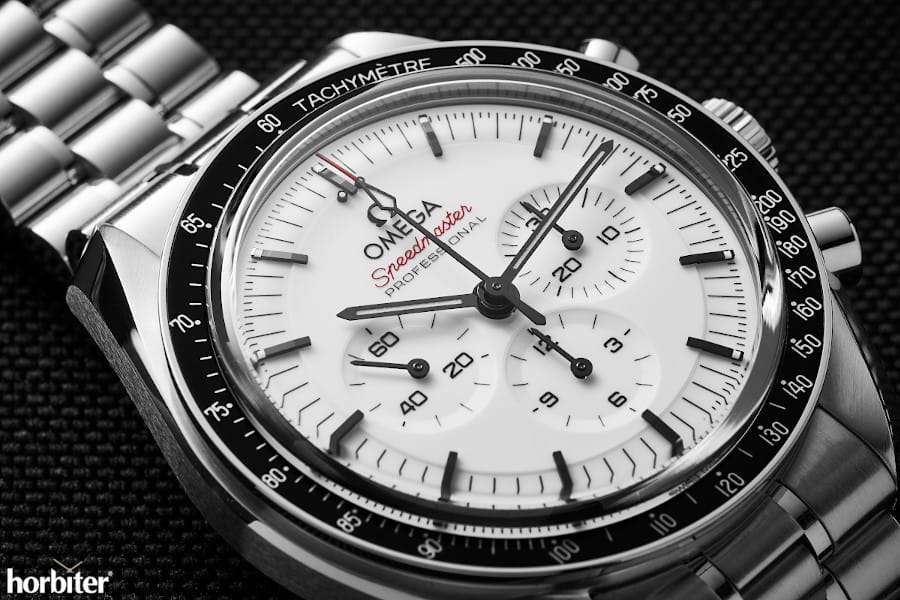
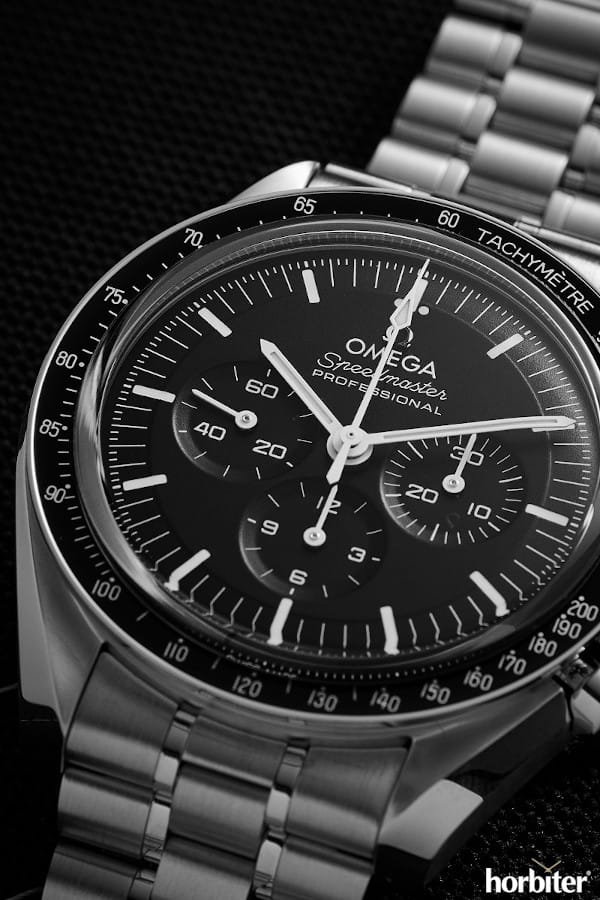
Enamelling is not solely synonymous with shiny features; the white lacquer flows across the dial. The Speedmaster’s signature “step dial” stands out against the mid sector, as do the V-shaped recessed counters, which are the Moonwatch Professional’s hallmark.
Applied indexes, wordings and hands are blackened out, contrasted by the red “Speedmaster” and the matching red central chronograph hand’s tip.
It is a Moonwatch
The Moonwatch White is unchanged at 42.0 mm across and 13.2 mm in thickness, with a 47.5 mm lug-to-lug distance. It weighs 140 grams, 6 grams more than the black model. We assume the weight gap is due to the lacquer layer.
Again, it is a Master Chronometer-certified chronograph and still belongs to a class of its own despite competitors working hard to close the gap with Omega.
The Calibre 3861, the METAS evolution of the long-established 1861, has significantly improved and exceeded the chronometric performance that any 1861 could not match. Its sight through the sapphire glass is lovely, as is its vintage look. However, we would love to see it adopt a column wheel mechanism to activate the chronograph mechanism.
Final thoughts
Omega’s strategy to add the Moonwatch with a white lacquered dial was brilliant, although we believe it took too long to extend the collection’s proposition. The enthusiasts can now opt for another Speedmaster Professional, which will not overlap with the existing one but boasts a new charm.
The adoption of lacquer confirms what we wrote when we reviewed the Speedmaster Racing Spirate™. Omega aims to increasingly extend decoration across the range and add a piece of Swiss-made savoir-faire to a watch-speaking space and performance. The Moonwatch White approaches the psychological threshold of 10,000 Euros, with a price list of €9,100 on a bracelet and €8,900 on a leather strap, the second option available.
It is still a great classic and a chronograph whose style is timeless and whose lacquered dial offers shine that no standard Professional can guarantee.
Two upgrades need to be included to make the recipe perfect, and we are sure the research and development team is working hard to upgrade the watch, i.e., to provide 100-meter water resistance and a column wheel mechanism, the first being our priority.
(Photo credit: Horbiter®)
Giovanni Di Biase @Horbiter®
In this article:
Chronograph
Complication that helps the wearer to measure time intervals without affecting the watch's standard time-telling function.
Chronometer
An instrument for measuring time very accurately. For any watch to be called a chronometer, it must meet the standards set by the C.O.S.C. (Contrôle Officiel Suisse des Chronomètres).
Calibre
A calibre is the type of watch movement encased in an assigned timepiece. Its name is usually associated with the manufacturer's name and a standard code, e.g., ETA 2824.
Strap
A leather, rubber or other material band that secures the watch to the wearer's wrist.