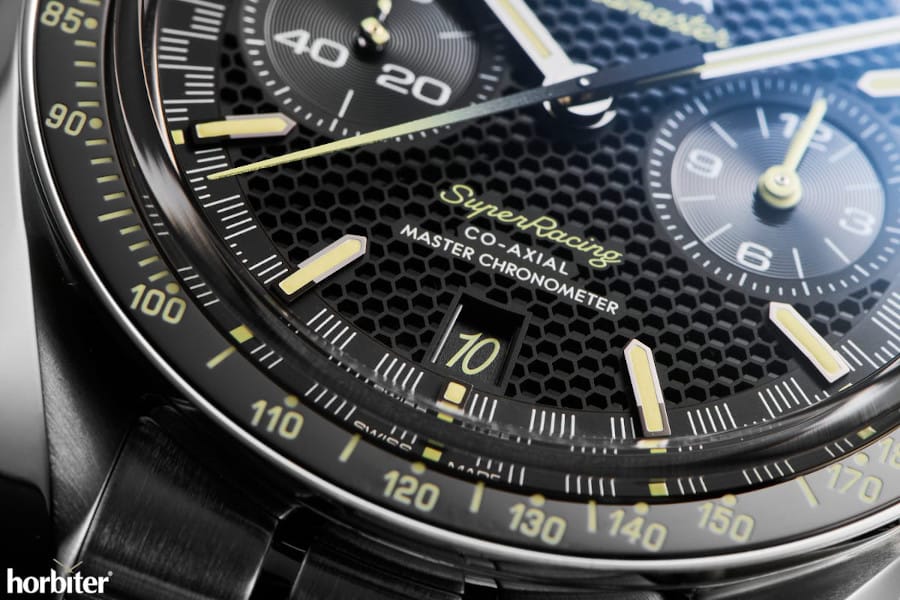
The new Omega Super Racing is the most precise Omega Speedmaster ever and is the brand’s most outstanding innovation, introduced in 2023. According to a vision that aims to push the envelope as much as no competitor can compete against, the Super Racing-equipped Spirate™ system technology steps the technical game up and strengthens Omega, whose performances are unrivalled in the industry.
Is the Spirate™ technology the ultimate step towards rate precision?
Since it began this journey nearly 25 years ago with the introduction of the co-axial escapement, Omega has invested like no other in new technologies to get where they are now and set new industry records while pushing the Swiss industry to raise its standards dramatically.
It all began in 1999, when Daniels’ escapement first appeared, followed by the silicon hairspring’s adoption in 2008, all the way through 2013 when a fully antimagnetic Seamaster Aqua Terra hit the market, followed by the industry-first Master Chronometerwatch. What a ride.
What Spirate™ (Spiral Rate) is and how it works
The introduction of the Spirate™ technology marks the Seamaster Aqua Terra > 15,000 Gauss 10th anniversary and is as clever and simple idea as it gets; the celebration is exemplified by design traits (a specific number 10’s font in the date window hints at the celebration, too) and colour scheme that mimic the Aqua Terra’s on the new Super Racing.
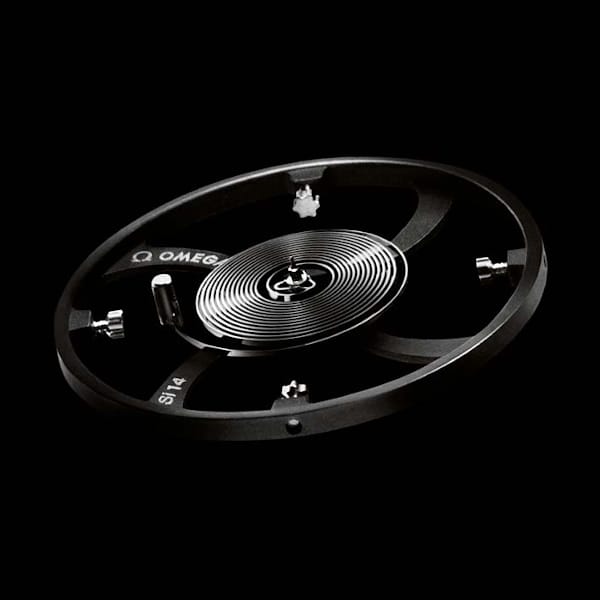
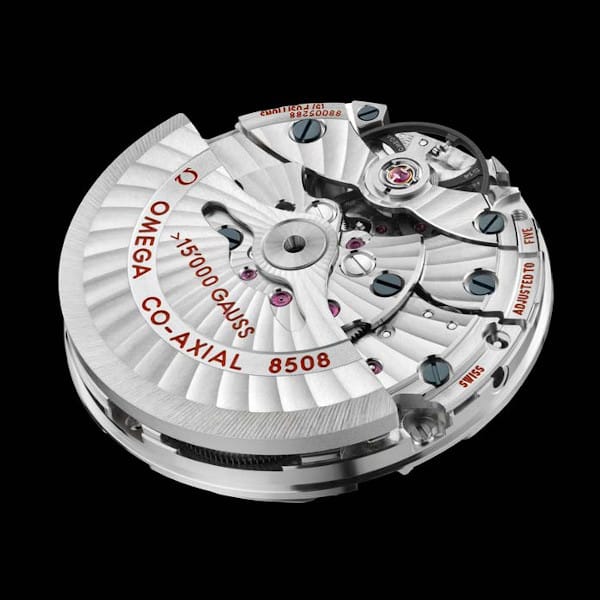
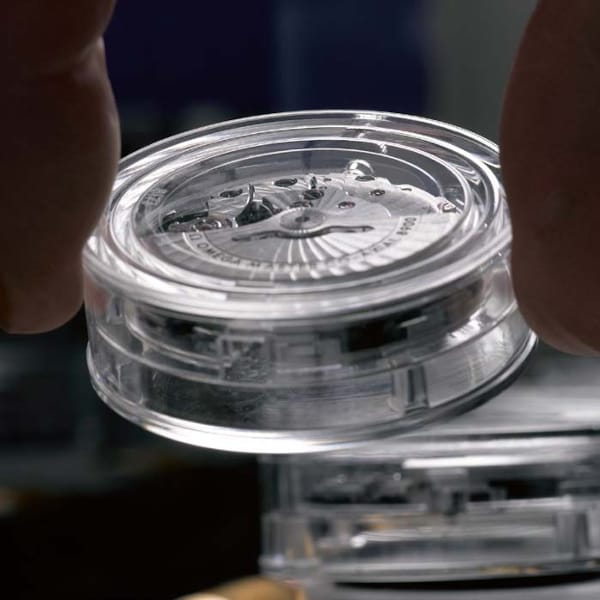
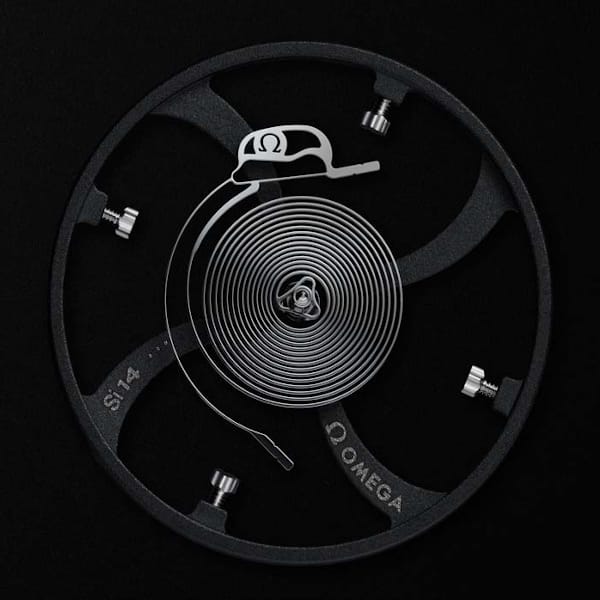
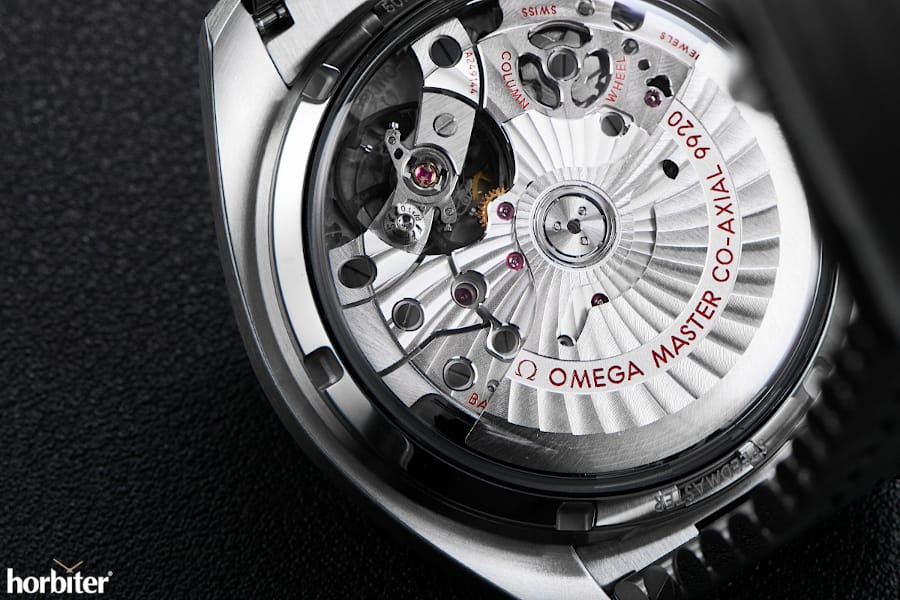
Omega’s engineers developed a patented system allowing watchmakers to fine-tune the hairspring via an eccentric graduated adjustment mechanism placed on the balance cock, and visible through the case back.
The idea is brilliant for several reasons: it allows a watchmaker to regulate the most crucial part of the mechanical movement without re-engineering the base 4 Hertz architecture via an easy-and-direct-to-use device connected to a custom-designed silicon hairspring.
While an ordinary hairspring lets the watchmaker adjust it to the desired rate, such an operation is delicate when mastering a silicon hairspring, given that silicon is far less resilient than any metal. The Spirate™ system requires a single specific tool and also requires a single operation.
Some background notes and the precision of Spirate™
Breguet, which belongs to the Swatch Group, was the first brand to design an overlapping terminal curve in silicon, whose execution required the separation between hairspring and overcoil, joined together by a connector.
According to Omega, and namely to the certification that comes with each timepiece, each Omega Super Racing is precise to 0/+2 seconds per day, a stunning result when compared with the equally excellent 0/+5 seconds per day of any Master Chronometer certified watch (watch head and not the movement alone).
Is the design as attractive as the technical package?
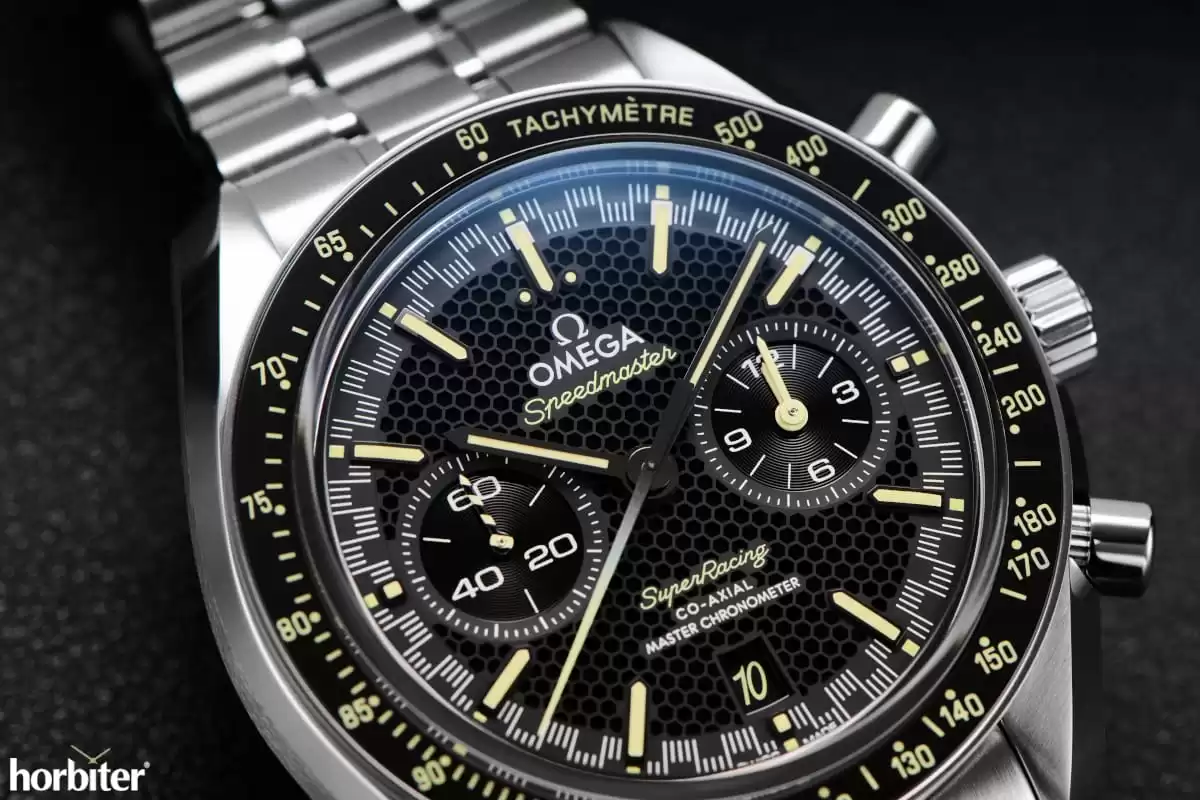
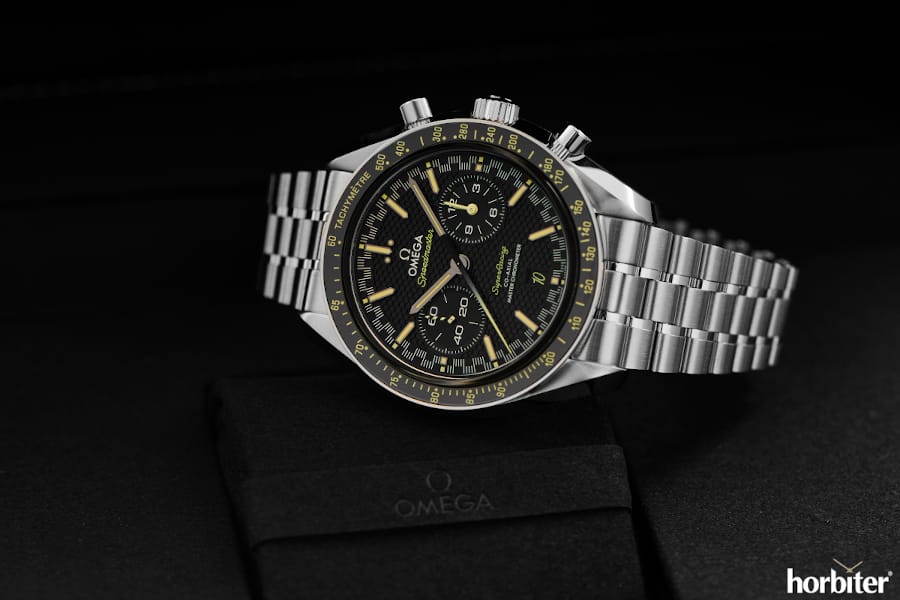
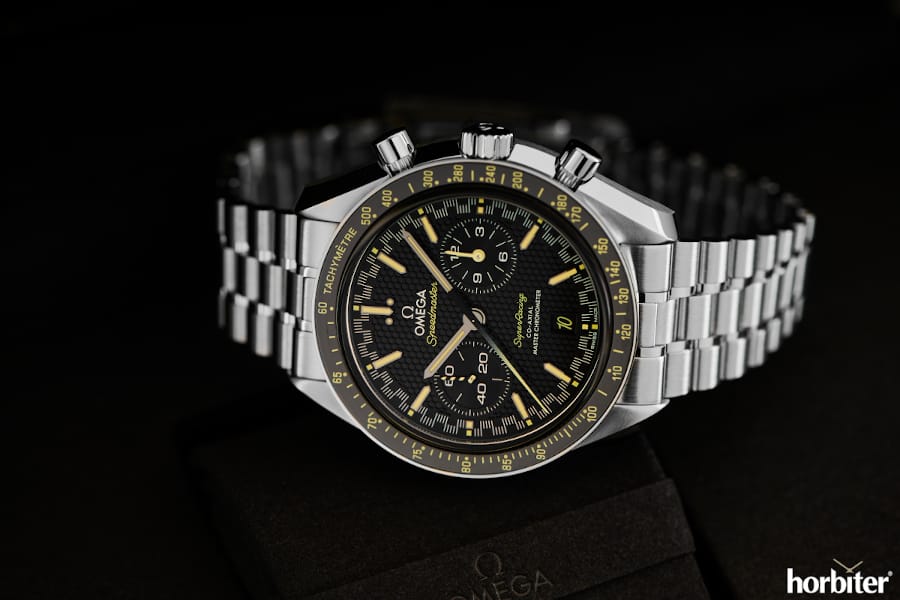
Yes, it is and is no less innovative despite building on a well-known layout, to which Omega has added some exquisite new cues. Spirate™ comes with the latest generation Master Chronometer certified automatic Chrono calibre and builds, therefore, on a two-counter Speedmaster, boasting a generous 44.25 mm large case.
We can’t wait to see what the future holds and whether Omega extends the technology to other product families, Moonwatch included.
The honeycomb dial
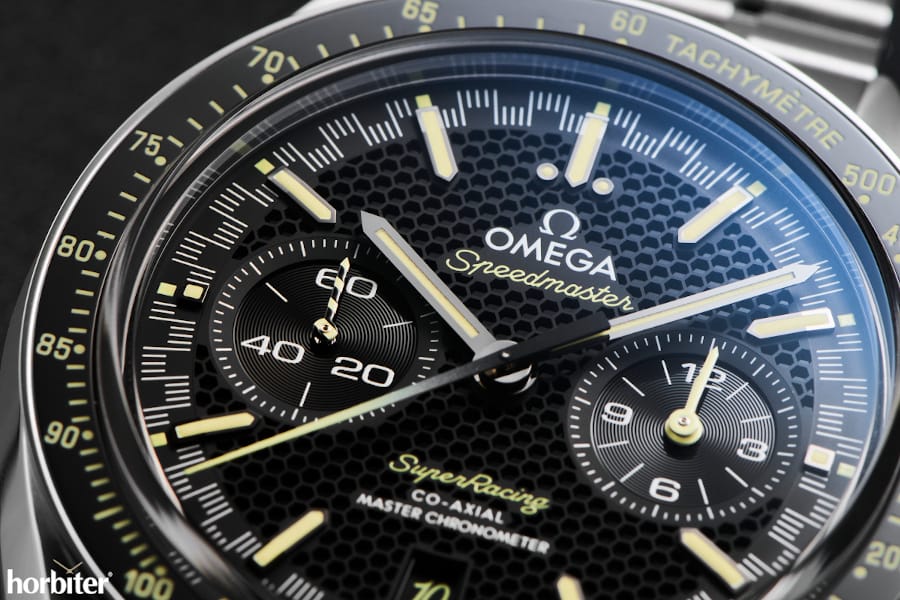
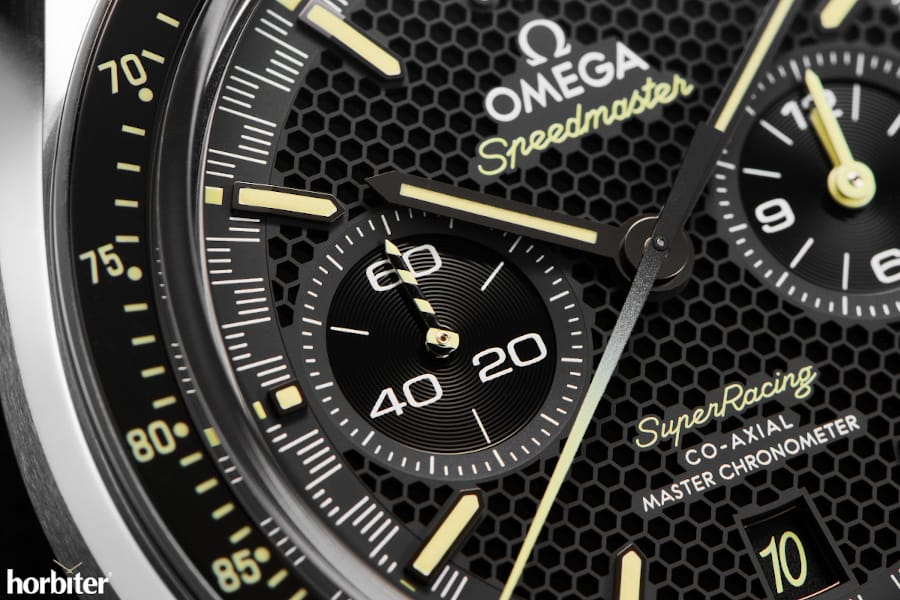
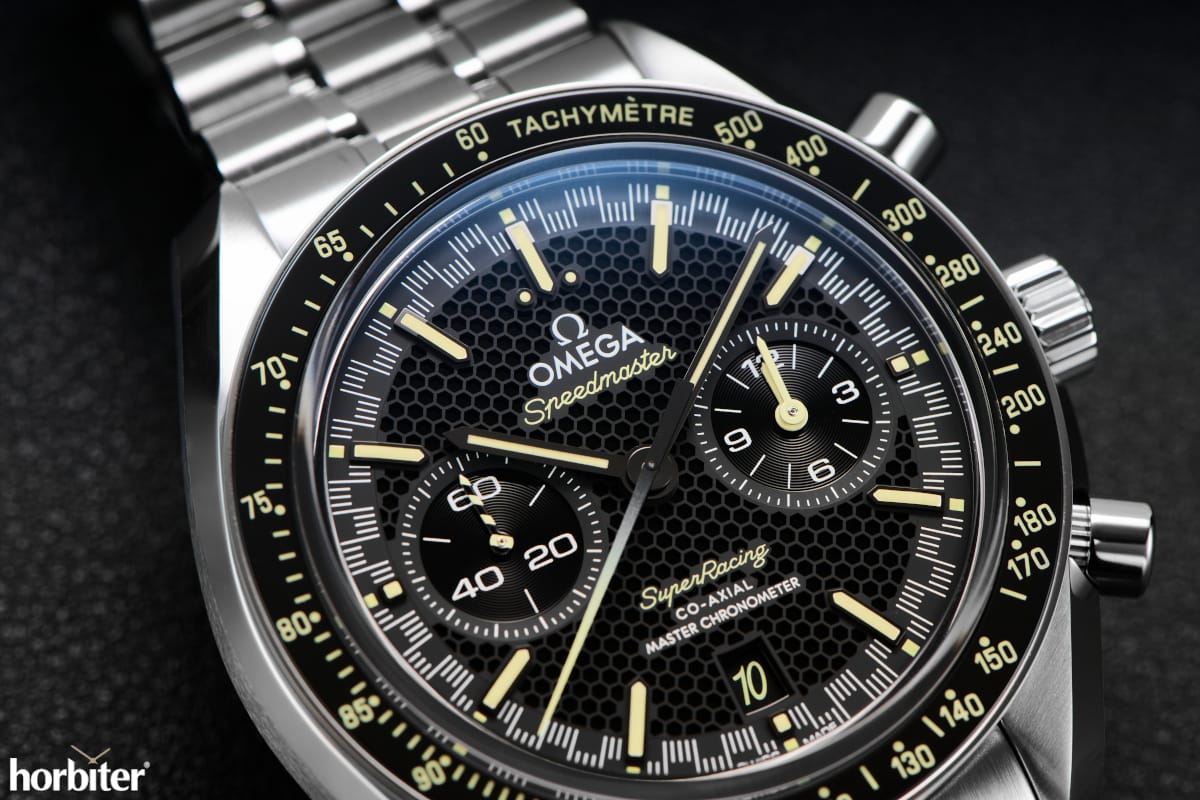
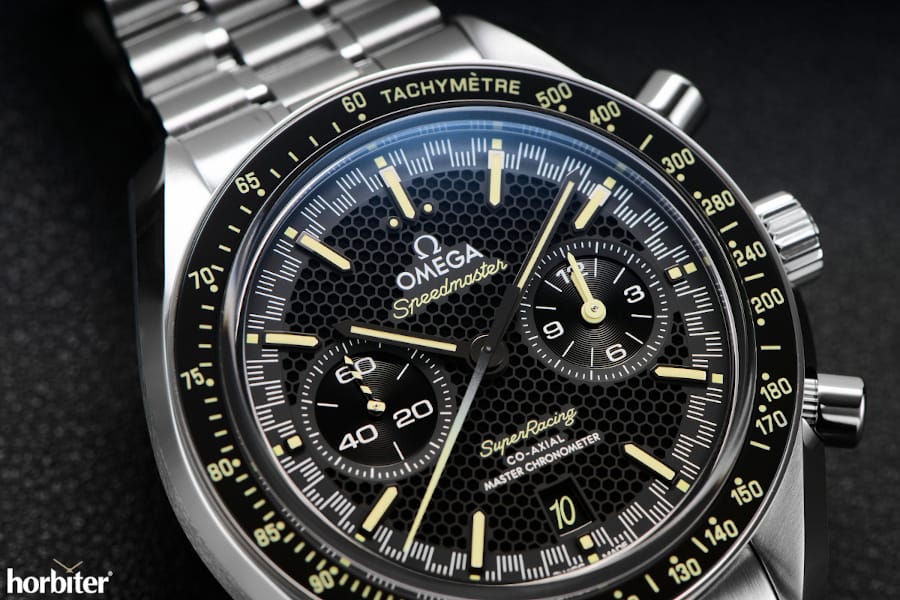
The dial combines several sources of inspiration, mainly from the recent past. A black and yellow colour combo pays tribute to the Seamaster Aqua Terra > 15,000 Gauss, as said. The “Racing” pattern on the outer ring pays, instead, homage to the Speedmaster Moonwatch Japan and the automatic chronographs once promoted by Michael Schumacher.
A new honeycomb sandwich dial pays homage to the experimental watch that withstood magnetic fields up to 160,000 Gauss in the Omega laboratories instead.
Omega added some savoir-faire to the Omega Super Racing, as proved by the scale on the ceramicbezel in yellow “Grand Feu” and the applied diamond-cut indexes.
Surrounded by a black line (not highlighting their superb craftsmanship), they showcase double curved profiles to pair with the curved “rehaut”. Also, the yellow glowing Super-Luminova™ is new despite not offering the same lume performance as you’d expect.
In brief, Omega’s designers add a kind of traditional “savoir-faire” to a timepiece executed by top-class industrial processes to ensure the highest quality possible. Those lucky to have walked through the Omega factory can confirm the brand is on top of the game regarding high technology and quality.
Perhaps an O-Megasteel case and bracelet is what we’re missing; imagine such a watch equipped with Omega’s patented new steel alloy. We assume O-Megasteel is still a niche technology and has yet to roll out the whole production process fully. It is currently restricted to Ultra-Deep and the latest PloProf Summer Blue Edition.
Final thoughts
The Omega Super Racing is a milestone in watchmaking and has made less noise than expected. The Spirate™ system is a world-first whose achievement is certified by an independent body. From a design perspective, it is all but an ordinary Speedmaster Two Counters.
Here is a new Speedmaster category that best exemplifies what a sports chronograph historically stands for, i.e. Racing. The dial looks crowded but not as hard to read as you imagine, given that it comes with two contrasting colour palettes: black and yellow.
The first execution of the Spirate™ technology retails for 13,000 Euros, thus spontaneously comparing the Super Racing with their siblings: Snoopy and 321. However, they’re so different that pricing cannot be a deciding factor. Each belongs to a specific product category and holds its heritage.
On top of the O-Megasteel alloy, we suggest Omega provide its Super Racing with a rubber strap in replacement, of the current NATO replacement strap. For additional information, please visit the official Omega website.
(Photo credit: Horbiter®)
Giovanni Di Biase @Horbiter®
In this article:
Chronometer
An instrument for measuring time very accurately. For any watch to be called a chronometer, it must meet the standards set by the C.O.S.C. (Contrôle Officiel Suisse des Chronomètres).
Antimagnetic
Watch capable of withstanding magnetic fields. There are different ranges of magnetic resistance, from a few Gauss up to fully antimagnetic resistance, something only OMEGA Watches can currently guarantee on its Master Chronometer-certified watches.
Date
It indicates the date of the month. There are different types of display: via a window or a pointer, where an additional hand is usually placed centrally or on a…
Case back
It can be screwed in, pressure-fastened, or secured to the case via screws. Occasionally, it comes as a single piece, with the case of specific professional diving watches (for example,…
Case
It encases the mechanical movement and is crafted in one or more parts. It can also be a single piece, as with some professional diving watches, or made of unconventional…
Calibre
A calibre is the type of watch movement encased in an assigned timepiece. Its name is usually associated with the manufacturer's name and a standard code, e.g., ETA 2824.
Ceramic
Widely used for crafting a watch case and, in recent years, also for the bezels of diving watches and dials. Obtained from zirconia powder (ZrO2), ceramic offers superior scratch resistance…
Bezel
The bezel is particularly useful on diving watches, allowing you to check dive times. In this case, it unidirectionally rotates and usually comes in two parts: a metal (or ceramic,…
Line
It is the measurement unit that identifies the size of a movement. According to this measurement system, one line corresponds to 2,255mm.
Chronograph
Complication that helps the wearer to measure time intervals without affecting the watch's standard time-telling function.
Strap
A leather, rubber or other material band that secures the watch to the wearer's wrist.