At Bvlgari, Geneva Watch Days has so far been the venue for niche creations and experiments. At the same time, Watches and Wonders—the year’s main event—serves as a new-product amplifier, as exemplified by last April’s official Octo Finissimo 37 launch.
This strategy aims to avoid product overlap and makes the two Geneva-based events complement each other.
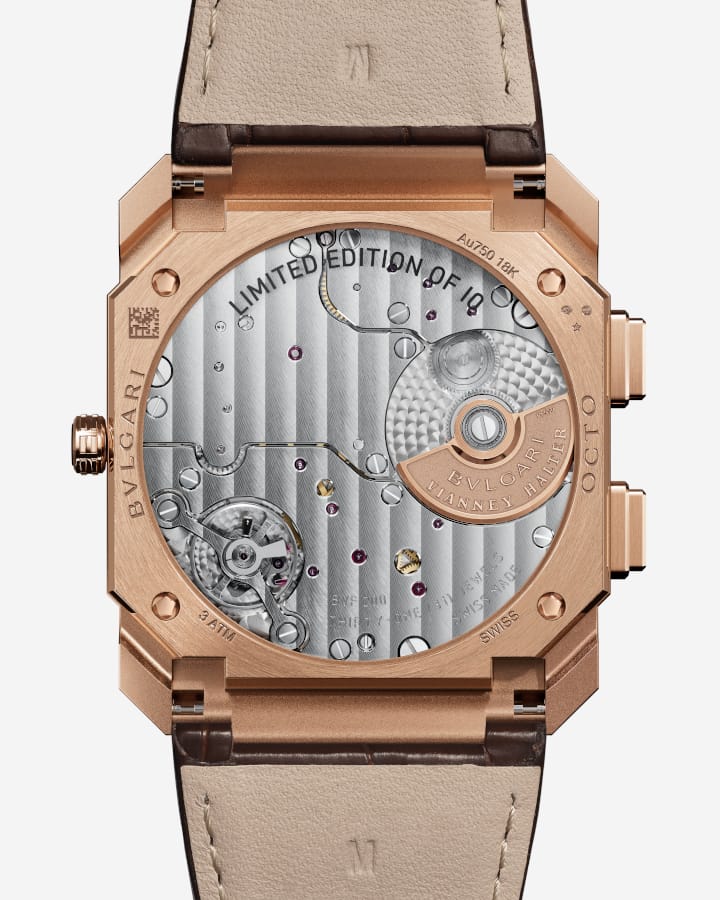
This year’s edition is not to be missed by collectors. Alongside a special-edition titanium Octo Finissimo and the new Bvlgari Titanium, the brand unveils an exclusive, unexpected duo from its collaboration with master watchmaker Vianney Halter—turning the standard Octo Finissimo into something we have never seen before.
Octo Finissimo Dual Time x Vianney Halter
Even before accessing the press kit, the watch’s silhouette pays homage to Jules Verne’s steampunk design, a longstanding source of inspiration for Halter.
Luxury watchmaking and independent horology have more in common than you might think, with several brands trying to merge the two worlds’ concepts.
Bvlgari has been down this road before, having teamed with MB&F on an unconventional Serpenti. This project, however, was harder than ever before, given the Octo Finissimo platform.
The Finissimo is all about sharp edges, square lines, flat planes, and extreme thinness; Vianney Halter’s work celebrates curves and three-dimensional development instead.
How did Bvlgari and Halter connect such opposing visions? Simply put, they did not fuse them—they rather paired them.
The Finissimo’s lines were modified to aesthetically and technically house Halter’s visual language, as if an Antiqua watch had suddenly landed on a Finissimo dial and the movement beating beneath had been reworked to create a complex, high-luxury Mad Max–looking timepiece.
It is steampunk crossing with rationalism in a wristwatch. The outcome works, even if it might look weird at first glance: Halter’s steampunk-inspired design has reshaped the Finissimo’s rigorous, no-frills style.
The technical side is even more striking. Bvlgari’s designers and engineers had to preserve a 40.5 mm case and the Finissimo’s overall architecture.
Using the automatic BVL 138calibre as their baseline, the watchmakers developed the Dual Time/GMTmodule and added date and day/night indications.
The dial’s four titanium- or gold-overimposed registers are unmistakably Vianney Halter, from their opaline tone to the watchmaker’s trademark blue hands. They add depth while respecting the Finissimo’s design requirements.
At 9.70 mm overall, the case is nearly twice as thick as the standard model; the BVF 200 movement alone measures 5.49 mm.
Its platinum micro-rotor, engraved with Vianney Halter’s signature, provides at least 60 hours of power reserve.
The case side is 7.70 mm thick, rising to 9.70 mm atop the Halter-style counters.
Bvlgari will offer a 30-piece model on an integrated, fully sandblasted titanium bracelet, and a rose-gold edition—sandblasted on the case middle and satin-finished elsewhere—limited to 15 pieces.
Octo Finissimo Dazzle: Titanium Takes Centre Stage. Again.
The Finissimo was born in titanium, and Bvlgari’s Grade 5 titanium has often been the brand’s go-to material for limited and exclusive editions.
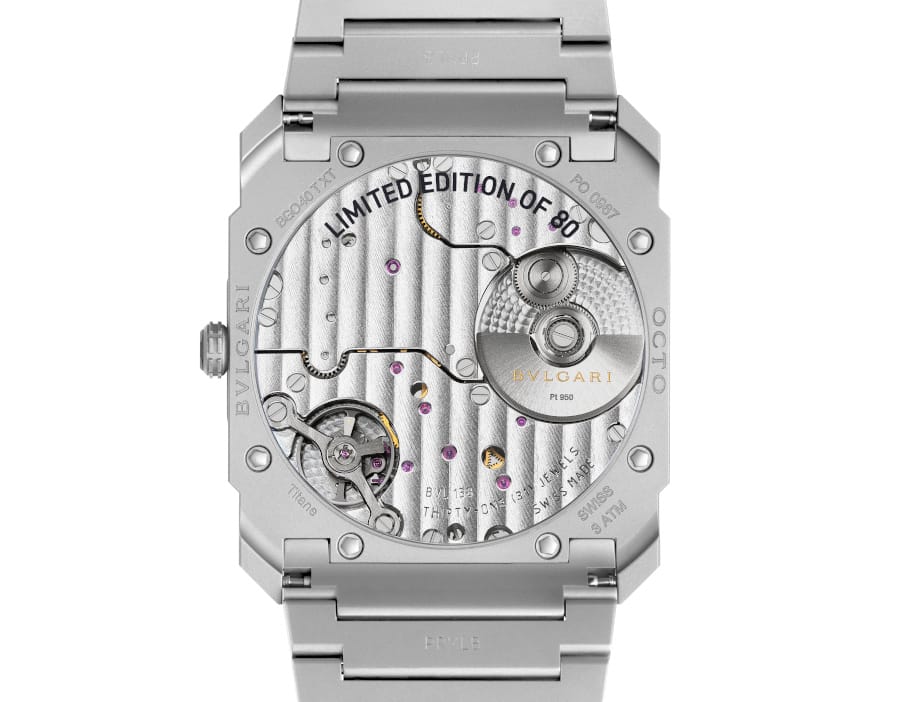
After steel took centre stage in recent releases, titanium returns as an 80-piece edition, underscoring Bvlgari’s commitment to genuinely limited, collector-ready models.
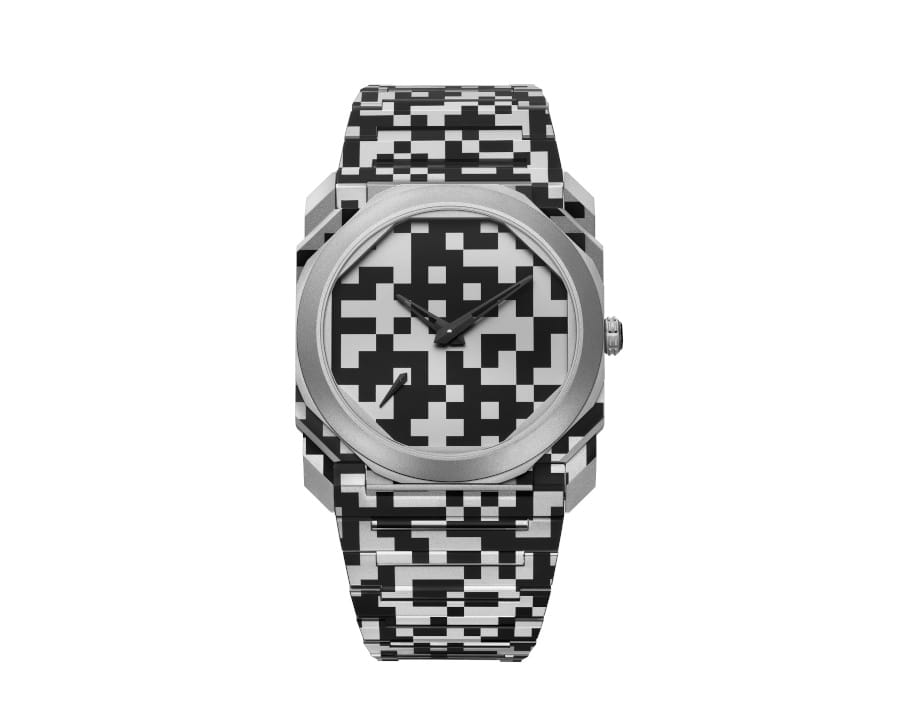
Here, the designers went further than usual, applying a case-and-dial pattern inspired by the camouflage wraps used on prototype cars. To my eye, it also recalls an enlarged QR code.
The treatment turns the 40 mm Finissimo into a pure design object—something Bvlgari has often pursued.
The Octo Finissimo Dazzle joins the long list of special, eccentric Finissimos. With black hands and hour markers, it will retail for €19,500.
Bvlgari Bvlgari Titanium
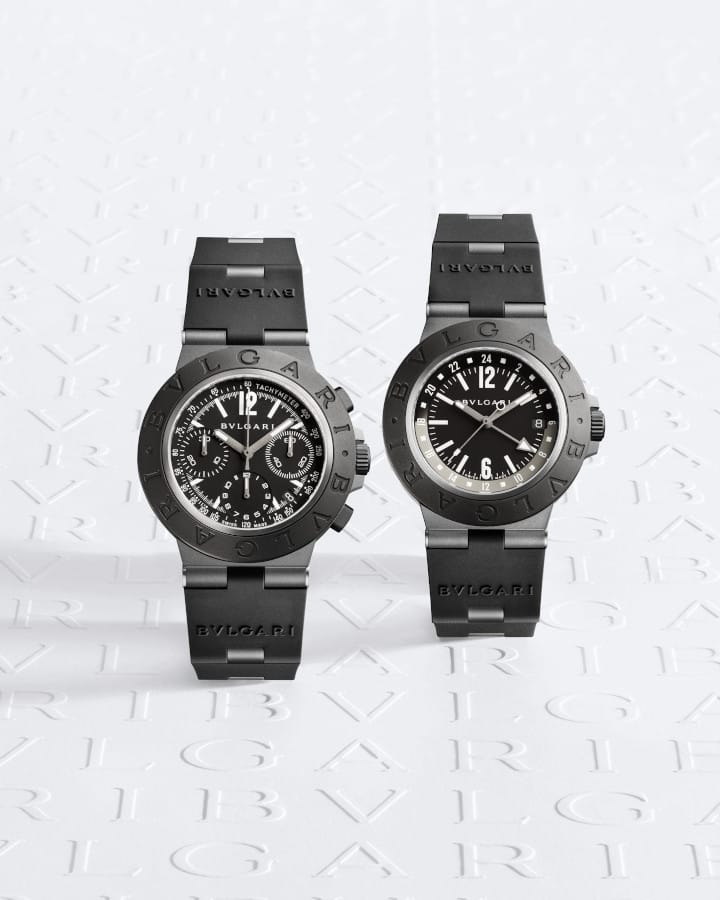
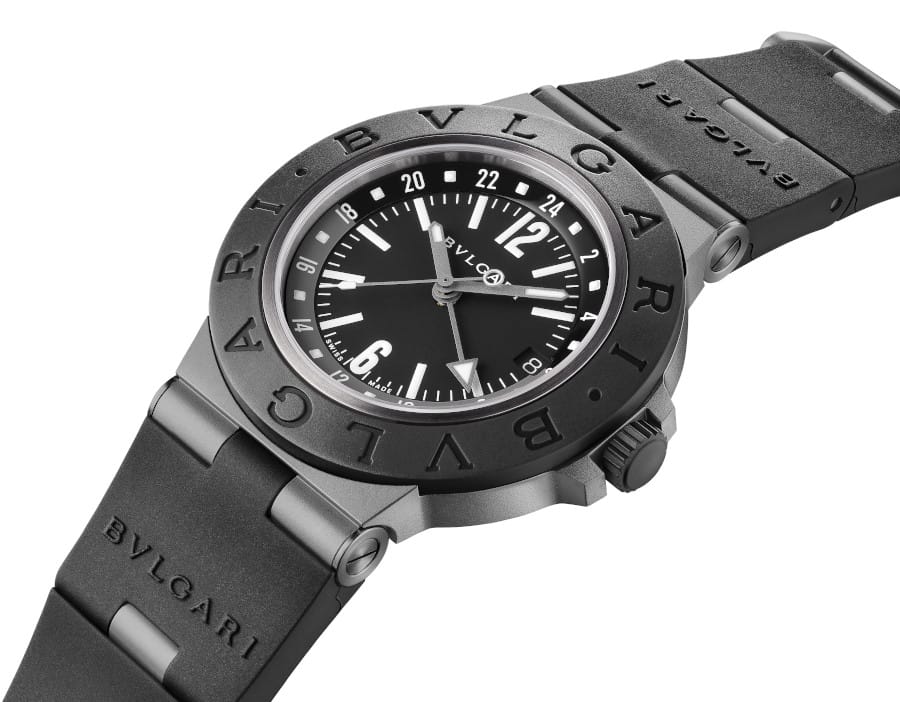
Bvlgari is taking its Aluminium concept into titanium. The brand has extensive experience with titanium alloys, especially Grade 5 titanium, the backbone of Finissimo production. Its sandblasted finish now moves to the Bvlgari case and bracelet, paired exclusively with rubber.
This release offers an alternative to the aluminium model, a material Bvlgari first introduced to watchmaking with the original 1998 collection.
Two models debut, both following established catalogue models: the Bvlgari Bvlgari Titanium GMT and TitaniumChronograph, each with a black dial. The GMT measures 40 mm across and 9.70 mm thick; the chronograph is 41 mm in diameter and 12.35 mm thick.
It runs on the B192 calibre, a 4 Hz, 50-hour-power-reserve Sellita-based movement with an improved power reserve. The chronograph uses the B381 instead, a 4 Hz Sellita-based calibre with a Dubois-Depraz module and a 42-hour power reserve.
Both feature the latest-generation hook-and-loop fastening strap, making them as easy to wear as a Velcro strap.
On the caseback, both use a solid DLC-coated titanium lid. They are priced at €4,900 and €6,200, respectively—€600 more than their aluminium case-and-buckle siblings.
(Photo credit: Bvlgari)
In this article:
Case
It encases the mechanical movement and is crafted in one or more parts. It can also be a single piece, as with some professional diving watches, or made of unconventional…
Module
It is an additional part of the base movement through which one or more complications can be added.
GMT
It is the acronym for Greenwich Mean Time and identifies a complication capable of displaying two or more time zones on the dial. The complication usually couples a 24-hour rotating…
Date
It indicates the date of the month. There are different types of display: via a window or a pointer, where an additional hand is usually placed centrally or on a…
Calibre
A calibre is the type of watch movement encased in an assigned timepiece. Its name is usually associated with the manufacturer's name and a standard code, e.g., ETA 2824.
Rotor
Part of an automatic watch that winds the mainspring by constantly rotating. Depending on the watch's winding capability, movement design, and value, it comes in various geometries, sizes, and materials.…
Power Reserve
A mechanical watch feature displays, on the dial or the case back, the remaining power in a watch movement, showing the length of time until the timepiece must be rewound.
Chronograph
Complication that helps the wearer to measure time intervals without affecting the watch's standard time-telling function.
Strap
A leather, rubber or other material band that secures the watch to the wearer's wrist.