Route du Rhum Destination Guadeloupe may not be one of sailing’s best-known events, but it is among its most compelling. Now in its 13th running, the race brings 118 skippers together for a solo Atlantic passage from Saint-Malo to Pointe-à-Pitre.
The course record currently stands at 6 days, 19 hours, 47 minutes and 25 seconds. Alpina is the event’s official timekeeper, but its involvement extends well beyond timing duties.
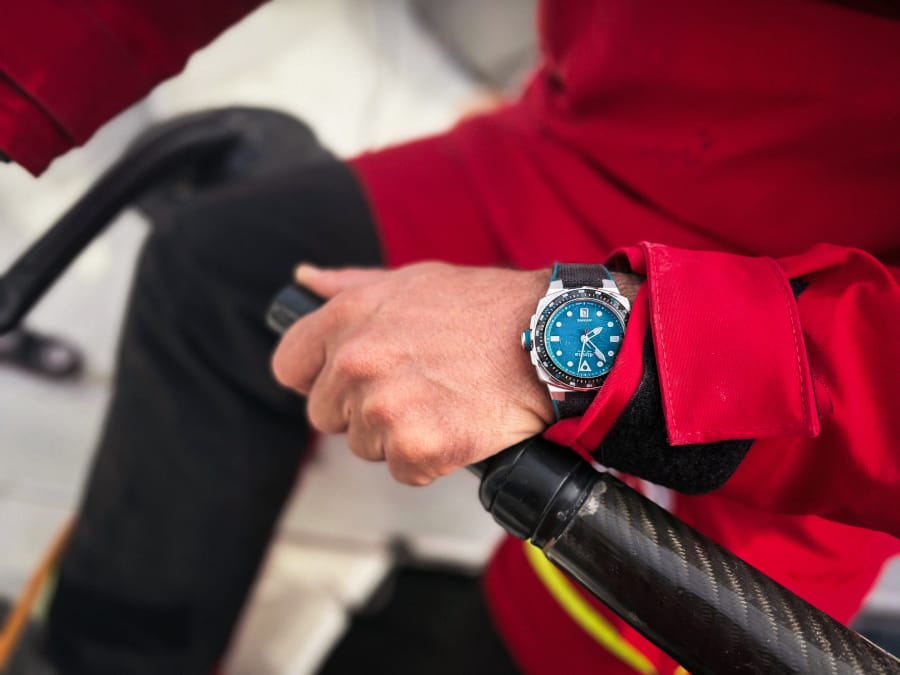
With the 6 November start approaching, the brand has unveiled two limited editions to commemorate the race and French skipper Éric Péron.
Alpina’s Two Route du Rhum Limited Editions
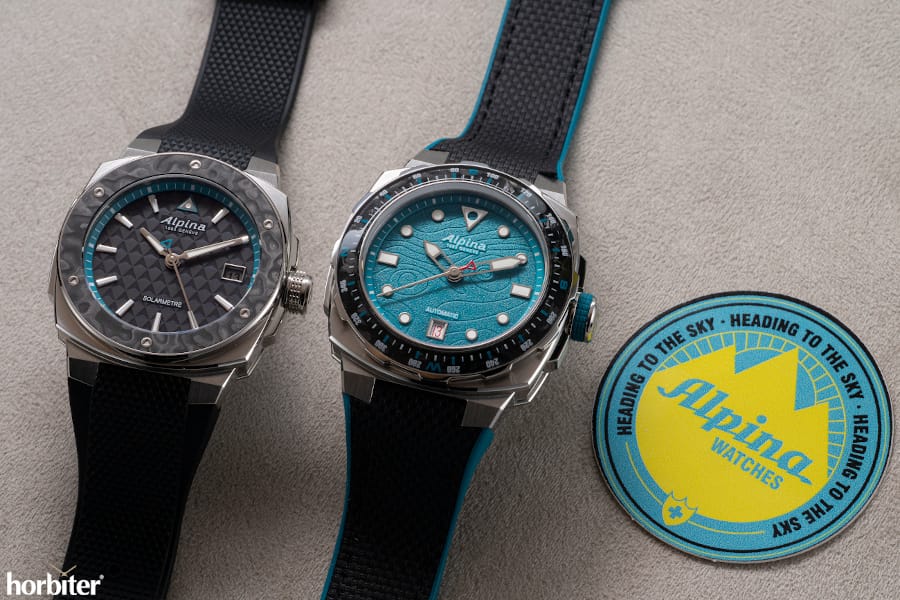
The two limited series—313 examples of one, 513 of the other—draw on Alpina’s sporting Seastrong and Alpiner collections.
In their Extreme iterations, both employ the same cushion-case architecture. Together, they form a fresh two-model proposition: a self-winding mechanical watch and a solar-powered alternative, each issued in limited numbers.
The occasion also lets Alpina span two distinct technologies—and price brackets—while leveraging its parent group’s resources.
In particular, it can call upon La Joux-Perret’s ready-made solar technology, supplied by the manufacturer both to brands outside Citizen Group and, where appropriate, to the group’s own houses.
The Route du Rhum pair comprises the Seastrong Diver Extreme Automatic and the Alpiner Solarmetre. Both have been thoroughly reworked for the race, although the automatic model is the more fully equipped of the two.
Alpina Seastrong Diver Extreme Automatic
The mechanical edition follows Alpina’s long-standing tradition of limited-run sports watches, a lineage that reaches back to the Regatta models. Competition runs deeper in this watch’s DNA.
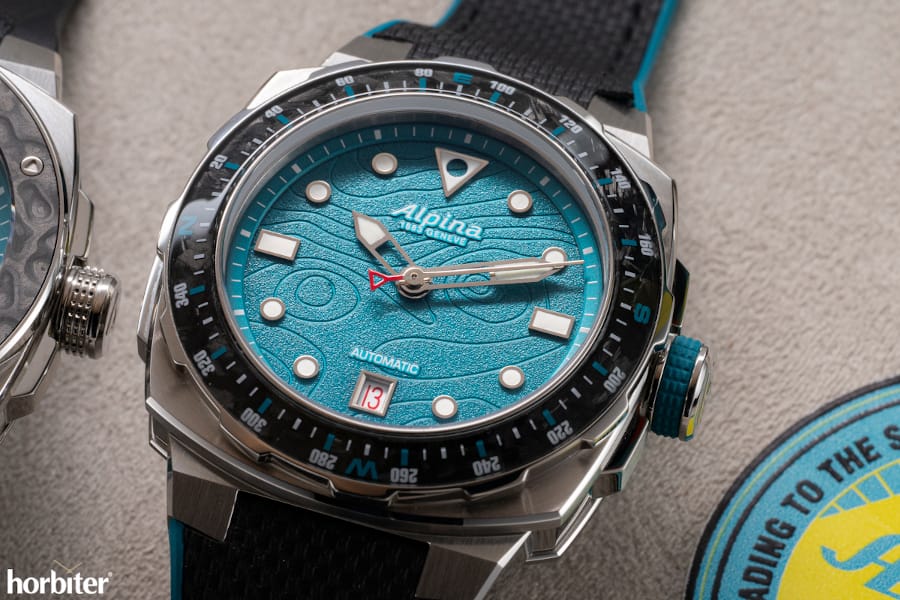
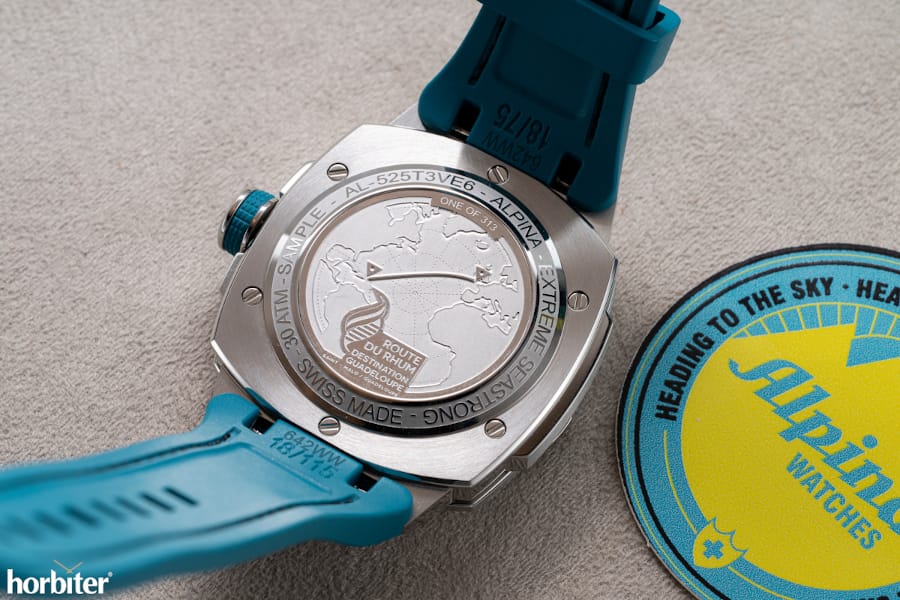
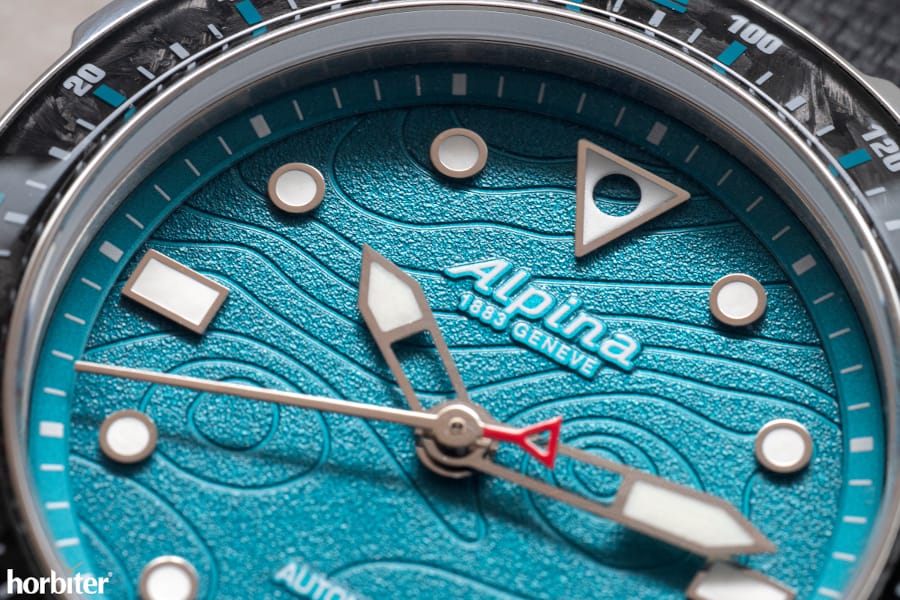
Alpina’s designers have given the Seastrong Diver Extreme a comprehensive makeover. The turquoise dial carries a pattern inspired by ocean currents, while the six-screw caseback combines a predominantly brushed surface with polished edges and relief details. Its centrepiece depicts the race route, and the execution remains impressively meticulous throughout.
The substantial bidirectional bezel is arguably a touch too broad for the dial, though its size clearly favours secure handling and easy reading. Angled in profile, it receives a carbon-fibre-composite insert marked with a compass’s degree scale and cardinal points.
Turquoise, one of the event’s signature colours, recurs throughout: on the screw-down crown’s rubber inlay, in the bezel markings, and along the strap’s outer edge and inner face.
Wisely, the designers have chosen a pin buckle—a fitting solution for a watch Péron will wear throughout the crossing.
The Seastrong’s steel case measures 39.0 x 40.5 mm and is 13.4 mm thick. Inside sits the AL-525, a 4 Hz, time-only movement with a 38-hour power reserve—an unremarkable figure by current standards.
Derived from a Sellita base, the calibre is a dependable, well-proven workhorse and helps keep the recommended retail price at €2,195.
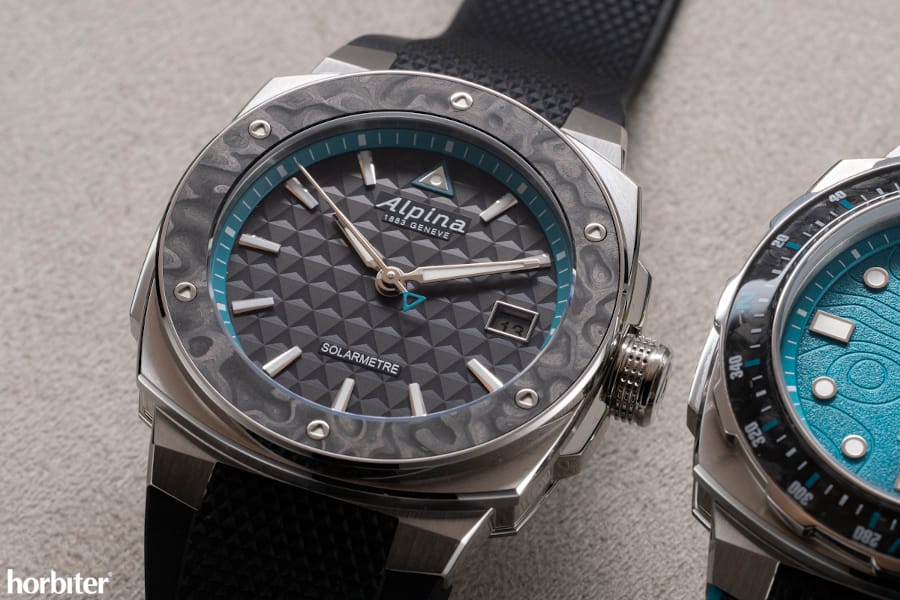
Alpina Alpiner Solarmetre
For all their visual kinship, the solar-powered model takes a notably different approach. It uses the same cushion-case format, albeit in a 37.50 mm, 10.19 mm-thick execution, and its solar platform stores sufficient energy for ten months of operation without any exposure to light.
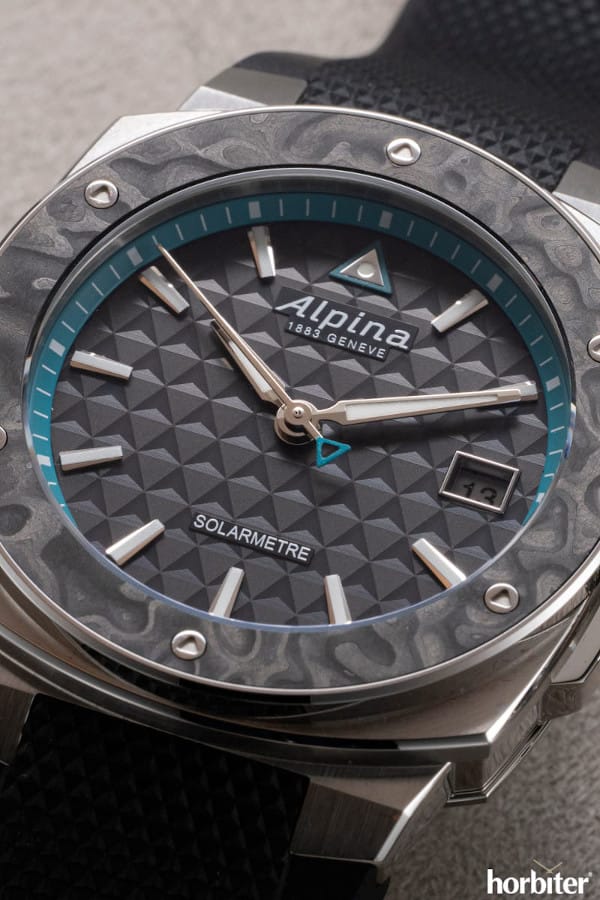
Its dial is darker and, stylistically, unmistakably Alpina: repeated triangular logos form a three-dimensional dark-grey pattern.
Turquoise survives only as a restrained accent, most notably around the dial’s rehaut. The bezel is fixed, since it has no functional role, and its carbon-fibre-composite insert is secured by screws shaped like Alpina’s logo.
Slimmer and flatter than the ring on its sibling, it sits naturally within the design and reinforces the watch’s more restrained character.
The Alpiner Solarmetre is water-resistant to 100 metres and fitted with a push-pull crown. It does not attempt to rival an Extreme Diver‘s credentials, as its highly competitive €1,095 retail price makes clear.
Final Thoughts
Alpina capitalises on the race’s distinctive appeal, using the Alpiner and Seastrong platforms to cast both collections in the spotlight. The two limited editions share a common spirit, yet their personalities remain clearly differentiated.
The Alpina Seastrong Diver Extreme Automatic Route du Rhum is the more sophisticated proposition: a genuine rubber-strap sports watch seldom seen since the 2000s. It will appeal to buyers drawn to bold colour, material contrast and an exceptionally accomplished level of finishing.
Its weaker point is the calibre’s dated performance, although that compromise helps restrain the price. It was no doubt a considered decision, particularly given that Alpina can manufacture time-only movements.
The Alpiner Solarmetre Route du Rhum, by contrast, occupies the analogue territory between mechanical watches—whose design language it borrows—and conventional quartz pieces, whose convenience and performance it channels. Its advanced solar technology dispenses with battery replacement altogether, while enabling a slim profile and a keenly pitched retail price.
(Photo credit: Alpina, Horbiter®)
In this article:
Case
It encases the mechanical movement and is crafted in one or more parts. It can also be a single piece, as with some professional diving watches, or made of unconventional…
Bezel
The bezel is particularly useful on diving watches, allowing you to check dive times. In this case, it unidirectionally rotates and usually comes in two parts: a metal (or ceramic,…
Strap
A leather, rubber or other material band that secures the watch to the wearer's wrist.
Crown
Placed on the case side, it winds the mainspring. When pulled out, it also sets the time and the date. A screw-down crown increases water resistance and protects the movement…
Power Reserve
A mechanical watch feature displays, on the dial or the case back, the remaining power in a watch movement, showing the length of time until the timepiece must be rewound.
Calibre
A calibre is the type of watch movement encased in an assigned timepiece. Its name is usually associated with the manufacturer's name and a standard code, e.g., ETA 2824.