Six years after its relaunch, Frederique Constant’s Highlife has become one of the brand’s defining collections.
Today, whether a luxury house or a microbrand, no watchmaker seeking a wider audience can afford to go without an integrated-bracelet sports watch—or a credible range of mechanical complications to accompany it.
The Swiss brand has already explored the Highlife through time-only models, Worldtimers, perpetual calendars with and without tourbillons, a chronograph, limited editions and several inventive collaborative projects. It now turns to another essential complication in any rounded-out sports-watch line-up.
That complication is the moonphase: a pleasingly undemanding addition, more engaging than a straightforward three-hander yet far less involved than a perpetual calendar. In other words, it occupies the sweet spot between simplicity and horological theatre.
The Highlife Moonphase Date Manufacture joins the range with the technical advances Frederique Constant has made in recent years, along with detail that underscores how far the brand has come.
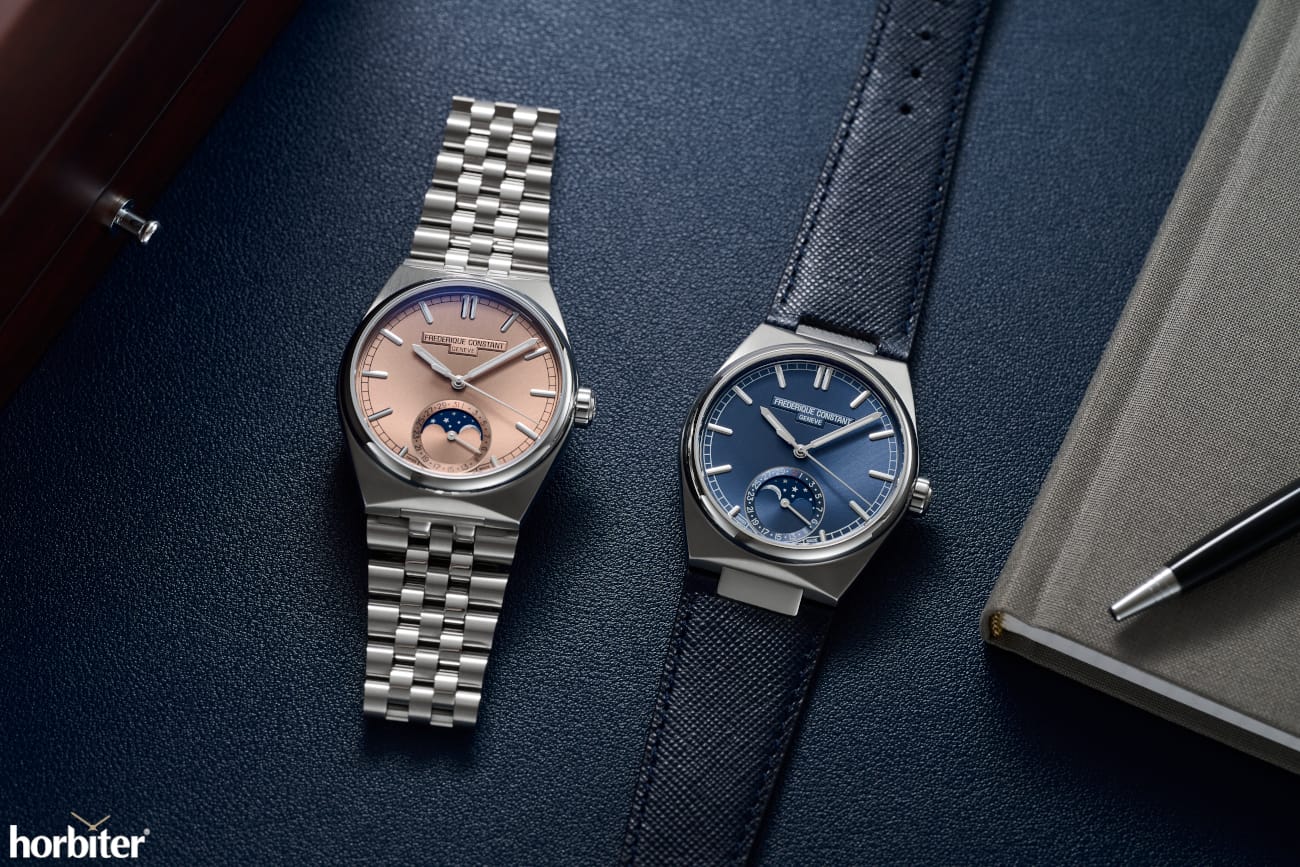
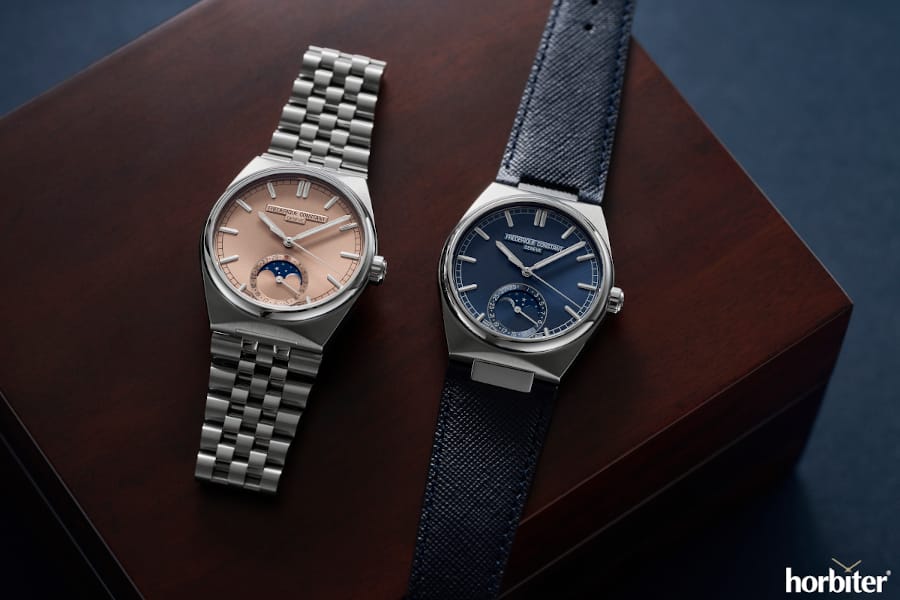
Two Takes on the Most Accomplished Highlife Yet
Frederique Constant was founded on a simple but brilliant idea: to bring Swiss-made watchmaking within reach of customers who either cannot—or will not—spend eye-watering sums, without compromising on the essentials of quality, performance and in-house movements for its more complicated watches.
That philosophy still centres on an average price comfortably below €5,000 (top complications excluded)—a threshold many premium brands have long since crossed, with their entry points now firmly in four-figure territory.
The Highlife has played a key role in broadening Frederique Constant’s appeal and strengthening its commercial position. The Moonphase Date Manufacture is both a welcome extension of the line and another sign of its steady development.
An In-House Calibre with a Three-Day Power Reserve
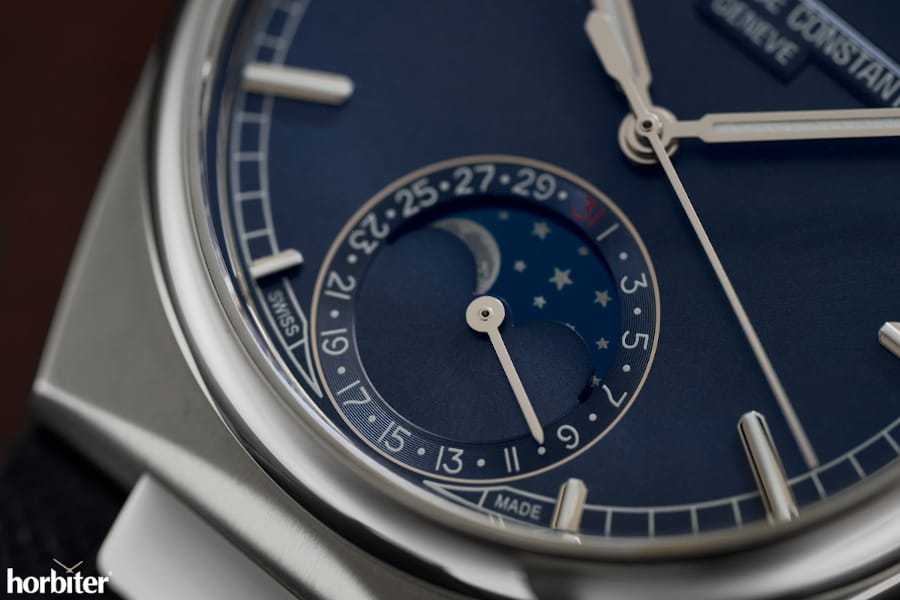
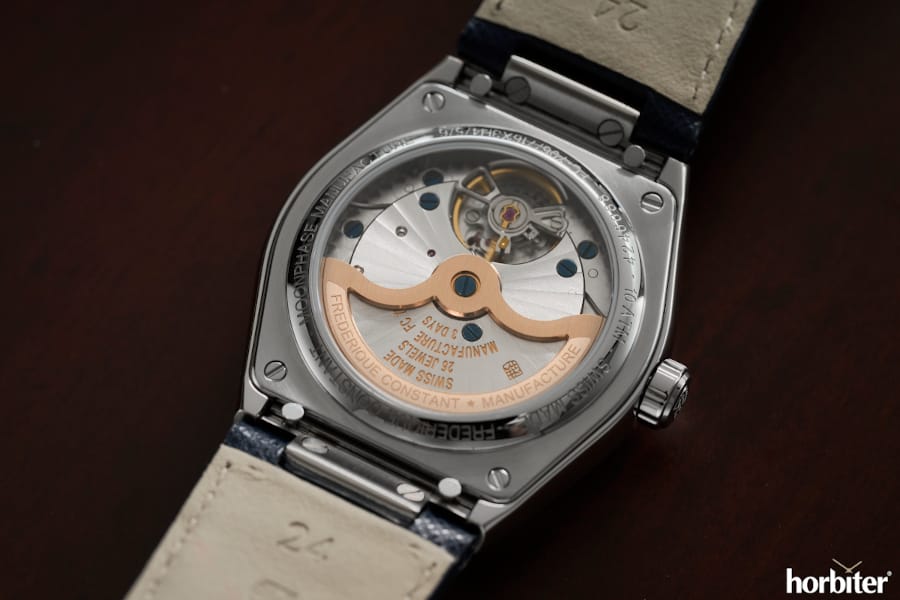
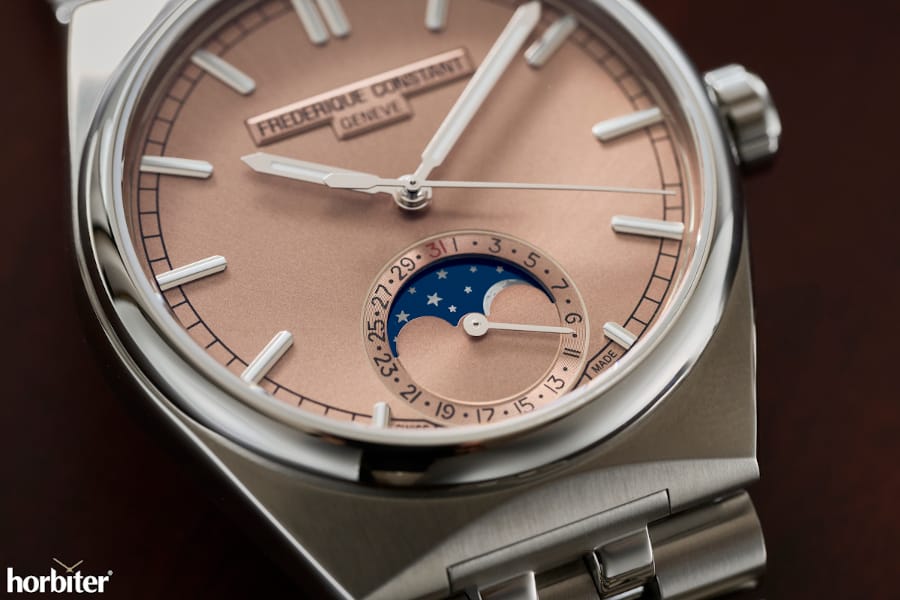
Powering the watch is Frederique Constant’s own FC-716 calibre, which combines a moon phase display with a date disc. According to the brand, a new barrel-spring alloy lifts the fully wound power reserve to 72 hours.
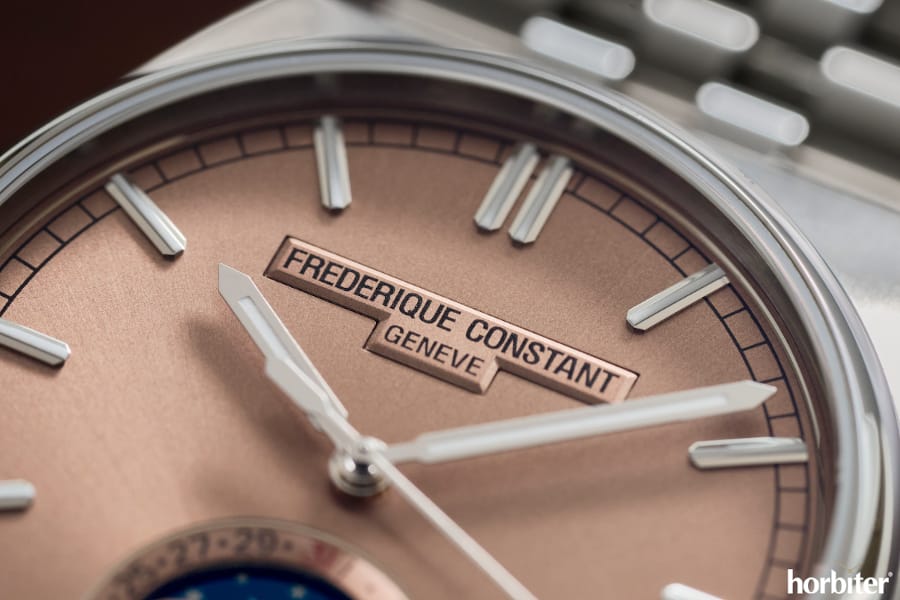
The finishing is classically Swiss, but one touch stands out: the sunburst decoration radiates from the moon phase display rather than the dial centre.
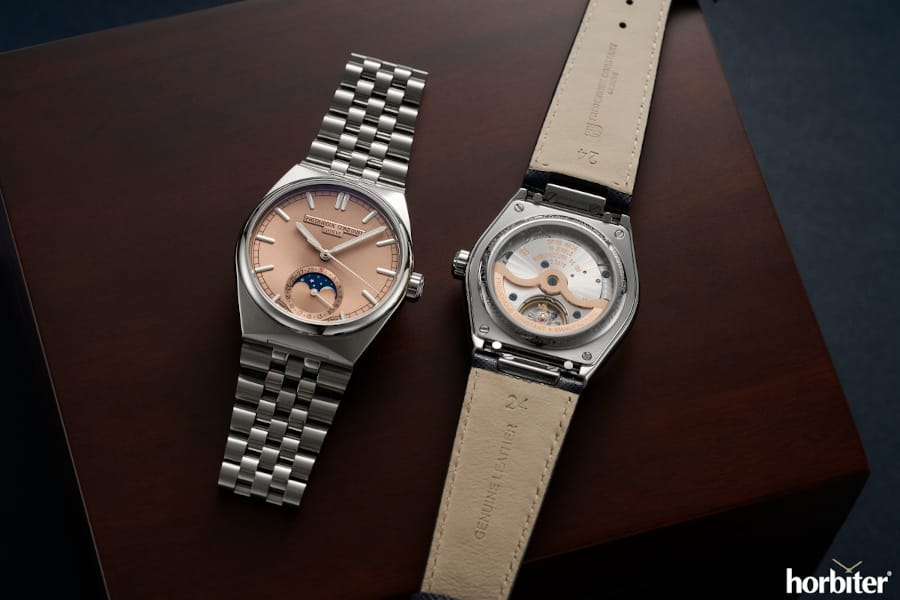
Frederique Constant has also made sure the package feels complete. Buyers can opt for a supple five-link steel bracelet or a Saffiano-leather strap with a folding clasp.
Saffiano leather is noticeably softer than alligator, while its even cross-hatched texture gives it a cleaner, more contemporary look.
The strap is offered with both launch versions. It suits the blue-dial model especially well, further reinforcing its traditional, understated character. The champagne-pink dial, on the other hand, comes alive on the steel bracelet, which brings out its brighter, more luminous side.
Both options swap easily. Better still, Frederique Constant offers a boxed set with the bracelet and strap, sparing buyers the need to choose.
A 39 mm Case
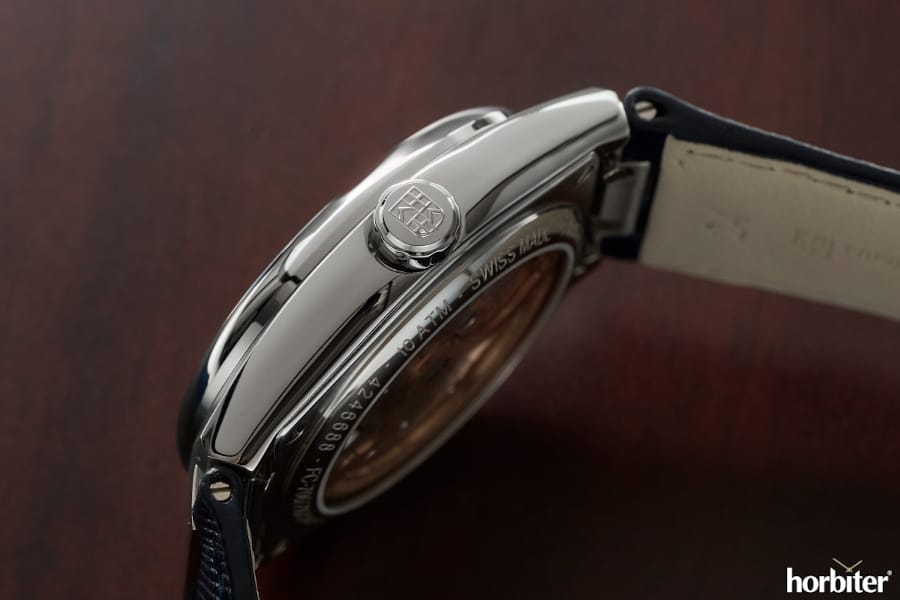
Without case-side correctors to disrupt its lines, the Highlife Moonphase Date Manufacture measures 39.00 mm across and 12.82 mm thick. All settings are handled through the crown. It is a push-pull design rather than a screw-down one, despite the watch’s 100-metre water-resistance rating.
That is not a deal-breaker, but a screw-down crown would have inspired a little more confidence for beach or poolside wear, particularly on a watch with these dimensions and this level of water resistance. Of course, anyone who already owns a proper dive watch is unlikely to reach for this first in that situation.
The applied, mirror-polished indexes feature a slim strip of luminous material down the middle, keeping the time easy to read in low light.
Final Thoughts
The Highlife Moonphase Date Manufacture is a well-made, well-judged watch from a stable brand that enjoys Citizen Group’s financial strength and industrial backing while retaining real operational independence—a balance its Japanese owner has handled wisely. At €4,495, it sits in a segment with surprisingly few convincing rivals.
This is the sort of mid-premium offering the market has been missing. Many brands have chased loftier, more overtly luxurious positioning; too often, though, they have relied on higher prices rather than meaningfully better watches to get there.
The Highlife has come a long way since its return, and every additional complication gives Frederique Constant another chance to refine the formula, strengthen the details, and close the few areas where rivals might otherwise have an edge.
Including both a strap and bracelet at this price only reinforces the value proposition. It is a smart move by Frederique Constant.
(Photo credit: Horbiter®)
In this article:
Line
It is the measurement unit that identifies the size of a movement. According to this measurement system, one line corresponds to 2,255mm.
Chronograph
Complication that helps the wearer to measure time intervals without affecting the watch's standard time-telling function.
Complication
The addition of any mechanical complication to a movement that usually displays the time.
Perpetual Calendar
The perpetual calendar is a complication that adjusts the watch's calendar for varying months and leap years. This cycle will end in 2100, and the wearer should apply the first manual correction.
Calendar
A feature that shows the day of the month and, in some cases, the day of the week. Some calendar watches show the date on sub-dials, while others display the…
Date
It indicates the date of the month. There are different types of display: via a window or a pointer, where an additional hand is usually placed centrally or on a…
Power Reserve
A mechanical watch feature displays, on the dial or the case back, the remaining power in a watch movement, showing the length of time until the timepiece must be rewound.
Calibre
A calibre is the type of watch movement encased in an assigned timepiece. Its name is usually associated with the manufacturer's name and a standard code, e.g., ETA 2824.
Barrel
It is a cylindrical metal box closed by a cover that contains a spiral spring called the mainspring, which provides energy to run the timepiece.
Strap
A leather, rubber or other material band that secures the watch to the wearer's wrist.
Crown
Placed on the case side, it winds the mainspring. When pulled out, it also sets the time and the date. A screw-down crown increases water resistance and protects the movement…
Case
It encases the mechanical movement and is crafted in one or more parts. It can also be a single piece, as with some professional diving watches, or made of unconventional…