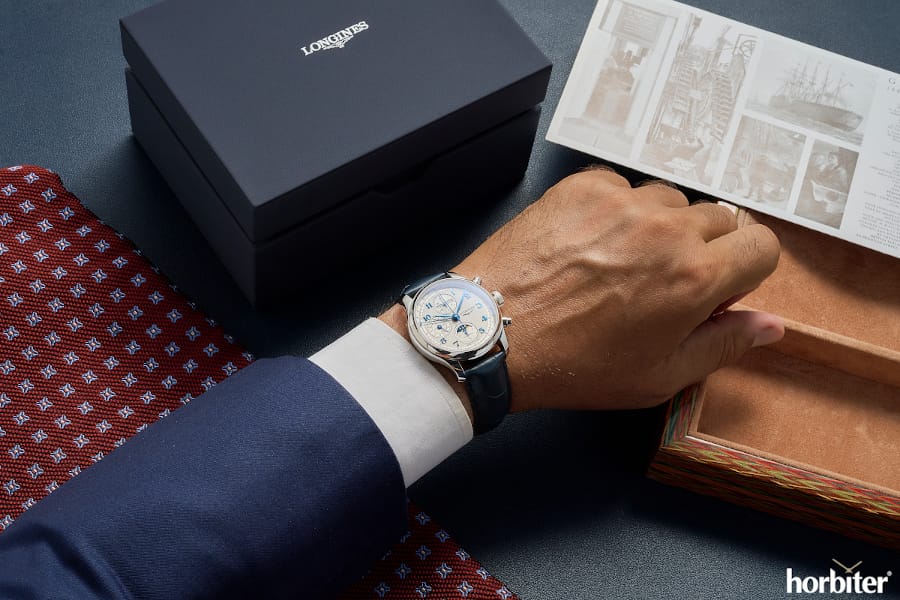
After long promoting HydroConquest, Longines has now turned our heads to the Master Collection, which has already undergone a significant refresh—mainly in the three-hand models with date display. The line now includes two new single push-piece chronographs and a revised Chrono Moonphase with Arabic numerals.
Since its launch in 2005, the Master Collection has evolved steadily, reflecting Longines’ rich heritage and appealing to a global audience through its timeless style and diverse options.
Its lineup has welcomed Longines’ latest technical and aesthetic upgrades and has finally renewed some chronographs that looked outdated.
Welcome Back, Monopusher Chronograph
The link between chronographs and the winged-hourglass logo brand is unmatched. Longines boasts an impressive production record and a long list of patents.
A visit to the brand’s museum is essential for anyone who wants to explore the quantity and technical prowess of the chronograph movements Longines has built. The flybackchronograph, for example, is a Longines patent.
Monopusher chronographs also make up a large chapter in this story and explain, along with Weems, Hour Angle, and many others, why Longines is so widely respected and keeps inspiring such high expectations.
The new monopusher chronographs are new to the Master Collection, not to Longines: they already appeared in the modern era. If the new watch gives you familiar vibes, you are not experiencing any Mandela effect.
Around 2013, Longines introduced a series of bi-compax monopusher chronographs with self-winding movements, including references L2.800.4.53.0 and L2.800.4.23.2, with black or white dials, pulsometer scales and the column-wheel L788 calibre. These watches now resurface within the Master Collection.
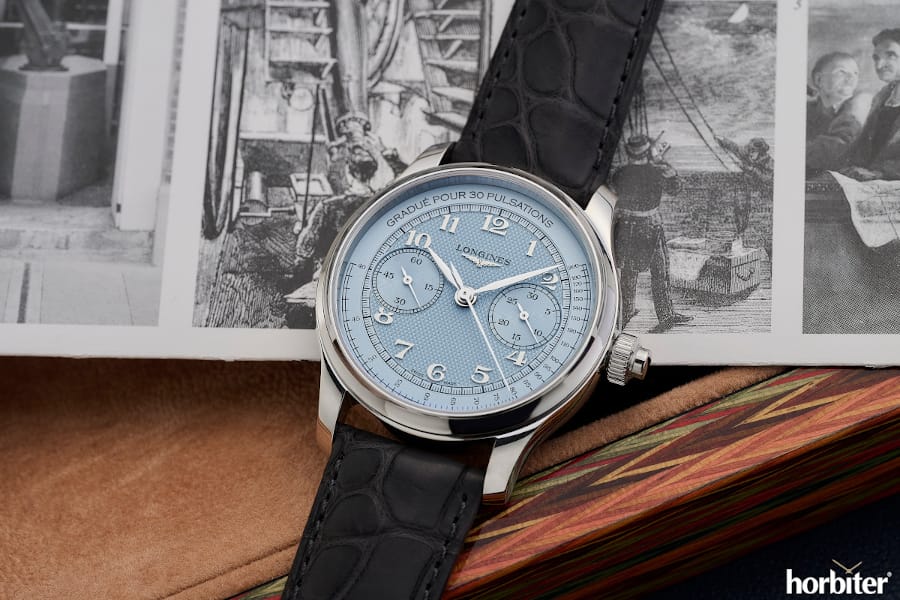
That said, the new models are a thorough reworking of that 41 mm architecture, redesigned to meet the brand’s current design codes and resulting in a more refined, ambitious style.
Fitted with the same Arabic numerals synonymous with the Master Collection, the dials feature a “grain d’orge” guilloché pattern that enriches the mid-section, surrounded by an easy-to-read pulsometer scale—a function we rarely use today, but adds to the sub-collection’s vintage appeal.
The L788 calibre has evolved into the current L799.5. Like its predecessor, it has a column wheel, but it is hand-wound.
It offers a superior finish, features a silicon balance spring, and provides a 68-hour power reserve. This development has not only made the monopusher chronograph more attractive; it has also helped reduce its thickness to 12.60 mm.
The case has been redesigned and softened, with curved lugs and a 48.60 mm lug-to-lug distance. Also, the date has disappeared.
The Master Collection Chrono Monopusher takes on the collection’s visual DNA: the bezel and caseback ring are concave, and it comes in two options—silver opaline and ice blue—with applied Arabic numerals in 5N rose gold or rhodium-plated finishing, respectively.
Master Chrono Moonphase
Here is the release that caught my attention, despite being a restyling—yet a very effective one. The Chrono Moonphase is recognisable and technically complete, but the Arabic-numeral variant looked outdated compared to the current Master Collection’s offering.
Yours truly, I never fully loved the Master Chronograph Moonphase in this variant, which I always found too crowded.
I also found its design too mainstream for a brand so rooted in watchmaking history. The new model has not undergone an extreme evolution; still, it is more appealing than ever.
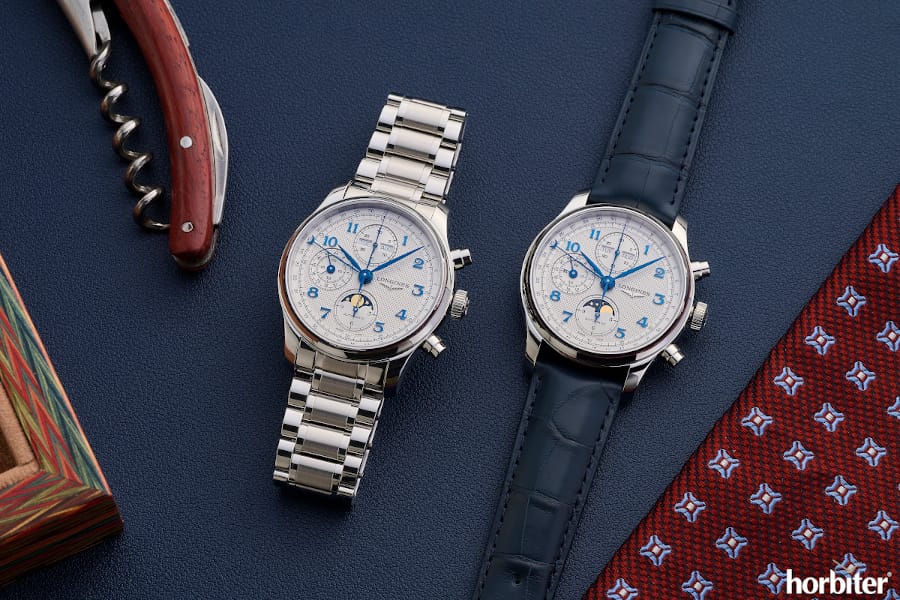
First of all, I believe it is the most complicated watch Longines currently builds: a chronograph with moonphase and calendar functions, a 24-hour display coaxial with the running seconds, 30-minute and 12-hour chronograph counters, and a pointer-date display.
Apart from the day and date display, this is an almost fully analogue watch. The dial retains the “grain d’orge” pattern, but everything else has been revisited to match its blue Roman numerals sibling.
From the hands to the applied, blued Arabic numerals, the minute track, and the date ring, the new design is elevated. Details such as the stepped day and month openings, along with the chronograph-seconds scale and the counters’ design, make the outcome more compelling.
Forget the original references and consider a new one: the former 40 and 42 mm sizes mixed up into a single 41 mm version—at least at launch.
Scaling the new Master Chrono Moonphase down to a single option might suggest Longines is running a SKU reorganisation, according to recent industry practice.
The excellent self-winding, column-wheel L687.5 calibre hasn’t changed. From a technical perspective, the outgoing model was already state of the art, adopting a silicon balance spring and increased power reserve. What makes the big difference lies in the details.
The crown has been redesigned and now features a truncated-conical top, a recessed upper surface, and concave surfaces on the bezel and, again, on the caseback ring. The bracelet end link replicates that of the 42 mm version, so the 41 mm model is more closely related to the 42 mm than to the 40 mm.
Another visible difference is the length of the chronograph pushers. Larger than before, they give the watch, together with the redesigned crown, an enhanced family feel to Longines’ other chronographs.
Interestingly, the watch is thinner, downsizing from the original 14.20 mm to 13.80 mm.
Available on either a strap with a folding clasp or a bracelet, both equipped with a micro-adjustment system, the Master Chrono Moonphase looks perfect on a steel bracelet.
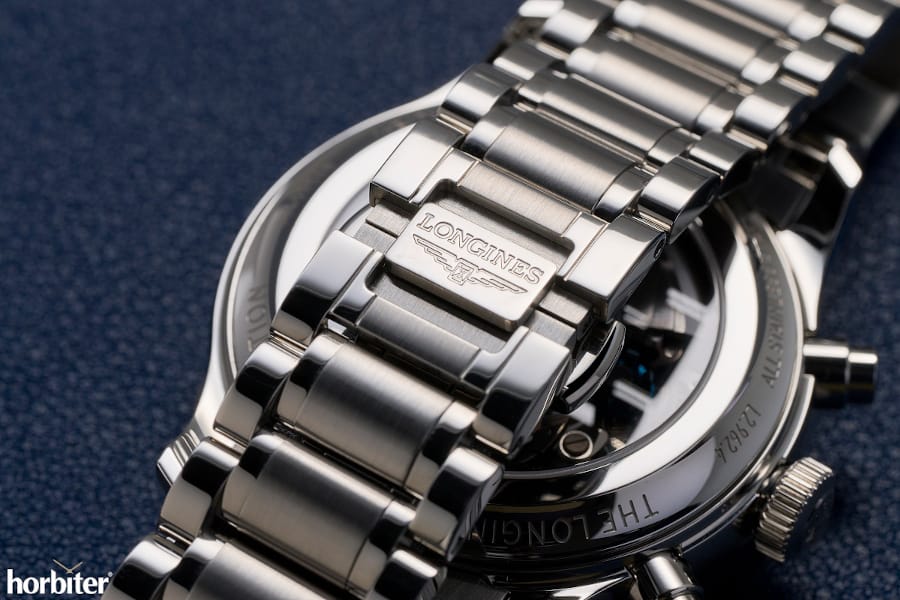
I would nevertheless have gone for a conventional clasp instead of a butterfly one. While the latter is undeniably elegant, when paired with a bracelet tapering from 20 to 18 mm, it cannot support the steel case as a conventional large clasp would.
New three-hand Models
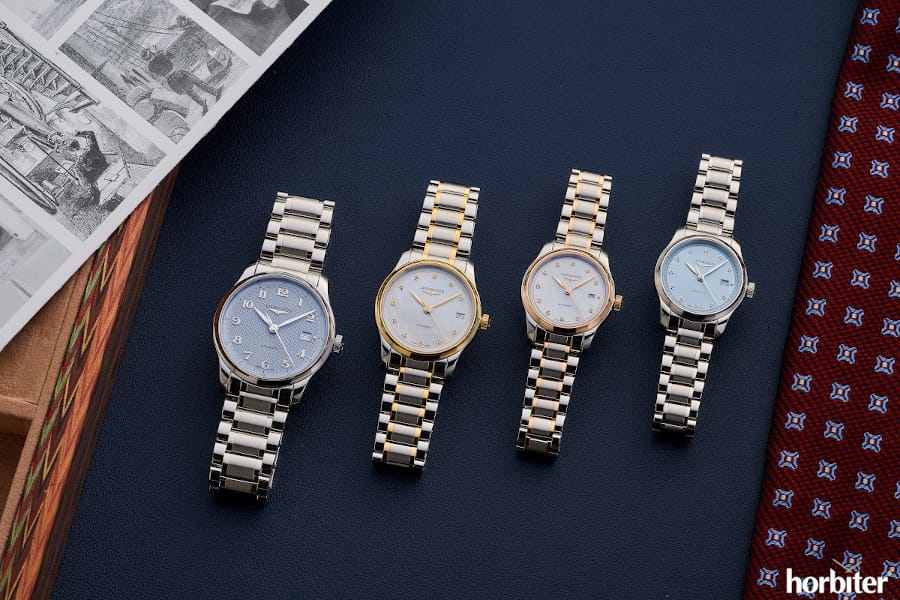
They’re no less relevant, since new variants join the current lineup. Longines is among the few brands to offer an almost fifty-fifty men’s and women’s offering, and has therefore introduced new 30 and 34 mm options, alongside bigger models sized 39 and 41 mm.
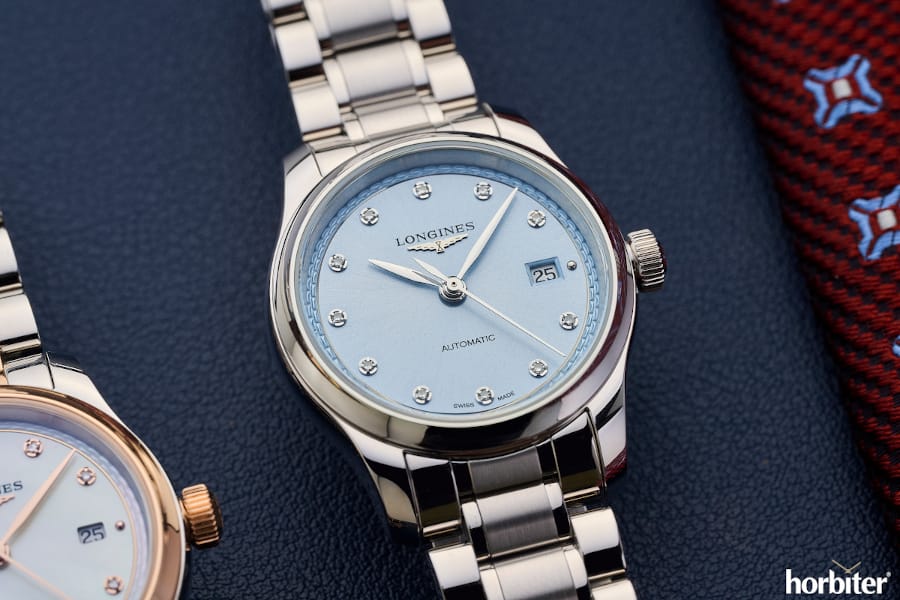
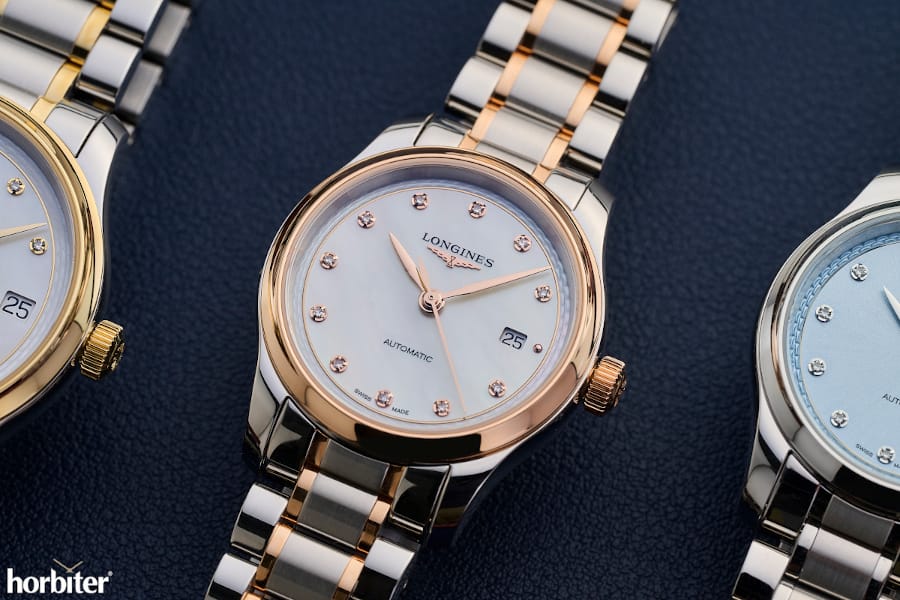
New ice-blue dials with either sunray or mother-of-pearl treatment top off the 30 and 34 mm sizes, with eleven Top Wesselton diamonds replacing the hour markers.
And, as usual, they all house automatic movements. In detail, the 30 mm models run on the L592.5 calibre, with a silicon balance spring and a 45-hour power reserve, while the 34 mm jump to the L888.5 movement, with a 72-hour power reserve, instead.
No wonder they mimic the same case-and-movement combination seen on their equally sized counterpart in the Conquest collection, which we introduced from the Rome flagship boutique two years ago.
As a reminder, the L888.5 calibre is the latest development in the L888 family and stands out for magnetic resistance exceeding more than ten times what the ISO 764 standard requires.
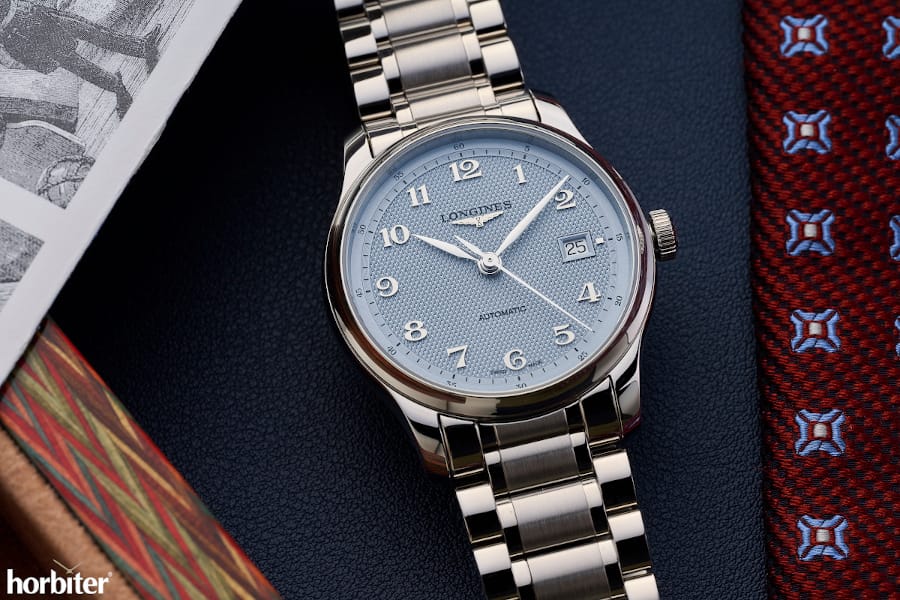
The newer 39 and 41 mm three-hand models share the same ice-blue, “grain d’orge”-decorated dial and are available on either bracelet or strap.
With a thickness ranging from 9.40 mm to 9.50 mm, the three-hand Longines Master Collection is an exquisitelyproportioned wristwatch. It’s a pity its water resistance is limited to 30 metres, but that is the price of keeping the case so slim.
Final Thoughts
The newer Longines Master Collection models exemplify how to turn a good design into an excellent one. A Monopusher is a welcome return, now under the umbrella of such a collection.
I was surprised; less so from the perspective of driving the collection closer to the brand’s historical families.
Longines is unquestionably building a stronger identity for the Master Collection, and it is reinforcing that strategy through its chronograph family.
With its hand-wound calibre, the monopusher chronograph is the most sophisticated and compelling single push-piece chronograph in its category.
The Moonphase Chrono has been improved where it deserved: aesthetically. Still, it feels entirely new. A final thought regarding the three-handers range extenders. Many are the new references.
Ice blue is currently trending. Yet, I believe the Longines blue paired with the “grain d’orge” is unrivalled, along with the silver dial, which highlights the blue Arabic numerals.
(Photo credit: Horbiter®)
In this article:
Line
It is the measurement unit that identifies the size of a movement. According to this measurement system, one line corresponds to 2,255mm.
Date
It indicates the date of the month. There are different types of display: via a window or a pointer, where an additional hand is usually placed centrally or on a…
Chronograph
Complication that helps the wearer to measure time intervals without affecting the watch's standard time-telling function.
Calibre
A calibre is the type of watch movement encased in an assigned timepiece. Its name is usually associated with the manufacturer's name and a standard code, e.g., ETA 2824.
Power Reserve
A mechanical watch feature displays, on the dial or the case back, the remaining power in a watch movement, showing the length of time until the timepiece must be rewound.
Case
It encases the mechanical movement and is crafted in one or more parts. It can also be a single piece, as with some professional diving watches, or made of unconventional…
Bezel
The bezel is particularly useful on diving watches, allowing you to check dive times. In this case, it unidirectionally rotates and usually comes in two parts: a metal (or ceramic,…
Calendar
A feature that shows the day of the month and, in some cases, the day of the week. Some calendar watches show the date on sub-dials, while others display the…
Crown
Placed on the case side, it winds the mainspring. When pulled out, it also sets the time and the date. A screw-down crown increases water resistance and protects the movement…
Strap
A leather, rubber or other material band that secures the watch to the wearer's wrist.