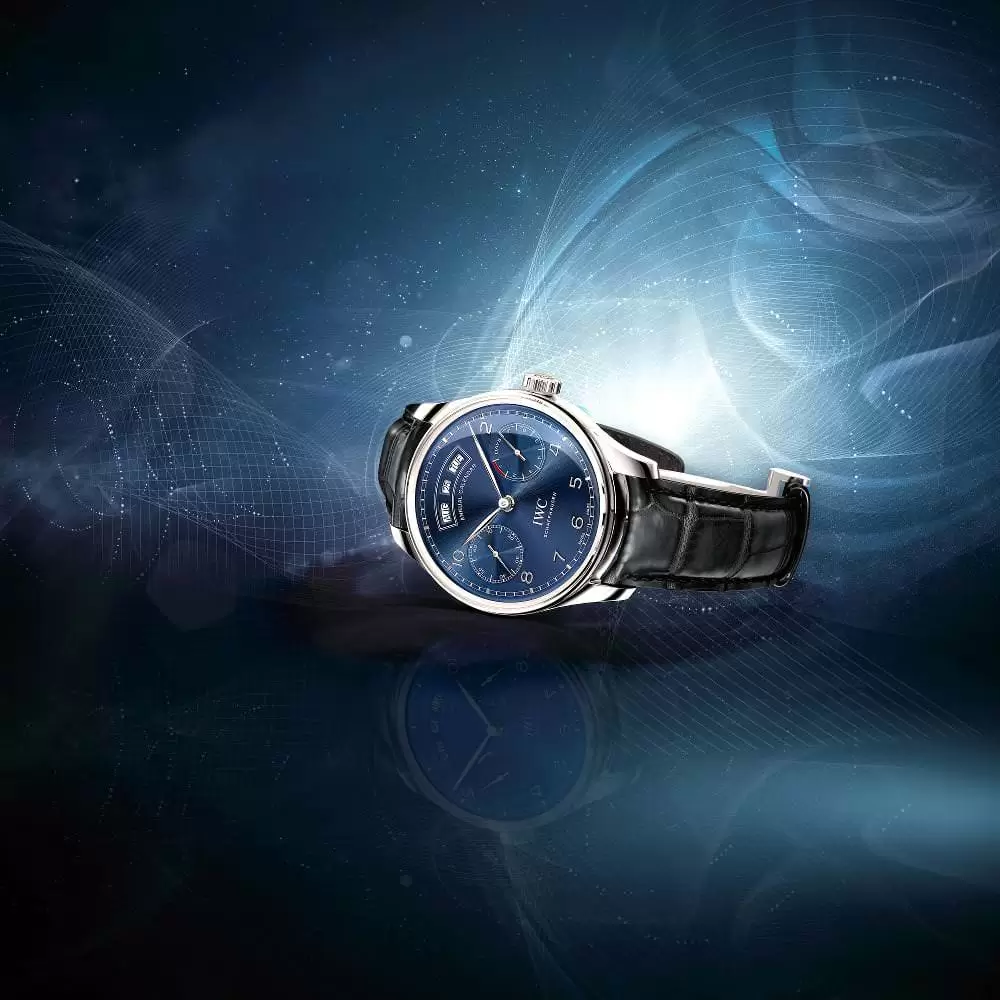
2015 begins with a certainty, at least for watch enthusiasts: this will be the year of the Portuguese. Here is the first available picture of the new IWC Portugieser Annual Calendar before its official debut at the upcoming SIHH 2015 in Geneva later this month.
This IWC is especially interesting for at least two reasons: the first being mainly aesthetic, it concerns its design, which preserves the classic two-counter dial layout introduced with the Portuguese Automatic, as all the relevant info such as day, date and month are included into an enlarged window, shaped as a circular sector placed at 12 (this follows the American order, as a homage to the IWC founder Florentine Ariosto Jones).
The second reason is of a technical nature and concerns the introduction of a new manufactured movement, namely the caliber 52850, which features two barrels to ensure a 7 dayspower reserve. The two barrels design ensures the release of the right torque needed to precisely operate the three independent discs.
Since we’re dealing with a calendar and not just a perpetual calendar, the IWC Portugieser Annual Calendar has to be adjusted at the end of each month of February to take leap years into account, but engineers at IWC have not provided the case with a corrector, as all the adjustments are set exclusively via the winding crown.
It is too early for a full evaluation but I think, however, that IWC has made a sleek and neat annual calendar, while introducing a technical complication that fills the gap between the Portuguese Automatic and the Perpetual Calendar. The IWC Portugieser Annual Calendar comes in three variations: reference IW503504 in red gold and two references in stainless steel, IW503501 and IW503502 respectively, with a silver or blue dial. Please find below a summary of its main technical features.
Mechanical movement – Pellaton automatic winding – Power reserve display – Annual calendar with displays for the date, day and month – Small hacking seconds at 9 o’clock – Glucydur beryllium alloy indexless balance with high-precision adjustment screws on balance rim – Breguet spring – See-through sapphire-glass back – Rotor with 18-carat gold medallion.
IWC-manufactured caliber 52850
Frequency: 4Hz Jewels: 36Power reserve: 7 days (168h) Winding: automatic
A feature that shows the day of the month and, in some cases, the day of the week. Some calendar watches show the date on sub-dials, while others display the…
Date
It indicates the date of the month. There are different types of display: via a window or a pointer, where an additional hand is usually placed centrally or on a…
Power Reserve
A mechanical watch feature displays, on the dial or the case back, the remaining power in a watch movement, showing the length of time until the timepiece must be rewound.
Perpetual Calendar
The perpetual calendar is a complication that adjusts the watch's calendar for varying months and leap years. This cycle will end in 2100, and the wearer should apply the first manual correction.
Corrector
The corrector is a tiny button on the case side that allows the wearer to update the watch date with a calendar.
Crown
Placed on the case side, it winds the mainspring. When pulled out, it also sets the time and the date. A screw-down crown increases water resistance and protects the movement…
Case
It encases the mechanical movement and is crafted in one or more parts. It can also be a single piece, as with some professional diving watches, or made of unconventional…
Complication
The addition of any mechanical complication to a movement that usually displays the time.
Rotor
Part of an automatic watch that winds the mainspring by constantly rotating. Depending on the watch's winding capability, movement design, and value, it comes in various geometries, sizes, and materials.…
Frequency
It is the number of oscillations of the regulating organ. It is divided into hours, mechanical watches, and quartz watches.