The H. Moser & Cie. Streamliner‘s staggering success is no longer in the headlines, yet the brand keeps grabbing the watch community’s attention with terrific new product releases. Among the first Indie brands to ever introduce a luxury sports watch, Moser was brave and clever enough to rock the industry with a class-leading timepiece whose attractiveness and engineering have rapidly grown a long waiting list.
It’s a list that includes the most discerning watch connoisseurs looking for a valuable option to mainstream offerings by Audemars Piguet and Patek Philippe, first and foremost.
H.Moser & Cie. has clinched the leaderboard’s top standings without – that’s a key point – even offering the ubiquitous ultra-thin watch. With the launch of the Moser Streamliner Tourbillon Vantablack®, the collection takes to new heights and now covers from the (no-longer-available ) Central Seconds Streamliner to the Tourbillon.
The Streamliner Tourbillon Vantablack® is also Moser’s take on the full-gold luxury sports watches. That’s entirely unexpected as it is a consistent addition to the “full gold” watches product offering, whose appeal (and sales volumes) skyrocketed; again, the brand sets itself apart as it did when debuting the chronograph-watch-hands-on/">Flyback Chrono or the calendar-watch-hands-on/">perpetual calendar.
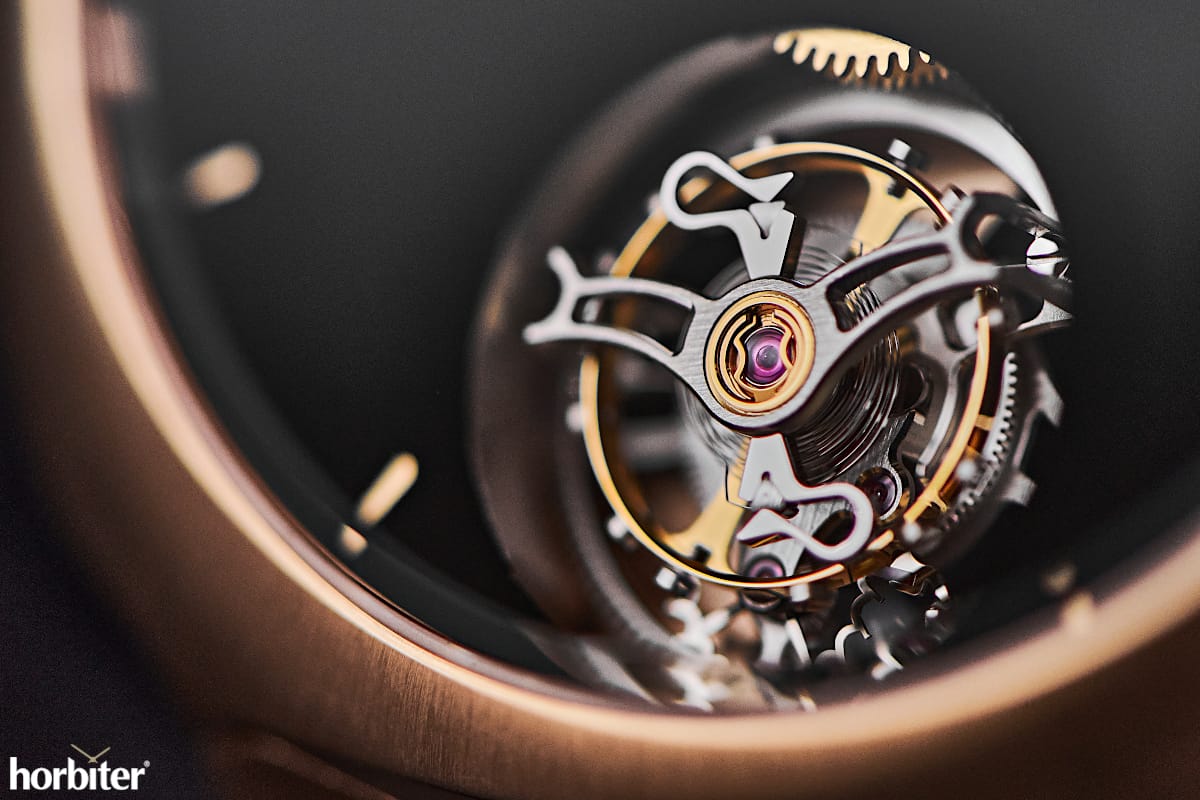
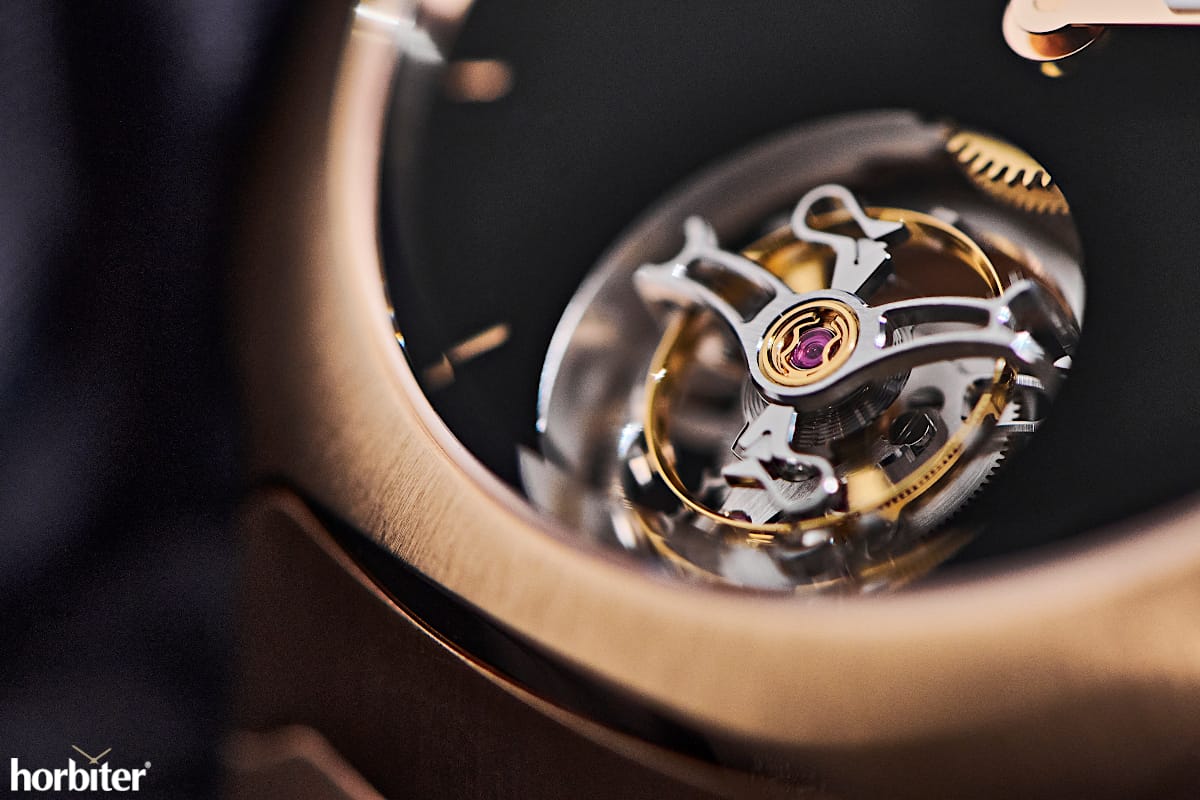
The in-house engineered tourbillon, whose design belongs to Moser’s early days and we’ll get through later, equips the Streamliner for the first time.
“Nomen omen” – since the Streamliner Tourbillon Vantablack® adopts the trademarked “Vantablack®” finish, which we have experienced with several products within the brand’s portfolio so far. Above are, in brief, listed the two major touch points setting this timepiece apart from the competition while abiding by the rules of what I define as the brand’s “radical minimalism”, its DNA.
First thoughts
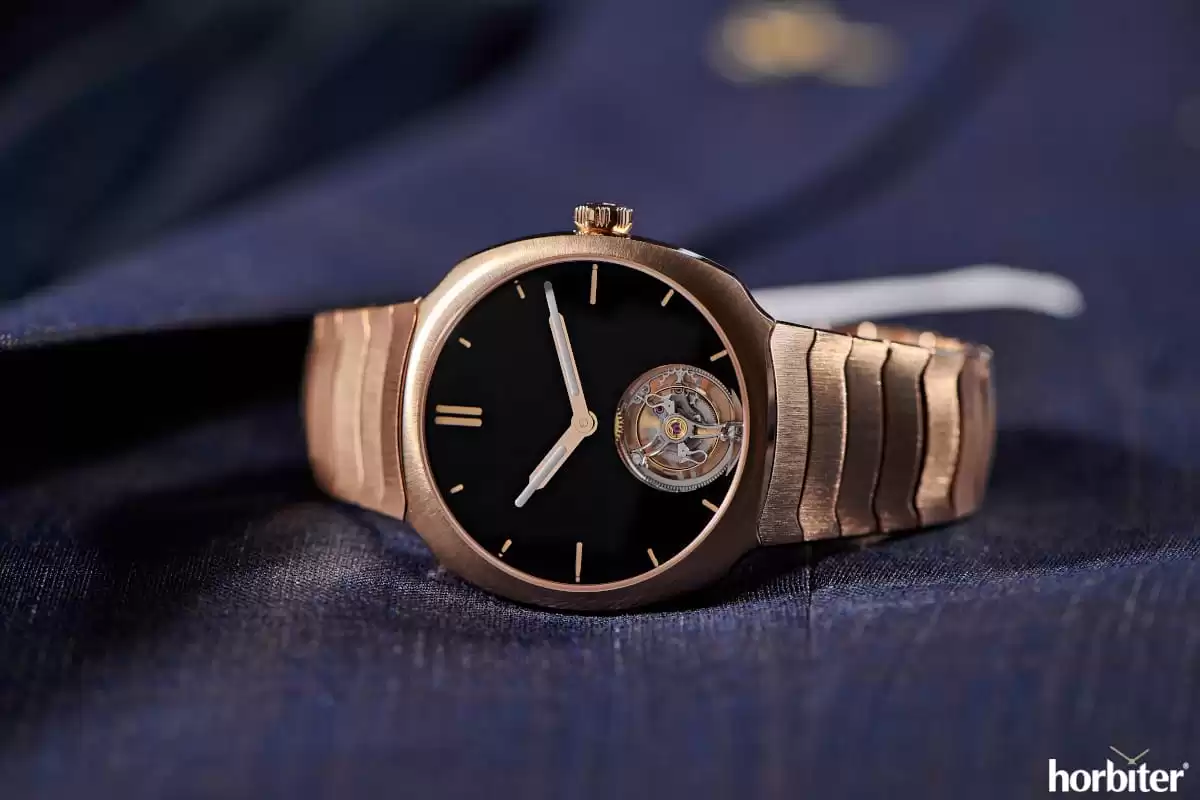
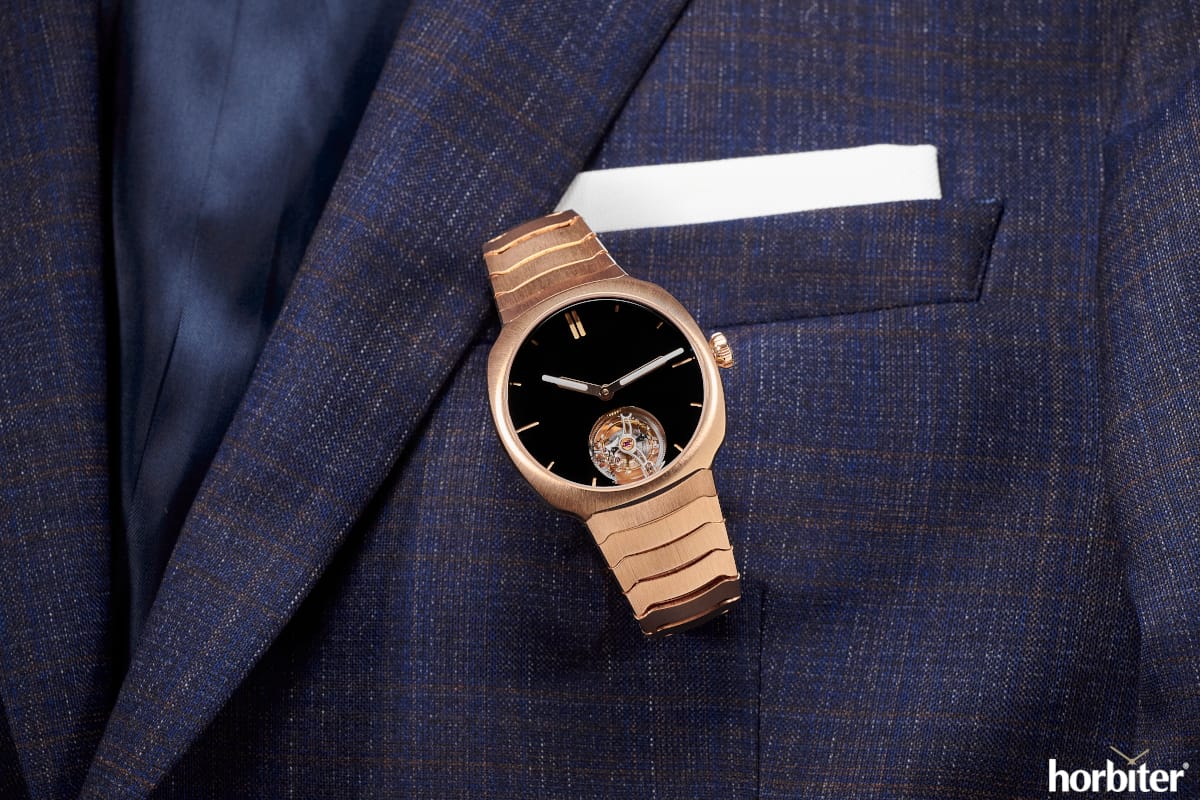
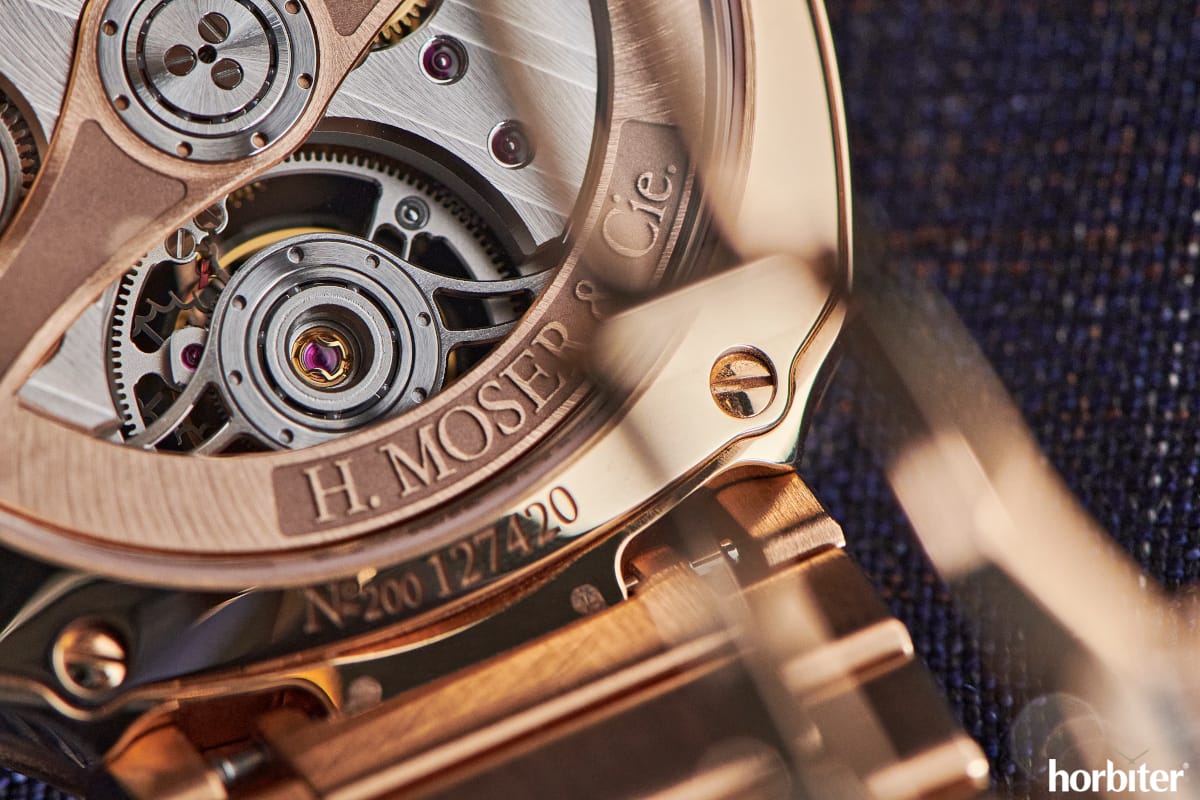
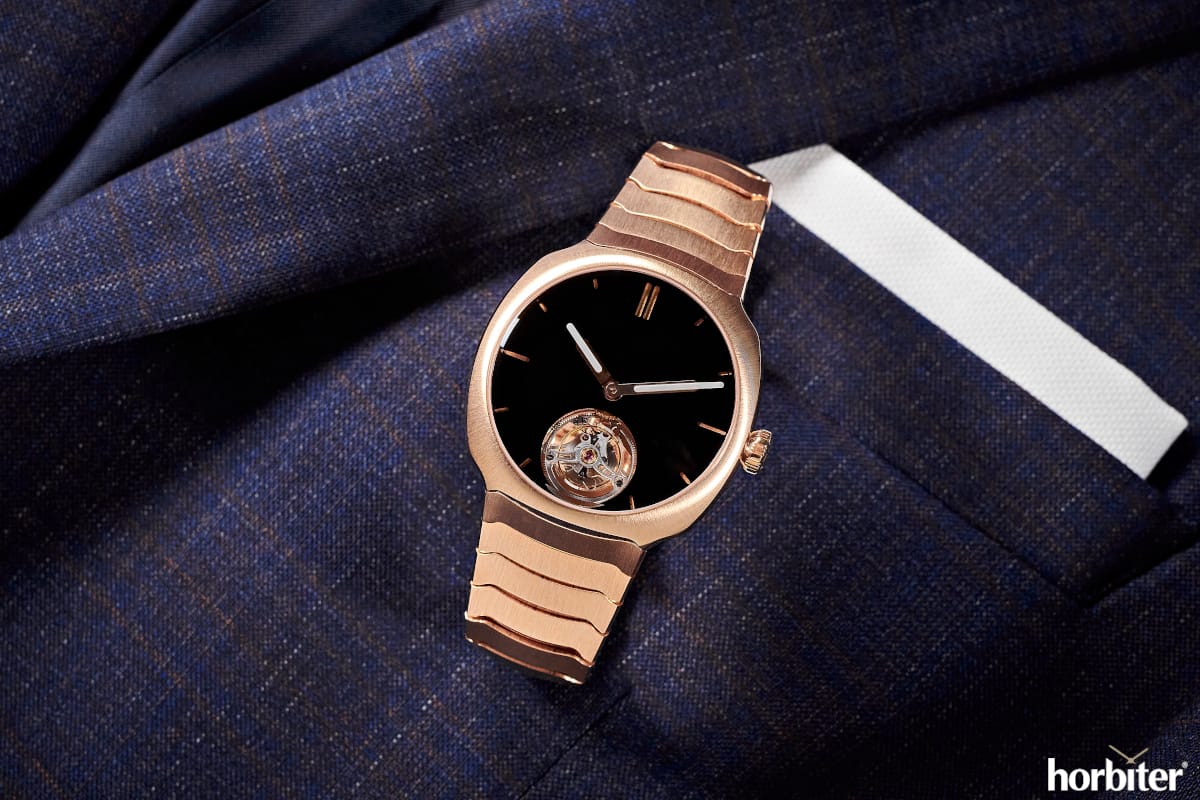
At a glance, the Vantablack® dial nicely contrasts the gold case and bracelet while softening the striking full gold effect, despite the Streamliner adopting design hues to make it already as understated as possible. The case top and links are brushed, showcasing tiny polished sections amidst them as you twist the timepiece along with unobtrusive mirror-polished lines set around the bezel and the polished see-through case back.
What is Vantablack®?
Vantablack® is not Moser’s original patent; Moser was not even the first to adopt it but paved the way to spread it in watchmaking, and throughout its product offering, Streamliner included. Vantablack® comes from carbon nanotubes, and the finished product is as black as it gets: its black tone can absorb up to 99.965% of the visible–spectrum light radiation.
The outcome is so deep black you might find yourself lost once you try and look into the dial; such experience contrasts with what we’re used to when discovering any new Moser dial, whose ordinary colour palettes are as intense and vivid as they are brilliant.
Here comes what H.Moser & Cie. is best at: wow effect. The more you try and foresee what’s next in the pipeline, the more you fail; that sets Moser apart from competing luxury players.
The mechanical movement is an ode to tradition instead (despite some choices place it among the “very rare” luxury calibres) and builds upon a rich technical legacy the manufacturer is renowned for; from a market perspective, the Streamliner Tourbillon Vantablack® competes in the sporty time-only category against the likes of Holy Grail watches like the Royal Oak Tourbillon.
Case and bracelet design, and (again) dial
Red gold case and bracelet and central flying Tourbillon apart, the case size and layout mimic a Streamliner Central Seconds: the former measures forty millimetres (crown excluded) and the winding crown holds an ordinary displacement as opposed to the Chrono or the Perpetual Calendar where such component is off-centred and somewhat hidden at first glance.
The bracelet has the much-appreciated, fully-integrated, seamless “snake” design, which looks the parts; yet, I can’t deny I’d love to see the “H. Moser & Cie. – Very Rare” moniker engraved somewhere on the butterfly clasp’s inner folding mechanism. As a watch enthusiast, I love placing my timepieces under the loupe enjoying details exclusive to the product owner. The dial has a sandwich layout, and the syringe-shaped hands hovering over it are covered with luminescent material.
The Moser HMC 804 calibre
The venerable HMC 804 automatic tourbillon movement has also found a place in a Streamliner. Among the first in-house calibres ever released by H. Moser & Cie., the 804 measures 32 mm across and is 5,5 mm tall, featuring a skeletonized and engraved gold oscillating weight, which fits the Streamliner Tourbillon beautifully.
Sturdy and performance–oriented, it prides itself on lowered after-sales maintenance costs thanks to a modular assembly allowing the watchmaker to service the tourbillon cage aside from the whole mechanical movement, thus dramatically improving the servicing experience in the benchmark.
The class–leading double hairspring adopts Straumann terminal curvesexclusively developed by Andreas Strehler for Moser. It is made in-house: two overlapping hairsprings (each rotated 180 degrees to the other) work to defy gravity more effectively than any ordinary single hairspring.
In this area, H. Moser & Cie. expertise is a class of its own; please consider the brand sources hairsprings to some of the most respected Haute-Horlogerie, too. As long as the tech sheet is concerned, here are the timepiece’s first-hand specs: the Streamliner Tourbillon Vantablack® runs for 72 hours when fully wound and is water resistant to 120 meters.
Final thoughts
Let’s kick off our final thoughts section by revealing and discussing retail price: a Moser Streamliner Tourbillon Vantablack® costs 109,000 Swiss Francs, which is a price for the few and confirms how the collection’s awareness keeps growing at a steady pace; let’s hope (and expect) an ultra-thin variant is underway and ready to hit the spot anytime soon.
In the luxury market competitive scenario, it’s a reasonably affordable price; like any Streamliner, the Tourbillon tapers your wrist exquisitely and offers unique “touch points” like the signature Vantablack® dial, for instance; if you’re looking for a modern take on the once–popular onyx dial, there you have it.
Also, the 804 offers excellent technical refinement and is nicely finished throughout despite not matching similar calibres by other Indie watch brands (whose price point is higher). However, I hope Moser will soon broaden the audience by adding a Streamliner Tourbillon in steel to the product range.
(Photo credit: Horbiter®)
Gaetano C @Horbiter®
In this article:
Perpetual Calendar
The perpetual calendar is a complication that adjusts the watch's calendar for varying months and leap years. This cycle will end in 2100, and the wearer should apply the first manual correction.
Chronograph
Complication that helps the wearer to measure time intervals without affecting the watch's standard time-telling function.
Calendar
A feature that shows the day of the month and, in some cases, the day of the week. Some calendar watches show the date on sub-dials, while others display the…
Case back
It can be screwed in, pressure-fastened, or secured to the case via screws. Occasionally, it comes as a single piece, with the case of specific professional diving watches (for example,…
Case
It encases the mechanical movement and is crafted in one or more parts. It can also be a single piece, as with some professional diving watches, or made of unconventional…
Bezel
The bezel is particularly useful on diving watches, allowing you to check dive times. In this case, it unidirectionally rotates and usually comes in two parts: a metal (or ceramic,…
Crown
Placed on the case side, it winds the mainspring. When pulled out, it also sets the time and the date. A screw-down crown increases water resistance and protects the movement…
Tourbillon Cage
The rotating cage includes the tourbillon, balance wheel, and anchor and escapement wheel.
Water Resistant
A watch is water resistant when it can withstand splashes of water. It indicates the depth to which a watch can be worn underwater.