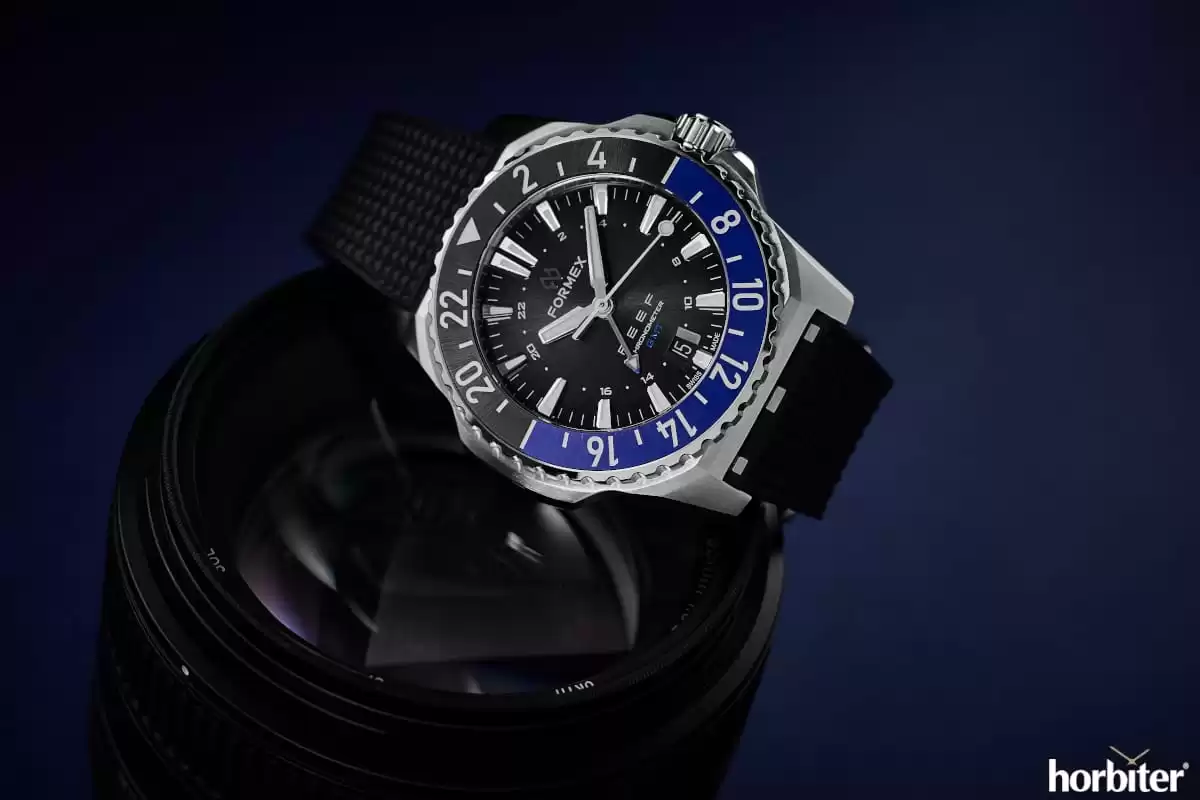
With the watch bubble bursting in 2022, we have witnessed a dramatic change in the business scenario; Indie watchmaking has risen to the top like never before, and so have many small watchmakers belonging to the accessible-luxury product category. Currently, most of these brands are usually located between the US and the Far East, but looking closely at the business map, you’ll notice plenty of new brands appeared across Italy, France and Switzerland. Formex is among the longest-established (contemporary) watchmakers – the brand initially hit the market in 1999 – thus proving that Swiss Made brands paved the way for smaller, independent workshops before anyone else.
The Formex Reef GMT marks our first-ever hands-on review of a Formex watch. Our early takeout is that the brand’s mission exceeds the ubiquitous “value for money” formula by matching the quality-to-price equation with the DNA you expect from an authentic Swiss Made product in design, components, build quality plus an array of clever features to make the experience as spirited as possible.
If I had to discuss the Reef from a product development perspective, I’d pick terms like “customization”, “usability”, and “touch and feel”. The Formex Reef GMT combines all the claims mentioned above within the popular GMT sports watch formula in its most sought-after execution, i.e. a three-time zones wristwatch.
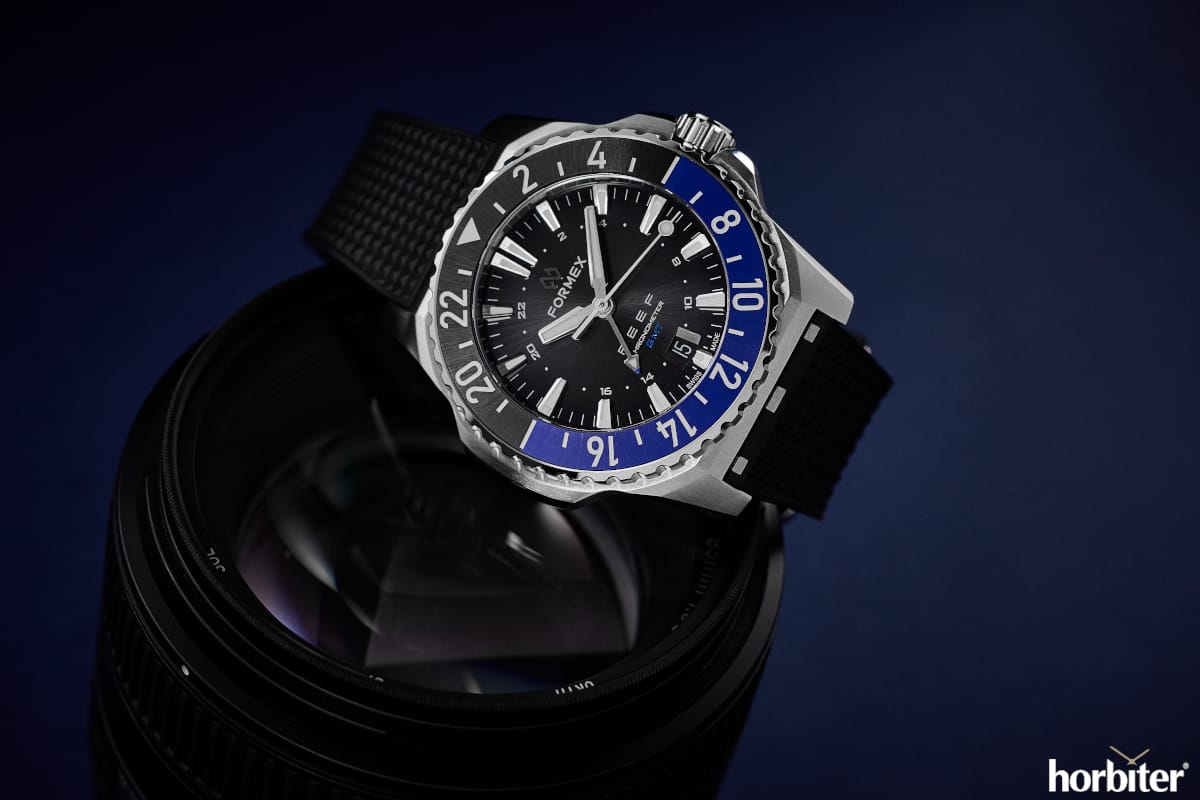
Before getting into how Formex has deployed customization, let’s start by exploring the proudly Swiss-made layout. The steel case, the matte ceramic-made bezel’s inlay, and the sunray dial with faceted, applied indexes atop testify how the engineers’ standard was to equally attract the newbie or the watch expert, looking for refinement inside and out and a step beyond what we usually reckon as “affordable luxury”. Inside as outside, given that the timepiece comes equipped with a Chronometer-grade Sellita SW 330-2 calibre, a top-grade outsourced self-winding movement.
Formex stands for “forme extrème” (extreme shape), but please forget the brand’s early designs; the Reef GMT is far from its 1999 forerunners and beyond. It’s a compelling yet more ordinary design than the rules-braking launch product family. The aesthetic layout is, therefore, mainstream, with the brand focusing its efforts on making the watch as customizable as possible during the buying experience and beyond, loaded with a couple of patents that make it the closest thing to a kind of made-to-measure wristwatch.
The online configurator lets you choose among six bezel options and as many dials; with that said, I’ll discuss the patented micro-adjustment mechanism on the clasp paired with the rubber strap. Through a tiny button, you’re allowed to slide and fasten the strap onto your wrist as tightly as possible, despite the strap’s ends being too long, thus adding to the overall thickness once they overlap.
We then scrutinized the quick-release Milan mesh bracelet option, offering a respectable 10 mm micro-adjustment hidden mechanism; such a bracelet also comes with a snap-in and snap-out mid (they’re screwed-in) links to make, again, the bracelet taper any wrist.
Either the quick change system and micro-metric adjustment are flawless and highlight the slim Reef GMT’s case; it measures a mere 11,4 mm across, slimming off the 42 mm case’s width. If I had to configure the watch myself, I’d choose a different bezel colour combo, and I suggest Formex explore further two-tone colour options; also, I’d offer the watch with a solid case back, given its professional diver’s pedigree (here is a Reef Diver, turned GMT).
Final thoughts
The main touch points of the Formex Reef GMT’s value proposition are excellent (perceived) build quality, the customization process and the smart solutions for clasp and bracelet to help you adapt the watch to your liking. A Reef GMT should fill your wishlist if you want to update or renew your timepiece unstoppably. As stated above, I like the blue and black bezel, but I think a Reef GMT is terrific on any single-tone bezel option, too; the bezel replacement is tool-free.
The lugs’ design and brushed and polished multi-faceted surfaces are the traits I like the most; I think the design is as sophisticated as it gets and slim enough to make it a slender watch, despite thinking that a 40 mm option should come next in the pipeline. The Formex Reef GMTChronometer 300M price list starts at €1,805 (on a NATO strap).
(Photo credit: Horbiter®)
Editorial team @Horbiter®
In this article:
Swiss Made
Swiss-made means that a watch's movement is Swiss, it is cased in Switzerland, and the manufacturer carries out there the final inspection.
GMT
It is the acronym for Greenwich Mean Time and identifies a complication capable of displaying two or more time zones on the dial. The complication usually couples a 24-hour rotating…
Chronometer
An instrument for measuring time very accurately. For any watch to be called a chronometer, it must meet the standards set by the C.O.S.C. (Contrôle Officiel Suisse des Chronomètres).
Ceramic
Widely used for crafting a watch case and, in recent years, also for the bezels of diving watches and dials. Obtained from zirconia powder (ZrO2), ceramic offers superior scratch resistance…
Case
It encases the mechanical movement and is crafted in one or more parts. It can also be a single piece, as with some professional diving watches, or made of unconventional…
Calibre
A calibre is the type of watch movement encased in an assigned timepiece. Its name is usually associated with the manufacturer's name and a standard code, e.g., ETA 2824.
Bezel
The bezel is particularly useful on diving watches, allowing you to check dive times. In this case, it unidirectionally rotates and usually comes in two parts: a metal (or ceramic,…
Strap
A leather, rubber or other material band that secures the watch to the wearer's wrist.
Case back
It can be screwed in, pressure-fastened, or secured to the case via screws. Occasionally, it comes as a single piece, with the case of specific professional diving watches (for example,…