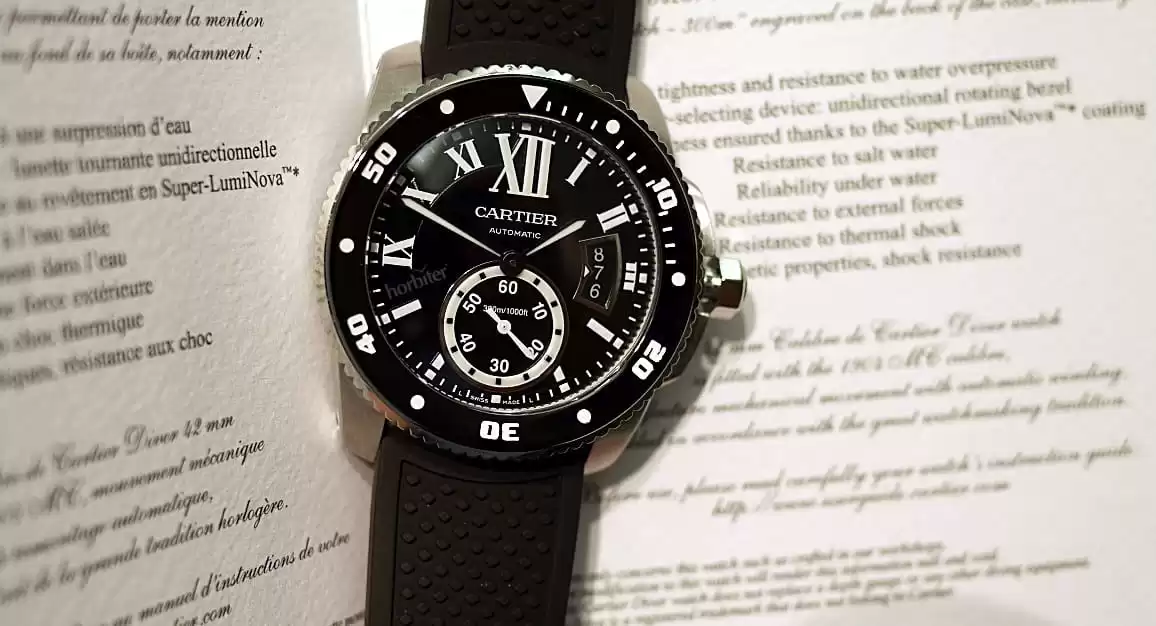
The Cartier Calibre de Cartier Diver watch hands-on
Giovanni Di Biase19 August 2020
0 Comments
When last january we introduced some of the novelties unveiled at the SIHH, we previewed the most interesting timepieces from the Richemont Group among which the most unexpected was and has been, for more than a reason, the Cartier Calibre de Cartier Diver.
Everybody, press journalists as well as watch enthusiasts, were wondering why Cartier and only Cartier, had launched a professional diver’s watch and by that I mean an ISO compliant one. It was anyway quite clear to me to be honest, as I’m not a consummate blogger but rather come from the Durable Consumer Goods sector: all the brands of the Richemont Group’s portfolio are independent and even if they share some technologies and parts, each follows its own product strategy, in compliance with its tradition and brand identity.
The Cartier Calibre de Cartier Diver is an ISO 6425 compliant professional diver’s watch. This certification is not so rare in watchmaking, at least outside Europe as you may easily verify that nearly all the Japanese sport watches usually boast the lettering “Diver’s” in replacement of the “Water Resistant” one on the dial or on their tech sheet. What distinguishes then the Cartier Calibre de Cartier Diver from any other Water Resistant timepiece in this sector?
A Water Resistant timepiece is, in a nutshell, tested with air and a production batch is usually spot checked, while with an ISO 6425 certified one, just to cite a few, all the production batch is fully checked, each wristwatch is tested at a 125% of the rated maximum depth (300m in this case) and for an extended period of time in water. Each Cartier Calibre de Cartier Diver must undergo and pass numerous tests. It’s all about a long series of very rigorous and complex tests to demand such a robust design, you can easily perceive it once you are hands on with it and compare it with any other Water Resistant wristwatch.
Gaps between parts are very tight; the unidirectional 120-notch bezel has a precise click and, moreover, if you place on a table three different diver’s watches one along the others, you may easily notice, I don’t know if it’s by chance or not, that none of them boasts a helium escape valve. It is, most probably, for Diver’s watches are so well sealed the mixed gas (Helium and Oxygen) never gets into the case while diving.
The Cartier Calibre de Cartier Diver is 42mm wide and just 11m thick, so to make it an everyday watch, as we are accustomed with any Cartier, thanks to the small size of caliber 1904MC, mechanical automatic with the balance wheel vibrating at 4Hz and 48 hours of power reserve. The bezel has no ceramic inlay, as it might seem at first sight, but boasts an ADLC (Amorfous Diamond Like Carbon) treated aluminum ring to give it a sort of lacquered like look and feel.
The Cartier Calibre de Cartier Diver is available on a rubber strap (or with a stainless steel bracelet), that easily reminds me the Aquatimer’s one by IWC and retails, in this stainless steel version, for 6800€. It is the next step in moving technically upmarket the entry level Cartier’s line up and it’s great to see the French maison is looking more and more to watch enthusiasts and true connoisseurs. But, to be honest, despite its finishes, which are truly outstanding, it still remains a bit overpriced as it is just a three hand timepiece and taking into account this certification should be a standard for any high end watch fit for sports diving.
(Photo credit: courtesy of Cartier; Horbiter®)
Gaetano C. @Horbiter®
In this article:
Calibre
A calibre is the type of watch movement encased in an assigned timepiece. Its name is usually associated with the manufacturer's name and a standard code, e.g., ETA 2824.
Water Resistant
A watch is water resistant when it can withstand splashes of water. It indicates the depth to which a watch can be worn underwater.
Case
It encases the mechanical movement and is crafted in one or more parts. It can also be a single piece, as with some professional diving watches, or made of unconventional…
Bezel
The bezel is particularly useful on diving watches, allowing you to check dive times. In this case, it unidirectionally rotates and usually comes in two parts: a metal (or ceramic,…
Power Reserve
A mechanical watch feature displays, on the dial or the case back, the remaining power in a watch movement, showing the length of time until the timepiece must be rewound.
Ceramic
Widely used for crafting a watch case and, in recent years, also for the bezels of diving watches and dials. Obtained from zirconia powder (ZrO2), ceramic offers superior scratch resistance…
Balance wheel
A part of a mechanical watch that oscillates, dividing time into equal portions.
Strap
A leather, rubber or other material band that secures the watch to the wearer's wrist.
Line
It is the measurement unit that identifies the size of a movement. According to this measurement system, one line corresponds to 2,255mm.