2025 marked the renewal of a historic Omega collection, part of a trilogy that, in 1957, introduced the brand’s main product pillars: the Seamaster 300, the Railmaster, and the Speedmaster CK 2915.
Back then, the Seamaster and Speedmaster were at the dawn of a staggering market success to become soon Omega’s flagship collections; in contrast, the Railmaster, the magnetic-resistant timepiece, hardly found its way.
Perhaps the Seamaster, which shared the same case architecture and whose market success steadily grew across the 1960s, outperformed its sibling.
The 2017 reissue of the 1957 trilogy offered a contemporary take on the original and the best execution of the Railmaster in decades.
That watch has undergone multiple design reviews over the years, evolving to feature lyre-shaped lugs and sizes of up to 49mm, as seen in the hand-wound Railmaster.
The Railmaster 2025 collection
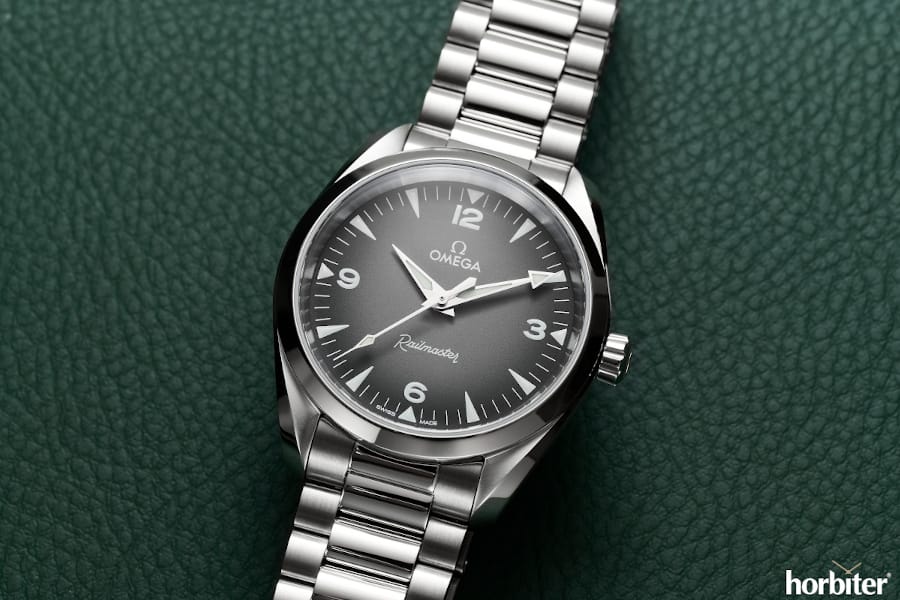
A brief historical overview helps us understand where the 2025 renewal is heading. Formally belonging to the extensive Aqua Terra product family, the new Railmaster, despite being listed in Omega’s Heritage collection, adopts a more classic design and a minimalist aesthetic, with a vague “tool watch” appearance.
Like for like with a 38-mm Aqua Terra (apparently)
While geared towards an audience different from an Aqua Terra, the case measures 38.0 mm in diameter and 12.36 mm in thickness, with a lug-to-lug distance of 44.92 mm.
Interestingly, the thickness is 0.10 mm greater than that of a comparable Aqua Terra, but the absence of a date display helps highlight the vaguely tool-watch appearance mentioned above.
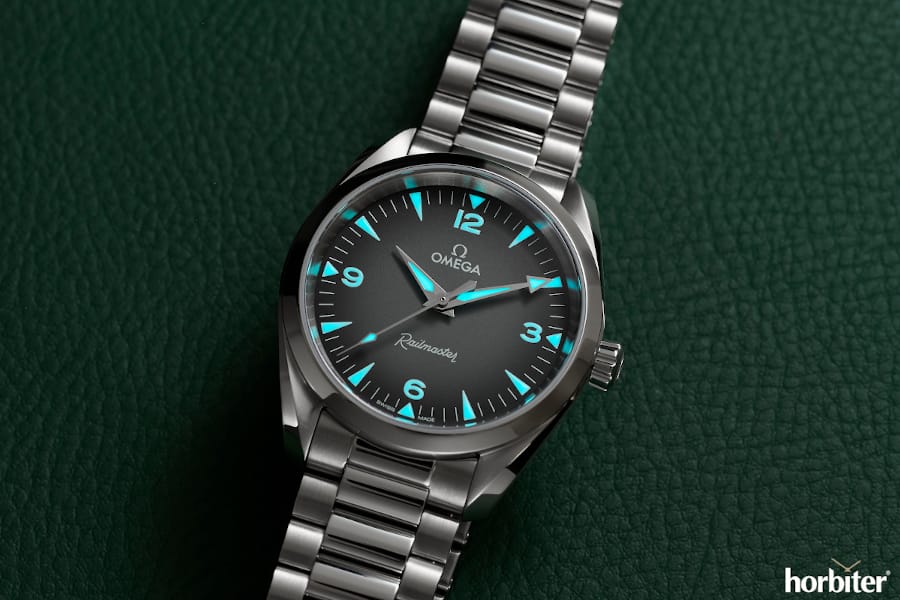
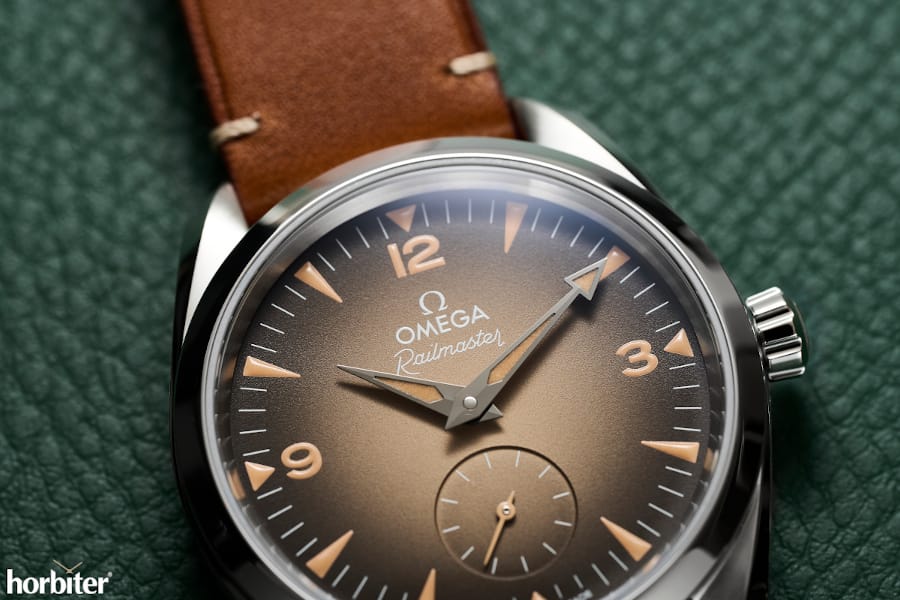
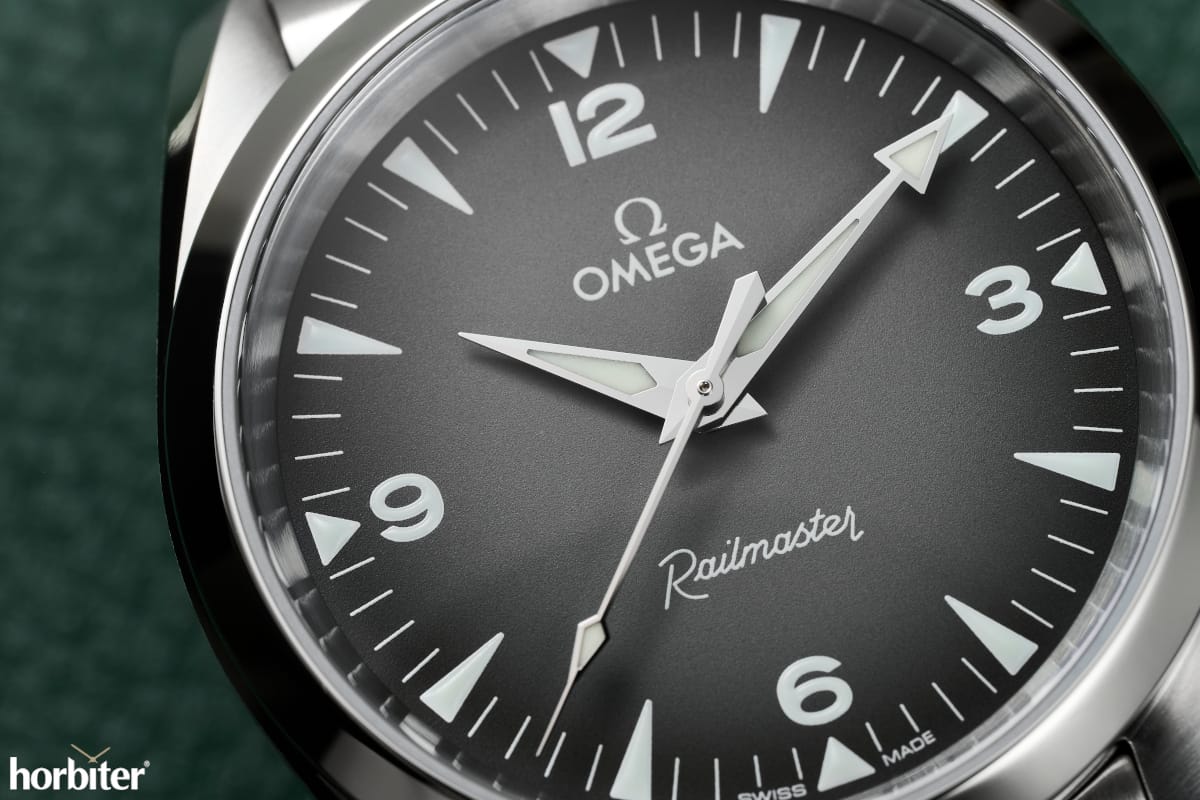
Broad Arrow hands are back in business, as exemplified by the minutes’ hand. Searching for an enhanced “family feeling”, Omega stepped back from the outgoing 40 mm collection.
A sturdy case construction offers do-anything, go-anywhere performance, including a screw-down crown and more than compelling water resistance.
The new Omega Railmaster is water-resistant to 150 meters and comes in each product iteration with a bracelet or a leather strap.
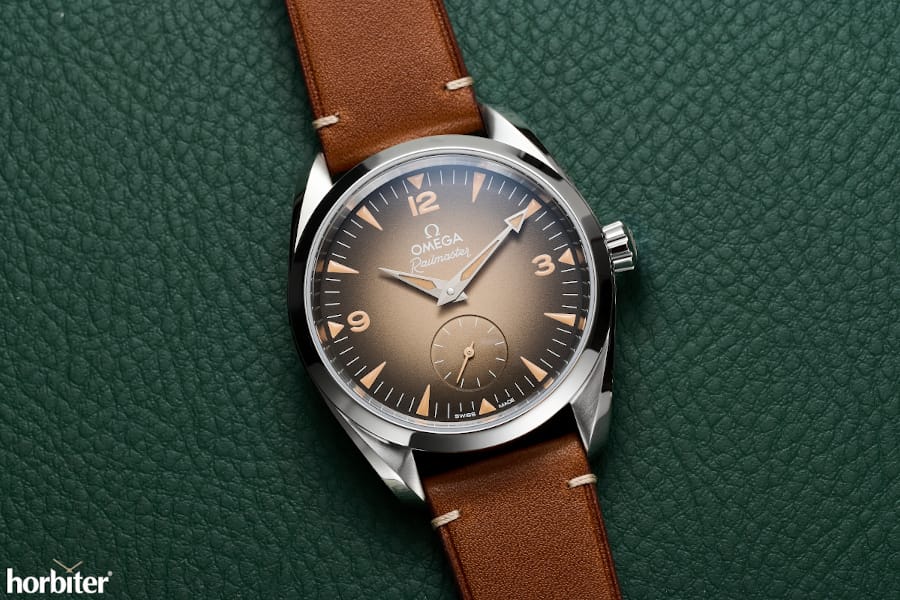
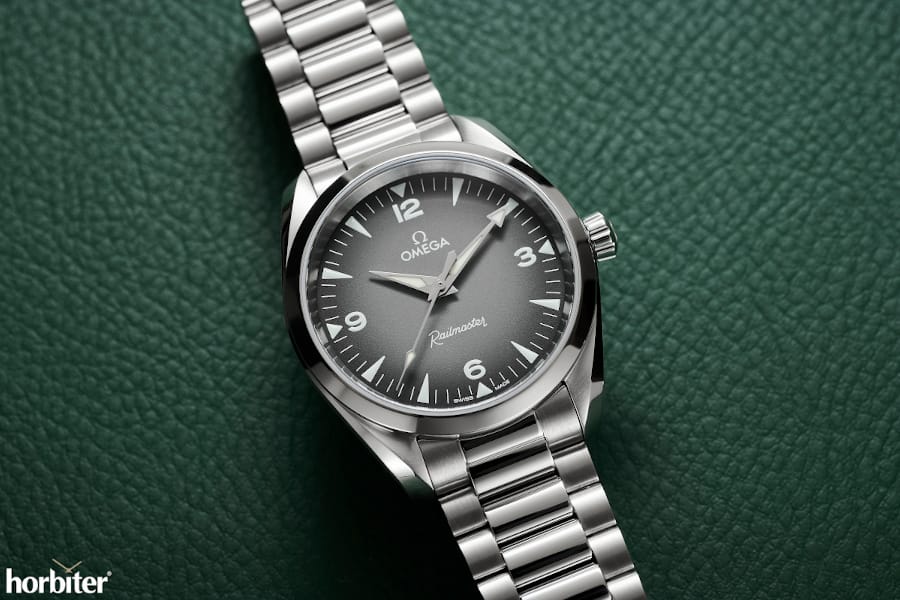
First is a three-link, soft-fitting bracelet with a 2 mm micro-adjustment mechanism on a standard butterfly clasp. Then comes a leather strap featuring Omega’s signature folding clasp.
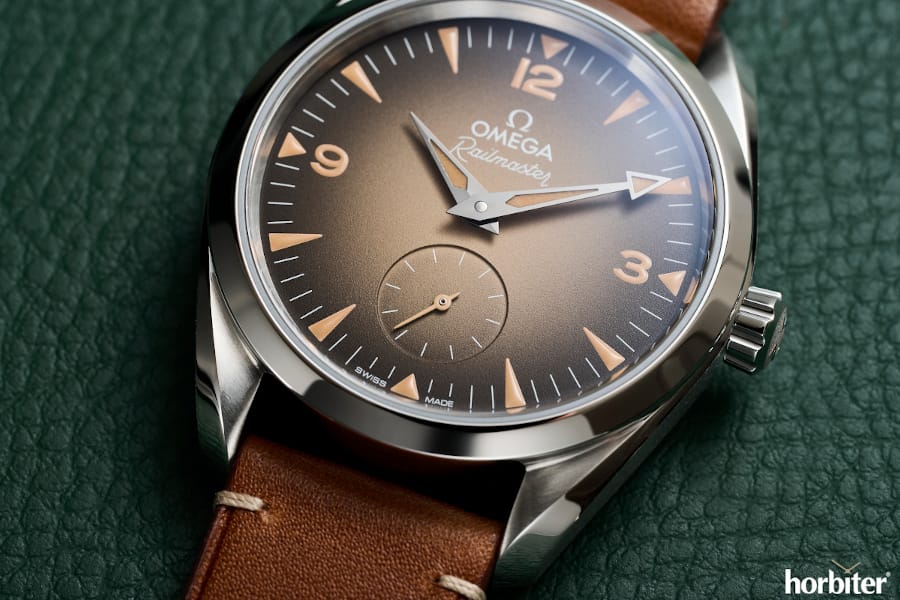
Omega offers two dial options: smoked beige paired with the small seconds complication, and smoked grey on the three-central-hands model instead.
Two technical options
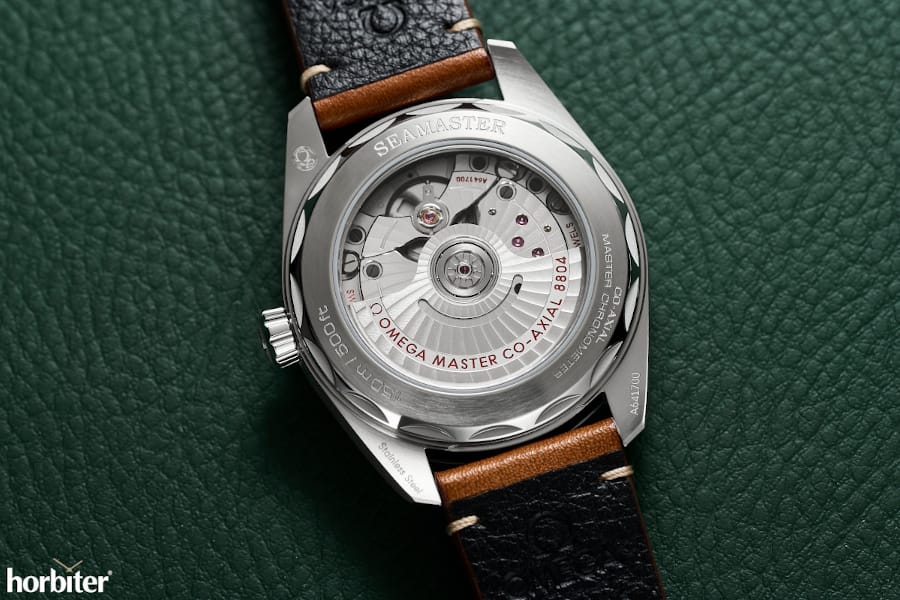
While showcasing slightly different mechanical movements with comparable specifications, they house Master Chronometer-certified calibres 8806 and 8804 (with a small seconds counter), and their exquisite decorations are crafted from an industrially engineered platform. Côtes de Arabesque waves on the rotor and bridges include the balance wheel.
They respectively offer 60 and 55 hours of power reserve when fully wound, via a single barrel. The caseback ring is Omega’s latest-generation design, but it won’t feature a NAIAD lock design, as found on some professional Seamaster diving watches.
Final thoughts
As mentioned, Omega has listed the new Railmaster in its historical collection to highlight the vintage feel. Essentially, it is an Aqua Terra timepiece pimped up with 1957 flair and a smoked dial, no date, and Arabic numerals.
The connection with the Aqua Terra product family is exemplified by the Broad Arrow minute hand, which adds a nostalgic touch, making the slightly complicated model stand out in our opinion.
In comparison, the three-hander lacks identity. Anyone hoping for a straight-lug 1957 reissue, equipped with state-of-the-art Omega technology, will be disappointed. The current proposition is for those seeking a vintage-inspired take on any Aqua Terra.
Listed prices are as follows: the three-hand central model ranges from €5,600 to €6,000, while the slightly more complicated edition ranges from €6,300 to €6,600, available either on a strap or a bracelet.
(Photo credit: Horbiter®)
Giovanni Maria Di Biase @Horbiter®
In this article:
Case
It encases the mechanical movement and is crafted in one or more parts. It can also be a single piece, as with some professional diving watches, or made of unconventional…
Date
It indicates the date of the month. There are different types of display: via a window or a pointer, where an additional hand is usually placed centrally or on a…
Crown
Placed on the case side, it winds the mainspring. When pulled out, it also sets the time and the date. A screw-down crown increases water resistance and protects the movement…
Strap
A leather, rubber or other material band that secures the watch to the wearer's wrist.
Complication
The addition of any mechanical complication to a movement that usually displays the time.
Rotor
Part of an automatic watch that winds the mainspring by constantly rotating. Depending on the watch's winding capability, movement design, and value, it comes in various geometries, sizes, and materials.…
Chronometer
An instrument for measuring time very accurately. For any watch to be called a chronometer, it must meet the standards set by the C.O.S.C. (Contrôle Officiel Suisse des Chronomètres).
Balance wheel
A part of a mechanical watch that oscillates, dividing time into equal portions.
Power Reserve
A mechanical watch feature displays, on the dial or the case back, the remaining power in a watch movement, showing the length of time until the timepiece must be rewound.
Barrel
It is a cylindrical metal box closed by a cover that contains a spiral spring called the mainspring, which provides energy to run the timepiece.