Why is a Datsun 240Z featured in a video produced by a watch-based digital media magazine? The car and the logo etched on the hood and tailgate of that car have a relationship with Seiko that dates back to when Datsun had a significant commercial and sporting success.
Source: Nissan
The 240Z, whose first cars rolled out from the production linein 1969, is a legendary yet affordable sports car that brought Japanese car design and engineering to the headlines as much as Seiko has done in the watchmaking industry, and won multiple global race competitions despite being mainly sold across the US and Japanese markets.
Source: Nissan
Powered by a 2.4-litre inline-six with double Hitachi carburettors, the car won the East African Rally in 1971 and 1973, and finished third in the 1972 Monte Carlo Rally with Rauno Aaltonen and Jean Todt behind the steering wheel.
A race-bred Rally car
In 1971, the car No. 11, driven by Herrmann Edgar and Schuller Hans, won the Safari Rally while proudly bearing a big SEIKO logo. Back then, it marked a partnership whose contemporary watchmaking counterpart is a specific Speedtimer-based collection, which includes a first-ever three-hander and two chronographs, thus reaffirming Seiko’s nod to motorsports racing.
Datsun is no longer in business, but its legacy lives on thanks to the Nissan Z-badged sports cars’ family: most recently, it all began with the 350Z, followed by the 370Z, and the current Z car, whose silhouette is a direct homage to the Fairlady Z, as it was once marketed in Japan.
A special celebration model was unveiled at SEMA 2023
The direct link between the current Z and the original 240Z broke cover at SEMA 2023 as the Nissan Safari Rally Z Tribute prototype.
Source: Nissan
Still, a 240Z has hit the Italian roads after a long journey that began at Datsun’s production facility in Japan and then continued to the United States.
The 240Z wasn’t officially marketed across the European market; however, small lots reached European soil, becoming sought after, as proved by an Italian petrolhead from Turin who imported and wholly restored a first-series 240Z that had been purchased and driven by a Harvard professor, who used it across the US for more than 300,000 miles.
Source: Nissan
Once custom-cleared, it collected multiple accolades at the most prominent “Concours d’Elegance.” Pictured here is likely the most authentic and pristine Datsun 240Z hitting the Italian roads.
Seiko and the Automotive Industry
The Seiko x Datsun collection builds on a marketing strategy to promote the Made in Japan industry; yet, it equally builds on an authentic story to foster Japanese culture, their products, and their unrivaled reliability—values shared by Seiko and the 240Z, which proved unstoppable in the toughest rally competitions and still embodies among vintage sports cars.
Seiko is not new to partnering with the automotive business. For instance, we can’t avoid mentioning its relationship with Honda, and several collaborative watches, such as the Astron GPS Solar Honda NSX Limited Edition, the Honda-e x Seiko Astron, and, more recently, the Seiko Astron x Honda Civic Type R, introduced to celebrate the latest-generation Civic Type R.
While the aforementioned collab projects hint at commercial advertising, what SEIKO x Datsun came out with holds a special place as a more romantic project.
The SEIKO X Datsun Collection
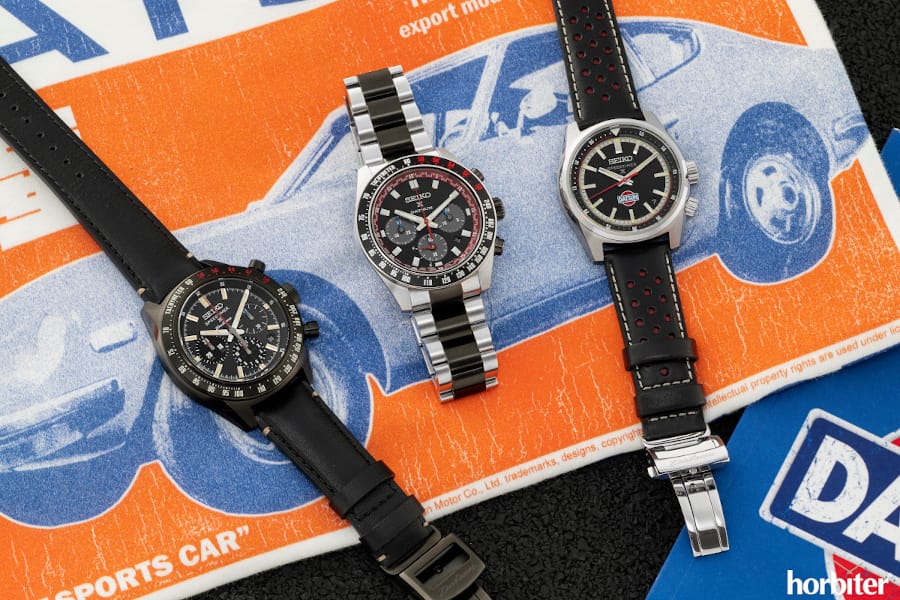
SEIKO brought the Datsun brand to new life with three timepieces that capture different timeframes in the Datsun 240Z’s life cycle by carefully mixing logos, colours, and fonts.
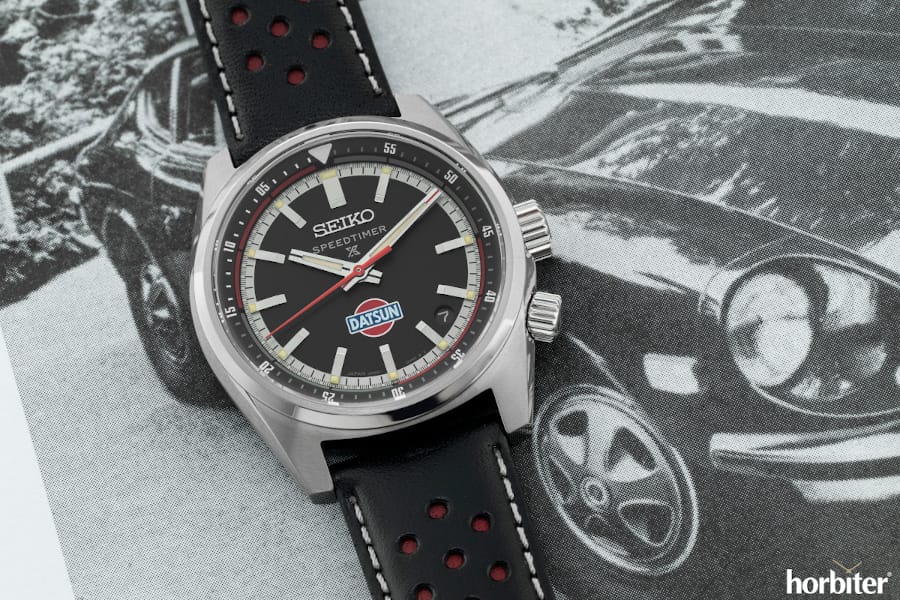
Standing out is, no doubt, the Prospex Speedtimer Mechanical Datsun 240Z Limited Edition, SPB517J1. Featuring time-only and date functions, it comes along with a standard bracelet-equipped option, adding to the current Speedtimer chronograph collection. Instead, the Limited Edition model comes equipped with the same black and red livery as the official Rally car.
Speedtimer time-only: a new addition to the collection
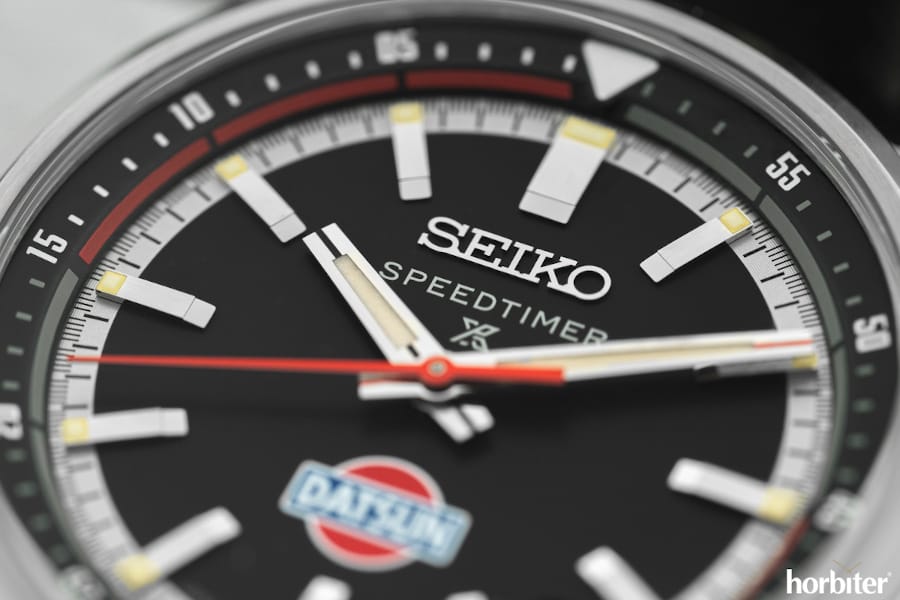
The font on the dial draws inspiration from the 240Z speedometer, and the Datsun logo on it is the original, boldly standing out on both the dial and the case back.
A first-ever in Speedtimer history, it is not a chronograph, unlike the legendary 1969 model. Still, it guarantees top-notch specs, including 200-meter water resistance, an inner rotating bezel with a countdown function, and all the features you would expect from such a commemorative timepiece, such as a leather rally strap with a folding clasp.
The case measures 39.5 mm by 12.0 mm and is treated with a “Super-hard coating” to withstand shocks that ordinary steel cannot.
Seiko’s designers aimed to recreate a nostalgic effect, and they nailed it.
The dial is attractive, as is the Datsun logo, and the outcome is as analogue and mechanical as a 240Z.
From a technical standpoint, sturdiness comes standard with the 6R55 calibre, boasting a three-day power reserve while keeping the price point affordable.
The Automatic Chronograph
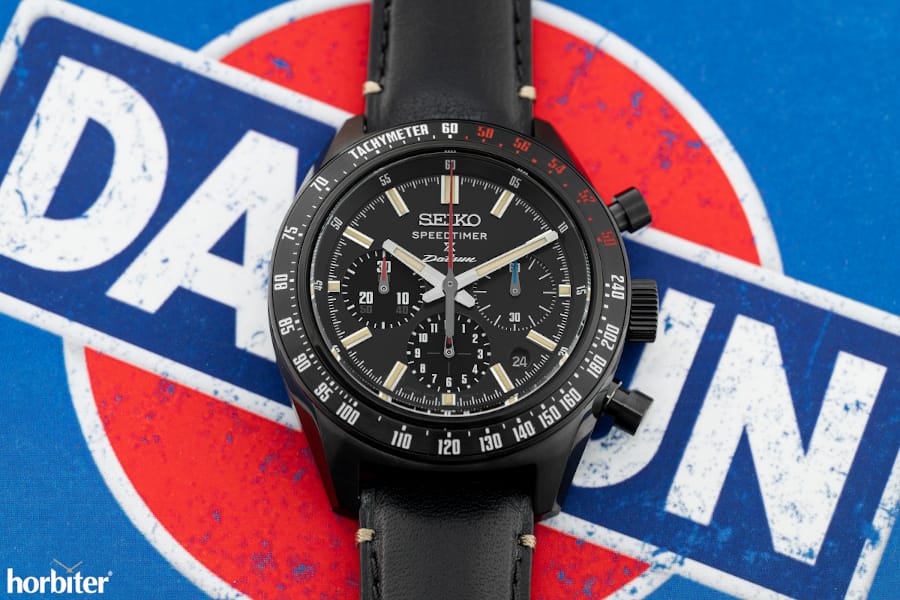
No doubt, the Prospex Speedtimer Mechanical Chronograph Datsun 240Z Limited Edition SRQ057J1 is the most refined model of the Datsun 240Z.
Technically speaking, it is not anything new; it’s a follow-up to a three-register model powered by the 8R48 calibre, equipped with a column wheel and a vertical clutch.
Thus, welcome an excellent self-winding chronograph, measuring 42.0 mm across and 14.6 mm thick, that commands presence on the wrist while offering a sleek design and comfort, thanks to a weight of 127.0 grams, ensured by a matching black leather strap.
On the tachometric scale, you’ll spot red touches between 50 and 60, as a tribute to the 1969 Speedtimer.
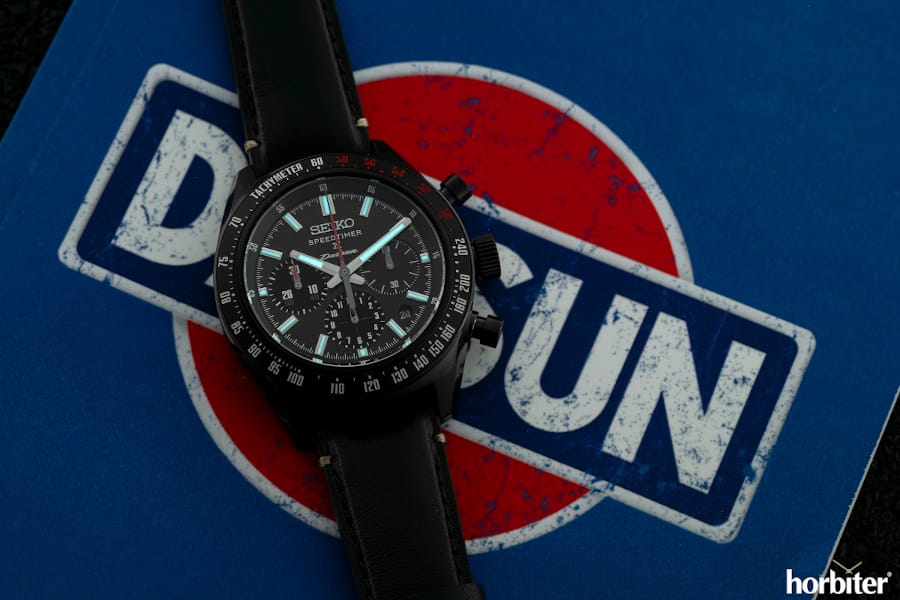
However, the headline news is where the tachy scale is placed, as the designers relocated it from the dial to the outer bezel. Showcasing a monochrome Italic Datsun logo on top and a bold one on the case back, it offers subtle Datsun corporate logo touches on the central hands and registers.
When I first saw it in pictures, I couldn’t avoid comparing this model to a Seiko Ananta ‘Kumadori’Chronograph Limited Edition SRQ015J1, a refined yet misunderstood Seiko chronograph from the Ananta series.
With the new reference, red, blue, and white are carefully applied across the dial, chronograph counters, and bezel, offering a colour combination closer to a contemporary current Nissan Z than a 240Z.
I can’t help but wonder whether it predicts an upcoming collaboration between Seiko and Nissan, rather than celebrating the 240Z.
The quartz chrono
Last but not least is the Seiko Prospex Speedtimer Solar Chronograph Datsun 240Z Limited Edition SSC957J1, the most pragmatic and contemporary proposition on offer.
Measuring smaller than its self-winding counterpart (41.4 x 13.0 mm) while weighing more (164.0 grams), it finalises a 7,000-piece Limited Edition offering.
As mentioned, this edition feels more like a call to the Z Nismo than a 240Z, except for the DATSUN logo, which mimics the 240Z’s badge on the steering wheel, as does the car’s silhouette engraved on the case back.
Final Thoughts
Standing out is the reference SPB517J1. That’s a perfect counterpart to the 240Z, fully embodying its philosophy and style.
It combines all you’ll ask for in a contemporary, well-equipped watch with vintage vibes, packed into a product retailing for €1,250. Hitting the stores as a 2,500-piece limited edition, it targets a niche group of Seiko and Datsun enthusiasts and owners.
Its charm is unquestionable, and I’m sure it will preserve its beauty for decades to come. Nevertheless, I would have gone for a no-X dial design, as it somewhat dilutes an authentic vintage trait.
The SRQ057J1 and SSC957J1 chronographs share a similar V layout, while offering technologies that appeal to different customers.
Again, I can hardly see Datsun in this edition. Yet, accuracy and price point make it a competitive choice: the Seiko Prospex Speedtimer Solar Chronograph Datsun 240Z Limited Edition SSC957J1 comes in 4,000 pieces and is priced at €990.
The mechanical chronograph SRQ057J1 is at the top of the leaderboard, and the tachometric scale, now relocated to the bezel, combines the collection’s DNA with a modern design.
Beautifully finished, it is an excellent automatic chronograph produced in 500 pieces and priced at €3,500.
(Photo credit: Horbiter®)
Gaetano C @Horbiter®
In this article:
Line
It is the measurement unit that identifies the size of a movement. According to this measurement system, one line corresponds to 2,255mm.
Date
It indicates the date of the month. There are different types of display: via a window or a pointer, where an additional hand is usually placed centrally or on a…
Chronograph
Complication that helps the wearer to measure time intervals without affecting the watch's standard time-telling function.
Case back
It can be screwed in, pressure-fastened, or secured to the case via screws. Occasionally, it comes as a single piece, with the case of specific professional diving watches (for example,…
Case
It encases the mechanical movement and is crafted in one or more parts. It can also be a single piece, as with some professional diving watches, or made of unconventional…
Strap
A leather, rubber or other material band that secures the watch to the wearer's wrist.
Bezel
The bezel is particularly useful on diving watches, allowing you to check dive times. In this case, it unidirectionally rotates and usually comes in two parts: a metal (or ceramic,…
Power Reserve
A mechanical watch feature displays, on the dial or the case back, the remaining power in a watch movement, showing the length of time until the timepiece must be rewound.
Calibre
A calibre is the type of watch movement encased in an assigned timepiece. Its name is usually associated with the manufacturer's name and a standard code, e.g., ETA 2824.