A new Richard Mille watch often shakes the industry when it hits the market, given the unique combination of cutting-edge technologies—the most advanced in watchmaking—on offer.
Even more so, considering that an RM 33-03 Automatic doesn’t look quintessentially Richard Mille at first sight, as it adopts a tonneau and circular geometries fusion, introduced with the RM 033 in 2011, followed by the RM 033-2.
The new RM 33-03 replaces and sharpens the outgoing collection, enhancing its look and specs with a fully revised layout, powered by a re-engineered skeletonised movement and topped by design traits that are closer to Richard Mille’s design language than ever before. That said, the first takeaway is that the watch wears thicker than the timepiece it is replacing.
The new RM 33-03 Automatic
Any new RM watch is as intriguing as the specs sheet gets, especially when you’re a seasoned mechanical engineer. Reading through the tech sheet brings back memories of my university education and the old-school technical training I received.
In this regard, Richard Mille is as unique as the materials and technologies derived from aeronautics and motorsports rather than the watchmaking industry.
Carbon TPT (and gold) or grade 5 titanium case
This section is perhaps less attractive here since carbon TPT, the acronym standing for Thin Ply Technology, is a long-established exclusive of Richard Mille.
I can’t forget my first and only business trip to their laboratories to discover the craftsmanship of a TPT-machined case.
On the other hand, a grade 5 titanium caseis always a welcome option. It confirms that titanium remains an excellent proposition, geared towards watch enthusiasts seeking lightness and hypoallergenic properties.
Either way, the watch measures 41.7 mm in diameter and is 9.7 mm thick, proving that the brand’s goal was to maintain a slim profile, which increased by 0.9 mm from one generation to the next.
Despite the increase, the case, whose shape retains a mostly circular silhouette, tapers to fit the wrist effortlessly. Ergonomics and comfort are among the brand’s top traits, along with ultra-high performance that is unmatched in the business.
The Richard Mille RMXP3 calibre
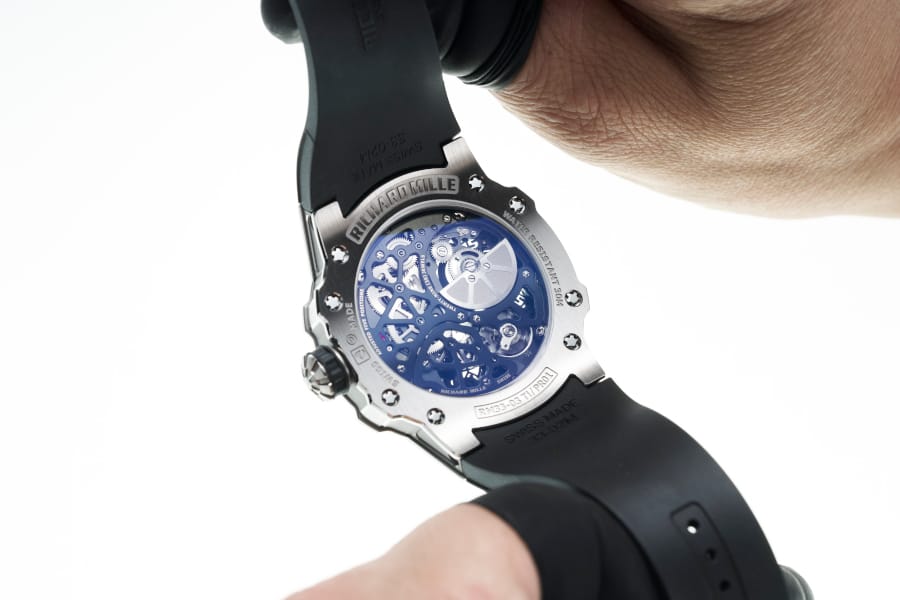
Here is where things start to get serious. A long list of high-tech materials and surface treatments involves the mechanical movement. The Richard Mille RM 33-03 Automatic debuts a new mechanical movement with a thickness of 3.28 mm. I assume that the increase in size aims to enhance the robustness of the RMXP1.
However, add a small running seconds counter at six and a semi-instantaneous two-digit date window at five, and you also understand that the now 3.28 mm thick calibre is not like-for-like with the 2.60 mm thick one it has replaced.
Still, it preserves a platinum micro-rotor, a “mandatory” combination to ensure an efficient winding process. It offers a layout that sets the RM 33-03 apart from most Richard Mille models, bringing it closer to its sports watch siblings in this category.
Although it may not be what we’re used to, it is no less refined. Both options feature a titanium mainplate treated with Titalyt®, an oxidation process we first encountered on a F.P.Journe élégante.
The bridges are also made of titanium, but treated with a black PVD coating. The two-digit date ring sits on the outermost dial section, and they’re arranged to align at five vertically.
No other brand discloses technical details as extensively as Richard Mille does. It’s not just a close call for industry veterans; it indeed confirms that every detail was thoroughly analysed and scrutinised during the design process, reaffirming that you’ll get something unique during your ownership experience.
A new owner embarks on a journey into engineering excellence, accompanied by a wealth of information, including figures, ISO standards checklists, surface treatments, and materials.
For example, the brand discloses the balance wheel’s moment of inertia, its lift angle, and the type of steel used to machine the barrel arbour.
From what I can recall, no other watch brand is so rich in details. The movement runs at 3 Hertz, as you’d expect from any self-winding and micro-rotor powered calibre, and runs for up to 42 hours when fully wound.
Final Thoughts
Again, reviewing a Richard Mille watch is a journey of discovery. The RM 33’s third iteration builds on the previous execution and sets itself once again as a more traditional, less disruptive timepiece than its RM siblings.
I often associate Richard Mille with a tonneau case and specific mechanical complications, but I admit that the RM 33-03 Automatic is more Richard Mille than the model it replaces.
The highly detailed technical specifications caught my attention, including the case set that features rubber inserts instead of an ordinary ring. Still, I was surprised that the overall weight wasn’t disclosed.
The new Richard Mille RM 33-03 Automatic sells for 115,000 CHF in titanium and 145,000 CHF with a TPT carbon and gold case.
(Photo credit: Richard Mille)
Gaetano C @Horbiter®
In this article:
Case
It encases the mechanical movement and is crafted in one or more parts. It can also be a single piece, as with some professional diving watches, or made of unconventional…
Date
It indicates the date of the month. There are different types of display: via a window or a pointer, where an additional hand is usually placed centrally or on a…
Calibre
A calibre is the type of watch movement encased in an assigned timepiece. Its name is usually associated with the manufacturer's name and a standard code, e.g., ETA 2824.
Rotor
Part of an automatic watch that winds the mainspring by constantly rotating. Depending on the watch's winding capability, movement design, and value, it comes in various geometries, sizes, and materials.…
Balance wheel
A part of a mechanical watch that oscillates, dividing time into equal portions.
Barrel
It is a cylindrical metal box closed by a cover that contains a spiral spring called the mainspring, which provides energy to run the timepiece.