Gone are the days when Patek Philippe’s sports watches hit the spot, overshadowing what Patek is renowned for, i.e., mechanical complications. Yours truly, it’s luxury sports watches, Cubitus included, still face scarce availability.
The 2025 new Patek Philippe watches reaffirm what started over five years ago, at least: the brand massively invested in classic watchmaking as much as in innovation, extending the product portfolio like never before.
I think that 2025 marks a baseline for such a roadmap; the product mix has dramatically grown. First, a smaller Cubitus hits the market along with multiple models, where the Grand Complications stand out.
Patek Cubitus 40 mm ref. 7128/1G: Everything works out now.
The 40 mm Cubitus went under the spotlight, answering the call from the brand’s die-hard fans.
I never experienced a Cubitus before. Therefore, Watches and Wonders was my first-ever chance to see the whole collection up close and compare big and small variants, in one go.
My perception is that the original release’s main issue never was about the size; of course, when your wrist is at least 19.5cm, like, you can effortlessly wear a 45mm squared wristwatch.
What I discussed when the watch came out was, and still is, the link between Cubitus and Nautilus, the former feeling like an attempt to mimic and evolve a legendary design into a new direction, setting the expectations too high.
What a 45 mm Cubitus misses is a sleek case-to-calibre size ratio; build quality was not, and still is not, a discussion topic. In contrast, the 40 mm variant is not a “downsizing” per se but evolves the original formula into a more proportioned design.
Either option, white or rose gold, case specs and tapered bracelet build a more compliant and global value proposition.
An exquisite build quality showcasing brushed-to-polished edges makes for a premium luxury sports watch that wears just beautifully.
A Nautilus is unquestionably a legendary timepiece, but a 40mm Cubitus speaks volumes, and the Patek calibre 26-330SC fits in seamlessly compared to a reference 5821/1A-001 instead.
The watch stops at 8.5 mm in thickness, making it slightly thicker than a 5811 and its bigger steel sibling. To my surprise, water resistance stops at 30 meters—a performance you’d expect on a three-hand dress watch, not a sports watch.
Patek Philippe Ref. 5370R Split-Seconds Chronograph Brown Enamel: new dial and Grand Feu
It is the most attractive model Patek Philippe has released. Still, the reference 5370R builds on a well-known design, crafted for the first time with a rose gold case and a two-tone brown and beige option.
Grand Feu enamel pairs with beige “champlevé” on chrono counters and tachometric scale arranged on the outermost part of the dial, featuring a layout where the counters are slightly recessed. In contrast, the tachometric scale is raised instead, to enhance depth.
It replaces the now-discontinued references 5370P-001 and 5370P-011, which outperforms in beauty and appeal.
The rose gold build features matching rose-gold applied Breguet numerals and brown enamel, making it a head turner, although I’m not a fan of the off-centred register layout.
Measuring 41.00 mm across and 13.56 mm in thickness, the 5370R is not small nor light, even on a leather strap, but turns heads thanks to an elaborate case geometry featuring a polished concave bezel, case back, lugs and crown contrasted by a brushed case side.
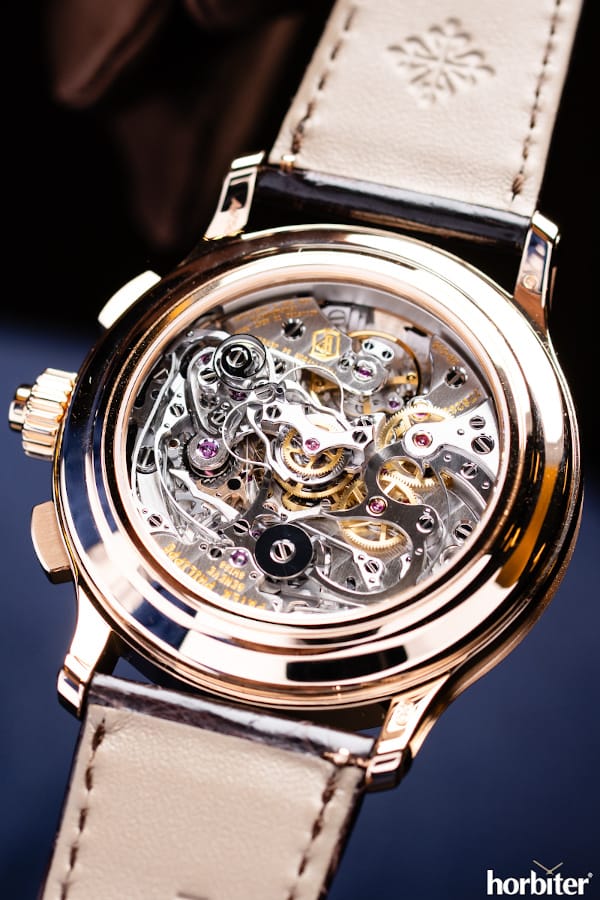
Flip it over and you’ll love watching the hand-wound CHR 29-535 PS calibre equipped with a Breguet balance spring and column wheel visible through the open case back.
It adopts a Gyromax free-sprung balance, which sets itself apart by housing small adjustable masses on the balance wheel in place of traditional screws.
Here is not a super-decorated movement when compared to similar executions like the Split Seconds Chronograph by A. Lange & Söhne, for example, and its price tag is demanding at €300,000. Still, the watch’s appeal is second to none.
Patek Philippe Retrograde Perpetual Calendar Ref. 6159G
A perpetual calendar with retrograde date has been around for nearly a century at Patek Philippe. The new reference 6159G is a revolutionary take on a known template, sourcing inspiration from the Calatrava reference 6119R-001, as the signature Clous de Paris decoration on the bezel and see-through case back proves.
The new Retrograde Perpetual Calendar Ref. 6159G combines historic traits, like a retrograde calendar display, with classic ones from a Calatrava, mixed up with contemporary upgrades in the shape of a smoked grey sapphire crystal, and a leather and fabric strap with a triple folding buckle.
I see too much sportiness in the white stitching on the strap, too bold against the delicate Clous de Paris pattern mid-centre.
By arranging the main info amidst the dial, leap year display at twelve and moon phase one at six included, the watch face adopts a transparent sapphire glass with a grey metallic to black gradient, the lighter mid-section highlighting day and month display alongside a retrograde date ring.
No breaking news here, yet a Patek’s original design with a contemporary twist, following the likes of competing Haute Horlogerie brands whose major complications adopt see-through dials to showcase the underlying mechanisms.
I see some Audemars Piguet Code 11.59 vibes, for example, from a purely aesthetic perspective. Specs-wise, the white gold case measures 39.5 mm in diameter and 11.45 mm in thickness.
Patek’s calibre 26-330 S QR builds on the large-scale central-rotorcalibre 26-330 series introduced in 2019. It powers several Patek timepieces, and includes the annual calendar 26-330 S QA iteration, and my favourite classic perpetual calendar, the In-line one, which I love.
Equipped with a Gyromax balance wheel and Spiromax hairspring, the 26-330 S QR measures 5.36mm in thickness, a slim mechanical movement for such a complication and a central-running rotor. However, it underperforms in efficiency, with a maximum power reserve of 45 hours.
Should you ask me to pick my favourite, I’ll go all-in as said with an in-linecalendar ref. 5236 P-001 with a platinum case and a micro-rotorcalibre, spending around €30,000 more than the €118,799 Patek is asking for the new Retrograde Perpetual Calendar Ref. 6159G.
Patek Philippe Calatrava 8-Day Ref. 5328G: Our Favourite
The new Calatrava 8-Day Ref. 5328G tops our current list. It combines state-of-the-art engineering developed by Patek Philippe’s Advanced Research department with a beautifully designed hand-wound architecture.
Eight days of power reserve are a remarkable achievement for a 41.00 mm large and 10.52 mm thick (white gold) wristwatch and is the pinnacle of a long-standing tradition which kicked off with the ten-day power reserve reference 5100, followed by the superb 5101P Tourbillon and the Gondolo 5200 thereafter.
Nowadays, that Gondolo is off the brand’s catalogue, its name replaced by a women’s model with a square case, but its legacy lives on with the new reference 5328G.
A subdial offset at twelve is counterbalanced by a circular day-of-the-month indicator, with a day-of-the-week window in the middle. Both displays stand out on a textured dial, whose Pantone is a dark shade of pale blue.
Sitting on top are white-gold applied Arabic numerals, filled with plenty of luminescent material, reproducing the Calatrava ref. 5226G‘s. Building upon the sportiest three-hand Calatrava on offer, it improves the 5226G layout.
The Calatrava is a stunningly elegant watch, but it works brilliantly with the most classic references, 6119R and 6119G or the 6196P-001 with a salmon dial introduced this year.
Its sportier take does not; still, the 5328G well exemplifies how to combine classic and sporty touches, thanks to a symmetrical displacement and a pointer date replacing the date window.
I would have slimmed the bezel down, but the outcome is compelling, and the case is enriched with the signature Clous de Paris pattern on its side to enhance its classic and sporty identity further.
A double hand runs on the counter at six, the smaller being the running seconds hand.
An eight-day power reserve brings us to explore the calibre 31-505 8J PS IRM CI J. Behind it is a 4 Hertz manually-wound movement that embodies the very best from Patek.
It comes standard with a Giromax balance, A Spiromax hairspring, and a Pulsomax escapement; here is a complete list of the proprietary components making this 5.05 mm thick calibre a best in class of efficiency, capable of running for 192 hours when fully wound.
As technically refined as it is beautiful to look at, a five-bridge design, topped with extensive Côtes de Genève decoration, offers some Saxon-style vibes, but a much slimmer profile. The Patek Philippe Calatrava 8-Day Ref. 5328G is priced at €71,280.
Patek Philippe Calatrava Pilot Travel Time 5524G-010
Patek’s Dual Time watch gets an update, debuting in white gold with an ivory-treated enamel dial livery. It is the most compliant Travel Time iteration in years.
Pairing a white gold case and an ivory dial with thick applied Arabic numerals with plenty of luminescent material turns it into a kind of luxury exploration watch.
I love the Khaki green Perlon-like strap, making it my favourite over the rose gold options. The Travel Time is all but classy, and the new model is the most compliant to date, as does a 5370R Split-Seconds Chronograph Brown Enamel across its collection.
Operating the watch is easy and convenient, with all the relevant information at a glance. Home and local time hour hands — the first is skeletonised — are overimposed when not travelling across different time zones.
Two pushers on the case’s left side allow the wearer to adjust local time quickly.
The pointer date links to local time, and two tiny holes provide day and night indications for either local or home time. The Calatrava Pilot Travel Time 5524G-010 costs €61,419.
(Photo credit: Horbiter®)
Gaetano C @Horbiter®
In this article:
Case
It encases the mechanical movement and is crafted in one or more parts. It can also be a single piece, as with some professional diving watches, or made of unconventional…
Calibre
A calibre is the type of watch movement encased in an assigned timepiece. Its name is usually associated with the manufacturer's name and a standard code, e.g., ETA 2824.
Strap
A leather, rubber or other material band that secures the watch to the wearer's wrist.
Crown
Placed on the case side, it winds the mainspring. When pulled out, it also sets the time and the date. A screw-down crown increases water resistance and protects the movement…
Case back
It can be screwed in, pressure-fastened, or secured to the case via screws. Occasionally, it comes as a single piece, with the case of specific professional diving watches (for example,…
Bezel
The bezel is particularly useful on diving watches, allowing you to check dive times. In this case, it unidirectionally rotates and usually comes in two parts: a metal (or ceramic,…
Balance wheel
A part of a mechanical watch that oscillates, dividing time into equal portions.
Chronograph
Complication that helps the wearer to measure time intervals without affecting the watch's standard time-telling function.
Perpetual Calendar
The perpetual calendar is a complication that adjusts the watch's calendar for varying months and leap years. This cycle will end in 2100, and the wearer should apply the first manual correction.
Date
It indicates the date of the month. There are different types of display: via a window or a pointer, where an additional hand is usually placed centrally or on a…
Calendar
A feature that shows the day of the month and, in some cases, the day of the week. Some calendar watches show the date on sub-dials, while others display the…
Rotor
Part of an automatic watch that winds the mainspring by constantly rotating. Depending on the watch's winding capability, movement design, and value, it comes in various geometries, sizes, and materials.…
Line
It is the measurement unit that identifies the size of a movement. According to this measurement system, one line corresponds to 2,255mm.
Power Reserve
A mechanical watch feature displays, on the dial or the case back, the remaining power in a watch movement, showing the length of time until the timepiece must be rewound.
Complication
The addition of any mechanical complication to a movement that usually displays the time.