The Portugieser is the 2024 IWC new watches collection under the Loupe at Watches and Wonders. Self-winding-only time and chronograph models, which cover the brand’s most significant sales volumes, get several aesthetic and technical updates. The high-end complicated models starring the new Eternal Perpetual Calendar are topping those above.
IWC Portugieser Automatic
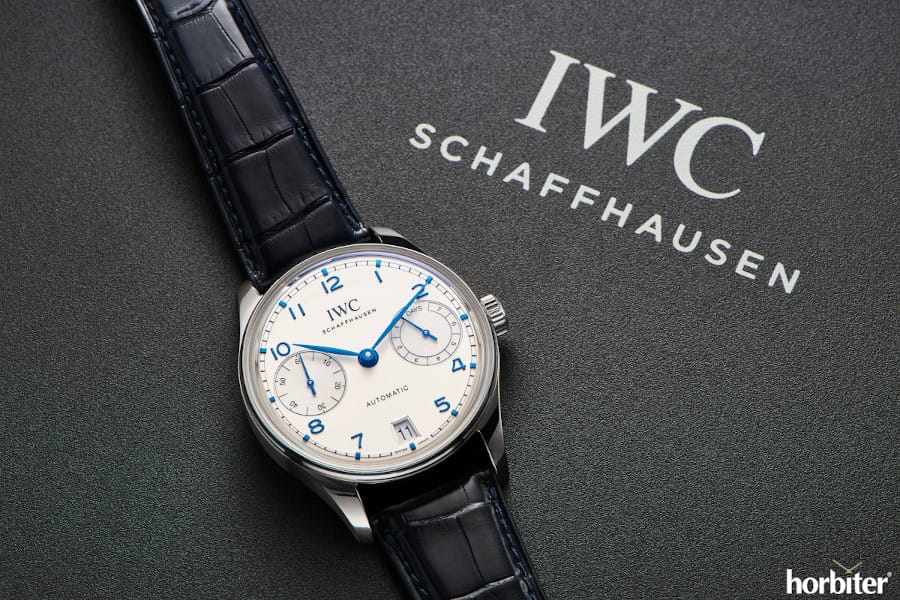
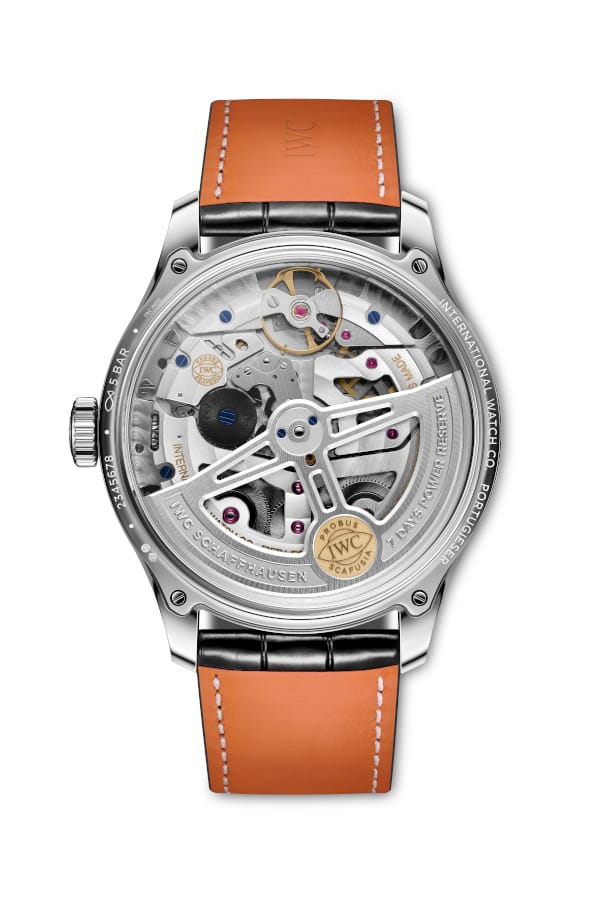
The new models, which come in 42 mm or 40 mm sizes, are different from each other. The 42 mm model is the venerable two-register timepiece housing the 4 Hertz calibre 52011, which boasts a 7-day power reserve when fully wound.
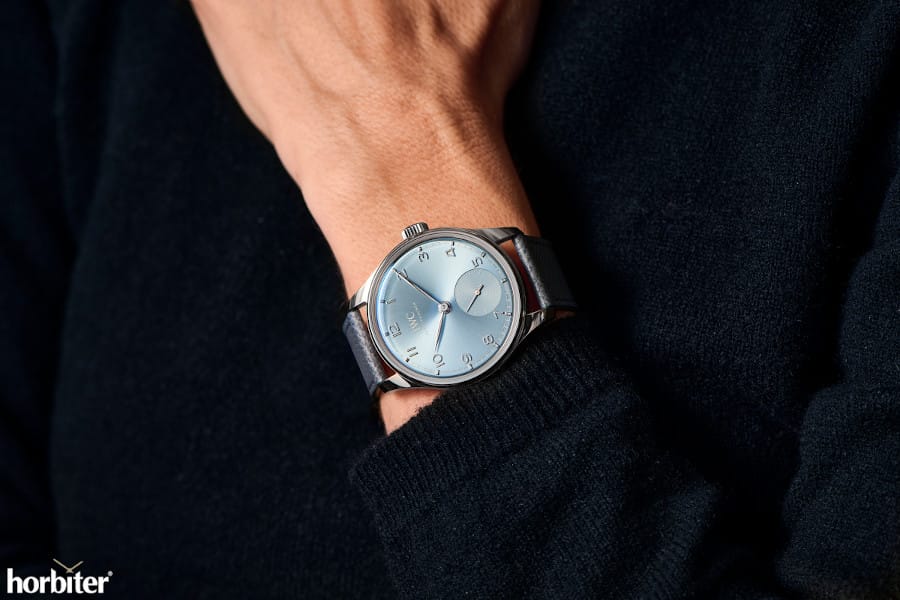
A 40 mm Portugieser, housing the running seconds at six, is powered by the latest 82200 calibre, with a 60-hour power reserve.
A refreshed Portugieser Automatic 42 mm
The 42-mil Portugieser’s appearance is a brand’s favourite. The exact layout also appeared on a few Big Pilot’s Watch special editions. Here is a rare mixture of elegance, boldness, class, and a long-established popular model. Knoop’s creative team thus upgraded a winner by fine-tuning some traits to make it more refined than ever before.
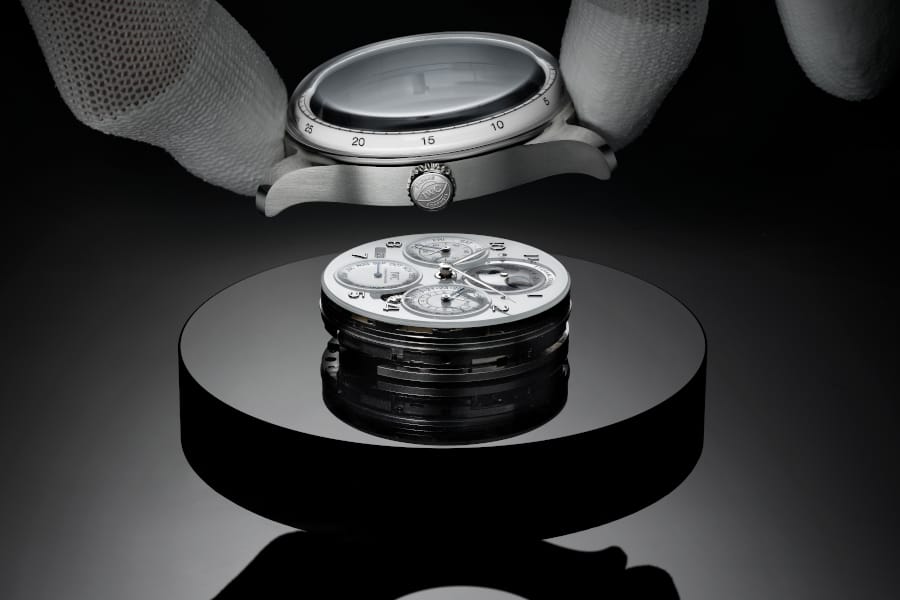
The case is now more slender and houses a double sapphire glass box to make the dial look wider. The fonts underwent a slight redesign, too. It is hard to pick all the subtle changes between old and new models, yet the whole package feels more compelling than before. On top of that, extraordinary new dials hit the spot and work as a collection refresher.
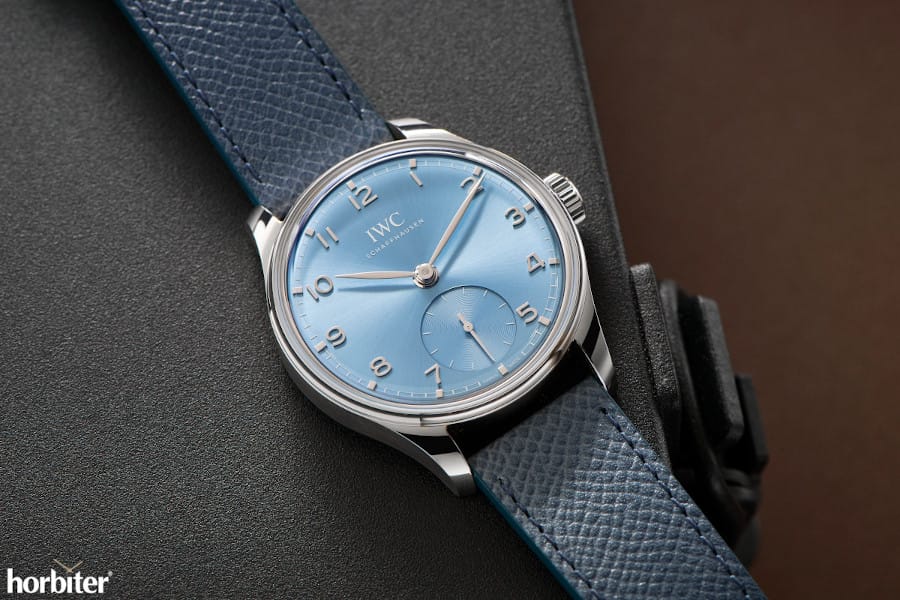
Please welcome Horizon Blue, Obsidian, and Dune.
The production process starts with a sunburst or matt-finished base, then treated with 15 layers of transparent lacquer.
The new Horizon Blue is the most beautiful; you will not find anything as attractive on any classic IWC watch. We also love the Sand treatment for its classy sophistication. While Horizon Blue and Sand have a steel case, Obsidian Black is exclusively associated with the red gold case.
A third option is a lacquered midnight-blue dial paired with the Portugieser Automatic 42, equipped with a steel bracelet for the first time. This range extender is a clever proposition since it allows the watch to become a steel sports watch, which you might opt for only with a Portugieser Chronograph.
The refreshed Portugieser Automatic Chronograph
As with its self-winding siblings, the Portugieser Chronograph needs no introduction or change. And no upgrades, too. The watch community has loved the Chronograph since it first appeared in 1998.
We hope a new split-second Portugieser is down the finish line, but that is a different story. The family feeling also applies to the Chronograph, meaning the same new dial options apply to the Chronograph, where the counters are milled into the dial after the 15 layers have been previously applied.
IWC Portugieser Eternal Calendar
The perpetual calendar is synonymous with IWC. Finding another Swiss brand offering the same impressive range of perpetual calendars among premium watch brands is hard. There is also an Aquatimer professional diving watch with a perpetual calendar.
What stops a current perpetual calendar from being indeed perpetual is the need to carry out a manual correction as you cross the year 2100, where the 4-year leap year cycle stops. Here is where IWC engineers worked hard and have ended up fixing this old-gone issue.
When turning from one century to another, only those years you can divide by 4 are leap years. This means that a wearer shall adjust the date to 2100, 2200, and 2300, hence three manual corrections over 400 years, from 2000 to 2400.
Given that no one of us has to ever worry about, this constraint has always represented a technical challenge for a movement defined as “perpetual”.
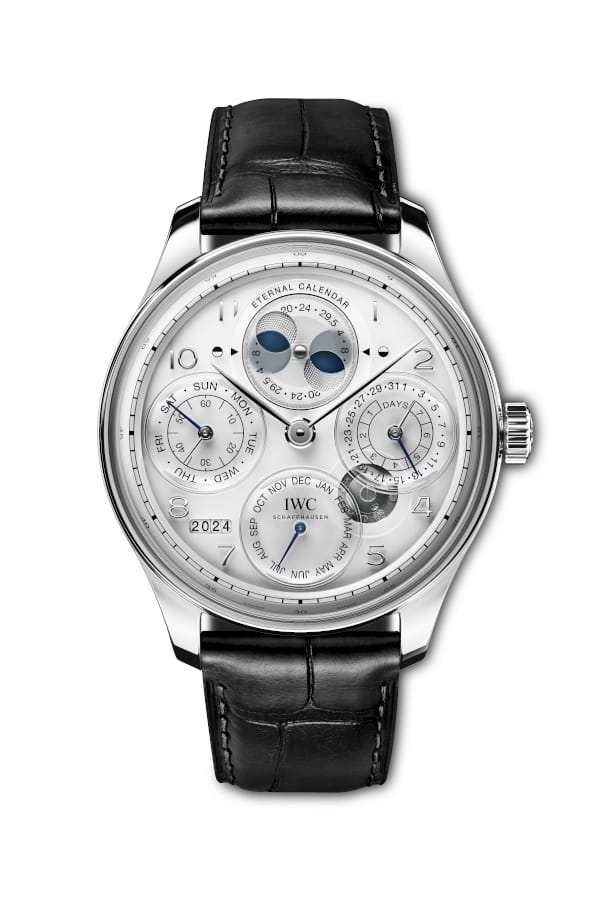
The new Perpetual Eternal Calendar only requires manual correction in the year 3999 and does it solely because we will not know if the year 4000 will be a leap year.
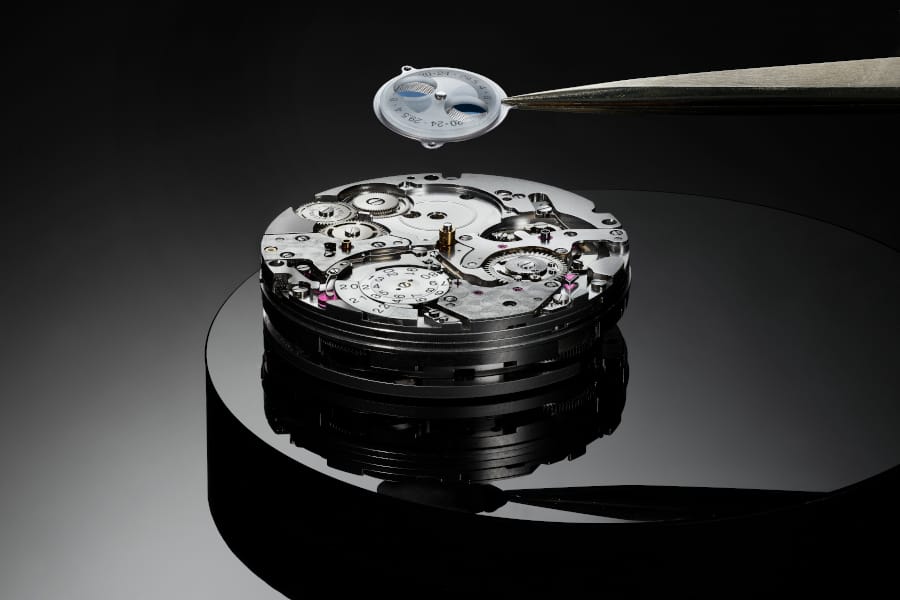
The new calibre comes standard with all the features we love about IWC’s perpetual calendar, like the crown-operated setting and adjustment. To make things work perpetually, the engineer added, in brief, a module which, every four years, tells the calendar’s mechanism whether a new year is leap one or not.
A 45-million-year-long accurate moon phase
If you think the magic is over, sit down and listen. We are all aware that a lunation deviates from any standard 30-day cycle, thus lasting 29 days, 12 hours, 44 minutes and 2.8 seconds. The most accurate moon phase display complication accounts for one day every 577.5 years.
Based on advanced computer simulations, the new moon phase display ensures a one-day deviation every 45 million years. The new IWC Portugieser Eternal Calendar, running as always for seven days when wound, is 44.4 mm across and 15.0 mm in thickness and debuts a renewed, slightly curved dial and glass box.
(Photo credit: Horbiter®, IWC)
Giovanni DI Biase @Horbiter®
In this article:
Perpetual Calendar
The perpetual calendar is a complication that adjusts the watch's calendar for varying months and leap years. This cycle will end in 2100, and the wearer should apply the first manual correction.
Chronograph
Complication that helps the wearer to measure time intervals without affecting the watch's standard time-telling function.
Calendar
A feature that shows the day of the month and, in some cases, the day of the week. Some calendar watches show the date on sub-dials, while others display the…
Power Reserve
A mechanical watch feature displays, on the dial or the case back, the remaining power in a watch movement, showing the length of time until the timepiece must be rewound.
Calibre
A calibre is the type of watch movement encased in an assigned timepiece. Its name is usually associated with the manufacturer's name and a standard code, e.g., ETA 2824.
Case
It encases the mechanical movement and is crafted in one or more parts. It can also be a single piece, as with some professional diving watches, or made of unconventional…
Line
It is the measurement unit that identifies the size of a movement. According to this measurement system, one line corresponds to 2,255mm.
Date
It indicates the date of the month. There are different types of display: via a window or a pointer, where an additional hand is usually placed centrally or on a…
Module
It is an additional part of the base movement through which one or more complications can be added.
Crown
Placed on the case side, it winds the mainspring. When pulled out, it also sets the time and the date. A screw-down crown increases water resistance and protects the movement…
Complication
The addition of any mechanical complication to a movement that usually displays the time.