The Lange Zeitwerk’s forerunner dates back to 1841. Back then, there were no wristwatches, and the art of time measurement had a different meaning. The original Zeitwerk was a big five-minute interval clock installed at the Semper Opera theatre in Dresden, assigned to Johann Christian Friedrich Gutkaes. The master watchmaker was asked to design a digital clock that anyone in the audience could easily read at a glance, especially those sitting in the background. The task required Mr Gutkaes to involve a brilliant watchmaker: Ferdinand Adolph Lange.
In 2009, the Saxon Haute Horlogerie atelier introduced Zeitwerk, the historical legacy of the original project and a source of inspiration to many independent watchmakers’ machines so far. The digital time display is as intuitive as it is hard to conceive and realize, even more so when it comes to “Haute Horlogerie” and technical layout, given all the constraints and requirements found on a wristwatch.
In contrast, digital time displays are intuitive, sleek and pretty attractive. Thirteen years in the making, A.Lange & Söhne is now introducing a significant upgrade whose specifications tell much more than the collection’s style might suggest.
Upgraded calibre (and an additional function)
The new Lange Zeitwerk’s case is slightly thinner than the now-old one; it still measures 41.9 mm across but comes at 12,22 instead of 12,60 mm. It proves engineers worked hard to downsize the biggest “three hands” timepiece from Lange as much as possible. From a technical perspective, the headline news is that the L043.6 calibre offers twice as much power reserve as the old one: from 36 to 72 hours.
It comes paired with the brand’s patented constant energy release mechanism, whose most demanding task is to manage the requested amount of energy (whose peak occurs when all the discs change altogether). There also comes a new double-spring barrel capable of storing the power for twice as many cycles as before. Quite an achievement indeed.
The new timepiece now houses the push-button-activated hour change introduced with the Zeitwerk Date, ensuring quick hour change without affecting time measurement. Once in action, the push button triggers a clutch to disengage the hour disc from the measurement’s mechanism.
Size matters in gear train design; the tens and minute discs are 19,0 and 12,7 millimetres in diameter, respectively. What is impressive is that both discs are just 0,2 mm from each other, thus requiring extreme engineering and highly skilled hands to make all the assembly work; that’s something we were lucky enough to experience during our visit to the manufacturer, where a young yet very experienced team of Saxon looks after the entire Zeitwerk’s production cycle.
You won’t find any significant esthetic changes, including the type and amount of finishes, plenty visible through the case back’s sapphire crystal. In brief, Glashütte ribbons are paired with gold chatons, and the engravings on the balance wheel’s bridge and the escapement bridge are nothing short of extraordinary. The icing on the cake, the swan neck regulating mechanism, is a feast for the eyes of the most demanding watch connoisseur.
Final thoughts
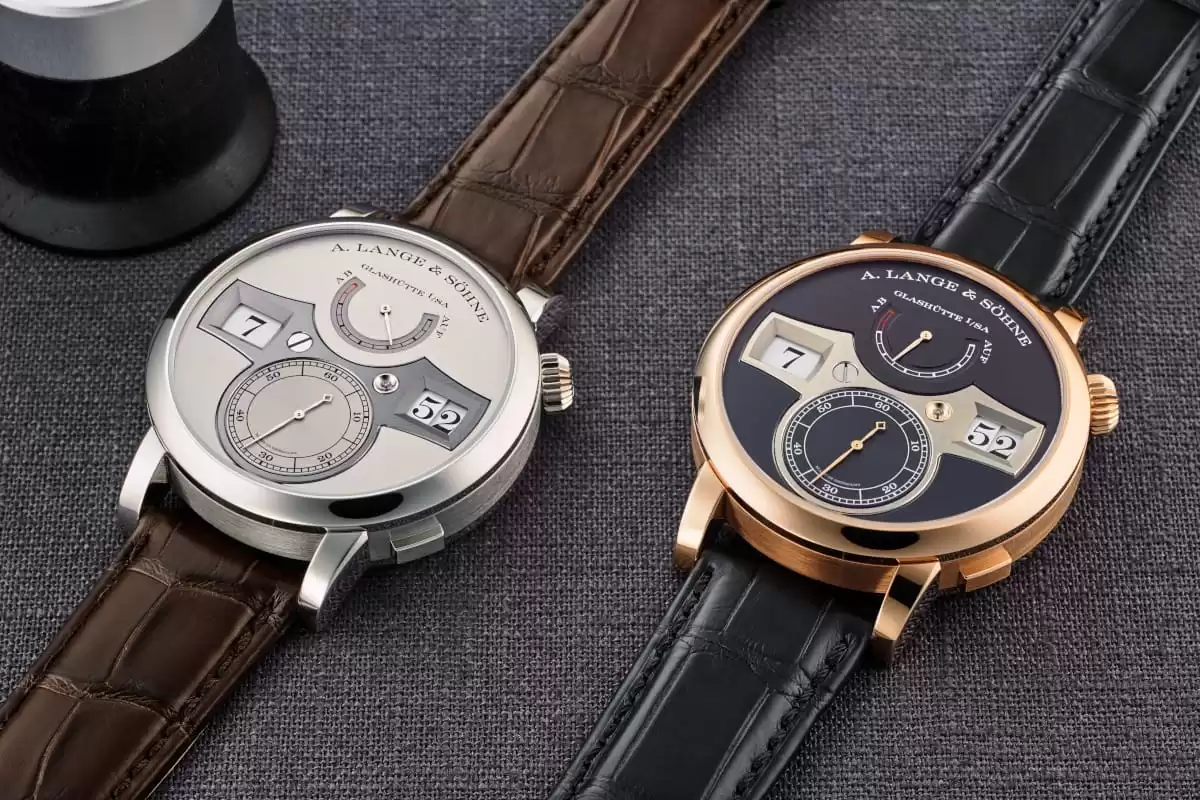
The new A. Lange & Söhne Zeitwerk comes in two options, one in platinum and one in rose gold. They share the same silver dial with different finishes: rhodium-plated on the platinum model and black on the pink gold Zeitwerk. Let’s expect the waiting list to grow as soon as the new timepieces are available; the Zeitwerk is among the brand’s most wanted watches, and this one is the entry model too.
Lange has barely upgraded the style, which stands the test of time as no other timepieces can, while technically upgrading the watch as much as possible and updating the size, which still is a deal breaker for most enthusiasts Zeitwerk lovers alike. Here is where we believe the design team might keep working moving forward to extend such an original formula to an even wider audience.
(Photo credit: A.Lange & Söhne)
Editorial team @Horbiter®
In this article:
Power Reserve
A mechanical watch feature displays, on the dial or the case back, the remaining power in a watch movement, showing the length of time until the timepiece must be rewound.
Case
It encases the mechanical movement and is crafted in one or more parts. It can also be a single piece, as with some professional diving watches, or made of unconventional…
Calibre
A calibre is the type of watch movement encased in an assigned timepiece. Its name is usually associated with the manufacturer's name and a standard code, e.g., ETA 2824.
Barrel
It is a cylindrical metal box closed by a cover that contains a spiral spring called the mainspring, which provides energy to run the timepiece.
Date
It indicates the date of the month. There are different types of display: via a window or a pointer, where an additional hand is usually placed centrally or on a…
Case back
It can be screwed in, pressure-fastened, or secured to the case via screws. Occasionally, it comes as a single piece, with the case of specific professional diving watches (for example,…
Balance wheel
A part of a mechanical watch that oscillates, dividing time into equal portions.