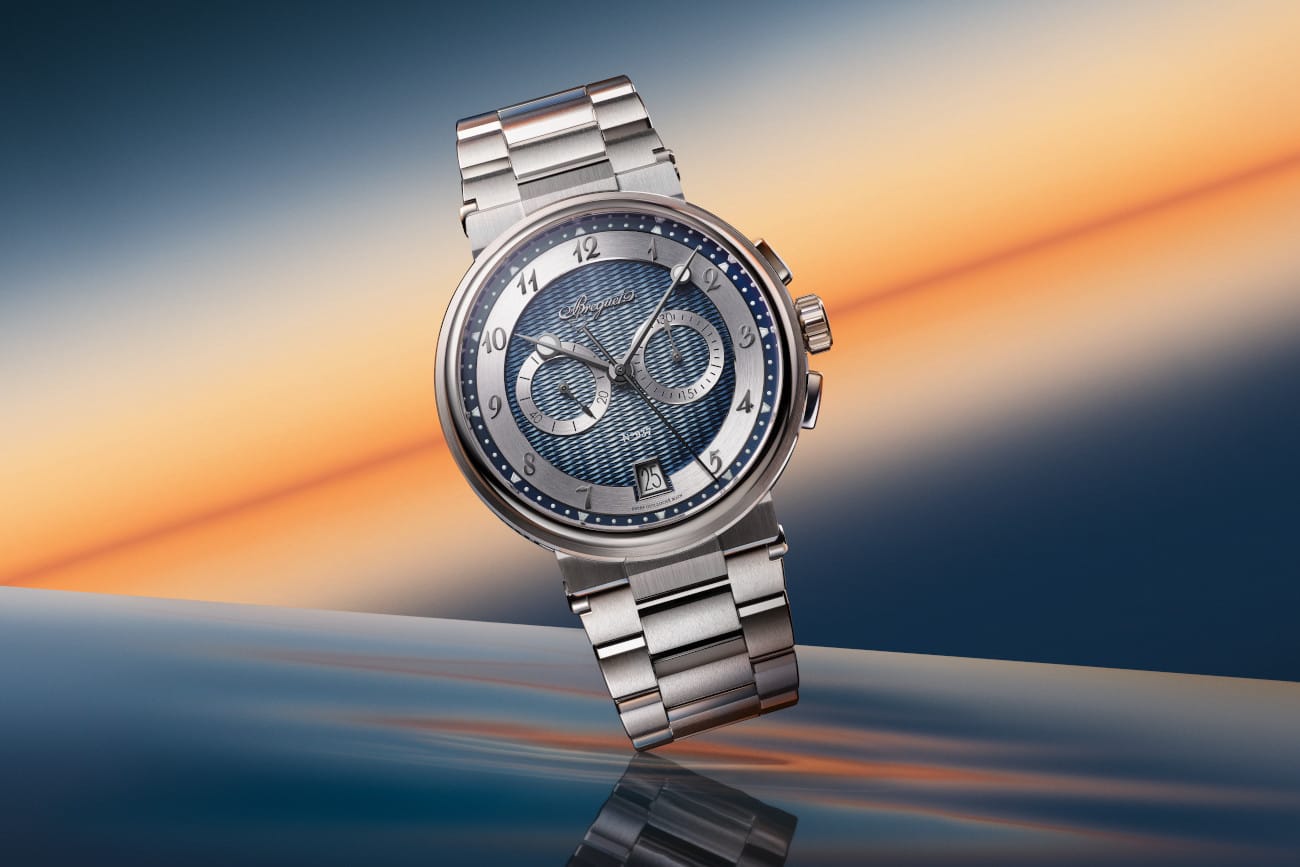
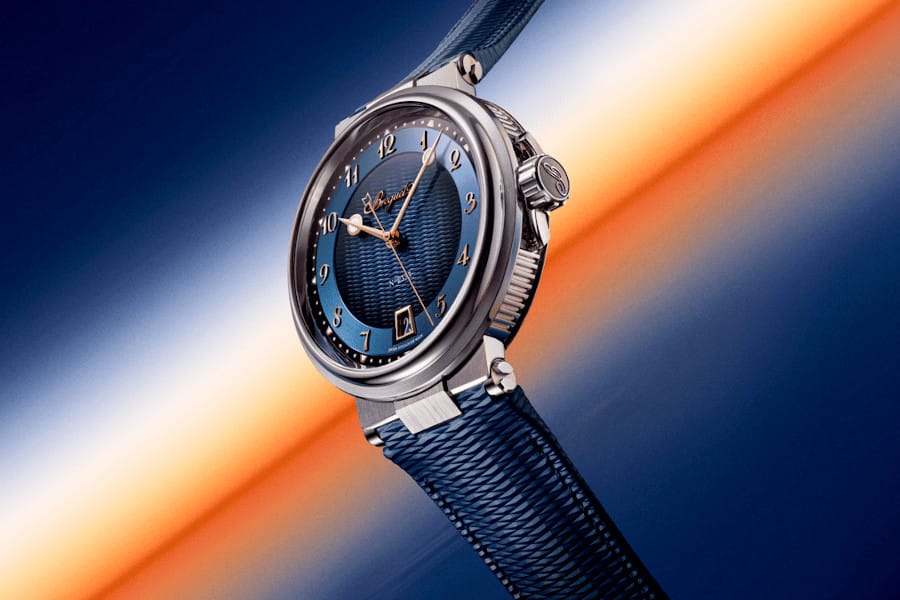
Breguet has taken an unexpected turn with its Marine collection, reworking the time-only and chronograph models in the design idiom that has already transformed the brand’s classic watches.
Rather than a revolution, this is what I’d call a “model-year refresh”: new decorative touches that add refinement and update the collection’s identity.
The changes span the Marine 5517 and Marine Chronographe 5527, from their entry-level models to their more opulent gold counterparts.
Titanium, guilloché and Arabic numerals
Both refreshed lines share several design cues. The dial’s centre debuts the “Quai de l’Horloge” pattern, a hallmark of Breguet’s 250thanniversary, joined by applied gold Arabic numerals that replace the latest Marine generation’s broad, imposing Roman numerals.
The guilloché adds decorative depth to a watch that straddles classical elegance and sporting style; rooted in Breguet’s decorative tradition, the process involves a treated gold base finished with a lacquer layer in the chosen shade.
Applied gold numerals sit on the dial’s outer ring, keeping the hours and minutes easy to read. In contrast, the applied gold “Breguet” signature sits within the central section and the date aperture at six o’clock bridges the two.
Completing the new Marine’s dial are luminescent“pomme” hour and minute hands, matching luminous triangular markers around the outermost ring, and a central seconds hand tipped with a nautical-style B.
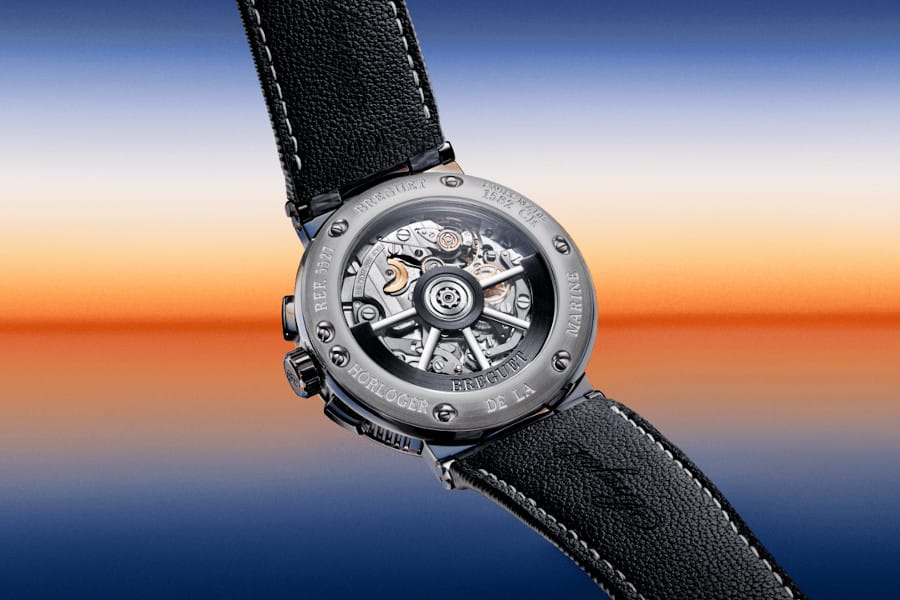
One welcome addition is the new rubber strap’s design and, more notably, its textured outer surface, which echoes the dial’s “Quai de l’Horloge” pattern; the caseback retains its current construction, with a ring framing the sapphire window through which the movement and its openworked, ship’s-wheel rotor can be admired, a motif repeated on the strap’s clasp.
As we’ll see, Breguet’s design choices across the two families deserve a closer look; taken together, they offer plenty of talking points and, to my mind, hint at the thinking behind some very deliberate product decisions.
Breguet Marine 5517
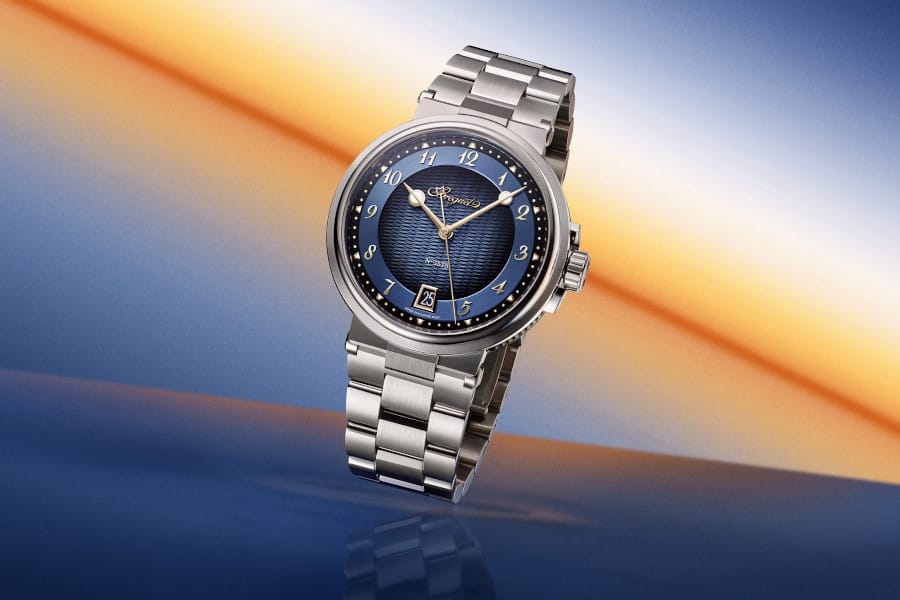
Mechanically, this is the closest to the existing 5517. Breguet’s self-winding calibre 777A remains untouched, but the entry-level Marine 5517 now comes in titanium, on either a strap or a bracelet.
Measuring 40.0 mm across and 11.5 mm thick, the Marine’s coin-edge case isn’t ultra-thin, but titanium’s substantial weight savings fundamentally change the 5517’s wearing experience.
That choice will be especially welcome on the bracelet model, whose all-steel sibling can be prohibitively heavy.
With no quick-release system available, you cannot easily swap between strap and bracelet.
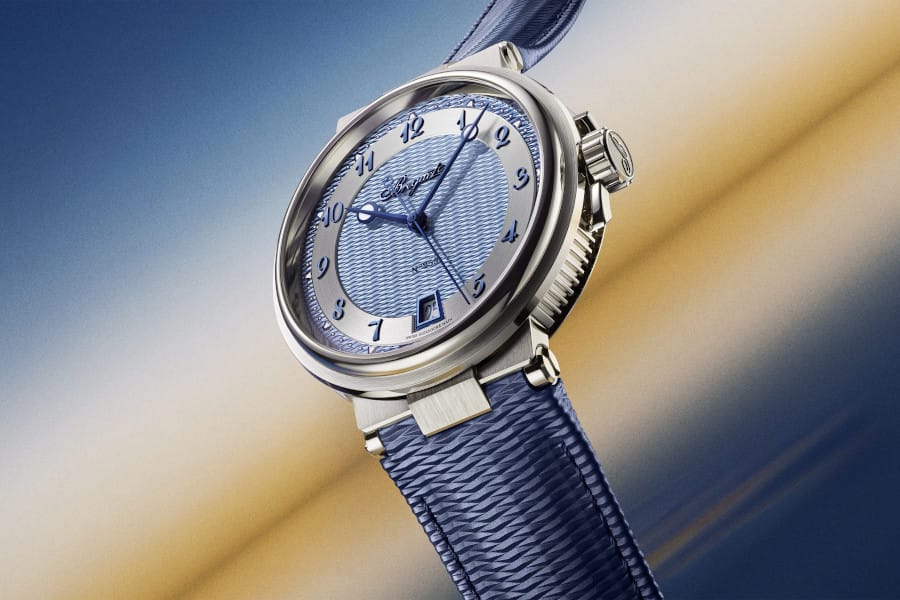
Sitting above the titanium model are two precious-metal options: 18-carat white gold with an ice-blue dial, and 18-carat rose gold with a black lacquered dial.
For me, the white gold version stands out in the new line-up; the screw-down crown and 100-metre water resistance also offer real versatility for everyday wear.
Breguet Marine Chronographe 5527
The Marine Chronographe follows a similar approach, with one notable departure from the existing 5527.
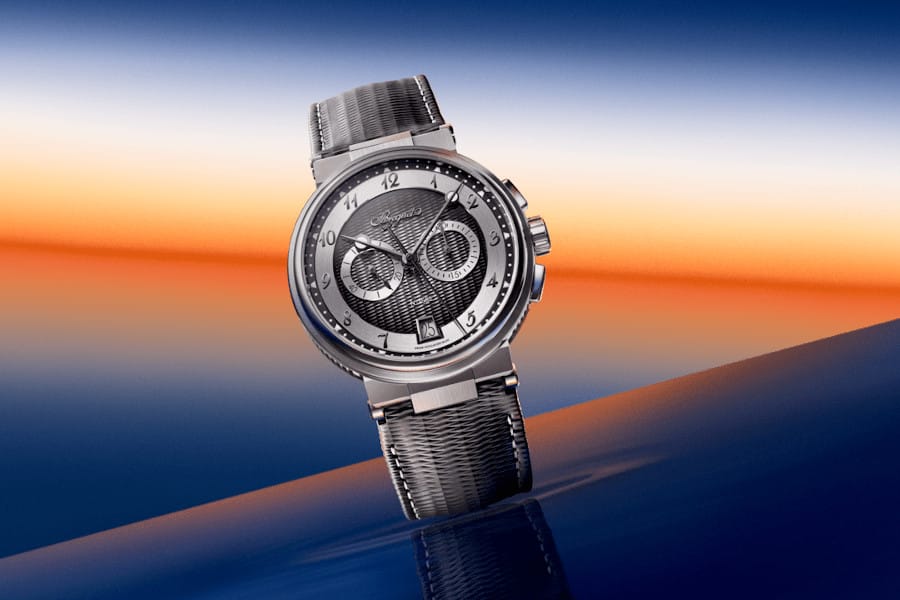
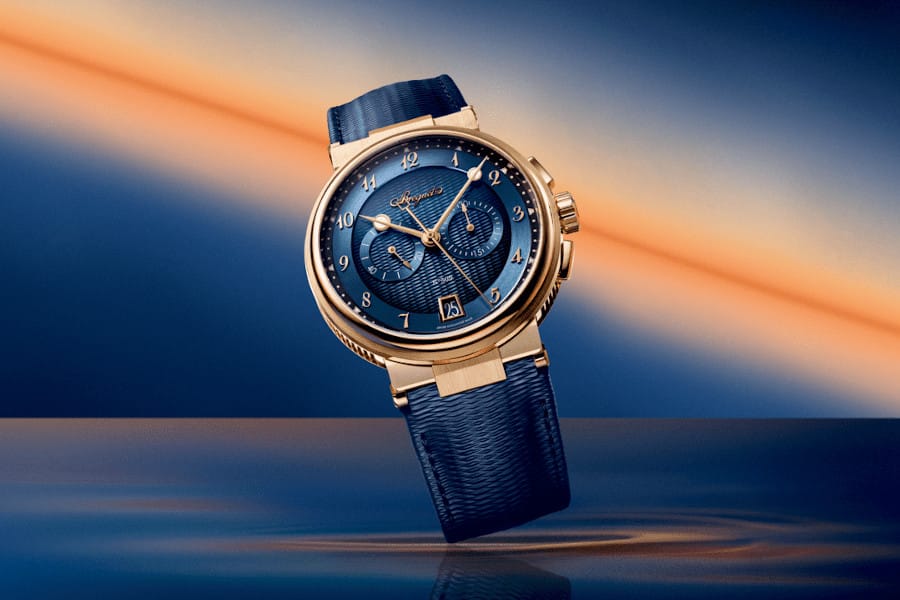
Breguet’s base calibre 582 QA is unchanged, but the dial loses its 12-hour chronograph register—another change that, in my view, works particularly well.
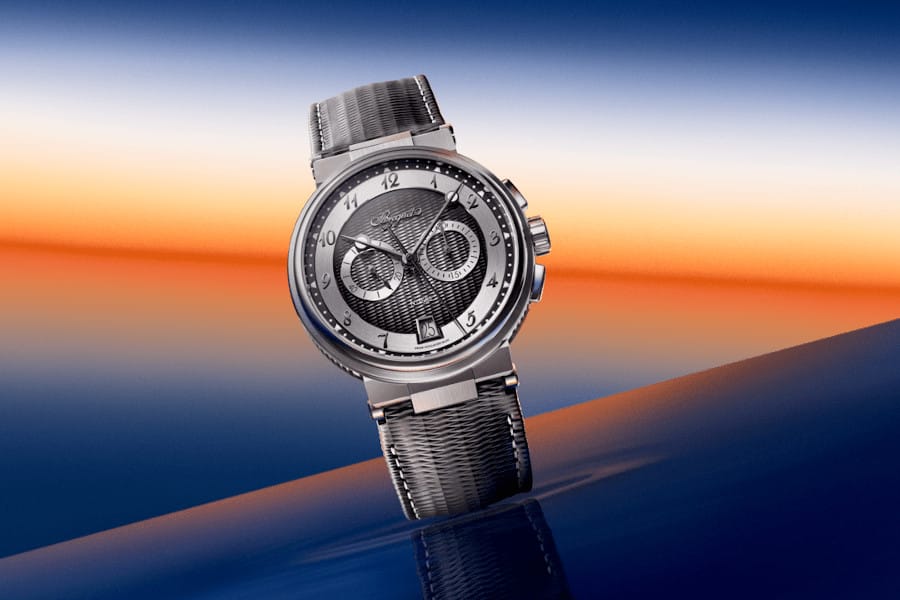
The refreshed Marine Chronographe 5527’s perfectly symmetrical bi-compax layout is cleaner and more pleasing than its three-register predecessor’s, while also sitting more comfortably alongside the three-hand range.
Here, too, the choice is titanium, white gold or rose gold. The white gold model takes its cue from its three-hand sibling, though its dial darkens towards the perimeter and its applied Arabic numerals are grey rather than blue.
Rose gold, meanwhile, is paired with a blue dial—a well-judged colour pairing with an established following in this category of gold-cased sports watches on bracelets.
The self-winding calibre also offers flyback functionality, a feature worth highlighting.
Both gold versions have considerable appeal, but they are undeniably bulky; at 42.3 mm across and 13.9 mm thick, the case makes a spectacular impression, particularly in white gold, though I would regard a strap as essential here to minimise the overall heft.
As noted earlier, Breguet also offers the chronograph in titanium, this time with a grey palette: a gradient treatment at the dial’s centre and a matt grey matching strap.
Based on the press photographs, it looks rather subdued next to the other variants—and the titanium 5517.
Prices and first thoughts
This far-reaching redesign achieves its aim: softening the current Marine generation’s visual heft and giving the collection a new allure.
Titanium, which may not be the only long-term option, makes both the 5517 and 5527 immediately more wearable and compelling.
Ice blue—one of watchmaking’s current colour trends—adds a fresh dimension to the range, and I feel the white gold versions of both references capture the collection’s character most convincingly.
Taken as a whole, the new Marine models champion classical design and fine craftsmanship, bringing the strengths of Breguet’s more traditional collections into the sports-watch arena; that combination gives them a distinctive position among their peers.
The two movements, however, are technically outdated: neither their beat rates nor their power reserves sets them apart in this competitive field.
As for prices, entry into the new Breguet Marine range starts at €23,800 for the titanium model on a rubber strap, rising to €27,000 on a bracelet.
In either white or rose gold, prices start at €44,000 on a strap and rise to €72,300 on a bracelet. The Marine Chronographe 5527 starts at €29,800 in titanium on a strap, or €33,000 on a bracelet. Whether in white or rose gold, the chronograph costs €53,600 on a strap and €84,600 on a bracelet.
(Photo credit: Breguet)
In this article:
Chronograph
Complication that helps the wearer to measure time intervals without affecting the watch's standard time-telling function.
Date
It indicates the date of the month. There are different types of display: via a window or a pointer, where an additional hand is usually placed centrally or on a…
Strap
A leather, rubber or other material band that secures the watch to the wearer's wrist.
Rotor
Part of an automatic watch that winds the mainspring by constantly rotating. Depending on the watch's winding capability, movement design, and value, it comes in various geometries, sizes, and materials.…
Calibre
A calibre is the type of watch movement encased in an assigned timepiece. Its name is usually associated with the manufacturer's name and a standard code, e.g., ETA 2824.
Case
It encases the mechanical movement and is crafted in one or more parts. It can also be a single piece, as with some professional diving watches, or made of unconventional…
Line
It is the measurement unit that identifies the size of a movement. According to this measurement system, one line corresponds to 2,255mm.
Crown
Placed on the case side, it winds the mainspring. When pulled out, it also sets the time and the date. A screw-down crown increases water resistance and protects the movement…