The H. Moser & Cie. Heritage Dual Time watch hands-on
Giovanni Di Biase6 October 2021
0 Comments
With the Streamliner in the headlines, either with the Perpetual Calendar or the one-off Cylindrical Tourbillon for Only Watch 2021, H. Moser & Cie. takes us on a journey through pure classicism and legacy with the new Heritage Dual Time.
The timepiece, whose embargo ends today, minds the gap between base Heritage and Haute Horlogerie specialities like the perpetual calendar and the Tourbillon.
As recently exemplified by the Streamliner, the new H. Moser & Cie. Heritage Dual Time debuts a technical upgrade and dial colour combo, which is exclusive to this model.
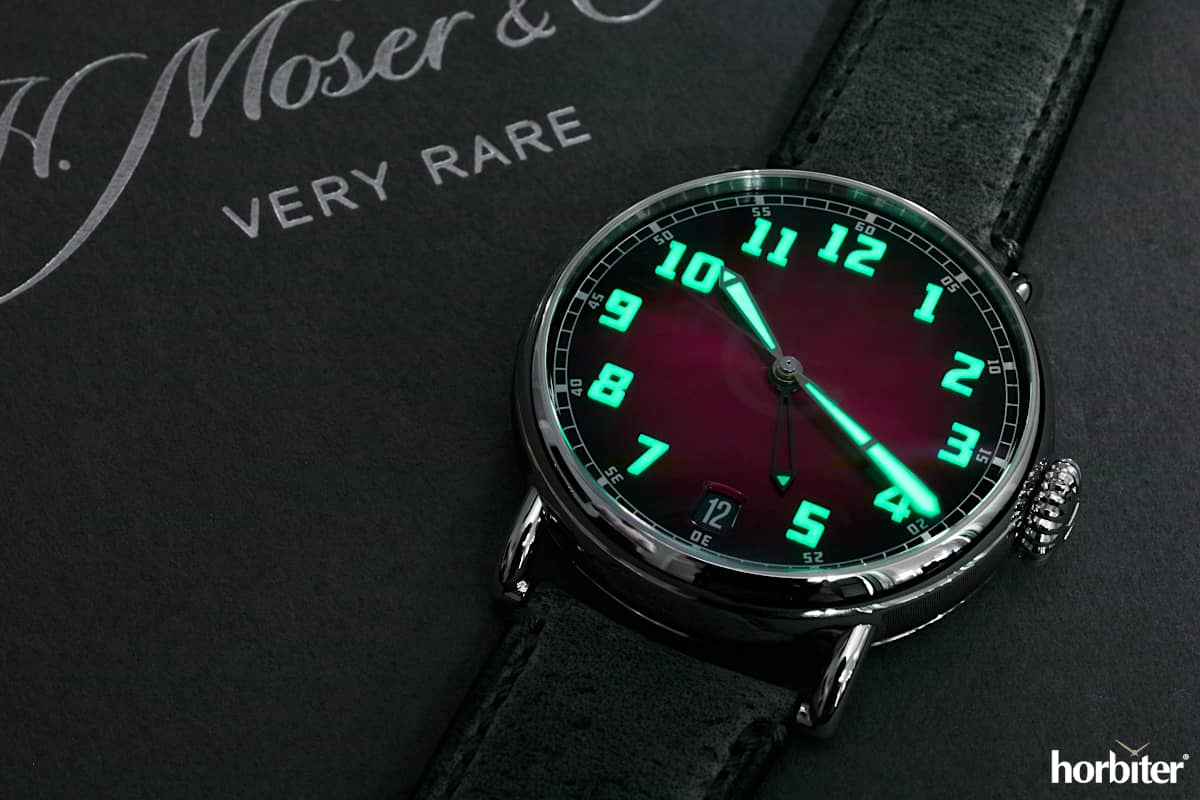
With introducing a two-time zonecomplication, the H. Moser & Cie. Heritage Dual Time also debuts the sunray-patterned burgundy smoked dial on a Heritage, thus extending this template, long-established on an Endeavour or a Pioneer, and promotes Moser‘s family feeling across different collections.
The Heritage is an ode to traditional watchmaking, and the storytelling is pocket-watch inspiration out of a three-hander whose technical equipment and size couldn’t be more contemporary, Dual Timecomplication included.
The case is 42 mm across, which looks outrageous at first sight on a timepiece this classic and refined, but the H. Moser & Cie. Heritage Dual Time is just 11.6 mm thick, and the lugs are so thin and curved they feel like wire lugs and therefore shorten the lug-to-lug distance to such an extent that the Dual Time wears and feels smaller than expected. Remove the large Arabic numerals for a while, and it looks like a slightly beefy 40 mm watch.
Interestingly, Moser empowered its most classic platform with the most innovative esthetic feat; here is where Globolight® is at its full potential, thanks to a bold font out of three-dimensional outsized Arabic numerals, which turns the Dual Time into kind of a vintage aviator watch whose lume performance is impressive. The watch comes standard with Moser‘s hallmark kudu leather strap; its softness is legendary.
The new model also debuts the new H. Moser & Cie. “secret” logo, hence an ultra-thin layer of translucent enamel deposited on the dial. With this one being my second experience in a row, I confirm I’ll go hands down for the old white italic logo.
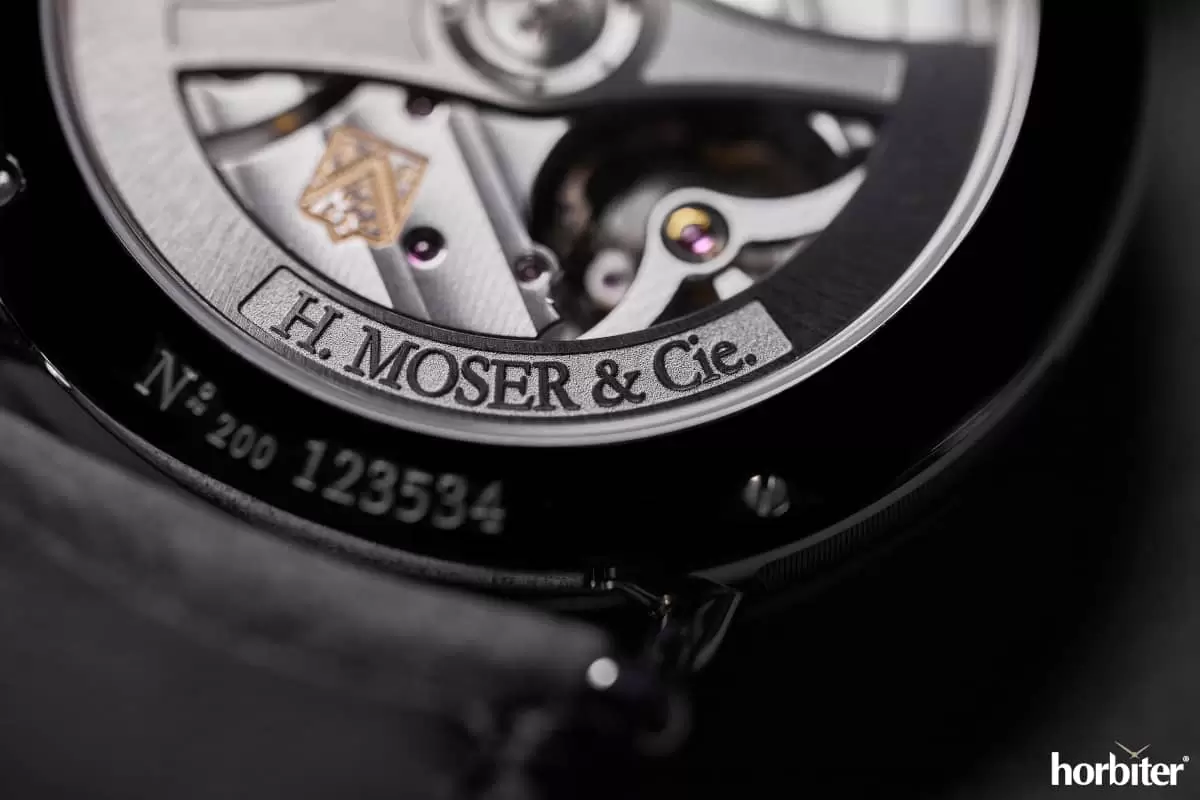
From a technical perspective, the H. Moser & Cie. Heritage Dual Time adopts the new HMC 809calibre. You can clearly set the Dual Time hand to hide it beneath the hour hand if you’re not travelling, but it is nonetheless subtle if you have the two times display engaged, too.
The additional hour hand is so skeletonized that you can hardly spot it against the burgundy dial, and the only chance to perceive it is when in dark or dim light conditions; the plain tip end comes with an arrow-shaped spot filled with Super–Luminova®.
The Calibre 809 is a Calibre 200‘s technical evolution capable of a three-day power reserve (when fully-wound) and a bi-directional pawl winding system.
Kudos to H. Moser & Cie. designers and engineers on how they effectively master every new timepiece, making it stand out even when they belong to the same collection and share the base layout.
In this regard, their mastery is legendary when two options adopt the same mechanical movement, too, as exemplified by the Pioneer Perpetual Calendar Blue Vs its Burgundy sibling.
To sum things up, the H. Moser & Cie.Heritage Dual Time adds to a successful collection, and the smoked burgundy dial is a stunner alongside such a practical and straightforward complication.
It retails for 20,900 Euros, a fair price point considering the exclusivity and craftsmanship each Moser is known for; yet we can’t deny it’s a 50% price increase over its standard two hands counterpart whose execution, let apart from the mechanical complication (which includes the date), is as refined.
(Photo credit: Horbiter®)
Gaetano C @Horbiter®
In this article:
Perpetual Calendar
The perpetual calendar is a complication that adjusts the watch's calendar for varying months and leap years. This cycle will end in 2100, and the wearer should apply the first manual correction.
Calendar
A feature that shows the day of the month and, in some cases, the day of the week. Some calendar watches show the date on sub-dials, while others display the…
Time zone
Time zones refer to the twenty-four regions of the globe. Milan, Rome or Naples will indicate our time zone here in Italy.
Complication
The addition of any mechanical complication to a movement that usually displays the time.
Case
It encases the mechanical movement and is crafted in one or more parts. It can also be a single piece, as with some professional diving watches, or made of unconventional…
Strap
A leather, rubber or other material band that secures the watch to the wearer's wrist.
Calibre
A calibre is the type of watch movement encased in an assigned timepiece. Its name is usually associated with the manufacturer's name and a standard code, e.g., ETA 2824.
Power Reserve
A mechanical watch feature displays, on the dial or the case back, the remaining power in a watch movement, showing the length of time until the timepiece must be rewound.
Date
It indicates the date of the month. There are different types of display: via a window or a pointer, where an additional hand is usually placed centrally or on a…