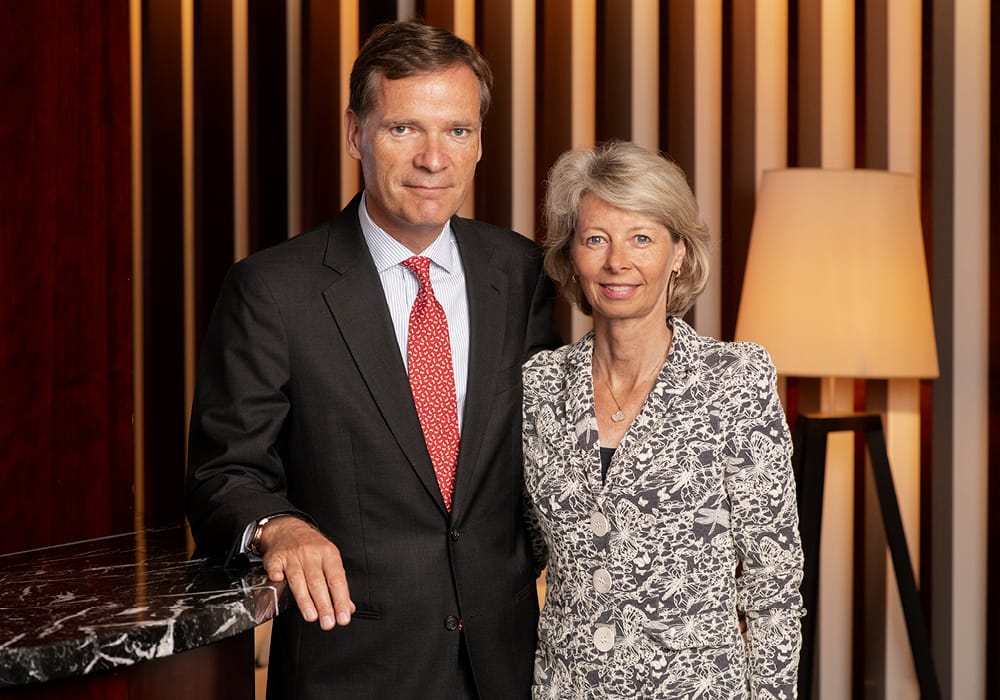
Frederique Constant turned thirty-five in 2023, and during this brief yet busy time frame, its workshops have released at least 30 new calibres, which looks impressive and accounts for approximately one new calibre per year. When Peter and Aletta Stas founded Frederique Constant’s brand in 1988, they aimed to revolutionize the watchmaking industry by offering accessible Swiss Made luxury watches without giving up on finishes and mechanical complications, representing, along with timing performance, the industry’s foundations.
The brand belongs today to the Citizen Group, and its top management works unstoppably to evolve the original vision, i.e., to keep offering the most affordable luxury watch, yet with a different, more aspirational “tone of voice”.
The thirty-fifth anniversary is celebrated with the classic complication par excellence, the tourbillon, whose popularity has grown in recent years thanks to the brand’s proposition, too, despite not being the most complex engineered ever.
The 2008 Classic Tourbillon Perpetual Calendar Manufacture, for instance, is a technical-aesthetic marvel proving this vertically-integrated manufacturer’s capabilities have no constraints; the brand’s modular approach at creating mechanical complications, currently adopted by many premium brands, too, offers plenty of advantages which include an accessible price list, top-notch quality and reasonable service costs.
The Design
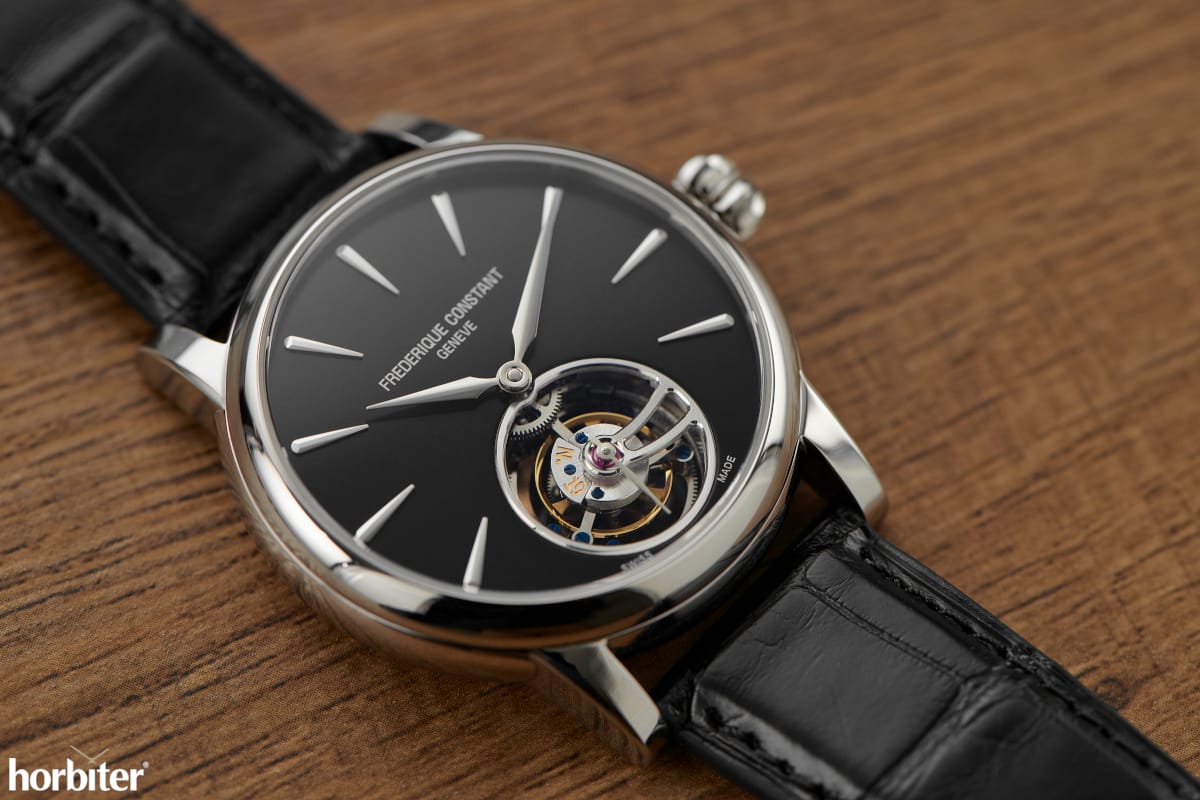
The savoir-faire is best exemplified on classic timepieces, and the Classic Manufacture is, therefore, the platform chosen to introduce a more simplified and refined style, which still adopts a three-part round case with an equally rounded case profile, with the signature onion-shaped crown on top.
The overall design blends an eighties-to-nineties-inspired silhouette to a smaller size and a simplified dial, thus showing off a more sophisticated look.
Building on the tried-and-tested FC-980 platform introduced in 2008, the timepiece now measures 39,00 mm in diameter according to the specs sheet (a few tenths off according to our measurements) and 10,99 in thickness (just over 11,00 mm in the middle of the glass), while the 44,60 mm lug-to-lug distance ensures comfort to a wide range of people and their wrists.
While the case’s shape looks familiar, it is worth noting that the original model measured 42,00 mm across, rising to 43,00 mm when equipped with a day and night indication whose thickness totalled 12,00 mm; yet, the new model marks kind of a revolution.
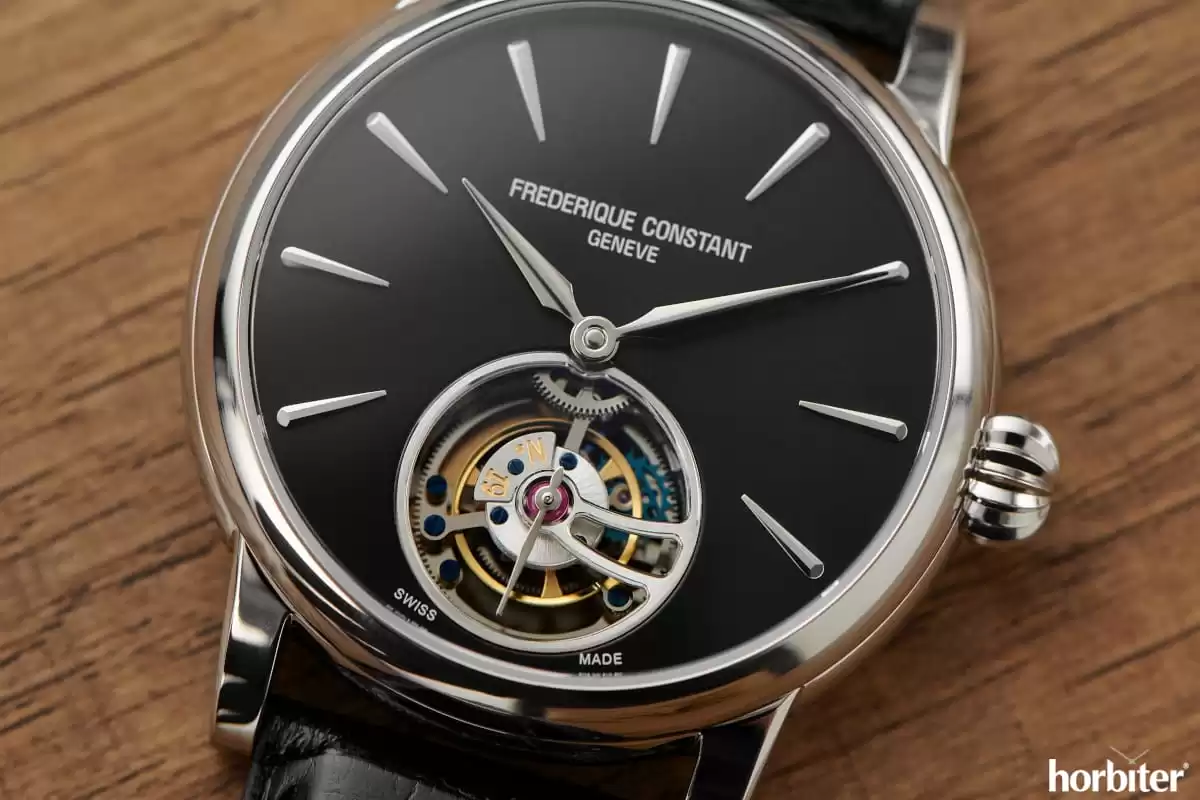
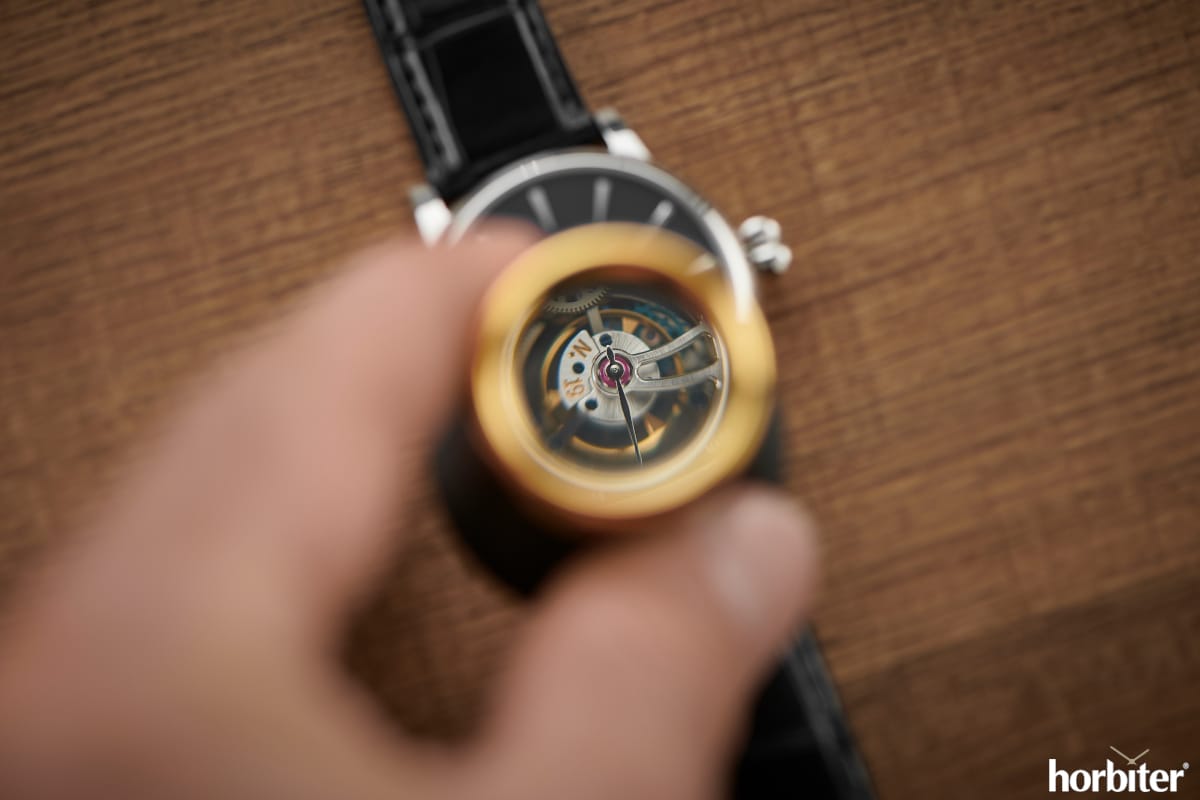
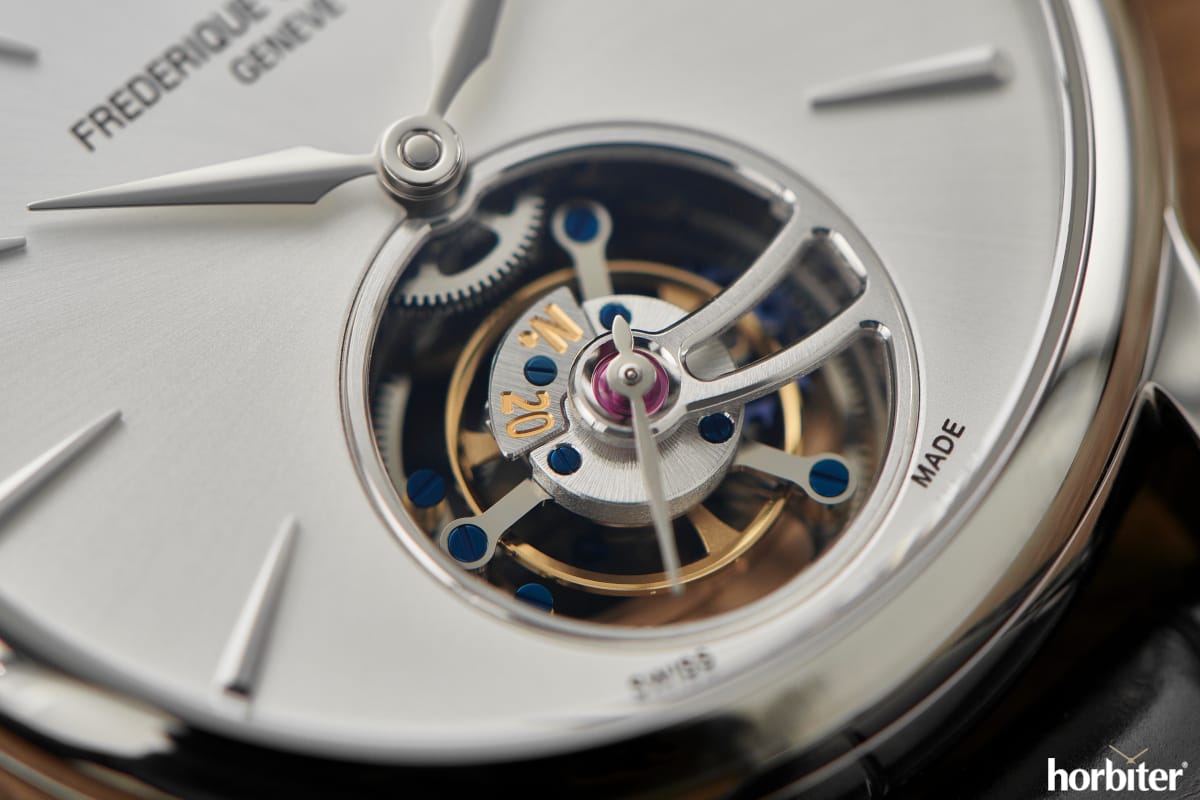
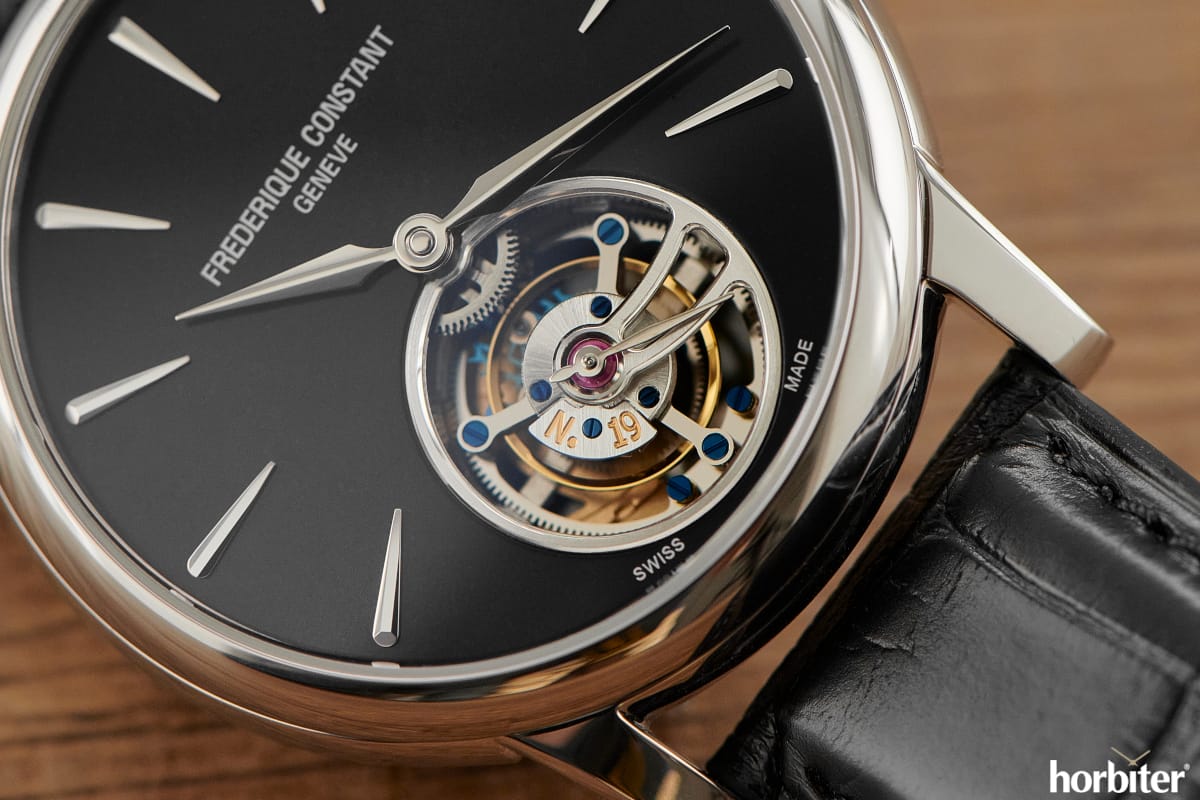
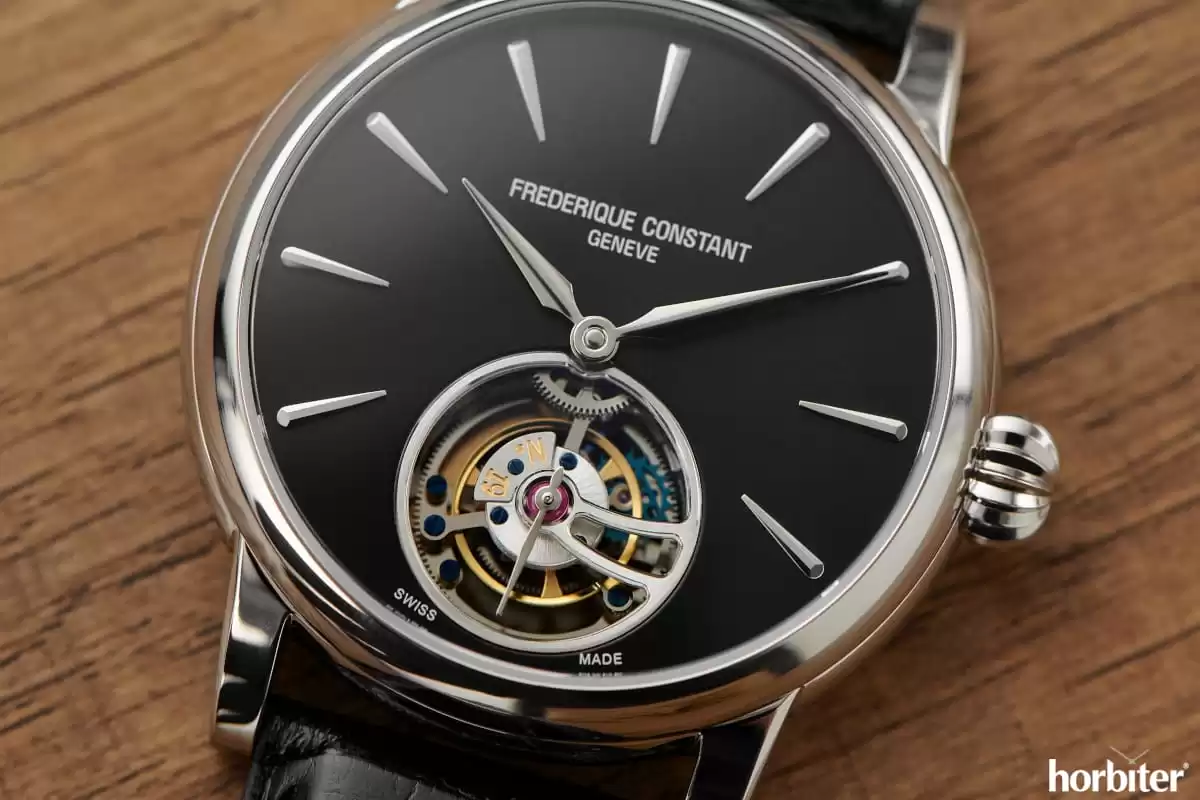
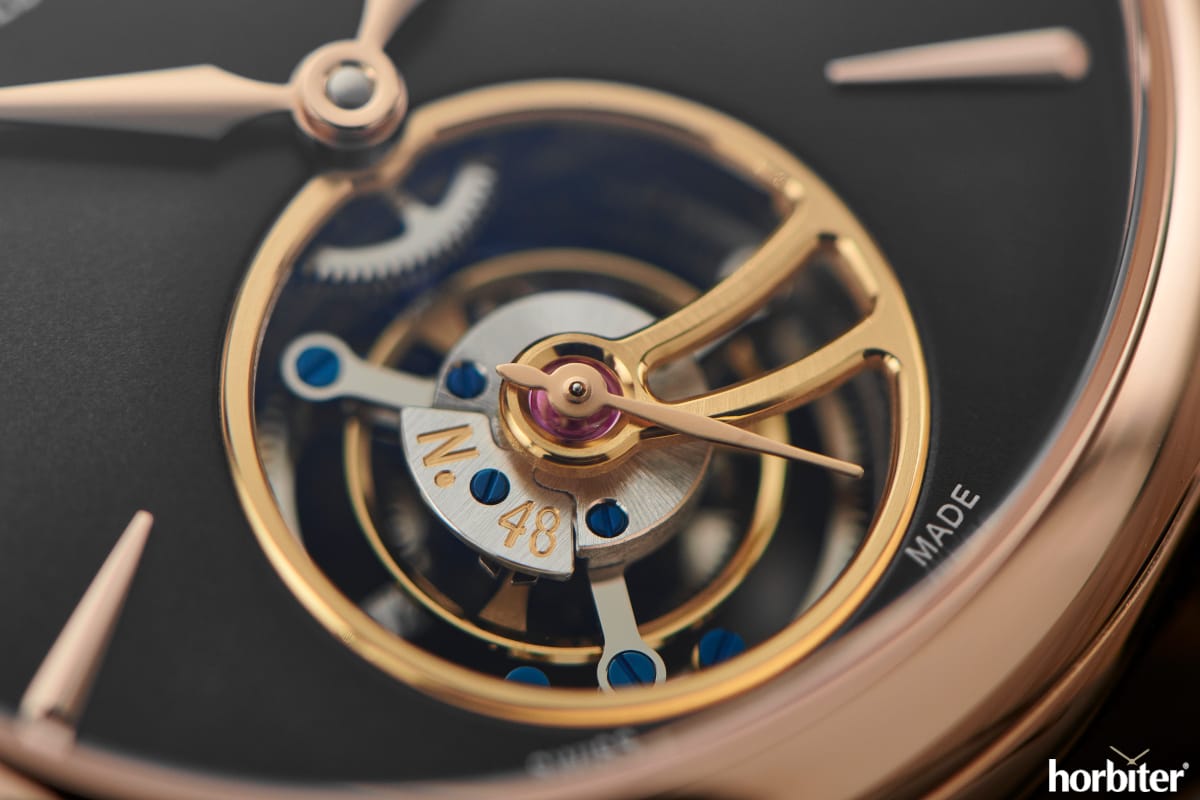
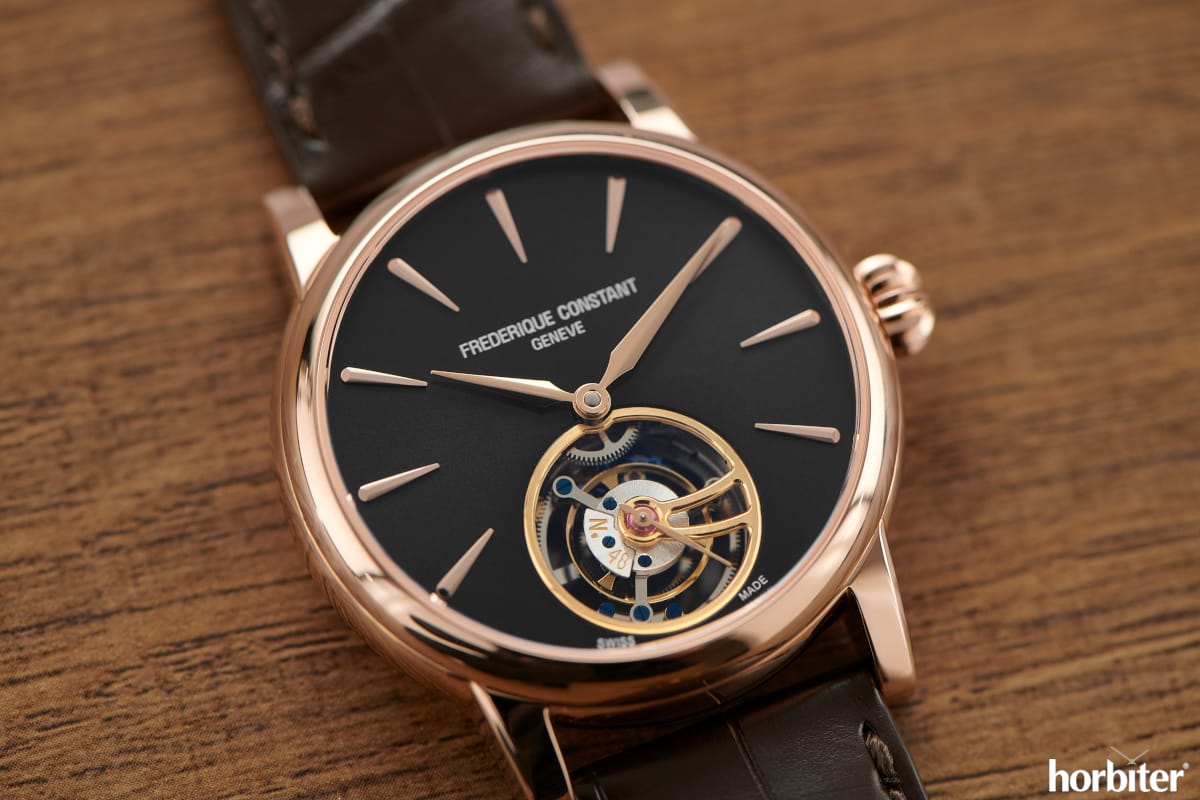
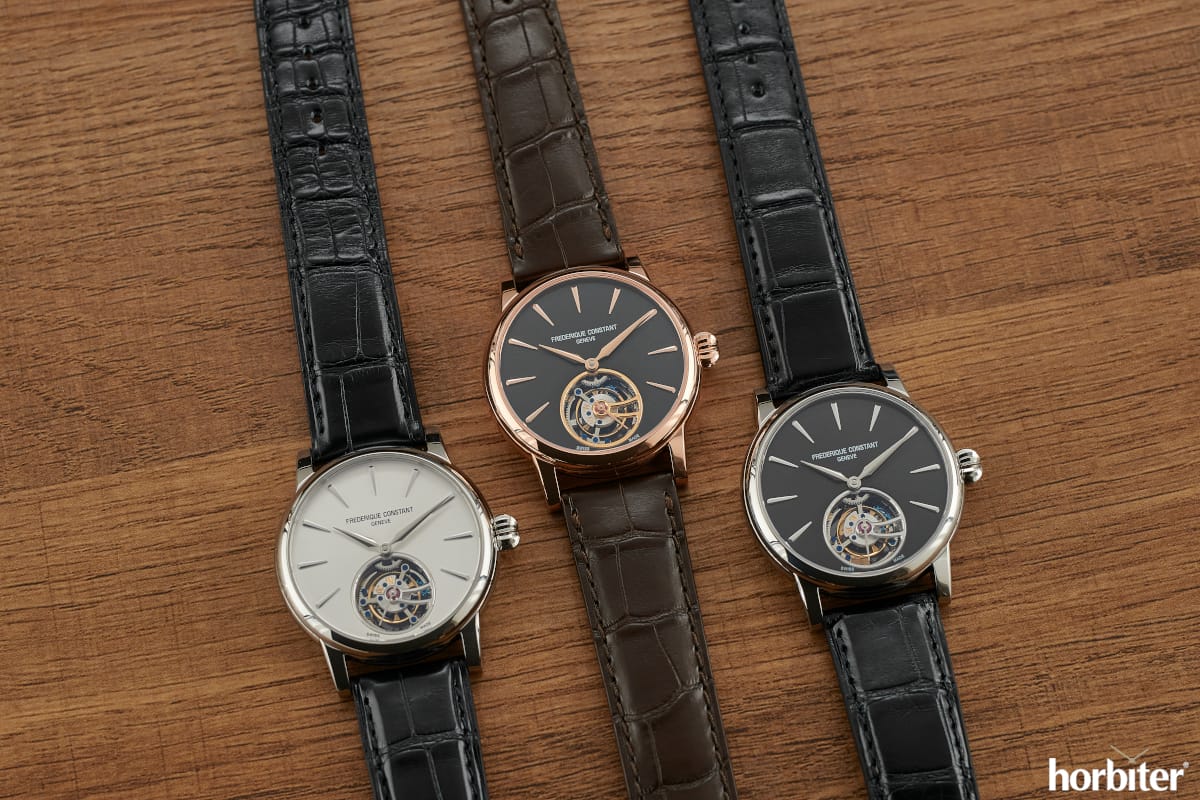
The new collection highlights the contrast between the tourbillon cage, whose assembly holds just 81 parts, is positioned at six, and is paired with a mirror-polished slim outer ring crossing the hour and minute hands’ axis, and the sunray-finished dial with diamond-cut indexes, whose sharp edges highlight the mirror polishing even further.
The hour and minute hands are fully mirror-polished, too, thus creating a more compelling, clean package when compared to the slightly baroque-looking old editions.
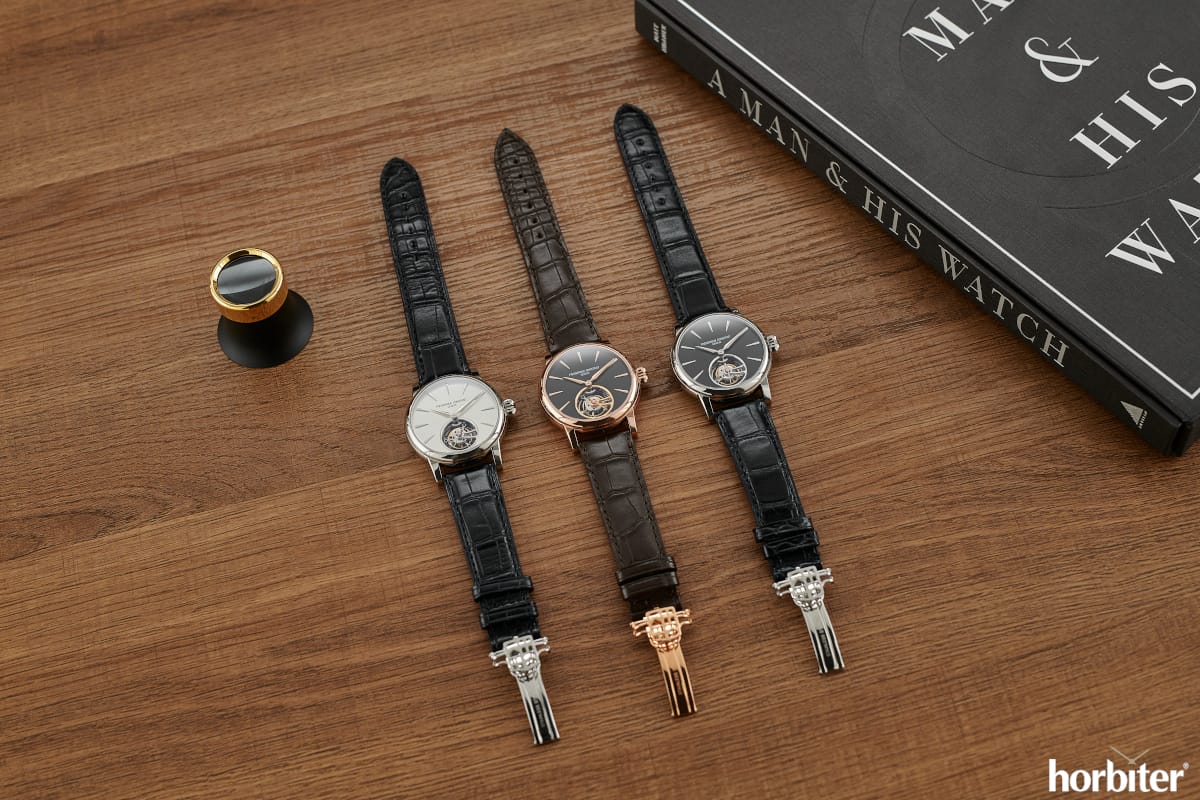
Each variant comes with a specific sunray dial: anthracite grey coloured on the pink gold model, blue or silver on the steel versions instead. The new model retains the signature Frederique Constant tourbillon traits like the curved upper bridge, whose running seconds hand sweeping below unveils the model’s serial number engraved on a plate. The purity of the execution reminds us of the classic Saxon-made watchmaking heritage.
The calibre FC-980
The FC-980 movement appeared in 2008 and has yet to undergo significant upgrades. It is a 4 Hertz self-winding movement offering a 38-hour power reserve when fully wound; it also offers Côtés de Genève and perlage throughout, along with rounded corners and a two-bridge-mounted balance wheel, for enhanced sturdiness. It also adopts a silicon escapement wheel and anchor.
In brief, it’s a rock-solid movement whose 38 hours of power reserve prove no major update during its life cycle while focusing on long-term reliability and reduced costs. The smaller case size also helps reduce the outer-ring-to-movement gap, as seen on the case’s backside.
Final thoughts
The execution is lovely; you won’t be wrong when you simplify to a no-frills design and let the tourbillon complication stand out. The most successful and enduring classic watches place the tourbillon complication in the first row with no additional, unuseful add-ons.
While being an evolution rather than a revolution, the perceived refinement is higher than ever. It proves Frederique Constant’s ambition to smoothly leave the accessible luxury arena to step up and gear towards an equally refined audience, ready to consider the new collection as an option despite the new models being aggressively priced as always. Here comes the explanation regarding some product choices, like the gold-plated hands or the gold-plated winding mass, for example; they’re not in line with the luxurious appearance but help, no doubt, keep the price tag attractive.
As stated, the designers have removed the old-fashioned “deja vu” traits. Thirty-five years can’t equal a competitor’s hundred or more years of heritage, but the new formula gives the Classic Tourbillon Manufacture strong selling points. I would have personally gone for a revised, more daring design as long as the case middle is concerned, in the shape of a sharper, more edgy silhouette, to further enhance the watch’s identity.
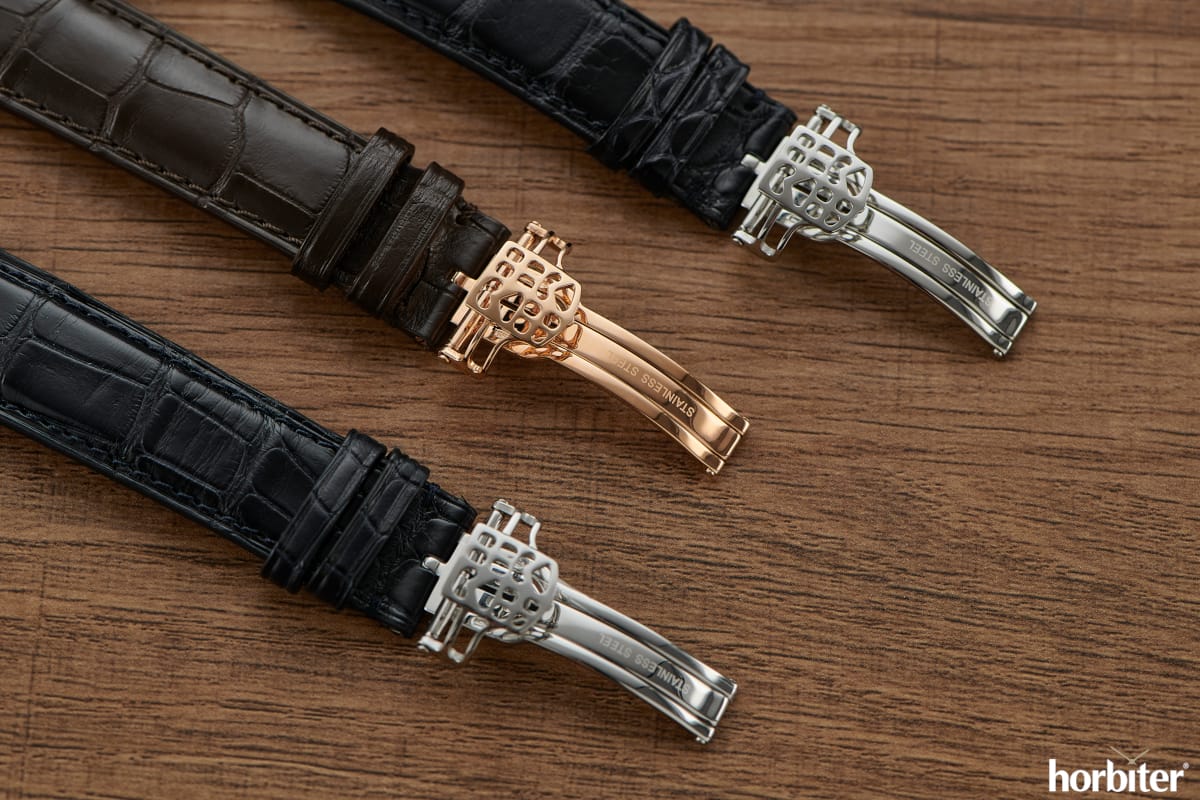
Instead, I would have gone for a bracelet, too, as an option, at least on the steel models. You’ll notice a bracelet is missing across the whole Classic Manufacture collection, sports models included, and that’s a pity considering that a bead-of-rice bracelet with a butterfly clasp, for example, might dramatically enhance the wearing experience which can today solely count on an alligator leather strap, which is as well crafted as it is stiff to wear and taper onto your wrist, especially in its new condition.
Frederique Constant has released three Classic Tourbillon Manufacture, one in gold and two in steel. The gold variant is warm and attractive, retails for €25,995 and is limited to 150 pieces, while the two steel options, each limited to 350 pieces, offer a blue or a silver dial. They both cost €14,995, which keeps being the most accessible retail price for a classic Swiss Made tourbillon, with the blue option winning hands down against its silver counterpart, in our opinion.
(Photo credit: Horbiter®, Frederique Constant)
Editorial team @Horbiter®
In this article:
Swiss Made
Swiss-made means that a watch's movement is Swiss, it is cased in Switzerland, and the manufacturer carries out there the final inspection.
Calibre
A calibre is the type of watch movement encased in an assigned timepiece. Its name is usually associated with the manufacturer's name and a standard code, e.g., ETA 2824.
Complication
The addition of any mechanical complication to a movement that usually displays the time.
Perpetual Calendar
The perpetual calendar is a complication that adjusts the watch's calendar for varying months and leap years. This cycle will end in 2100, and the wearer should apply the first manual correction.
Calendar
A feature that shows the day of the month and, in some cases, the day of the week. Some calendar watches show the date on sub-dials, while others display the…
Crown
Placed on the case side, it winds the mainspring. When pulled out, it also sets the time and the date. A screw-down crown increases water resistance and protects the movement…
Case
It encases the mechanical movement and is crafted in one or more parts. It can also be a single piece, as with some professional diving watches, or made of unconventional…
Tourbillon Cage
The rotating cage includes the tourbillon, balance wheel, and anchor and escapement wheel.
Power Reserve
A mechanical watch feature displays, on the dial or the case back, the remaining power in a watch movement, showing the length of time until the timepiece must be rewound.
Balance wheel
A part of a mechanical watch that oscillates, dividing time into equal portions.
Anchor
It is one of the parts of the escapement. Depending on the type of escapement, it has slightly different shapes. Its name comes from a ship's anchor-like design.
Line
It is the measurement unit that identifies the size of a movement. According to this measurement system, one line corresponds to 2,255mm.
Strap
A leather, rubber or other material band that secures the watch to the wearer's wrist.