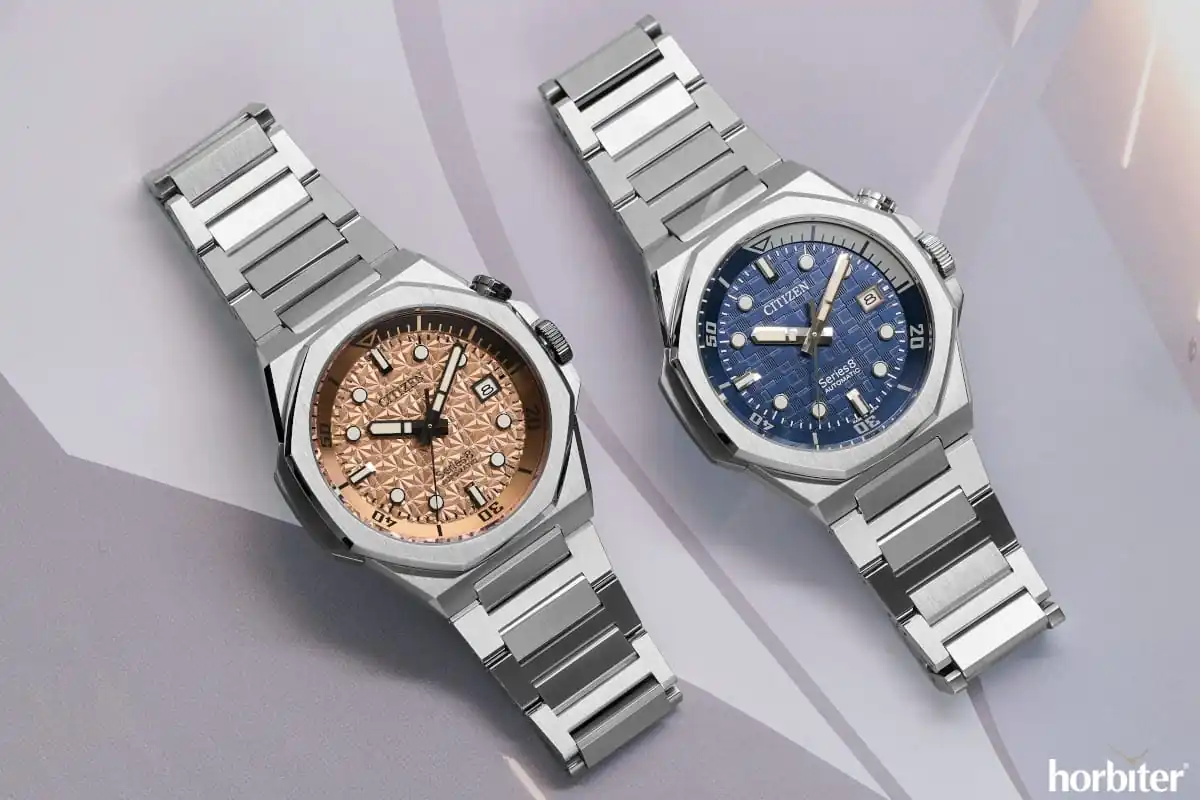
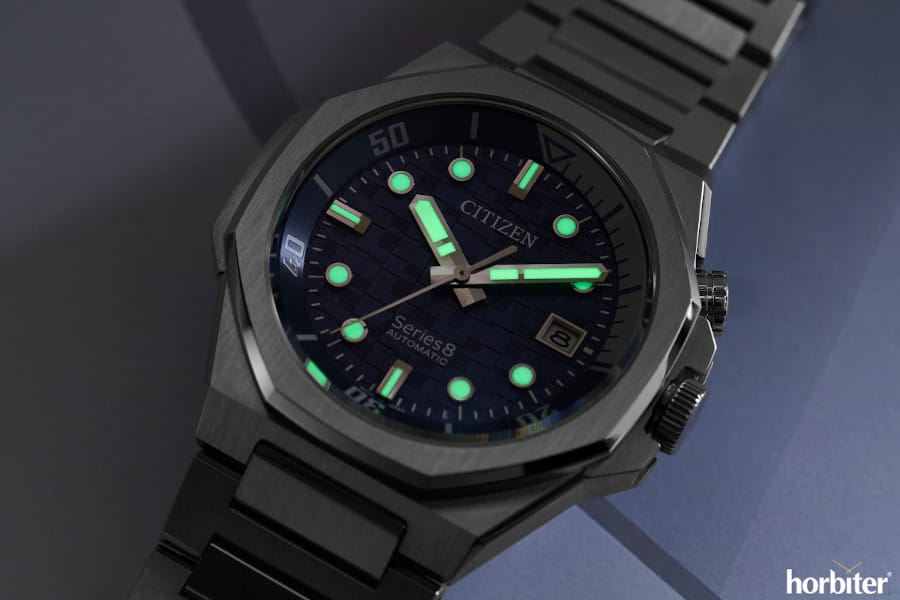
The Citizen Series 8 is the brand’s flagship mechanical collection. Keeping an eye on global and European markets, Citizen Watch released a wide range of self-winding three-hands and GMT models, drawing inspiration from the high-end La Joux Perret-powered timepieces branded under the “The Citizen” label and housing exclusive Miyota calibres.
The outcome is a sports collection to compete against the most popular Swiss brands in the 1k euro area and their historic Japanese competitor, Seiko.
With the 890 series, Citizen elevates the three-hander all-around sports watch on an integrated bracelet by offering a timepiece in their medium-to-high price point. It has several handy features and an aspirational design paired with the build quality you expect from a Citizen watch.
The style
When you look at a Series 8-890 Series, you immediately recognize traits and lines from a highly sought-after timepiece, especially its Diving option. The Genta-inspired octagonal case resonates so much in watchmaking that Citizen’s designers built on that template to make their latest collection.
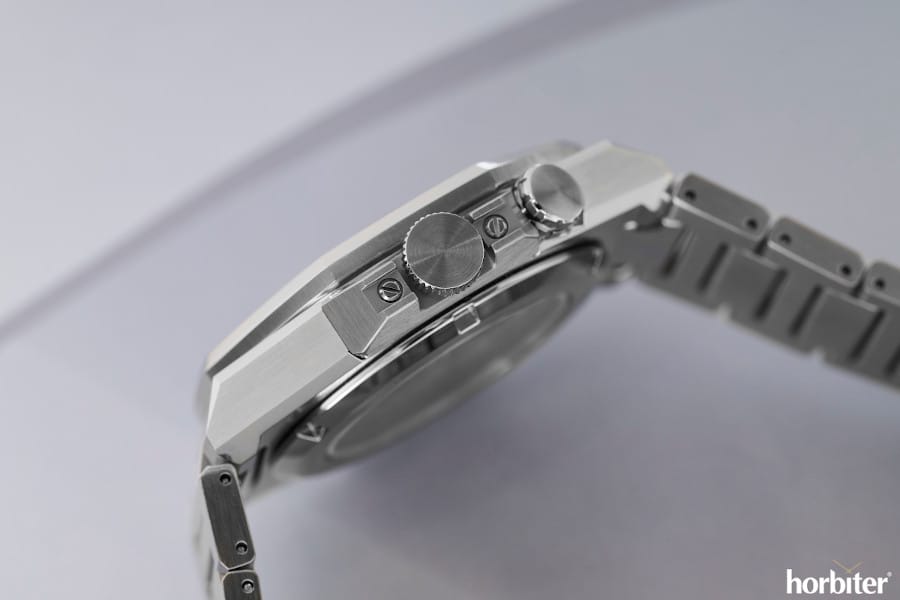
However, the sharp, edgy lines and the large H-shaped bracelet’s mid-link and trapezoidal crown protectors remind the Citizen 0-200 design language. That design triggered a list of models to revamp the brand’s heritage among mechanical watches and is a trend you have perceived should you have visited the 100-year brand’s exhibition held in Paris.
The Series 8-890 is among the centrepieces of this roadmap and fosters a legacy that will hopefully trigger new models and complications among mechanical watches, making their space among digital technology, whose dominance at the Japanese HQ has been dominant so far.
Digital watchmaking is still paramount, but new self-winding timepieces are surfacing, and archive models are moving forward.
An 8 Series collection is a means to make it happen; its task is to reinvigorate Citizen as a manufacturer of excellent mechanical watches, here with a contemporary look and feel, while we wait for the brand to relaunch some of their beautiful vintage-inspired timepieces, including a re-edition of the never-forgotten Bullhead.
Case and bracelet
With that said, let’s move on to product specs and appreciation. A Citizen Series 8 -890 measures 42.6 mm in diameter and is 11.7 mm thick.
Let us keep such figures aside since they summarize the watch, but there’s much more to share as you scratch the surface. However, the overall thickness is quite interesting. As a Series 8 owner (not this specific model), I can confirm that a key target was superior wearing comfort.
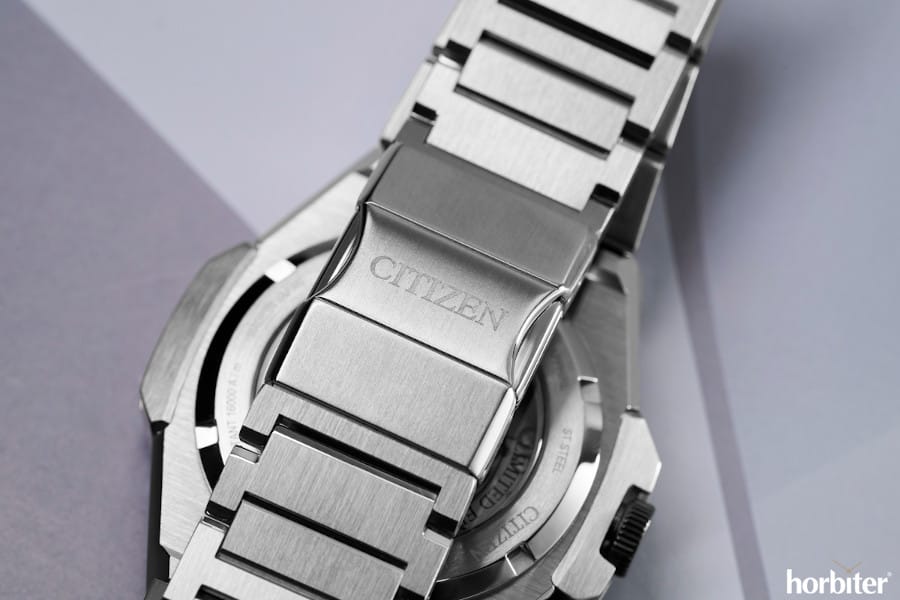
The three-piece case body seamlessly extends onto the wrist thanks to an integrated bracelet whose links taper towards the clasp, an ordinary folding one with a double safety button whose silhouette resembles a “butterfly” one.
The satin finish runs through the bezel to the bracelet, highlighting thin, mirror-polished areas as you move the watch around. Winding and inner rotating bezel crowns underwent an extensive mirror-polished treatment instead.
The dial
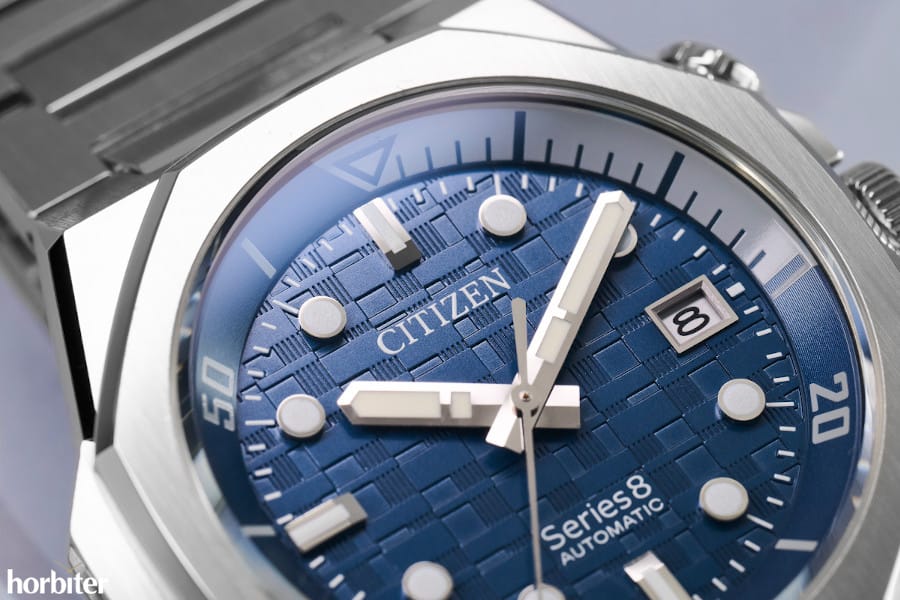
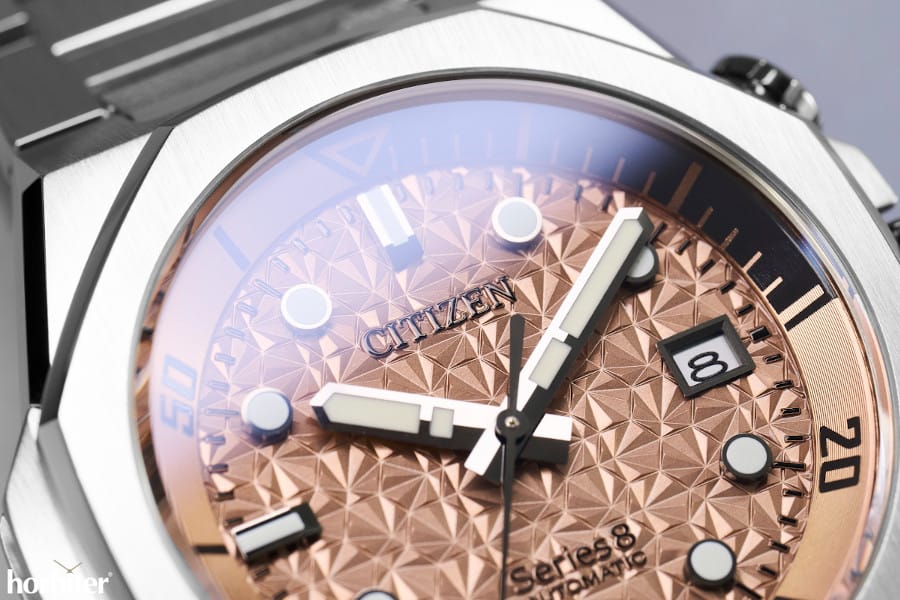
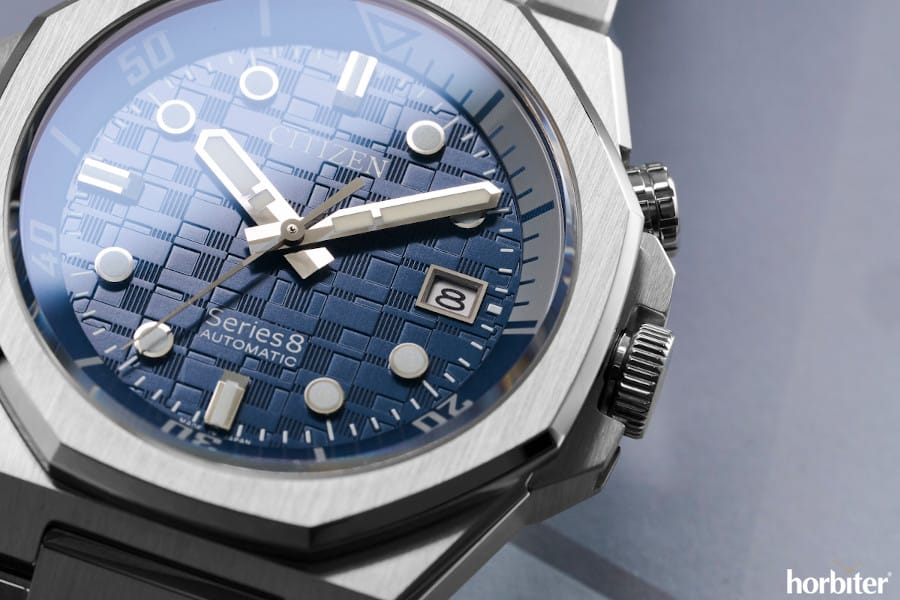
According to Citizen, the checkerboard pattern is inspired by the Tokyo skyline. Rather than a standard “tapisserie” motif, we spot an Ingenieur’s pattern, whose squared parts are different in size and shape.
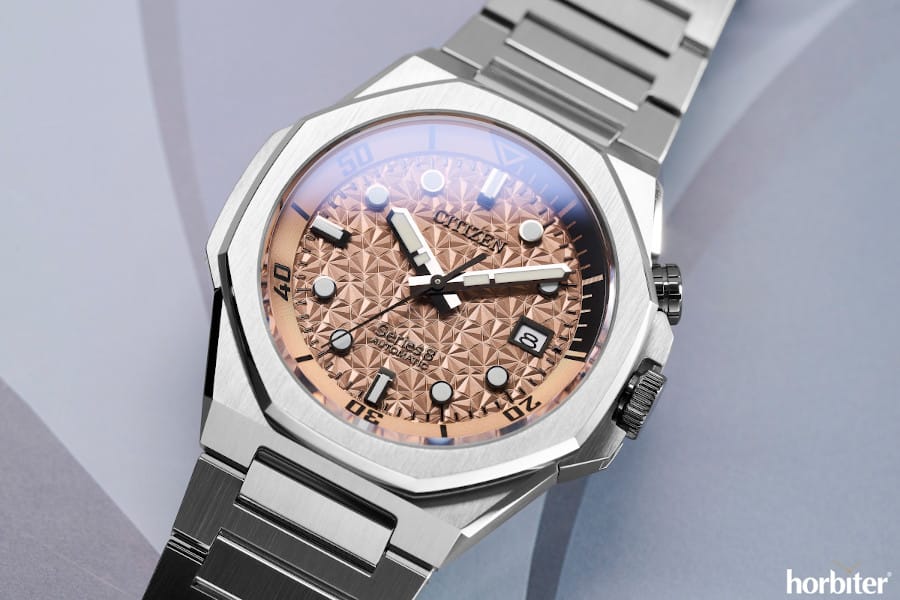
Also pictured here is a limited-series model whose pattern celebrates cherry blossom clouds.
A bolder trait is in the extensive hours and minutes hands and the Japanese date in font, shape, and size. Overall, the outcome is sleek and works. It builds on Japanese culture to personalize a familiar framework. It is nicely executed and offers much attention to detail.
The Miyota caliber 9051
Miyota is to Citizen what ETA is to Swatch, i.e., Citizen Group’s movement supplier to most entry-level brands within the Group. Citizen owns Miyota, and the 9051 calibre is exclusive to Citizen watches.
Unlike ETA, whose supply is primarily extended to SG’s brands, Miyota is an official third-party large supplier.
Therefore, the 9051 is manufactured by Citizen and for Citizen. It has standard features in frequency (4 Hz) and accuracy (between -10 and + 20 seconds per day) and in terms of resistance to magnetic fields (200 Gauss).
However, its power reserve is below average, stopping at 42 hours, whereas the best Swiss competitors last almost twice as long.
Final thoughts
Pictured here are two out of three references; one is in steel with a blue dial, and the other with cherry blossoms inspired one. They are, respectively, reference NB6060-58L and NB6066-51W.
The latter is limited to 1,700 examples and retails for 1,090 Euros instead of the 990 Euros standard version’s asking price. Both are reasonably priced and align with most Citizen Watches’ build quality and long-term reliability.
Nonetheless, I see some improvements. First in line is a longer power reserve to close the gap to the best Swiss competitors. Also, a quick-release mechanism would help customize the watch, a feature widely appreciated among watch enthusiasts.
(Photo credit: Horbiter®)
Giovanni Maria Di Biase @Horbiter®
In this article:
GMT
It is the acronym for Greenwich Mean Time and identifies a complication capable of displaying two or more time zones on the dial. The complication usually couples a 24-hour rotating…
Case
It encases the mechanical movement and is crafted in one or more parts. It can also be a single piece, as with some professional diving watches, or made of unconventional…
Crown
Placed on the case side, it winds the mainspring. When pulled out, it also sets the time and the date. A screw-down crown increases water resistance and protects the movement…
Bezel
The bezel is particularly useful on diving watches, allowing you to check dive times. In this case, it unidirectionally rotates and usually comes in two parts: a metal (or ceramic,…
Date
It indicates the date of the month. There are different types of display: via a window or a pointer, where an additional hand is usually placed centrally or on a…
ETA
Swiss manufacturer of mechanical and quartz movements owned by the Swatch Group.
Calibre
A calibre is the type of watch movement encased in an assigned timepiece. Its name is usually associated with the manufacturer's name and a standard code, e.g., ETA 2824.
Frequency
It is the number of oscillations of the regulating organ. It is divided into hours, mechanical watches, and quartz watches.
Power Reserve
A mechanical watch feature displays, on the dial or the case back, the remaining power in a watch movement, showing the length of time until the timepiece must be rewound.
Line
It is the measurement unit that identifies the size of a movement. According to this measurement system, one line corresponds to 2,255mm.