After having discovered pros and cons of the new Santos de Cartier Chronograph, let’s jump back to SIHH 2017 for a while and discuss one of the greatest masterpieces ever crafted by the French brand in recent years, a timepiece that perfectly blends technical prowess with an original design.
The end result was a timepiece geared towards true watch connoisseurs. You might like its design or not, but you can’t deny the Rotonde de Cartier Astrocalendaire Perpetual Calendar is one of the most technically refined perpetual calendar watches ever made.
As mentioned above, this is not any new watch but has, in our opinion, never been under the spotlight as it deserved. Cartier actually crafted two versions of this super-complicated watch, one in platinum with Roman numerals and a too elaborate design in my opinion, and a sleeker variant made in rose gold with no indexes at all, on the dial. They were launched at SIHH 2014 and SIHH 2017 respectively, the latter being the one we got our hands-on.
The Rotonde de Cartier Astrocalendaire Perpetual Calendar
The Astrocalendaire belongs to the Rotonde de Cartier collection, and its case comes in at 45mm across and is 15.1mm thick, to accommodate the caliber 9459 MC, an entirely manufactured movement that complies with the Hallmark of Geneva certification criteria.
The overall size of the watch looks all but familiar on a Cartier watch but is needed given this caliber includes two great complications, a flying tourbillon, and a perpetual calendar.
This combination is not so rare in “haute–Horlogerie” (A.Lange & Söhne, for example, crafts the Lange 1 Tourbillon Perpetual Calendar), what is unique instead is the perpetual calendar display, offered by Cartier.
Not your ordinary Perpetual Calendar
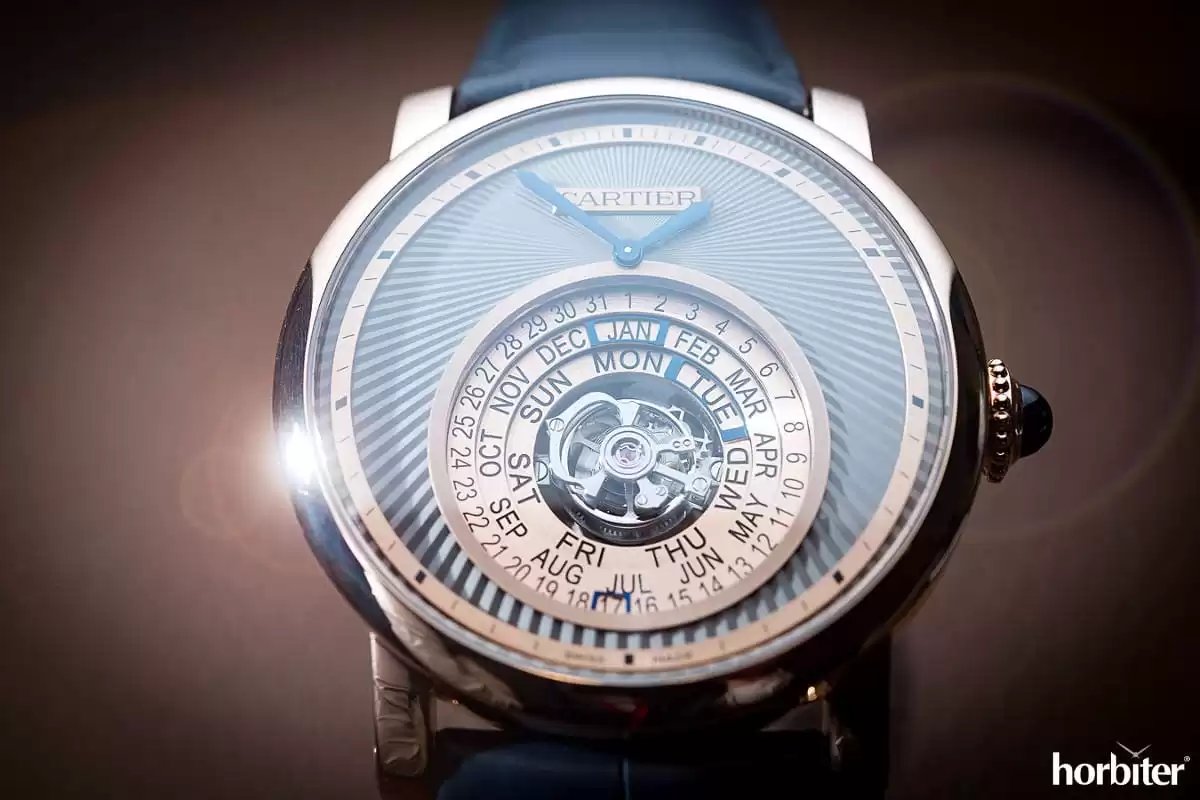
The central element of the design is the flying tourbillon, surrounded by a multi-tier circular display for the perpetual calendar. It looks like the tourbillon is sitting amidst a Roman amphitheater, a clear nod to ancient culture.
The tourbillon and perpetual calendar mechanism and display assembly take most of the dial’s space: on the three-tiered rings are displayed, from the outermost to the innermost respectively, date, month and day of the week. It is the smartest way to show the functions of a perpetual calendar I have ever seen.
The leap year indication is placed on the case back side, instead, and is partially hidden by the winding rotor. This choice has to do in my opinion with avoiding the multi-tier display be too hard to read, along with leaving enough space to the time display.
Three rotating bluebrackets, connected to the caliber’s gearings and placed on the three rings, allow you to read the date, the month and the day at a glance, thus making the Astrocalendaire the easiest-to-read perpetual calendar ever made. The tourbillon is a one-minute flying tourbillon sporting the signature C–shaped rotating cage.
The Cartier caliber 9459 MC
Caliber 9459 MC is different from the competition in the way designers have replaced springs and levers traditionally used in perpetual calendars, with gears, a choice that, according to Cartier, further increases reliability in the long term.
All the main functions are set via the winding crown: date and month can be set forward and backward, whereas a small corrector placed on the case helps you adjust the day.
Details
Apart from the perpetual calendar display, the Astrocalendaire‘s dial features the time display at 12 o’ clock by mean of two tiny gladiator-shaped blue hands and a pink gold plate engraved with the Cartier logo, plus an additional gold ring for the minutes’ display. The dial has a sunray decoration whose dark silver lines origin from the hour and minute rotating axis.
A sapphire cut cabochon is set into the winding crown, which has been lightly knurled, to probably increase grip, as well as give aesthetic appeal.
Final thoughts
The Cartier Rotonde de Cartier AstrocalendairePerpetual Calendar in rose gold was produced in a limited edition of just 100 pieces, and priced, at the time, at around € 200.000.
We are talking fine watchmaking here; therefore price is not accessible, but neither are technical prowess or design.
In the benchmark, the Astrocalendaire boasts a unique approach to designing a perpetual calendar and combining these two complications. Finally, I also think an Astrocalendaire still is the most easy-to-read perpetual calendar on the market.
(Photo credit: Horbiter®)
Andrea Frigerio @Horbiter®
In this article:
Chronograph
Complication that helps the wearer to measure time intervals without affecting the watch's standard time-telling function.
Perpetual Calendar
The perpetual calendar is a complication that adjusts the watch's calendar for varying months and leap years. This cycle will end in 2100, and the wearer should apply the first manual correction.
Calendar
A feature that shows the day of the month and, in some cases, the day of the week. Some calendar watches show the date on sub-dials, while others display the…
Case
It encases the mechanical movement and is crafted in one or more parts. It can also be a single piece, as with some professional diving watches, or made of unconventional…
Date
It indicates the date of the month. There are different types of display: via a window or a pointer, where an additional hand is usually placed centrally or on a…
Rotor
Part of an automatic watch that winds the mainspring by constantly rotating. Depending on the watch's winding capability, movement design, and value, it comes in various geometries, sizes, and materials.…
Case back
It can be screwed in, pressure-fastened, or secured to the case via screws. Occasionally, it comes as a single piece, with the case of specific professional diving watches (for example,…
Corrector
The corrector is a tiny button on the case side that allows the wearer to update the watch date with a calendar.
Crown
Placed on the case side, it winds the mainspring. When pulled out, it also sets the time and the date. A screw-down crown increases water resistance and protects the movement…