2024 is a celebration year at Cartier, whose new watches unveiled at Watches and Wonders cover, as usual, from the sports luxury watch to the most classic, and they are all as iconic as only the Maison Cartier can guarantee.
The legendary Santos turns 120, despite not setting any special milestone on the Santos de Cartier or the Santos-Dumont. Nonetheless, here is a preview provided by Cartier; rest assured, the brand will uncover many more models as we stroll through the fair’s booths.
Cartier Santos
Santos is so relevant that we prepared it and updated a collection guide. It has such a rich heritage and strong identity to be offered as the more contemporary Santos de Cartier or the vintage-inspired Santos-Dumont, in a range that includes time-only models or ultra-flat skeleton ones.
We would have gone for a chronograph update. Since it was released, we have liked it but thought there was room for improvement, especially from an aesthetic perspective. Cartier has instead focused on a new complication, which makes sense, plus further limited edition Santos-Dumont models.
Santos de Cartier Dual Time
A new Dual Time perfectly fills the gap between base models and chronographs, offering an intelligent option to frequent travellers while preserving the Santos De Cartier’s purity.
The second time zone’s counter, located at six o’clock, seamlessly fits into the overall clean design; it is so subtle that it looks like a running second counter despite the twelve-hour scale and day-and-night display.
Cartier markets the Santos Dual Time in size, measuring 40.2 mm by 47.5 mm (and 10.1 mm thick compared to the base model’s 9.4 mm). It offers the handy QuickSwitch and EasyLink systems as standard.
The dial is anthracite grey with a contrasting sunray treatment and a light grey Dual Time counter. The case is waterproof up to 100 meters, making the new Dual Time an all-rounder. Cartier still needs to disclose a price list.
Santos-Dumont Rewind
The Santos-Dumont welcomes a tasty new complication and three luxurious variants, building on the hand-wound architecture. “Nomen omen”, the new Santos-Dumont Rewind, showcases Roman numerals arranged in reverse order, an aesthetic and technical take made possible by adopting mechanical movement calibre 230 MC.
It features an attractive carnelian dial and a quartz belonging to the group, including agate and onyx. Cartier’s designers applied Roman numerals arranged counterclockwise. The case, in Cartier’s large size, is made of platinum and is the same size as the ordinary large hand-wound-operated model, whose ultra-thin 7.3 mm size stands out.
The platinum case with a carnelian dial is fastened to a semi-matt brown alligator leather strap. Cartier will produce 200 pieces of the new Rewind collection.
Santos-Dumont Limited Edition
Cartier releases collectors-ready Limited Edition models crafted in gold and platinum witha lacquered dial. As with previous iterations, the lacquer extends to the case and bezel, a touch that made these models highly sought-after. The Maison builds on the success granted all the series released so far since the Santos-Dumont hit the market.
The three new editions include a 200-numbered-piece platinum model with an olive green lacquered dial and two yellow and rose gold editions featuring dove grey and peacock blue lacquered dials.
Unlike the Rewind model, the three editions feature a sunray treatment on the dial and house the 430 MC calibre.
Cartier Privè
With the Privè collection, we join the elite club of pure watch lovers and admirers of watchmaking in its purest form. The Tortue celebrates the eighth edition of the Privè collection with a new range, including a time-only and an excellent mono-pusher chronograph, a complication first appearing in 1928 and offered again in 1998.
Cartier Tortue Hours and Minutes
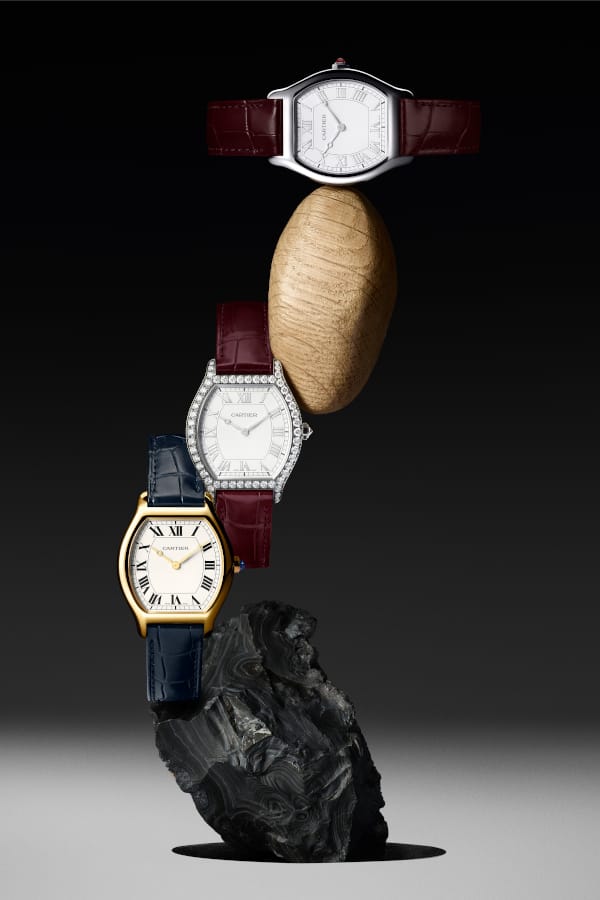
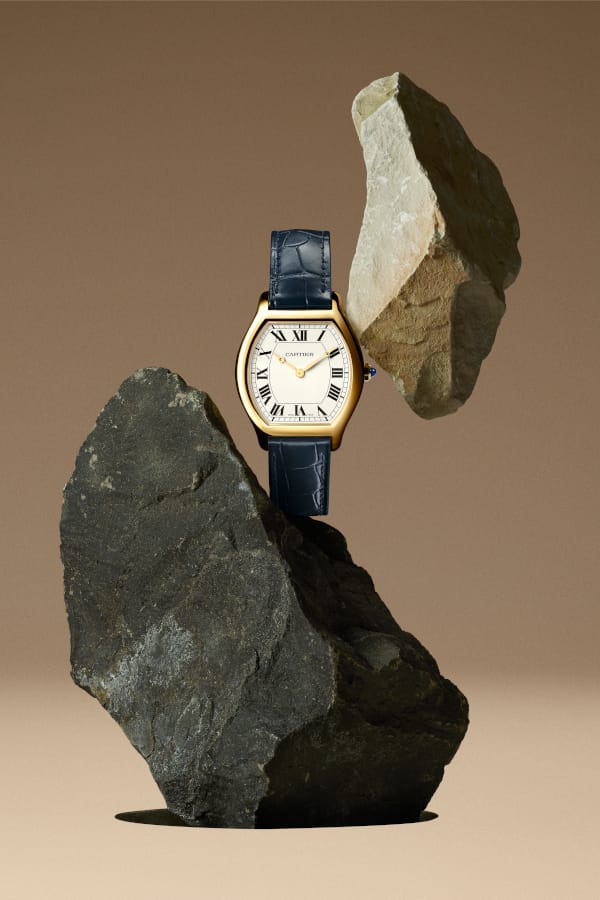
Along with Santos, Pasha, and Tank, the Tortue case is one of the most recognizable in watchmaking. Its tonneau-shaped silhouette is like no other, and its iteration in yellow gold and black Roman numerals is Cartier.
Three are the options, but the model in yellow gold with the equally classic black alligator strap and pin buckle is our favourite and the most attractive of the new proposition.
We think the other two options are also attractive. Platinum has a historical presence in the brand’s catalogues; yet it doesn’t boasts the same charm as the yellow gold model.
The two platinum models differ from each other; they both adopt applied Roman numerals with a rhodium finish but the most exclusive model offers brilliant-cut diamonds on the case, crown and bezel. It is limited to 50 pieces.
The platinum and yellow gold models are limited to 200 pieces each. Again, the Tortue adopts the same hand-wound movement as the Santos-Dumont.
Cartier Tortue Monopusher Chronograph
Can we list the new Tortue Monopusher Chronograph as 2024 Cartier’s highlight? While we are eager to access Watches and Wonders, our answer is “Yes.” After briefly introducing the mono-pusher chronograph’s history and milestones, let us dig into some details of this glorious chronograph based on the information we have so far.
As per the tradition of the Privé collection, yellow gold and platinum are both lovely, but platinum wins hands down against yellow gold.
The yellow gold Tortue Monopusher Chronograph is a nice evolution of the Tortue Hours and Minutes, with the mechanical complication standing out as its style: two perfectly sized counters, blued “pomme” hour and minute hands, and a “chemin de fer” minute track.
The hand-wound calibre 1928 MC (we have no pictures so far) has chamfers on the bridges (and Côtes de Genève décoration), levers, and mainsprings, while the wheels and barrels are finished with cerclage. Overall, it measures just 4.3 mm in thickness.
(Photo credit: Cartier)
Giovanni Di Biase @Horbiter®
In this article:
Chronograph
Complication that helps the wearer to measure time intervals without affecting the watch's standard time-telling function.
Complication
The addition of any mechanical complication to a movement that usually displays the time.
Time zone
Time zones refer to the twenty-four regions of the globe. Milan, Rome or Naples will indicate our time zone here in Italy.
Case
It encases the mechanical movement and is crafted in one or more parts. It can also be a single piece, as with some professional diving watches, or made of unconventional…
Calibre
A calibre is the type of watch movement encased in an assigned timepiece. Its name is usually associated with the manufacturer's name and a standard code, e.g., ETA 2824.
Strap
A leather, rubber or other material band that secures the watch to the wearer's wrist.
Bezel
The bezel is particularly useful on diving watches, allowing you to check dive times. In this case, it unidirectionally rotates and usually comes in two parts: a metal (or ceramic,…
Crown
Placed on the case side, it winds the mainspring. When pulled out, it also sets the time and the date. A screw-down crown increases water resistance and protects the movement…