There’s a new word to familiarise with in watchmaking, and that is “Tropic-proof.” When most watch brands turned their heads to the sports watch category in the late 1960s, Alpina didn’t develop exclusively diving or GMT watches, like the majority of their competitors.
The Swiss brand’s take on intercontinental flights to the world’s most exotic destinations ultimately resulted in a traditional three-hand watch, laconically named “Tropic-Proof,” whose performance was not as ordinary as its classic style.
“Tropic-proof” does not identify any new product specification; still, it was a brilliant marketing strategy to attract frequent flyers and offer them a three-hand watch in steel similar to the models flooding the market back then, yet equipped with a more tried-and-tested steel case than anything else in the benchmark.
François Borgel for Alpina
Alpina partnered with François Borgel, a case builder whose name resonated in Swiss haute horlogerie, thanks to a case construction known for its extraordinary robustness and superior craftsmanship.
Borgel may be new to younger watch aficionados, who are unaware that their cases, identified by the FB logo on the caseback, have been praised for their excellent resistance to dust and humidity.
Here comes the “Tropic-Proof” moniker to ensure a watch’s superior outdoor capabilities, under certain conditions. Among the watch brands partnering with Borgel is Patek Philippe, with its reference 1463.
The 2025 Tropic-Proof
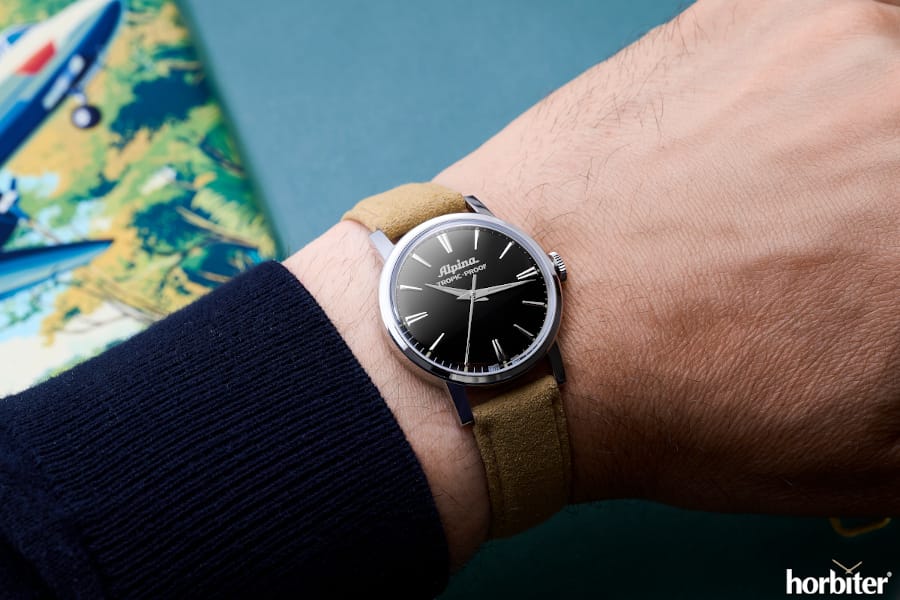
The contemporary Alpina Tropic-Proof faithfully pays tribute to the original, reproducing all the traits found on the circa 1965 model, when it is believed the brand began production.
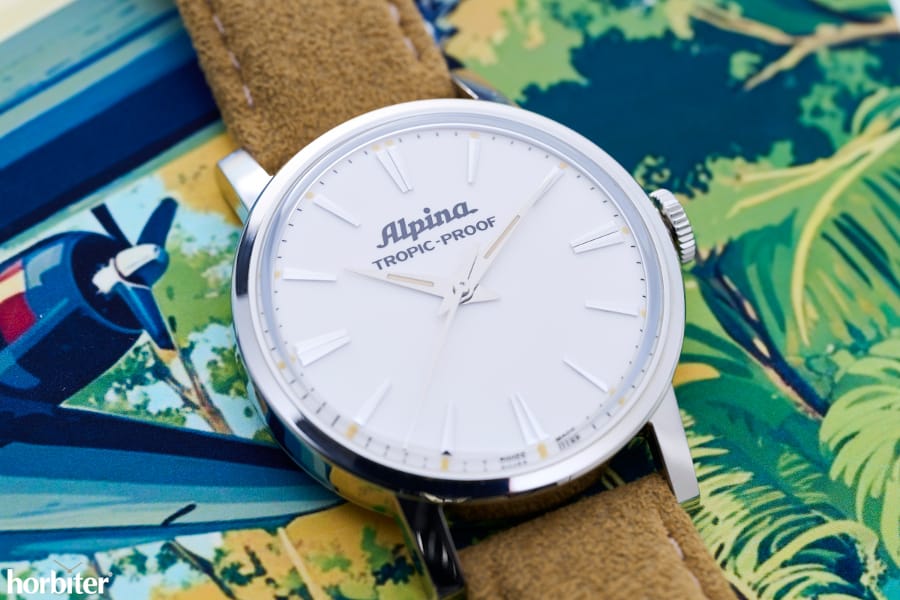
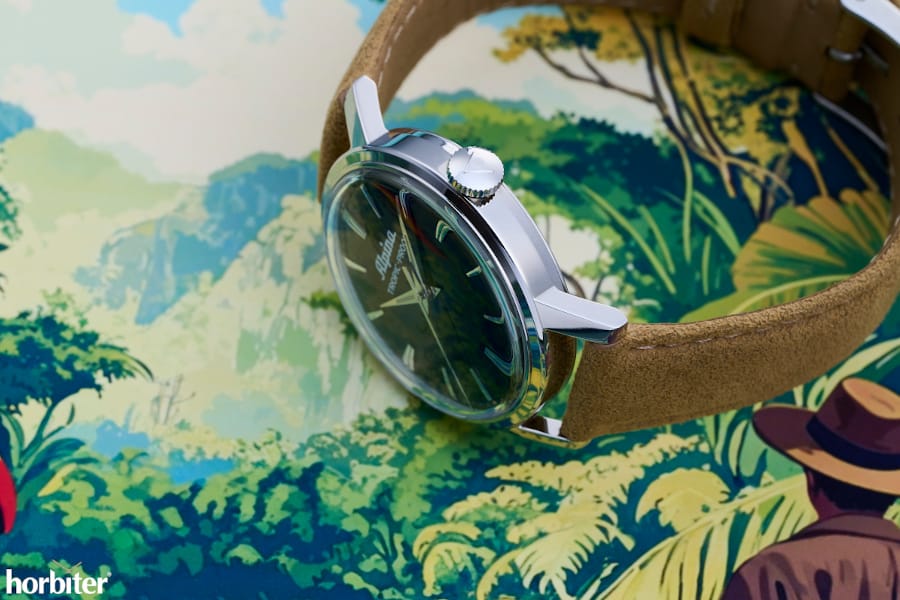
Among them is a sapphire crystal with a “glass box” design, which mimics the feel of the first-ever Tropic-Proof.
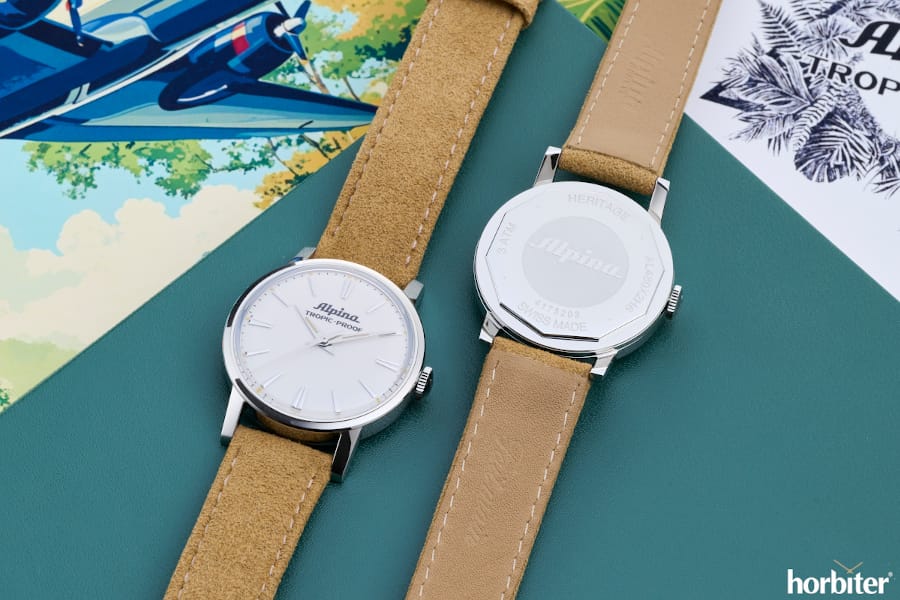
Measuring 34 mm in diameter and showcasing a decagonal caseback, its thickness stops at 9.25 mm as opposed to the forerunner’s 11.50 mm.
What sets old and new apart is the calibre, which honours the original concept, yet with few similarities. The new Tropic-Proof houses a movement internally coded as AL-480 but retains a hand-wind mechanism.
While mimicking the historic model, it differs from the original 2.5 Hertz Alpina in-house 598R movement.
Powering the 2025 model is a 4 Hertz movement with a 42-hour maximum power reserve, not as prestigious as its vintage counterpart.
You won’t see it, as the designers have closed the case to reproduce the original decagonal solid caseback.
Wearing and feeling like an ultra-classic watch, it pairs with an Alcantara strap on a pin buckle to ensure superior comfort.
Thumbs up to Alpina for sizing the watch at 34mm, like its 1960s counterpart. While downsizing is a trend, it may look and feel too small by modern standards.
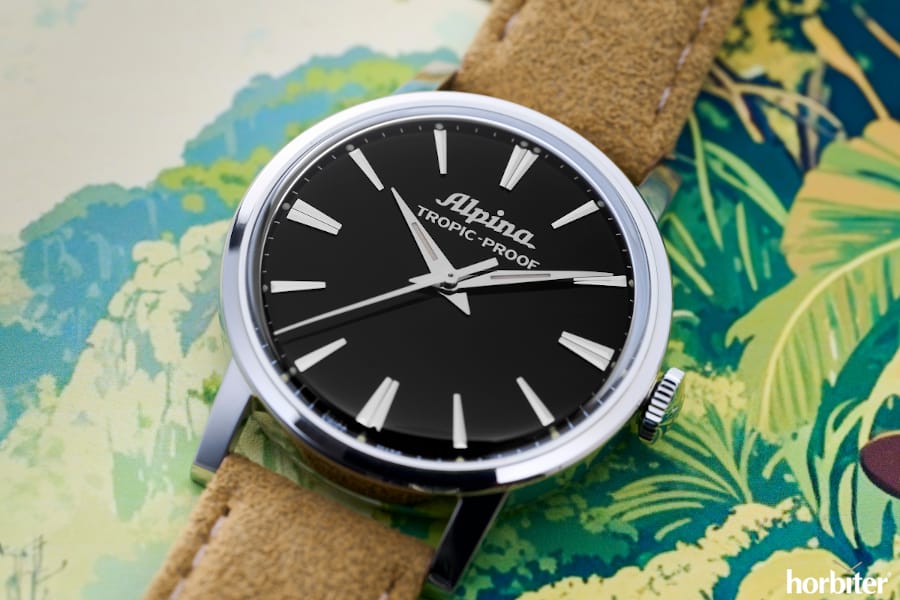
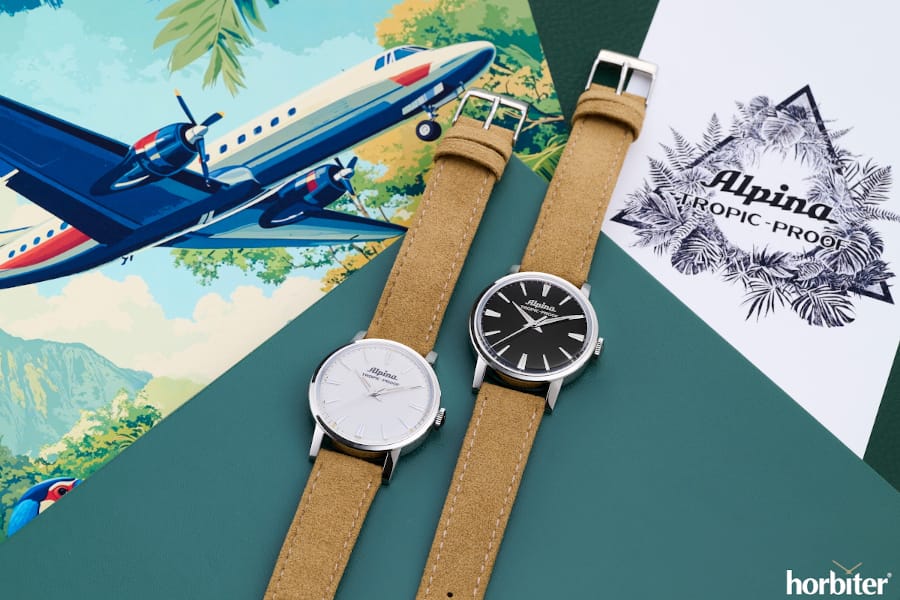
A glossy white or black dial features applied indexes with luminous dots, as well as double indexes located at 3, 6, 9, and 12.
A small strip of luminescent material was applied to the dauphin’s hands. Turning the case on its side reveals straight, angled-down lugs for maximum comfort.
Final thoughts
Who is Alpina Tropic-Proof’s prospective customer? The answer isn’t as tricky as the question suggests.
It is instrumental to introduce Alpina watches to newbies and raise brand awareness by reproducing historic models.
That’s the Heritage collection’s primary goal, and a Tropic-Proof fits in as never done before by any recent Alpina Heritage model.
A 34 mm size is a call to vintage enthusiasts, a community gathering young and old watch fans, who are allowed to purchase a contemporary reissue with an authentic pedigree at less than €1,800—€1,795 to be precise—choosing between two clean dials.
My only concern, as mentioned elsewhere, is the slightly oversized logo on an otherwise exquisite dial design.
This watch was not engineered for large volumes; it is a promotional item for a legendary watch manufacturer, and I hope it will be available in more sizes and feature a larger in-house mechanical movement soon.
(Photo credit: Horbiter®)
Giovanni Maria Di Biase @Horbiter®
In this article:
GMT
It is the acronym for Greenwich Mean Time and identifies a complication capable of displaying two or more time zones on the dial. The complication usually couples a 24-hour rotating…
Case
It encases the mechanical movement and is crafted in one or more parts. It can also be a single piece, as with some professional diving watches, or made of unconventional…
Calibre
A calibre is the type of watch movement encased in an assigned timepiece. Its name is usually associated with the manufacturer's name and a standard code, e.g., ETA 2824.
Power Reserve
A mechanical watch feature displays, on the dial or the case back, the remaining power in a watch movement, showing the length of time until the timepiece must be rewound.
Strap
A leather, rubber or other material band that secures the watch to the wearer's wrist.