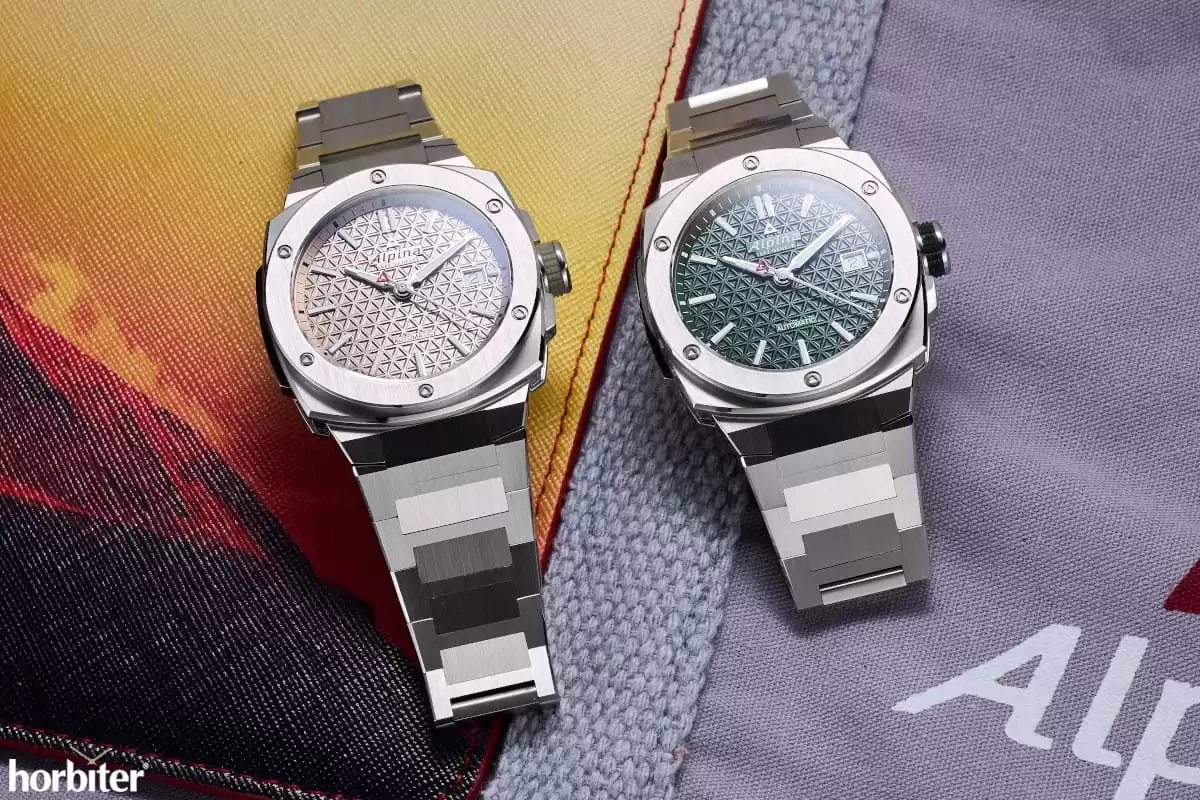
A few years ago, the Alpina brand was randomly distributed across the Italian market and, more extensively, into Europe. Once acquired by the Citizen Group, the latter premiered its sister brand, Frederique Constant, first, adding new products and a renewed retail organization to set the ground for Alpina’s comeback.
Alpina is, therefore, under the loupe, and Italy plays a primary role in a new strategy to conquer the international markets and Italian soil with an equally renovated product offering. Forget the stunning but niche divers’ and regatta watches; they were as original as they referred to a selected group of watch enthusiasts.
If we exclude some brilliant projects to promote Alpina’s in-house calibres, the new core offering includes more mainstream timepieces with much bang for the buck and a curated design.
Brand identity is vital to success, especially when your playground is the low-to-mid-range product category.
Alpina history in brief
We cannot summarize what Alpina is in a few lines; such a brand deserves a dedicated article to deepen all the milestones of a manufactory building the Swiss Made legend.
The brand fostered Swiss manufacturing when Gottlieb Hauser, the founder, created a Swiss watchmaker corporation, SUG, in 1883. SUG’s mission was to encourage and share parts development for the entire industry.
As a brand, Alpina will appear later on to badge the highest-quality watches, including some certified chronometers. Keep the word “quality” in mind since it will recurrently appear as you scroll the text.
The new Alpiner Extreme
We often associate an Alpina watch with a Regulator, and we cannot deny that Regulators hold a special place in the brand’s catalogue. The Extreme concept is nothing new but a clever evolution of an existing concept. With the contemporary Extreme case, Alpina aims to create its view on the all-round sports watch engineered for outdoor activities, as promoted by the brand.
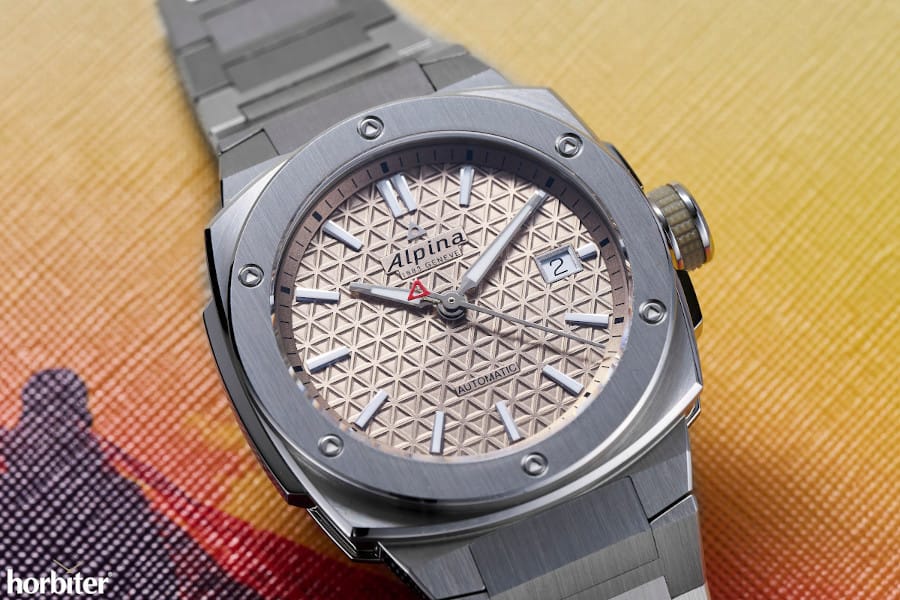
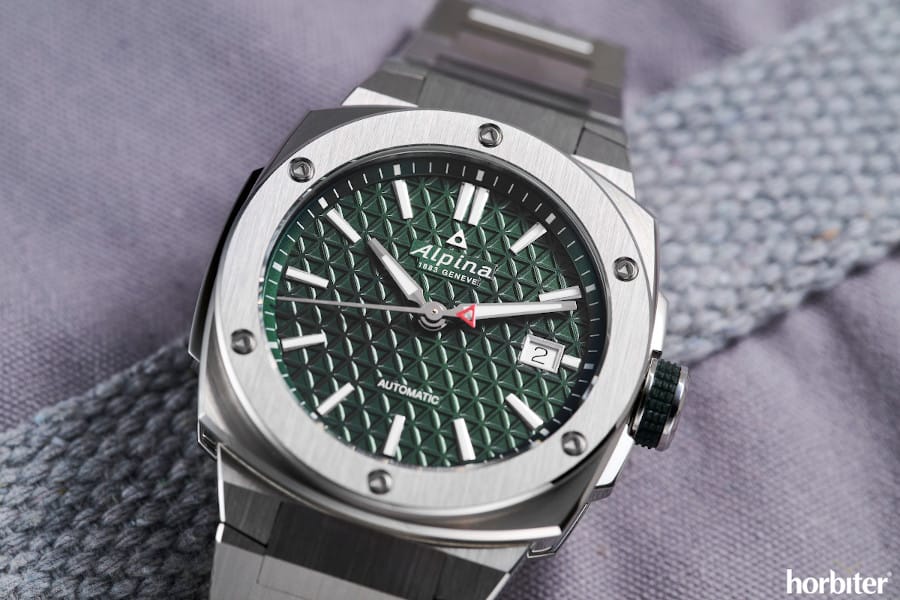
The connection between brand and winter sports is a close one. The Alpiner Extreme works as a sports three-hander range extender whose original cushion case was strengthened with a round bezel secured by six screws and an integrated steel bracelet with a wide H-shaped mid link.
First appearing as a 41.0 by 42.5 mm watch, the Alpiner Extreme downsizes to a more reasonable size, considering any cushion case makes a watch look and feel bigger. According to our measurements, an Alpiner Extreme weighs 141g in its 39.0 by 40.5mm size.
It all comes down to the details.
Alpina’s designers extensively developed the base style to make it a head-turner. The focus is on the tiniest details on the case and bracelet.
Each watch linewas thoroughly assessed; the outcome is an intricate combination of flat surfaces, sharp edges, and strict tolerances between the parts.
As said in our Reel about the Seastrong Diver Extreme model, the cushion caselooks sturdy and functional.
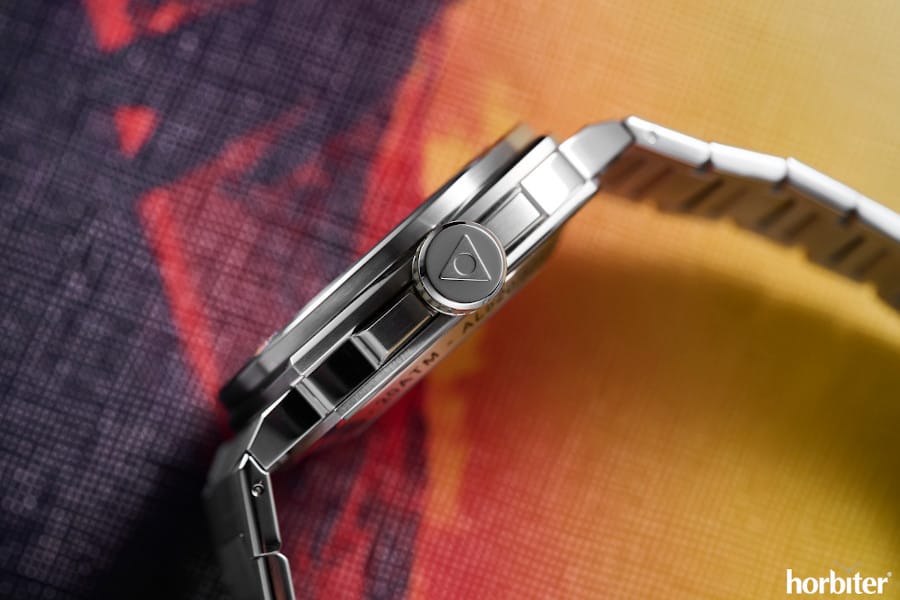
A prominent bumper on the left side stands out and counterbalances the protectors surrounding the screw-down crown, which has a rubber ring in the middle. The Alpiner Extreme is also guaranteed waterproof up to 200m despite not housing a diving bezel.
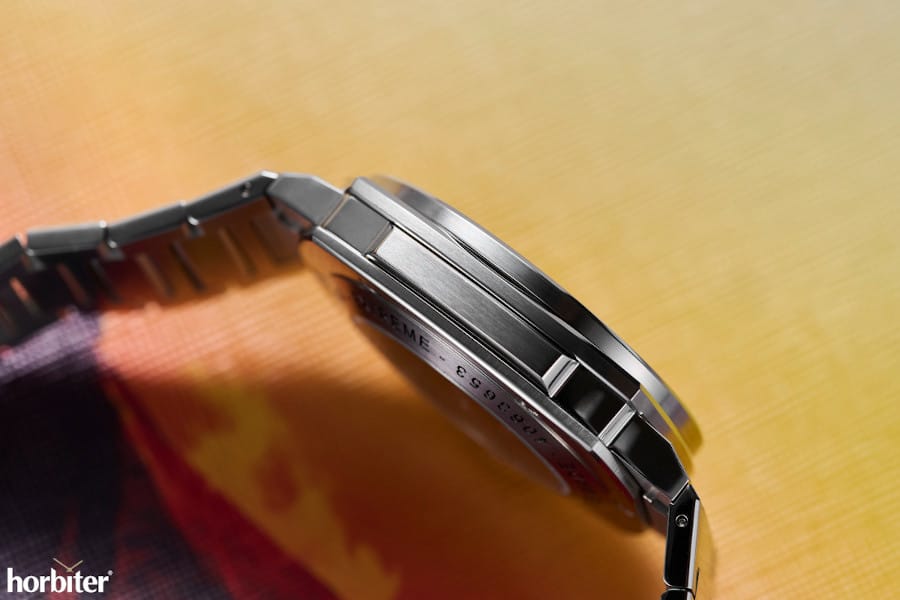
The bumper is one piece with the case; thus, it helps to protect the case from impacts but highlights any scratches or dents resulting from daily use. However, an add-on rubber profile would have looked weird.
The bracelet plays a vital role in the equation. It has the same satin finish found on the case and bezel, sports a rather large H-shaped mid link, and has a high build quality that makes it seem like a one-piece bracelet.
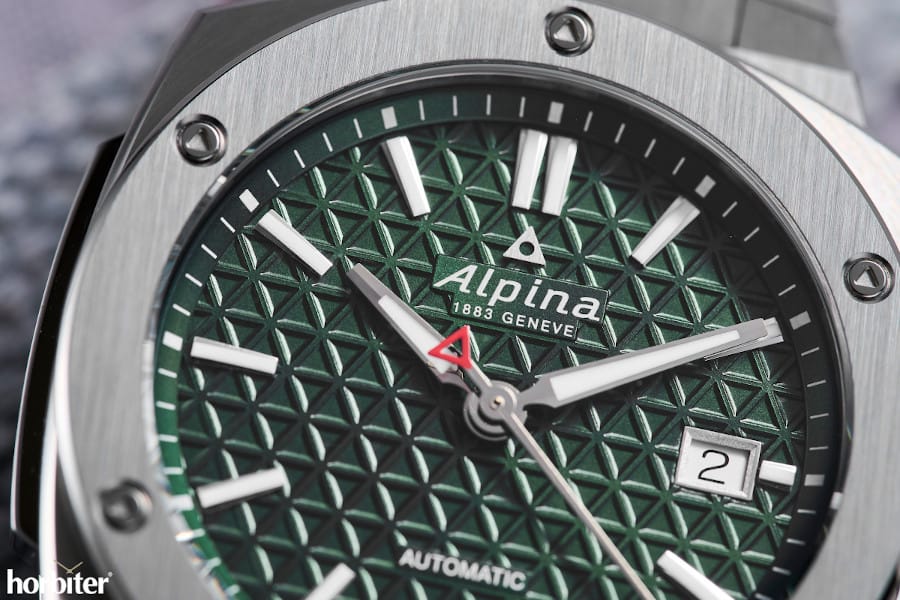
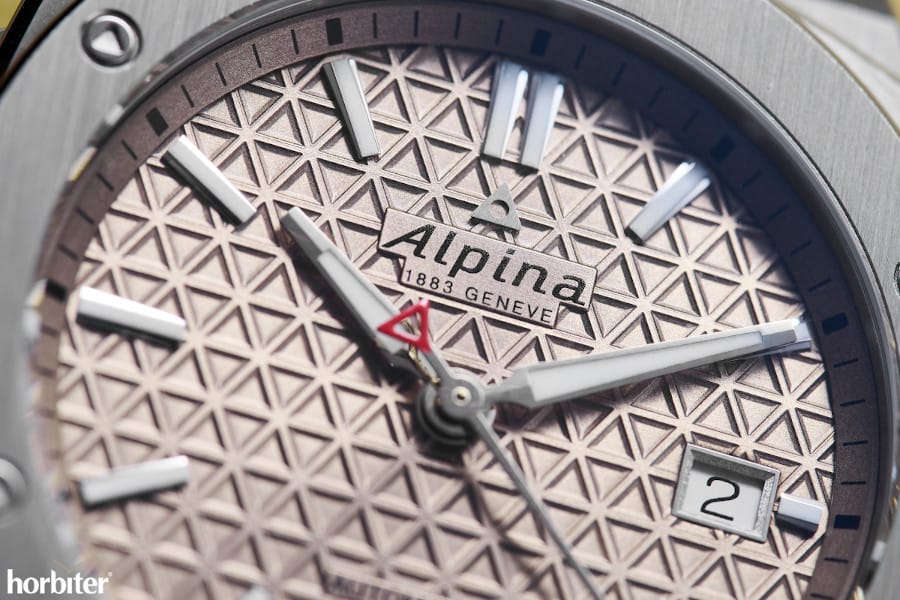
It ends on a butterfly folding clasp with safety push buttons and the Alpina logo on top, which you will find replicated across the dial, and whose pattern stops towards the date window, which we find useless.
The case back and the AL-525 calibre
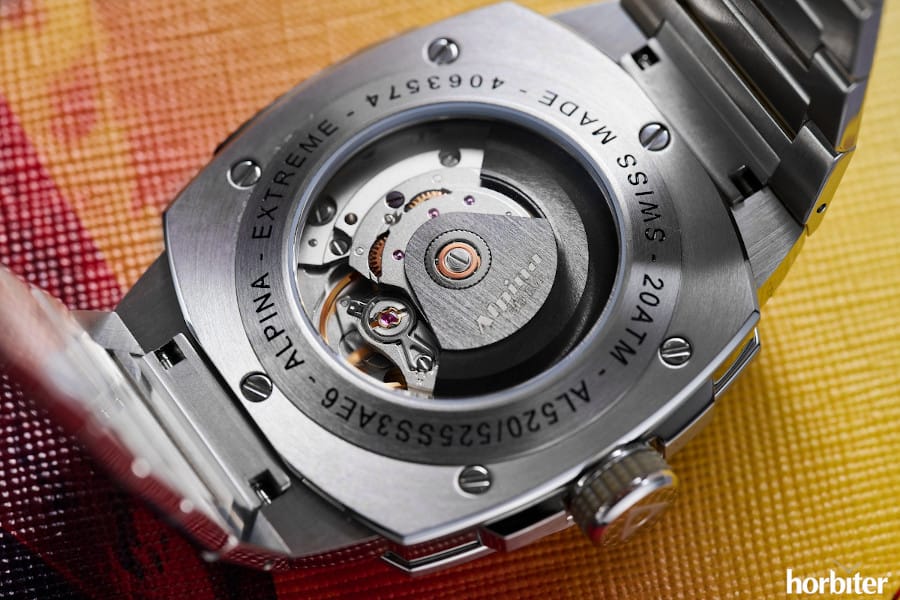
Flipping the watch over confirms the top-notch build quality; the see-through case is fastened via six screws. Coded as AL-525, the self-winding movement is a customized Sellita SW 200-1 bearing an Alpina-badged winding rotor.
It is a workhorse and does the job, but it offers a low 38 hours of power reserve. In contrast, it has proven reliability and low service costs. To me, such a choice is a trade-off of quality, reasonable price point and after-sales costs.
Final thoughts
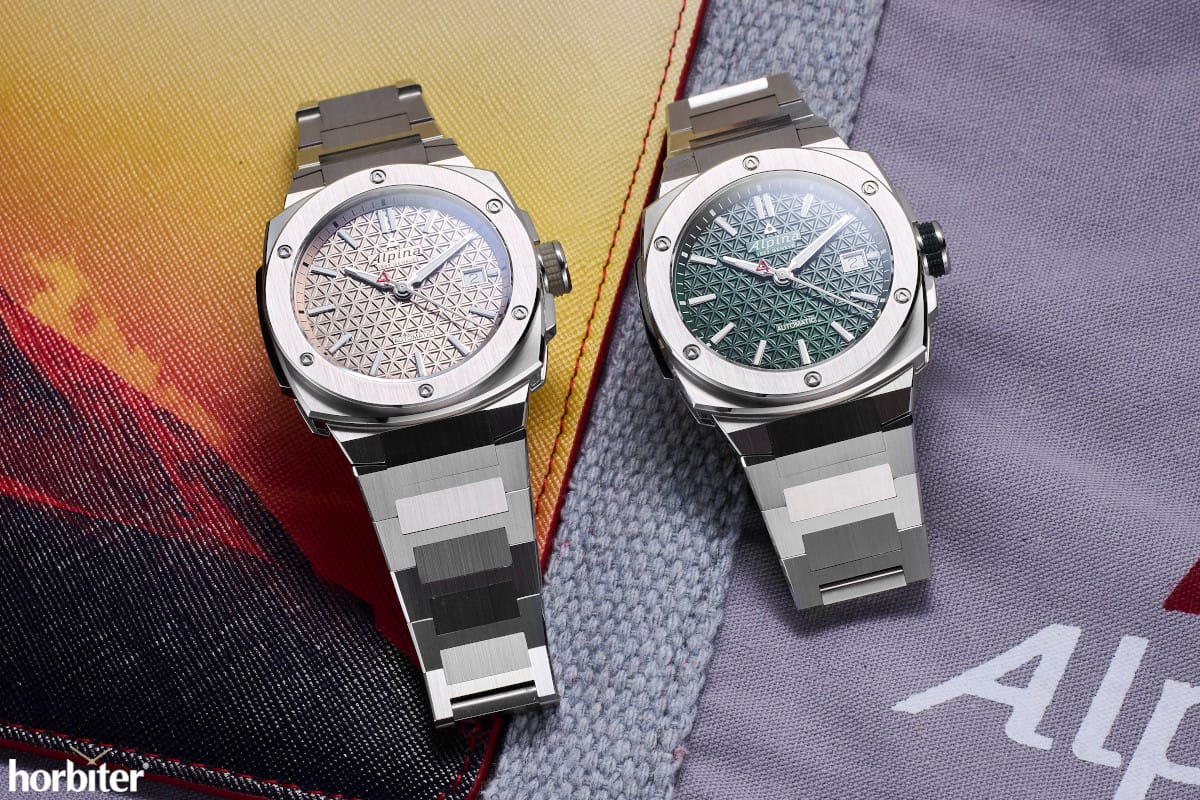
The new Alpiner Extreme 39, here in a British Racing Green and beige livery, costs €1,995. It drops to €1,695 if you opt for the integrated rubber strap. They are reasonable prices for the quality. The high build quality of the case and bracelet stands out.
Alpina has manufactured excellent steel sports watches with nice finishes for the product category, showcasing lovely surface treatments on watches belonging to higher categories.
The size works perfectly on big wrists, too; with a 19.5 mm wrist size, the watch is all but small and provides excellent comfort if we exclude some pinching due to the semi-rigid bracelet.
Finally, I would propose that the brand offer a no-date and a slimmed-down profile by lowering the bezel’s height as much as possible, thus reducing the glass-to-dial gap and thickness overall.
(Photo credit: Horbiter®)
Giovanni Maria Di Biase @Horbiter®
In this article:
Swiss Made
Swiss-made means that a watch's movement is Swiss, it is cased in Switzerland, and the manufacturer carries out there the final inspection.
Case
It encases the mechanical movement and is crafted in one or more parts. It can also be a single piece, as with some professional diving watches, or made of unconventional…
Bezel
The bezel is particularly useful on diving watches, allowing you to check dive times. In this case, it unidirectionally rotates and usually comes in two parts: a metal (or ceramic,…
Line
It is the measurement unit that identifies the size of a movement. According to this measurement system, one line corresponds to 2,255mm.
Crown
Placed on the case side, it winds the mainspring. When pulled out, it also sets the time and the date. A screw-down crown increases water resistance and protects the movement…
Date
It indicates the date of the month. There are different types of display: via a window or a pointer, where an additional hand is usually placed centrally or on a…
Rotor
Part of an automatic watch that winds the mainspring by constantly rotating. Depending on the watch's winding capability, movement design, and value, it comes in various geometries, sizes, and materials.…
Power Reserve
A mechanical watch feature displays, on the dial or the case back, the remaining power in a watch movement, showing the length of time until the timepiece must be rewound.
Strap
A leather, rubber or other material band that secures the watch to the wearer's wrist.