The automatic Navihawk marks an unexpected new product, confirming Citizen’s ambition to create mechanical siblings to its most sophisticated, long-running professional models—watches originally conceived as multifunction analogue-digital instruments.
Before taking a closer look at the Promaster Navihawk Automatic, let’s briefly review the collection’s history and how it has evolved over more than three decades.
The Navihawk appeared in 1994 as part of Citizen’s professional Promaster collection, introduced ten years earlier.
Source: Citizen Design
The first reference, PMG 65–8991, combined analogue and digital displays—a signature approach that set Citizen apart from the wider watch industry, particularly its Swiss competitors.
The Navihawk’s roots lie in the 1989 Promaster Pilot, which brought a slide rule, world time, and analogue-digital timekeeping together on the wrist.
Source: Citizen Design
Promaster’s analogue-digital pilot’s watch took a significant leap forward in 1994 with the first Navihawk. This multi-hand model’s C300 calibre let users switch immediately between analogue and digital world-time displays, operate a chronograph, and access a host of other functions.
From one Navihawk generation to the next
Today’s Navihawk collection retains the original’s analogue-digital architecture in some, though not all, models, ranging from fully analogue watches to more sophisticated analogue-digital versions.
A defining feature of these “combination watches,” including the PMG 65-8991, was an interactive digital display: the case pushers let users navigate the watch’s various functions. A bidirectional slide-rule bezel added further functionality, with turbine-nozzle-inspired protrusions—a detail echoed across many current models.
In 2000, the Navihawk entered a new era with Eco-Drive, eliminating routine battery changes and adding a power-saving function to extend its running time.
Advancements in Super Titanium™, the continued development of Eco-Drive and its ability to draw power from any light source, and the addition of radio-controlled timekeeping have made the Navihawk one of Citizen’s most technically advanced and complete collections.
An extensive lineup with genuine aviation credentials
Across recent and established models, the Citizen Navihawk has used at least six calibres—B620, U680, E660, H800, H804, and H830—depending on the technology and level of functionality.
From B620- and E660-powered analogue chronographs to H804-equipped models, H800 analogue watches, and the latest U800 analogue-digital generation, Citizen has explored Eco-Drive’s full potential. Standout editions honouring the Red Arrows, Blue Angels, and Snowbirds further reinforce the collection’s aviation pedigree.
That rich history of ever-greater sophistication makes the Promaster Navihawk Automatic’s simplicity all the more striking. It opens a new chapter for Promaster, seemingly contrasting with the multifunction philosophy that built the collection.
The first mechanical Navihawk
The obvious question is: why build an automatic Navihawk? Why simplify a watch after developing it so heavily to make it more sophisticated, efficient, and capable?
I’ll return to that question at the end, but one ambition is already clear: Citizen wants to fight back in mechanical watchmaking, a process that began with the Series 8.
That collection, however, was mechanical from the get-go, drawing inspiration from The Citizen’s Calibre 0200 and extending that approach into Citizen’s broader lineup.
It is an intriguing move in Eco-Drive’s 50th–anniversary year, particularly within Promaster, a collection whose identity—its dive watches aside—has historically revolved around the analogue-digital instrument watch.
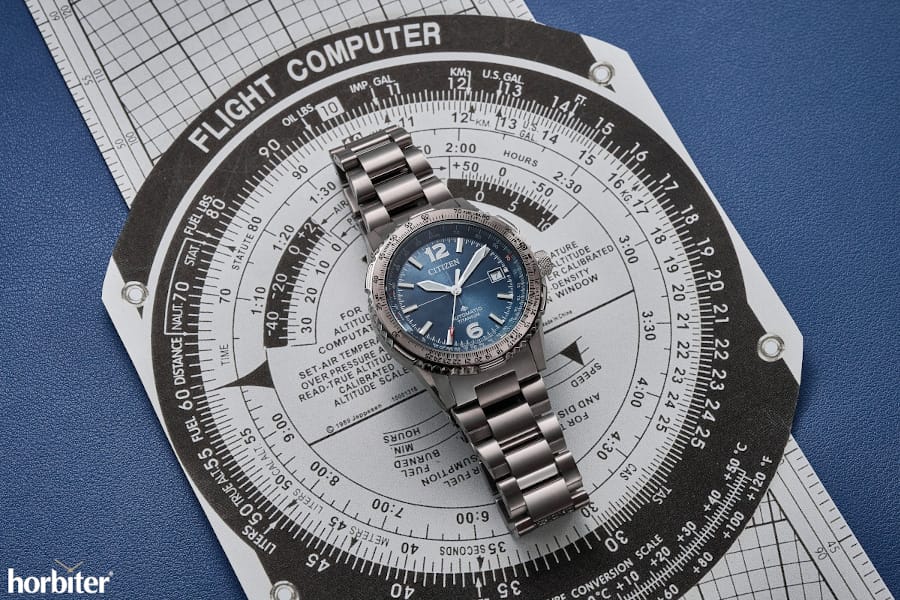
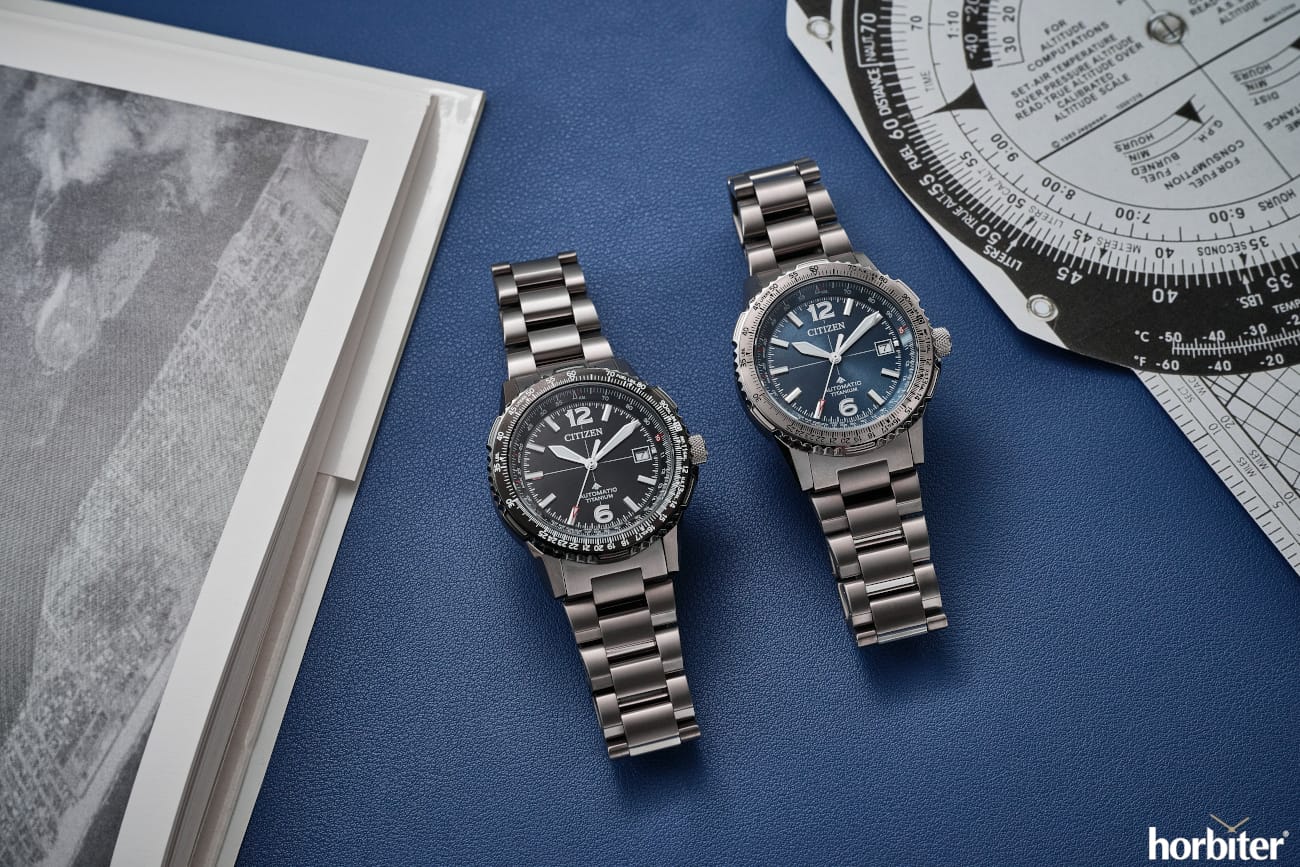
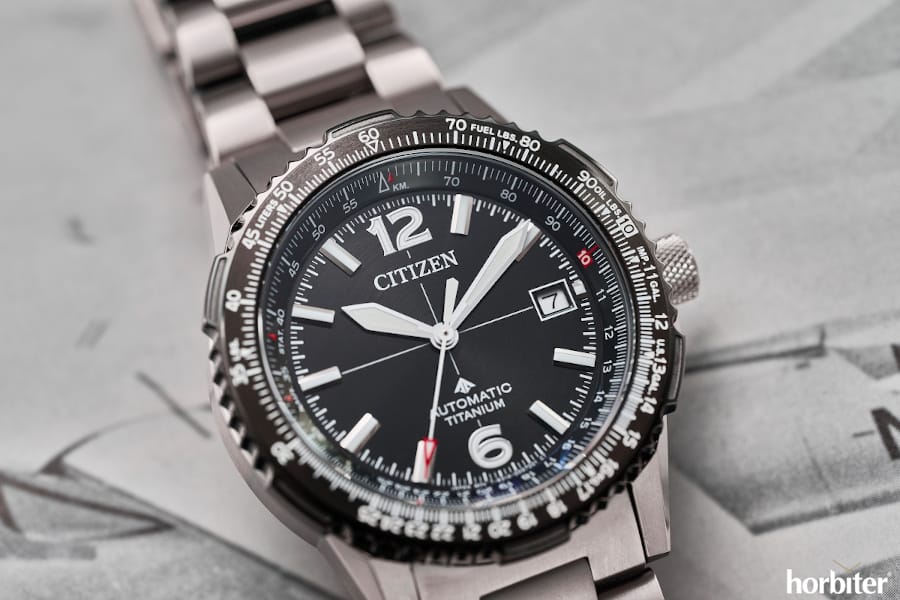
The two new references are essentially three-hand sports watches with a date and central seconds. Their Super Titanium cases measure 40.0 mm across and 13.3 mm thick, while the bracelet tapers from approximately 20.0 mm at the lugs to around 17.0 mm at the clasp.
Titanium keeps things light.
The watch weighs 104.0 grams and is water-resistant to 200 meters, with a screw-down crown for added security.
It comes on the familiar Navihawk–link bracelet, with the usual folding clasp, safety latch, and dual-push-button release.
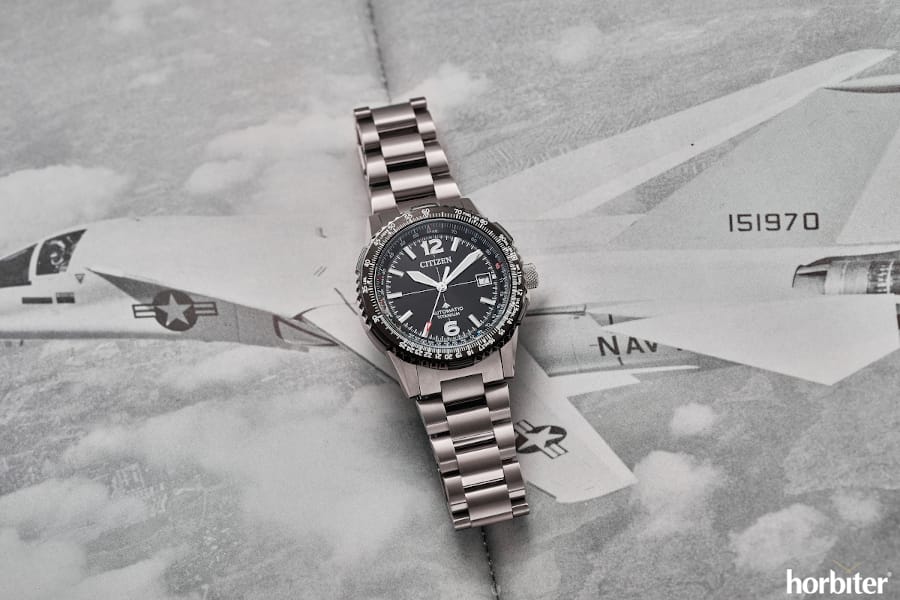
Two dial colours are available at launch: blue and black, the latter paired with a black DLC-treated bezel.
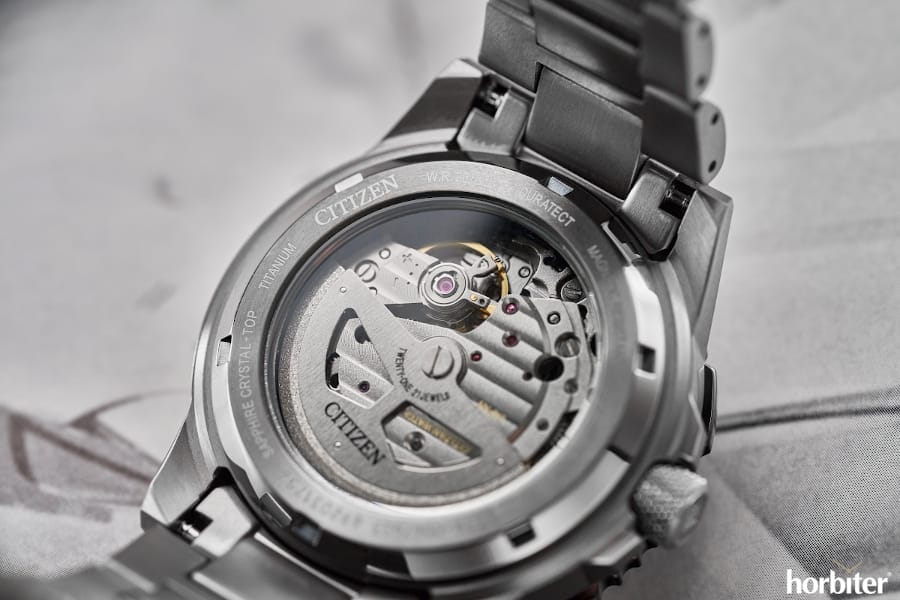
Now for the main event: this is the first Navihawk with a display back. Like the front crystal, its window is sapphire, revealing a movement marked “8314” toward the bottom.
That is Citizen’s internal designation for its customised Miyota 8310, a 3 Hz movement fitted with an openworked rotor. It delivers a 60-hour power reserve at full wind and a claimed daily accuracy of −20 to +40 seconds.
It is a reliable movement with unidirectional automatic winding. Should you choose to wind it manually, a full wind takes 51 turns of the crown.
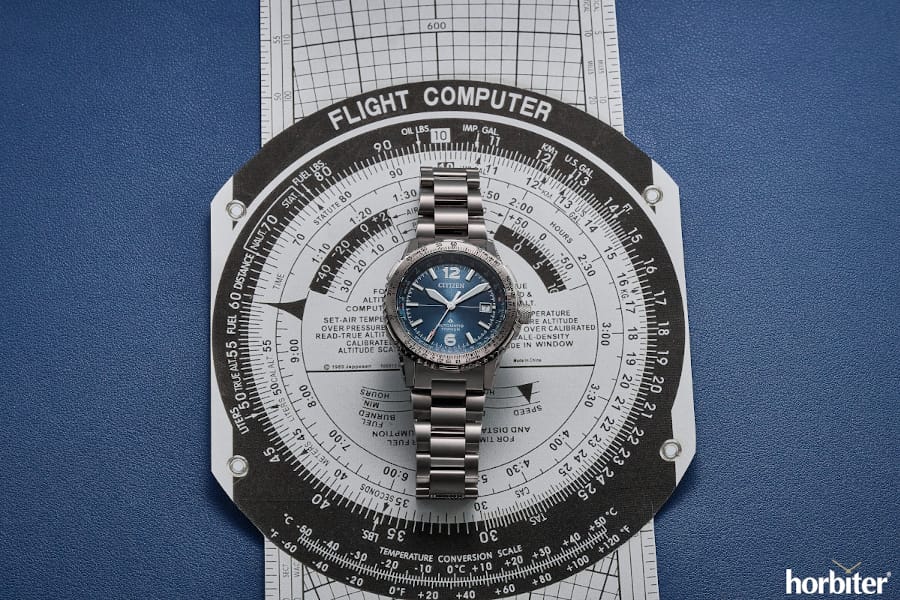
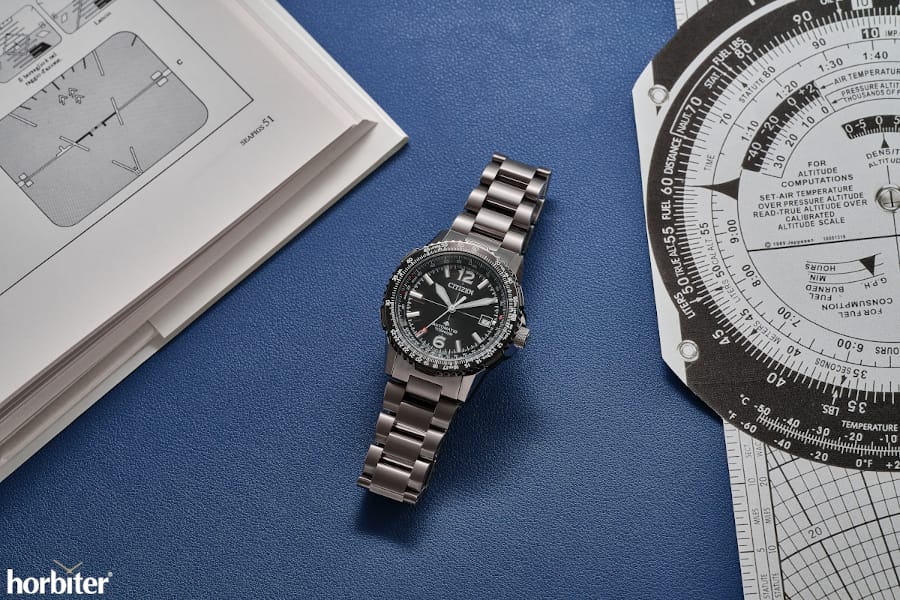
On the wrist, the watch offers a well-judged sporting balance. Despite its simpler architecture, it retains the slide rule—a logarithmic analogue computer that no Navihawk should do without.
The rotating outer bezel and fixed scale on the inner flange let you convert kilometres to nautical miles and litres to gallons, and perform division and proportional calculations.
Few owners will probably use it, but it is readily accessible when needed—and on a Navihawk, it belongs.
Final thoughts
Once the surprise of an automatic Navihawk wears off, its positioning makes sense: Citizen has priced this mechanical alternative in line with the average selling price of its quartz counterparts. That is no coincidence.
Function-minded enthusiasts who actually use their analogue-digital watches will almost certainly choose a latest–generation Eco-Drive Navihawk. They are unlikely to give the mechanical version a second look; some may even consider it heresy.
The Automatic, by contrast, offers a fresh choice among three-hand automatic sports watches for buyers who like the Navihawk but do not want an Eco-Drive model’s complexity.
At €599, Citizen offers an alternative to the multifunction watch without leaving the collection’s usual price bracket.
In short, this is a different kind of mechanical sports watch: one that bears an established collection’s name and still can perform a few calculations through its slide rule.
Keeping the price below €600 probably meant forgoing the greater accuracy of Citizen’s 90–series calibres—the 4 Hz movements used in the Series 8, which are also thinner than the 8310.
A higher-spec movement would have strengthened its position in today’s competitive market, where a 4 Hz automatic is generally expected.
Even so, I hope Citizen keeps developing the collection, including a more refined folding clasp with micro-adjustment.
With the mechanical debut now behind it, I would like to see Citizen follow the Series 8’s development path and add a mechanical Navihawk chronograph.
Not only would that complication make perfect sense in a Navihawk, but it would finally deliver the chronograph we have been waiting for—and Citizen’s history shows it has the technical expertise to execute it exceptionally well.
(Photo credit: Horbiter®)
In this article:
Chronograph
Complication that helps the wearer to measure time intervals without affecting the watch's standard time-telling function.
Calibre
A calibre is the type of watch movement encased in an assigned timepiece. Its name is usually associated with the manufacturer's name and a standard code, e.g., ETA 2824.
Case
It encases the mechanical movement and is crafted in one or more parts. It can also be a single piece, as with some professional diving watches, or made of unconventional…
Bezel
The bezel is particularly useful on diving watches, allowing you to check dive times. In this case, it unidirectionally rotates and usually comes in two parts: a metal (or ceramic,…
Date
It indicates the date of the month. There are different types of display: via a window or a pointer, where an additional hand is usually placed centrally or on a…
Crown
Placed on the case side, it winds the mainspring. When pulled out, it also sets the time and the date. A screw-down crown increases water resistance and protects the movement…
Rotor
Part of an automatic watch that winds the mainspring by constantly rotating. Depending on the watch's winding capability, movement design, and value, it comes in various geometries, sizes, and materials.…
Power Reserve
A mechanical watch feature displays, on the dial or the case back, the remaining power in a watch movement, showing the length of time until the timepiece must be rewound.
Line
It is the measurement unit that identifies the size of a movement. According to this measurement system, one line corresponds to 2,255mm.
Complication
The addition of any mechanical complication to a movement that usually displays the time.