Unveiled as a prototype in 1935, the Radiomir appeared on 24 October. Today does not mark the anniversary celebration we would expect (it has been 89 years since it came out). However, Panerai did not wait any longer to add the new Radiomir Perpetual CalendarGMT Goldtech™ PAM 1453 to their perpetual calendar lineup. With this new Radiomir, the brand adds to Luminor’s first-ever contemporary perpetual calendar.
Luminor or Radiomir?
The brand’s followers belong to two main categories: Radiomir and Luminor owners. The latter is the men’s Panerai par excellence; it is sporty and bold, despite Panerai trying to slim it down with the Luminor Due. A Radiomir’s original military pedigree has turned into the brand’s most classic model, and its association with a traditional high-end mechanical complication like a perpetual calendar makes sense, especially when executed with the purity you would expect from any Panerai.
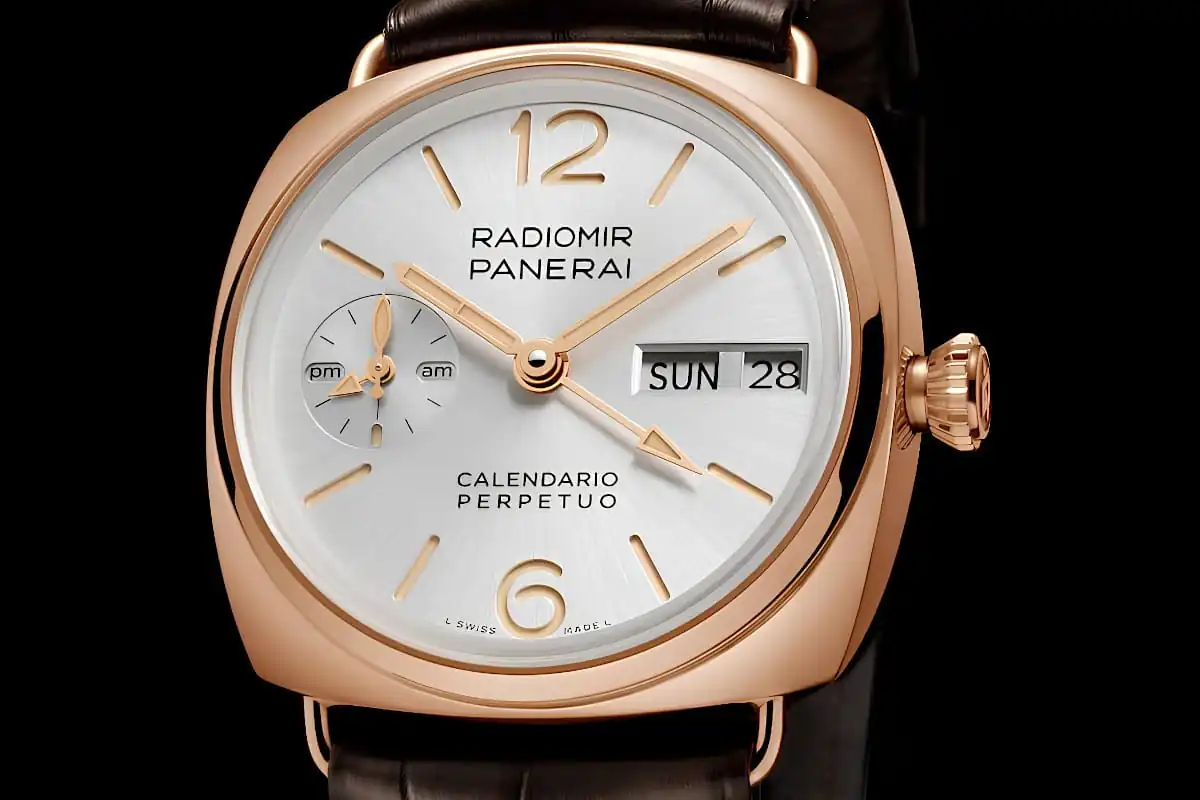
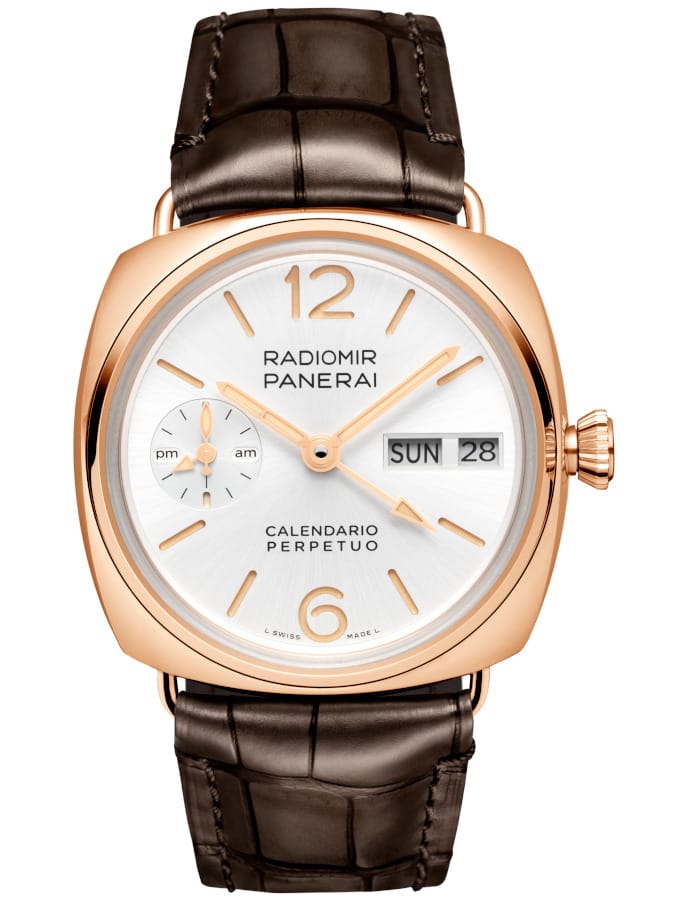
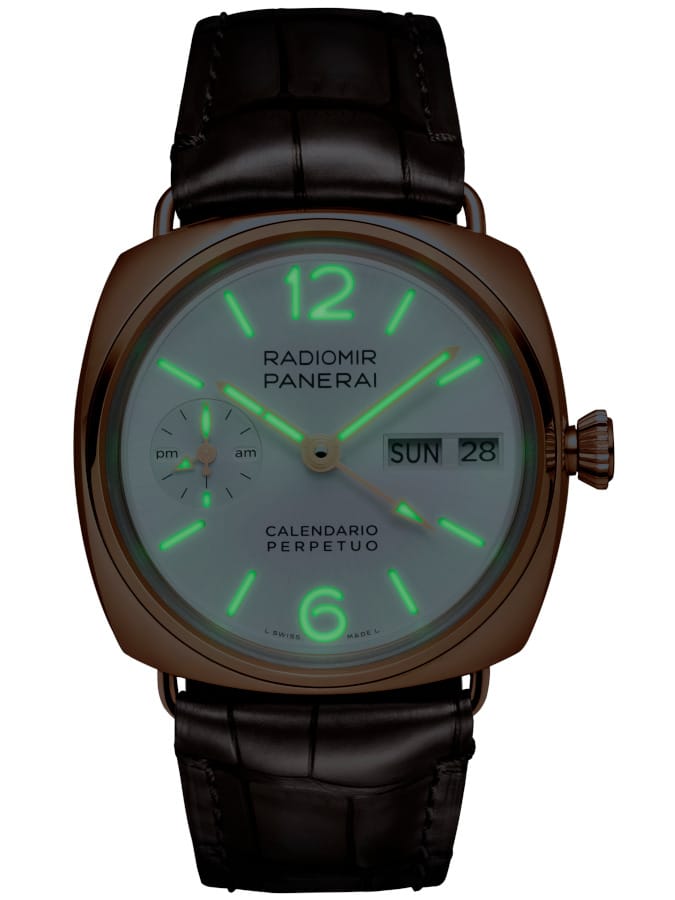
The dial mimics its Luminor sibling’s clean and uncluttered layout, let alone the protective bridge at three o’clock. It welcomes a refined sunray finish over a white tone and a set of immediately recognizable information. The date and day window sits at three, and a GMT indication with a matching 24-hour AM/PM indication at nine is all you need for everyday use.
If you have any questions about the kind of calendar, please head down to the“Calendario Perpetuo” wording to get more information. Paired with a 45 mm Goldtech™ gold case, it is a stunning and classy piece of watchmaking.
However, Panerai did not disclose the case’s thickness, which is high (we wore the watch at Watches and Wonders) since the in-house P.4100 calibre is all but slim. With that said, a Panerai is a big watch and will always be. Its calibre was not designed with thinness in mind but with functionality and sturdiness as core targets.
The Panerai P.4100 caliber
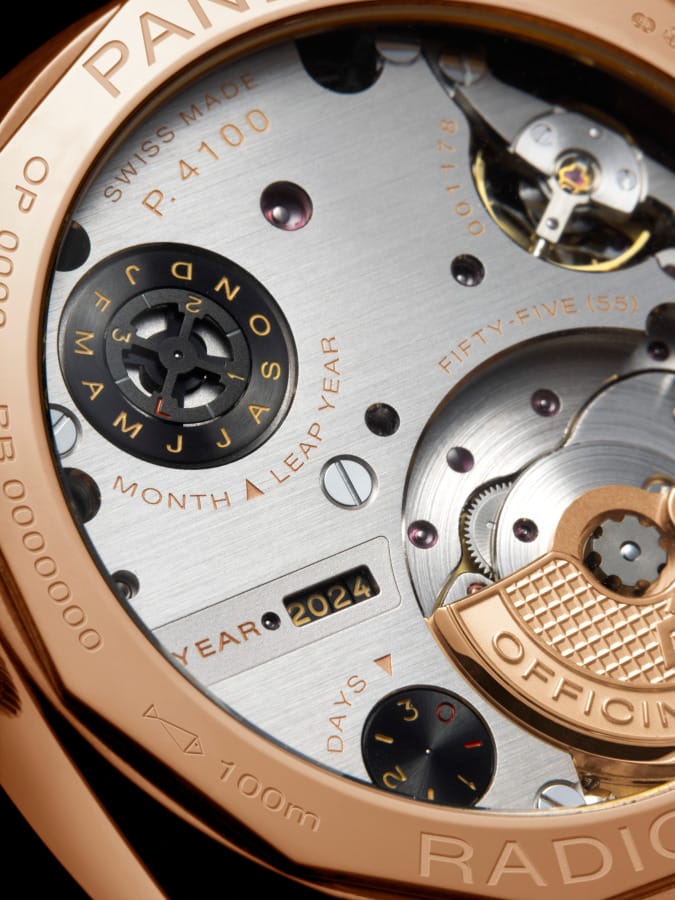
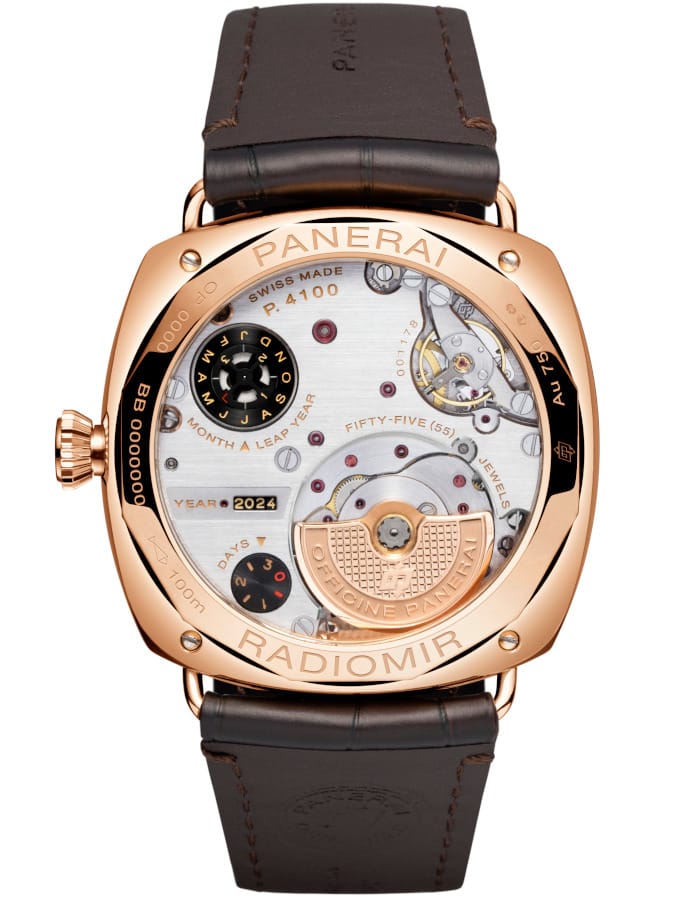
A Panerai Radiomir Perpetual CalendarGMT Goldtech™ PAM1453 features one of the most refined mechanical movements ever engineered at Neuchâtel, conceived to offer ease of use and power reserve for three days once the barrels are fully wound.
All functions are selected and set via the winding crown, thus leaving the case free of unwanted and weird correctors. The primary readings are available on the dial; flip the watch over, and you will access the perpetual calendar ones.
A gold micro-rotor winds the watch, a rare technical solution on a Panerai. In truth, Panerai has already marketed a time-only or a GMT model with a micro-rotor when selling the now-phased-out Radiomir 40 collection. It is a pity that they are no longer available. The P.4100 is a complicated, tried-and-tested mechanical movement manufactured in small quantities. It does not stand out in finish and decoration, but that is not its purpose, placing usability and functions first.
Final thoughts
The Radiomir Perpetual CalendarGMT Goldtech™ PAM1453 costs €50,000, which aligns with what we expect in today’s premium luxury market, whose pricing curve keeps growing steadily.
However, it is not a deal breaker if we cross this kind of complication with other brands in the same product segment, whose offering also includes ultra-thin watches. The Radiomir Perpetual Calendar stands out in boldness and style and, from our perspective, it is a timepiece you will wear and like for a long time.
Here is the most luxurious Gold Radiomir watch you can buy in decades. It is also 100-meter water resistant. Therefore, we can hardly understand why Panerai did not add a replacement rubber strap so that you can easily wear such beauty during the summer season.
(Photo credit: Panerai)
Giovanni Maria Di Biase @Horbiter®
In this article:
Perpetual Calendar
The perpetual calendar is a complication that adjusts the watch's calendar for varying months and leap years. This cycle will end in 2100, and the wearer should apply the first manual correction.
GMT
It is the acronym for Greenwich Mean Time and identifies a complication capable of displaying two or more time zones on the dial. The complication usually couples a 24-hour rotating…
Calendar
A feature that shows the day of the month and, in some cases, the day of the week. Some calendar watches show the date on sub-dials, while others display the…
Complication
The addition of any mechanical complication to a movement that usually displays the time.
Date
It indicates the date of the month. There are different types of display: via a window or a pointer, where an additional hand is usually placed centrally or on a…
Case
It encases the mechanical movement and is crafted in one or more parts. It can also be a single piece, as with some professional diving watches, or made of unconventional…
Calibre
A calibre is the type of watch movement encased in an assigned timepiece. Its name is usually associated with the manufacturer's name and a standard code, e.g., ETA 2824.
Power Reserve
A mechanical watch feature displays, on the dial or the case back, the remaining power in a watch movement, showing the length of time until the timepiece must be rewound.
Crown
Placed on the case side, it winds the mainspring. When pulled out, it also sets the time and the date. A screw-down crown increases water resistance and protects the movement…
Rotor
Part of an automatic watch that winds the mainspring by constantly rotating. Depending on the watch's winding capability, movement design, and value, it comes in various geometries, sizes, and materials.…
Water Resistant
A watch is water resistant when it can withstand splashes of water. It indicates the depth to which a watch can be worn underwater.
Strap
A leather, rubber or other material band that secures the watch to the wearer's wrist.