When you think of an F.P.Journe timepiece, your mind suddenly shifts towards the quintessential classic watch, housing a full-gold movement loaded with exclusive, patent-covered specifications.
The Swiss watch industry has risen to new heights since this master watchmaker opened its workshop, thus fostering next-level Haute Horlogerie like never before and making traditional watchmaking popular like no other watch brand can in the benchmark.
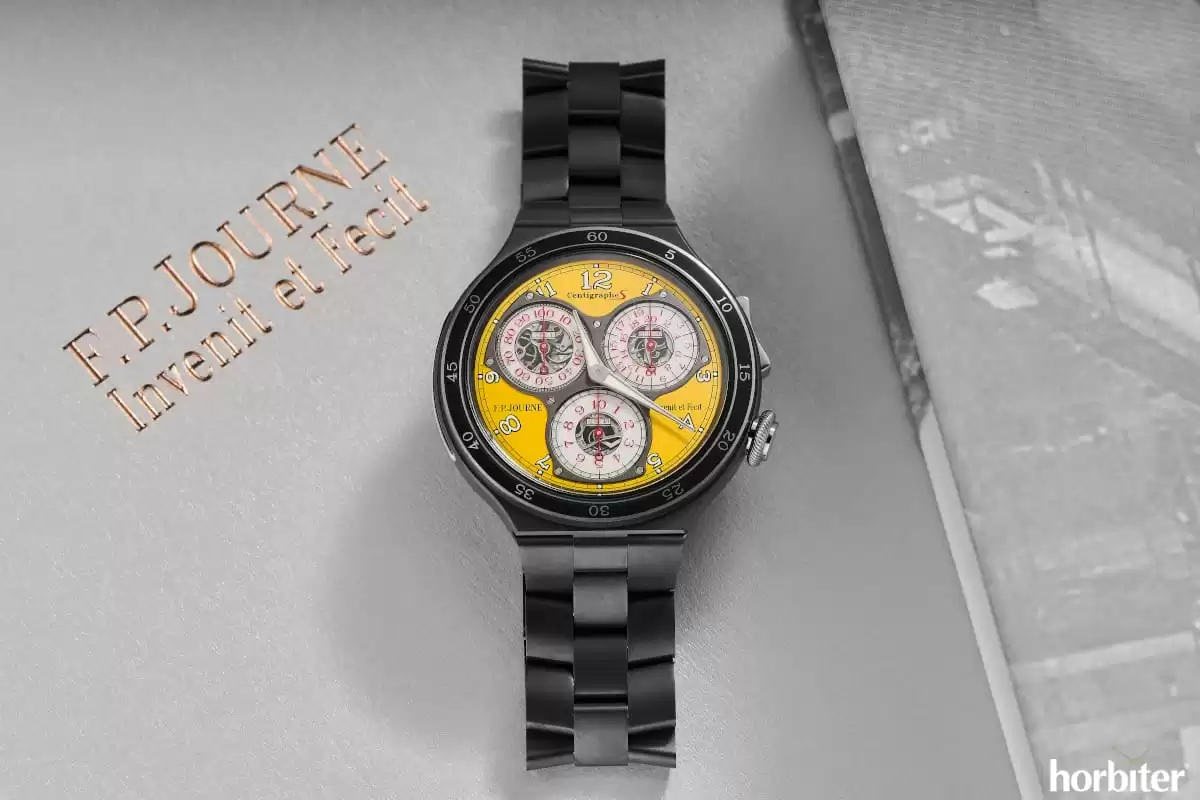
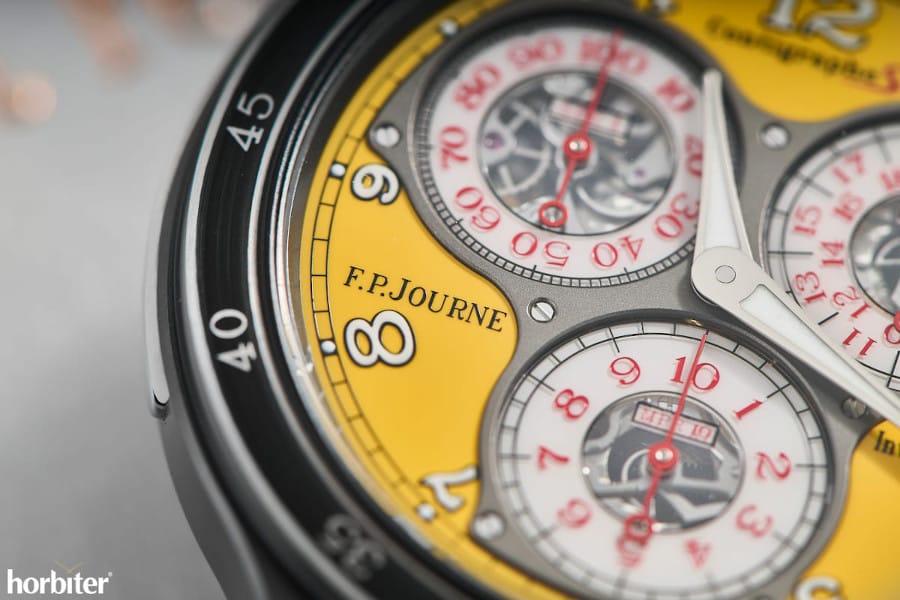
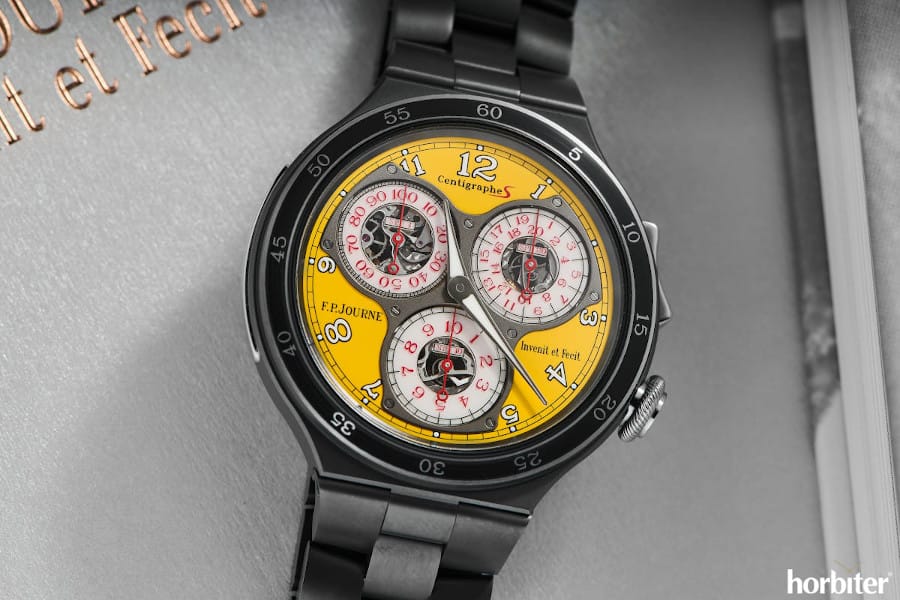
F.P.Journe’s LineSport is F.P.Journe’s take on luxury sports watchmaking, and the F.P.Journe Centigraphe follows up the glorious Centigraphe Souverain introduced in 2008.
How is an F.P.Journe Centigraphe made?
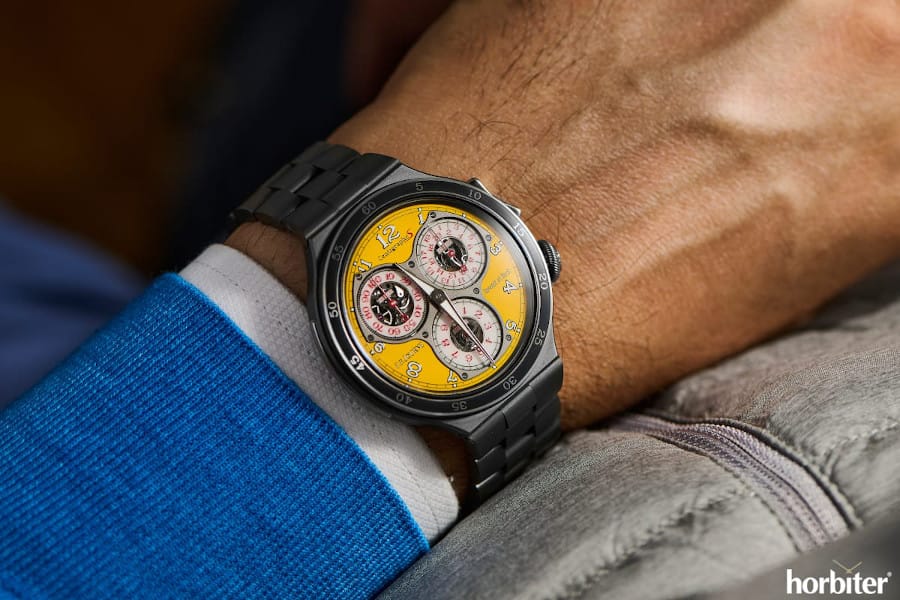
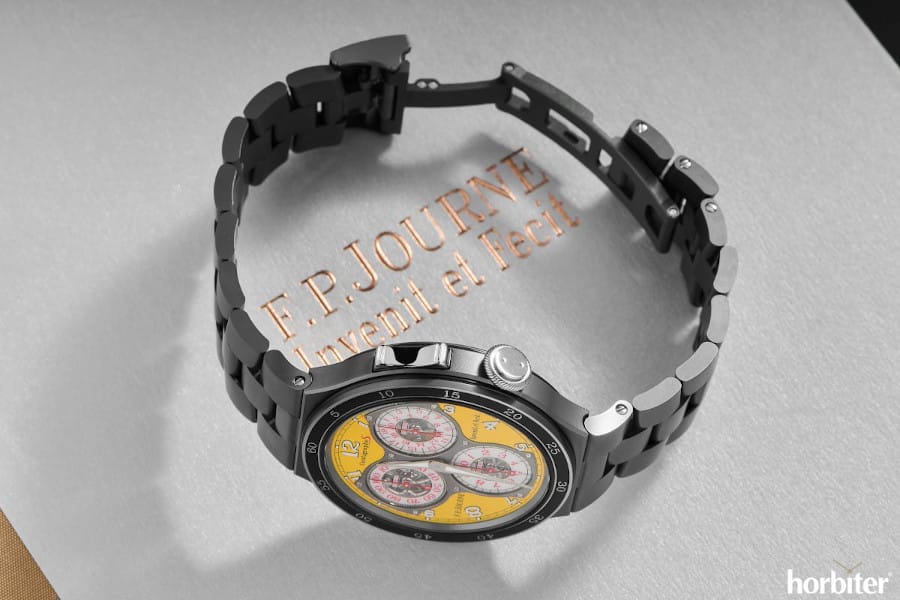
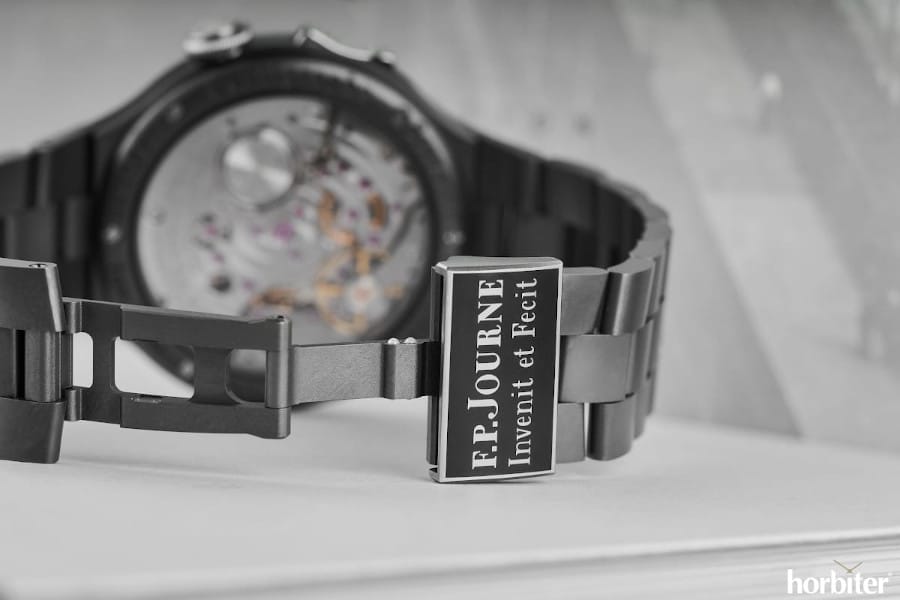
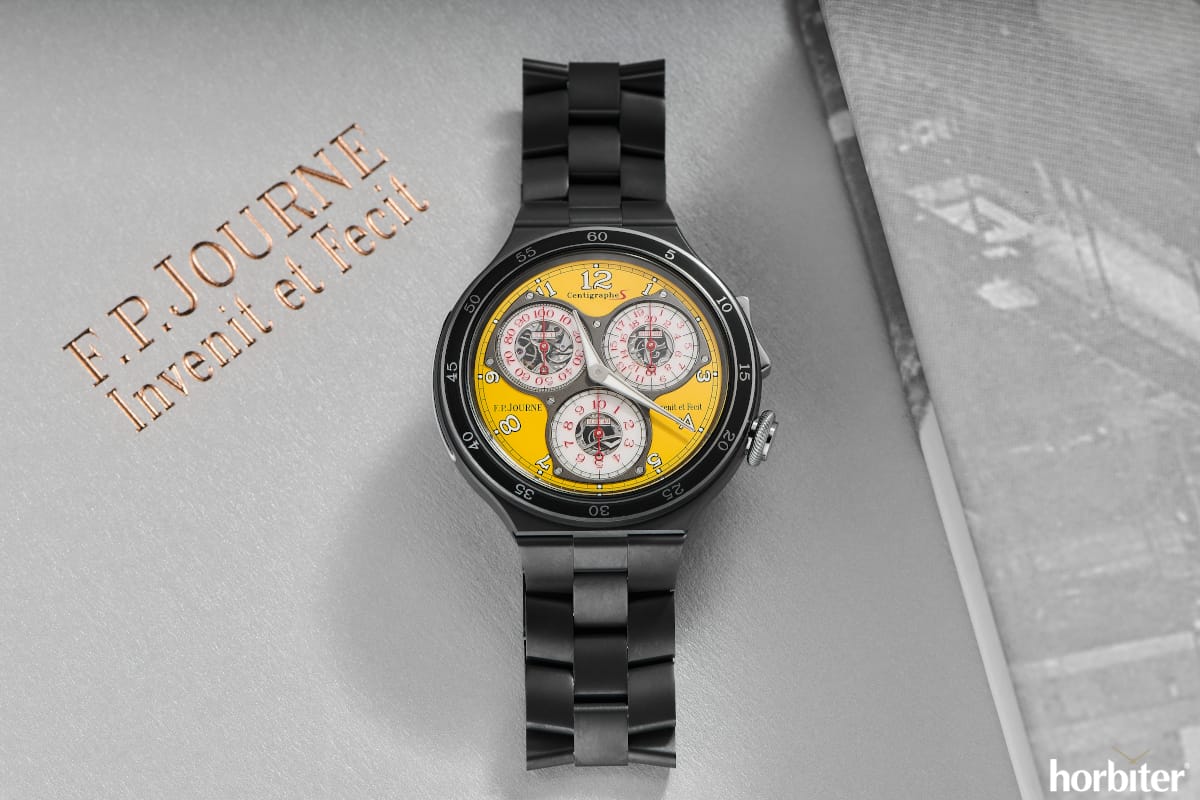
Case and bracelet prove how committed designers were to offering a watch deserving the F.P.Journe moniker inside and out; judging by the eccentric colour scheme proposition, it was pretty challenging. This Centigraphe’s case comes in grade 5 titanium as the integrated bracelet (please note that the Centigraphe also comes with a rose gold or a platinum case, and a gold movement) whose first section joints to a mainstream three-link, fixed-width bracelet which extends all the way down to a folding clasp sporting a big black plate with the “F.P.Journe – Invenit et Fecit” brand name and pay off.
Case and bracelet
Such an extensive logo sits on the opposite side of the spectrum to trend-setting marketing strategies where “the smaller, the better” and somewhat clashes with the super light package’s appearance.
Titanium grants the 44 mm large and 11 mm thick case a two-digit weight: on paper, it marks an excellent 81 grams, but please consider that it runs on an aluminium alloy hand-wound mechanical movement.
The wholly flexible bracelet ensures supreme comfort and outstanding balance between case and bracelet once you secure the watch onto your wrist. Just wear it, and you’ll look at your wrist in minutes to perceive whether you ever wore it. Form and function are, therefore, entirely complementary.
The “rocker” hides first-class engineering.
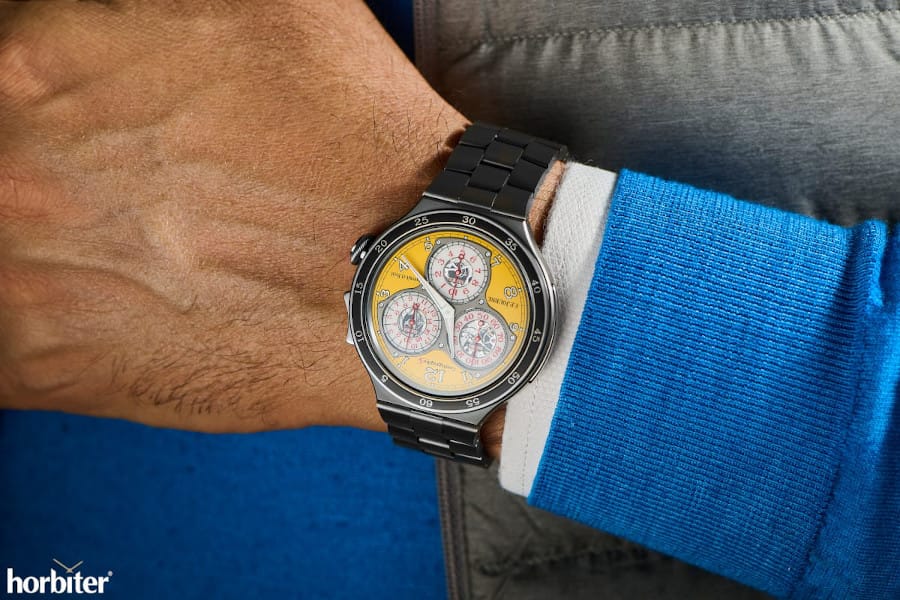
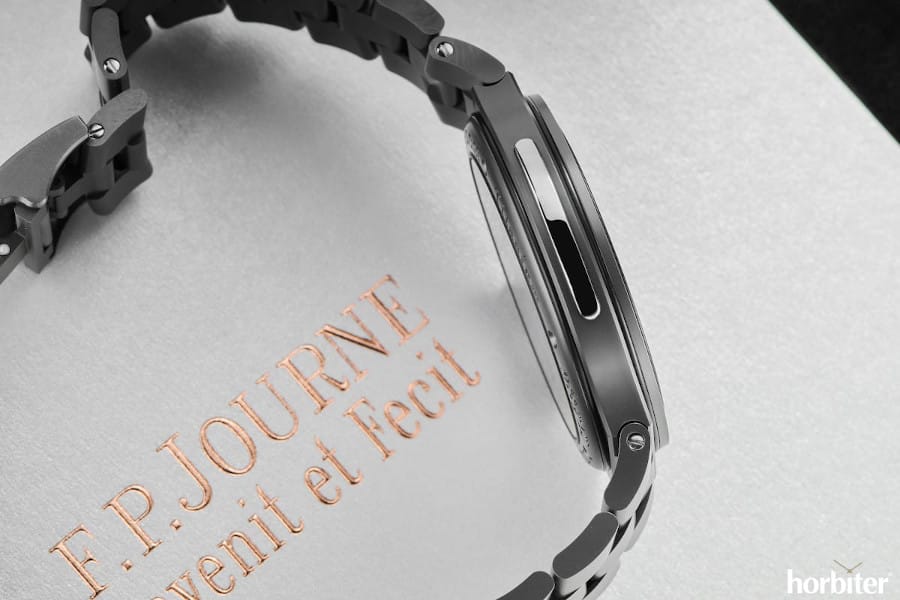
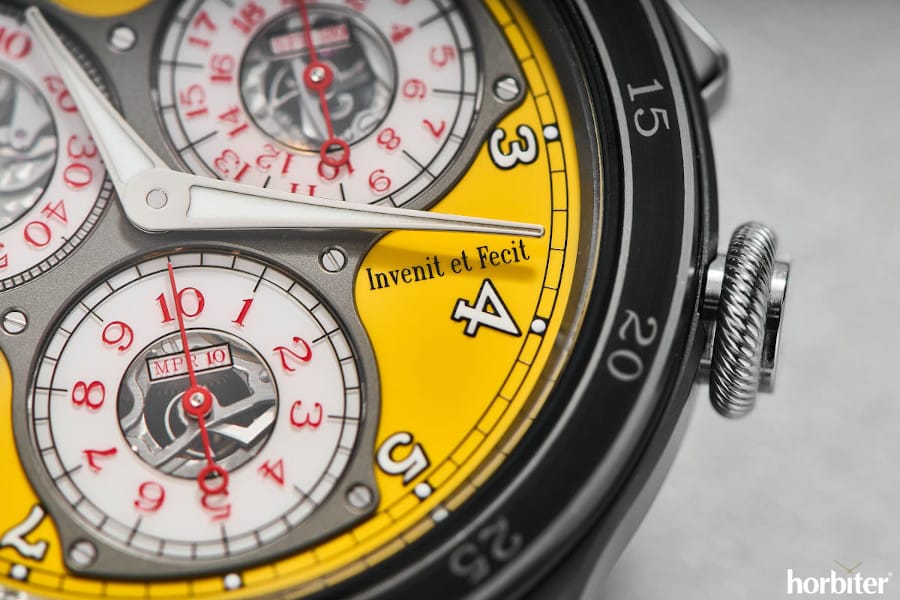
Contrasting the brushed finish, ceramicbezel included, is a polished winding crown placed at four o’clock and what looks like a slide at 2:30. Roll the watch over its right side, and you’ll spot an equally polished plate on the left-hand side. The former is the“rocker”, which integrates all the chronograph triggers into a single device and makes the case silhouette as sleeker as it gets.
Press the upper end, and you’ll start or stop the Chrono; press the lower one instead and see all the counters reset. It’s brilliant since it groups the Chrono functions into a single, ergonomic device you’ll love while wearing the Centigraphe on your left wrist; I wonder how it feels if you’re wearing it on your right one.
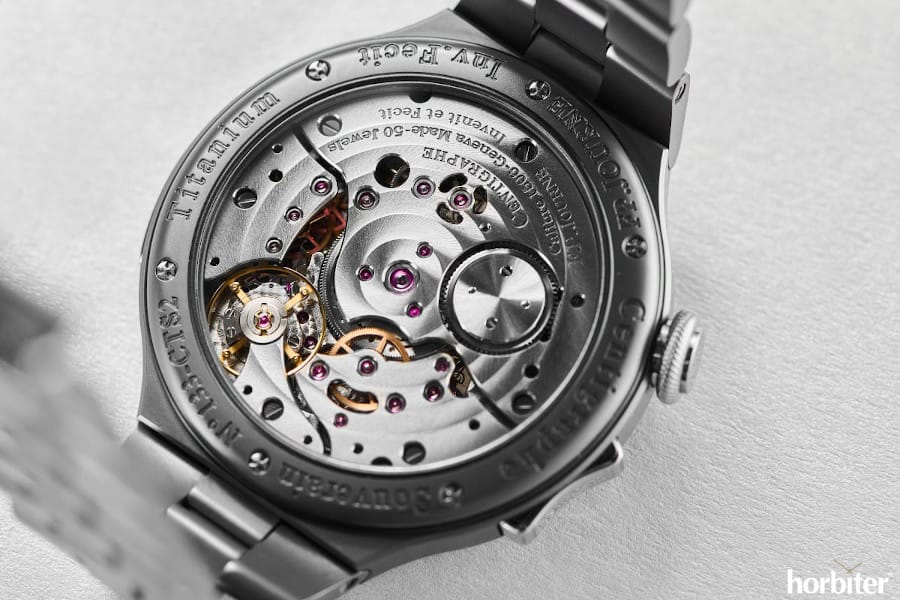
The rocker triggers the masterfully engineered 1506 movement’s chronograph, crafted in aluminium to save every ounce of weight: from an engineering perspective, 1506 proves why F.P. Journe is ages ahead and the fiercest competitor to any brand.
How can calibre 1506 measure one-hundredth of a second?
While aluminium ensures the 1506 movement weighs a jaw-dropping 12g, its design sets F.P.Journe as the leading master watchmaker in ingenuity, capable of defying any established convention. In 2007, the brand filed a European patent – the EP1978424A1 – about an innovative chronograph movement.
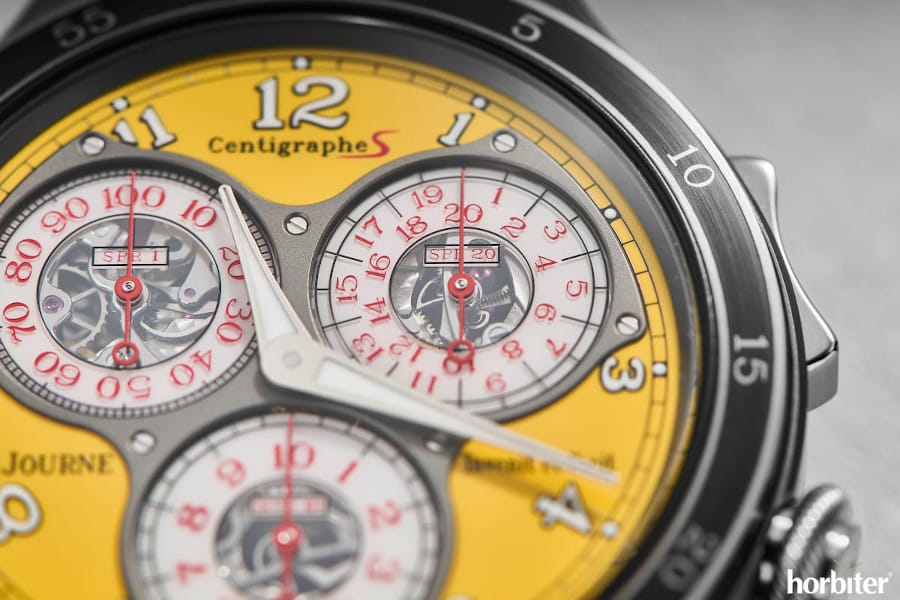
The 1506 runs at 3 Hertz but comes equipped with a chronographcomplication capable of measuring and displaying hundredths of a second, which looks impossible to achieve with such a layout; 3 Hz means the escapement vibrates at six beats per second.
Unlike any ordinary chronograph movement where the wheel train engages or disengages with the time wheel via a horizontal or vertical clutch, the F.P.Journe calibre 1506 adopts a holistic approach whose outcome we will try and explain via the patent’s official drawings.
A vicious cycle
By following a mainstream design, you end up with the following: if you keep increasing frequency, you increase the chronograph precision (and vice versa) but require more energy.
As a result, you’ll need more power reserve and increase the size and number of barrels, thus growing weight, too. Here comes F.P.Journe’s ingenuity.
The F.P.Journe Centigraphe adopts a single winding barrel positioned in the middle; the main gears and levers, like the column wheel and all the kinematics powering the chronograph, are arranged on the dial side. Yet, time and Chrono measurements are apart from one another, and so are their wheeltrains.
Why splitting time measurement from Chrono functions makes a difference.
What we described in the paragraph above prevents the chronograph from affecting the escapement’s amplitude once it’s running. Also, you can only measure something as precise as 1/6 of a second by mounting a 3 Hz escapement. How did F.P.Journe turn a 1/6 of a second time measurement into a 1/100?
The single barrel is not ordinary and was designed to release energy to the chronograph mechanism and the time-going train equally during any available mixed scenario where both operations are running. If you use your F.P.Journe Centigraphe as a time-only watch, you’ll run out of power reserve in 80 hours; activate the chronograph, and you’ll end up using your Centigraphe for 24 hours until it stops.
From 21.600 to 360.000 beats per hour
A view through teared-down calibre 1506 helps you spot the column wheel, all the cams and levers triggered by the rocker and the tiny wheel driving the tiny 1/100th of a second hand. Jump to the technical drawing pictured below to enjoy a clear view of all the mechanism gearings regarding the Chrono activation, stop and reset.
The star in the show is the small wheel marked as 4f; it engages with the F wheel, coaxial to the escapement, via a 5 to 1 ratio. It means that while the F wheel makes a complete revolution in 5 seconds, the 4f takes 1 second instead.
The latter is powered through the dotted-line five-wheel gear train connected to the barrel and is fastened up by wheel F through a finely tuned selective engagement (hence slip and engage), as opposed to any ordinary one where two gears’ teeth smoothly and continuously engage with their counterpart one by one.
How this currently happens would require a 3D animation, and we understand it’s the intellectual property’s centrepiece. However, it’s incorrect to claim that there is no engagement between the main wheel from the time measurement and the chronograph one at all; the wheel-to-wheel engagement is so selective (and precise) that the latter does not affect the escapement’s amplitude.
What an achievement
Francois-Paul Journe achieved two opposing targets: low frequency for superior power reserve and reduced wear and size with one-hundredth of a second reading, without adopting a fascinating yet easygoing two-escapement design, as exemplified by a Breguet Tradition 7077, for instance, which adds complexity, size and weight, and might affect long-term reliability and (or) service costs.
Final thoughts
Can we define F.P.Journe as the 21st-century Breguet? Yes, we can. His executions are masterfully conceived and bond pure classicism within a sporty attire. The proposition is unique, technically unrivalled, and fully justifies the retail price of CHF 65,900 (+ tax).
Nonetheless, no watch is perfect, and neither is the F.P. Journe Centigraphe. My only concern regards the bracelet; we’d like a more slender, less ubiquitous design with an entirely hidden butterfly folding clasp and a smaller logo. For further information please visit the official F.P.Journe website.
(Photo credit: Horbiter®)
Giovanni Di Biase @Horbiter®
In this article:
Case
It encases the mechanical movement and is crafted in one or more parts. It can also be a single piece, as with some professional diving watches, or made of unconventional…
Chronograph
Complication that helps the wearer to measure time intervals without affecting the watch's standard time-telling function.
Crown
Placed on the case side, it winds the mainspring. When pulled out, it also sets the time and the date. A screw-down crown increases water resistance and protects the movement…
Ceramic
Widely used for crafting a watch case and, in recent years, also for the bezels of diving watches and dials. Obtained from zirconia powder (ZrO2), ceramic offers superior scratch resistance…
Bezel
The bezel is particularly useful on diving watches, allowing you to check dive times. In this case, it unidirectionally rotates and usually comes in two parts: a metal (or ceramic,…
Complication
The addition of any mechanical complication to a movement that usually displays the time.
Calibre
A calibre is the type of watch movement encased in an assigned timepiece. Its name is usually associated with the manufacturer's name and a standard code, e.g., ETA 2824.
Frequency
It is the number of oscillations of the regulating organ. It is divided into hours, mechanical watches, and quartz watches.
Power Reserve
A mechanical watch feature displays, on the dial or the case back, the remaining power in a watch movement, showing the length of time until the timepiece must be rewound.
Barrel
It is a cylindrical metal box closed by a cover that contains a spiral spring called the mainspring, which provides energy to run the timepiece.
Line
It is the measurement unit that identifies the size of a movement. According to this measurement system, one line corresponds to 2,255mm.