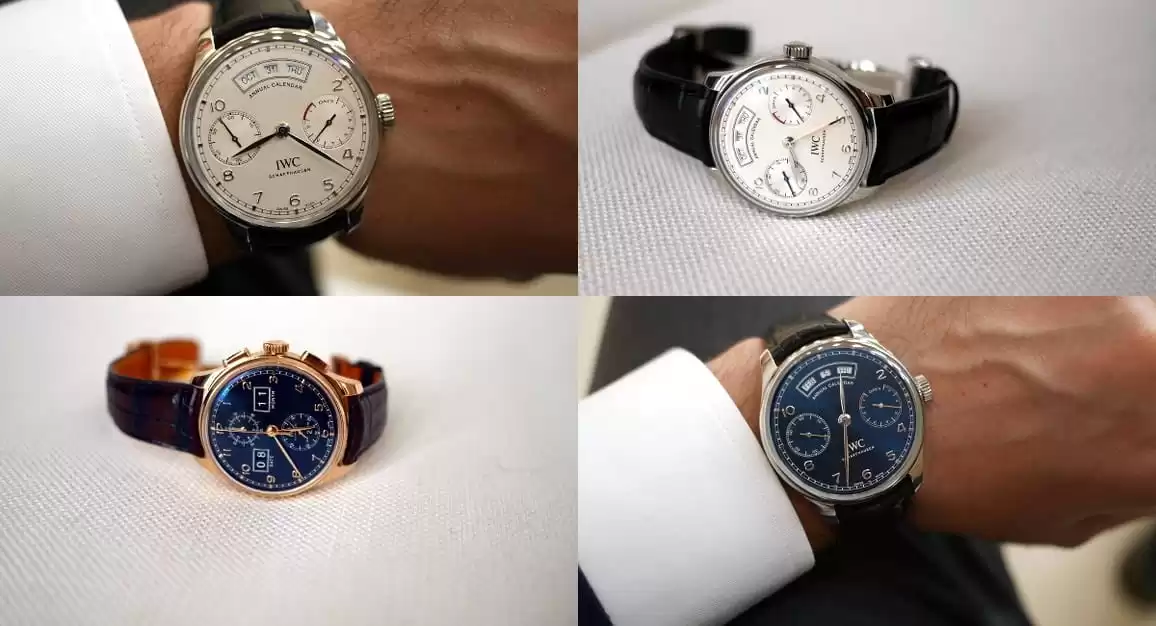
IWC at SIHH 2015: please welcome the new Portugieser.
Giovanni Di Biase17 March 2021
0 Comments
It is not by chance that we have not given during the fair a preview of any of the novelties introduced by IWC at the SIHH 2015, but just released a picture of some of them on our Instagram profile.
Behind the celebrations for the anniversary of an emblematic collection from IWC, the Portugieser (as Italians we will continue to call it “il Portoghese”, but please don’t call it “Portuguese” in English anymore), lays an impressive product development roadmap that goes well beyond the current year, and it revolves around present and future mechanical manufactured movements. To have given even a simple preview would have been reductive to say the least.
The Portugieser’s 75th anniversary is all about design, new products but, above all, a decisive acceleration towards the brand consolidating its position among well-established high-end watchmaking industries: concept, development and in-house production of every single component.
This message, quite clearly expressed during the press conference, has three main take-outs: the continuous improvement of the current range of complicated calibers, the upgrade of the Portugieser’s collection, a great deal of work on details. The most visible outcome is the launch of two new models, as well as six products updates; this raises the technical bar and improves brand awareness even further.
The future is represented by the launch of two new calibers, the IWC 69000 and the IWC 42000, a chrono and a three hands base movements: this will also mean that some entry-level models will adopt very refined in-house movements (expect the 42000 to go on the 40mmIngenieur and the Aquatimer, the 69000 to power the Aquatimer and Pilot’s chronos, maybe). We will discuss this in a separate article.
The flagship of the 2015 collection is the Portugieser Annual Calendar ref 5035. Eagerly awaited, teased and previewed, it fills in the gap between the Portugieser Automatic and the Perpetual Calendar, and is a complicated as neat as the PortugieserAutomatic (it features a 44,2mm wide and 15,3mm thick case), with the addition of three tiny windows for month, date and day of the week, placed along a circular sector at 12.
IWC has developed a new caliber belonging to its 52000 caliber platform, the 52850; this activates, merely via the crown (as always, no corrector is placed on the case), all months, except for February and leap years; for that we have the perpetual calendar.
Indeed, the entire 52000 series has been further improved by adopting, for instance, ceramics for reducing mechanical friction (the rotor’s ball bearings), a new rotor design, an increased balance wheel operating frequency. In a nutshell: 4Hz calibers boasting a 7 days Power Reserve, increased efficiency and an enhanced visibility of the movement, whose size is comparable to the case’s width.
IWC automatic timepieces have indeed a close to one movement size to case size ratio, thus making the Annual Calendar a complicated wristwatch that blends the pros of a high-efficiency automatic watch (I’m talking about the updated Pellaton winding system) with an almost “skeletonized” three-spoke bidirectional rotor, so that it almost feels like holding in your hands a complicated with a manual wind, Pocket Watch like caliber, for the pleasure of true connoisseurs.
So far no other brand in today’s haute horology has conveyed this message as successfully as IWC.
I asked myself why IWC added the writing “Annual Calendar” on the dial. Was it necessary? Probably not, but I think the answer is to be found in the word “symmetry”, which is taken quite seriously at Schaffausen (I already discussed this in a previous post, with reference to the Top Gun’s Perpetual Calendar’s four counters symmetry): try to ideally remove the writing from the dial, and it will seem that the circular sector has been moved towards the inner rehaut, thus increasing the visual gap between the window itself and the two counters plus the “IWC Schaffausen” wording.
What is hard to show you with photos is the “glass box” sapphire crystal: on the wrist, the Annual Calendar is “perfectly balanced” and if it weren’t for the price point (21.500€ for the stainless steel model, 31.700€ for the red gold, approximatively) it could easily overlap the Portugieser Automatic.
The Portugieser Automatic itself has undergone a technical renovation, receiving the updated caliber from the 52000 family (52010), featuring a Côtes de Genève and a perlage finish (and two barrels).
The Portugieser has always been associated with the Perpetual Calendar, and IWC has the greatest collection of complicated watches with a perpetual calendar “base architecture”, whether you’re a professional diver, a sailor or a pilot.
The IWC89801 caliber thus equips the 45mmplatinum (25 pieces) or red gold (75 pieces) Perpetual Calendar Digital Date Month Edition “75th Anniversary”’s case.
The Perpetual Calendarcomplication thus comes with a month, date and leap year (placed at 6) digital visualization and a flyback chrono function.
It is a fascinating complication, such as it appears on the Aquatimer, a Pilot’sWatch or an Ingenieur, but I believe it to be a bit out of context on a Portugieser, as it has a high-tech take look that does not really comply with a Portugieser’s style. It will retail at 45.700€ (approximatively).
The classic Portugieser Perpetual Calendar, invented by master watchmaker Kurt Klaus (he was at the Fair) has been updated too.
The reference 5034, featuring the double moon, for both Northern and Southern hemispheres, has replaced the next full moon countdown indicator with stars-embellished dial (as it appears on the Pilot’sPerpetual Calendar Edition Le Petit Prince, if I’m not mistaken). It comes in white gold at 40.900€ (approximatively) and at 38.900€ (approximatively) in red gold.
The reference 5033 has been aesthetically updated and now adopts a highly curved sapphire crystal. It will retail for 39.900€ in white gold and 37.900€ in red gold (approximatively).
I honestly can’t fathom why this model is also on offer with a double moon version, but I will attempt to find an answer to this when these three timepieces will individually feature in the Perpetually Yours column.
Going up the complications’ scale, the Grande Complication sits at the top. The most relevant esthetical update is the removal of the globe from the dial, and the return to the purity of the first Grande Complication.
The perpetual calendar comes with a chrono and a minute repeater for hours, quarters and minutes. The 45mmcase houses 659 parts that activate 20 different functions.
It’s a pity one can’t admire the movement, as the case back is closed and has, instead, a wind star engraved on it.
The strap is supplied by IWC’s Italian partner Santoni and has either a red gold or platinum stitching, depending on the version. It will be produced in just 250 pieces in platinum, and 250 in red gold and it will retail at 227.000€ and 197.000€ (approximatively) respectively.
(Photo credit: IWC; Horbiter®)
Gaetano C. @Horbiter®
In this article:
Perpetual Calendar
The perpetual calendar is a complication that adjusts the watch's calendar for varying months and leap years. This cycle will end in 2100, and the wearer should apply the first manual correction.
Date
It indicates the date of the month. There are different types of display: via a window or a pointer, where an additional hand is usually placed centrally or on a…
Case
It encases the mechanical movement and is crafted in one or more parts. It can also be a single piece, as with some professional diving watches, or made of unconventional…
Calendar
A feature that shows the day of the month and, in some cases, the day of the week. Some calendar watches show the date on sub-dials, while others display the…
Corrector
The corrector is a tiny button on the case side that allows the wearer to update the watch date with a calendar.
Crown
Placed on the case side, it winds the mainspring. When pulled out, it also sets the time and the date. A screw-down crown increases water resistance and protects the movement…
Rotor
Part of an automatic watch that winds the mainspring by constantly rotating. Depending on the watch's winding capability, movement design, and value, it comes in various geometries, sizes, and materials.…
Power Reserve
A mechanical watch feature displays, on the dial or the case back, the remaining power in a watch movement, showing the length of time until the timepiece must be rewound.
Frequency
It is the number of oscillations of the regulating organ. It is divided into hours, mechanical watches, and quartz watches.
Balance wheel
A part of a mechanical watch that oscillates, dividing time into equal portions.
Complication
The addition of any mechanical complication to a movement that usually displays the time.
Case back
It can be screwed in, pressure-fastened, or secured to the case via screws. Occasionally, it comes as a single piece, with the case of specific professional diving watches (for example,…
Strap
A leather, rubber or other material band that secures the watch to the wearer's wrist.