Satellite watches cover a specific product category, and Japanese watchmakers are the undisputed leaders. The Seiko Astron GPS Solar product family plays an essential role in such a scenario and stands as the brand’s manifesto of its capability to develop the most advanced digital timekeeping technologies.
2012: the dawn of a new era
Launched in 2012, the Seiko Astron GPS Solar was the world’s first GPS solar-powered watch. Designers and engineers were assigned the challenging task of turning the concept into a final product, i.e., miniaturizing the GPS-signal-based technology to such an extent that it could power a wristwatch. Since then, the brand has relentlessly improved its performance and size.
Evolution of the species
Any Astron GPS Solar watch pinpoints the GPS network to tell the exact local time anywhere in the world.
Source: Seiko – Photo: Yu Mitamura
Since its release, Seiko has continuously evolved and improved the Astron GPS Solar series, proving the brand’s commitment to innovation and improvement. The project involved several designers and engineers working to add new features, increase performance, and create an eye-catching design generation after generation.
From left: Seiko Quartz Astron 35SQ and Seiko 1969 Quartz Astron 50th Anniversary Limited Edition Model 18K Gold SBXD002 – Source: Seiko – photo: Yu Mitamura
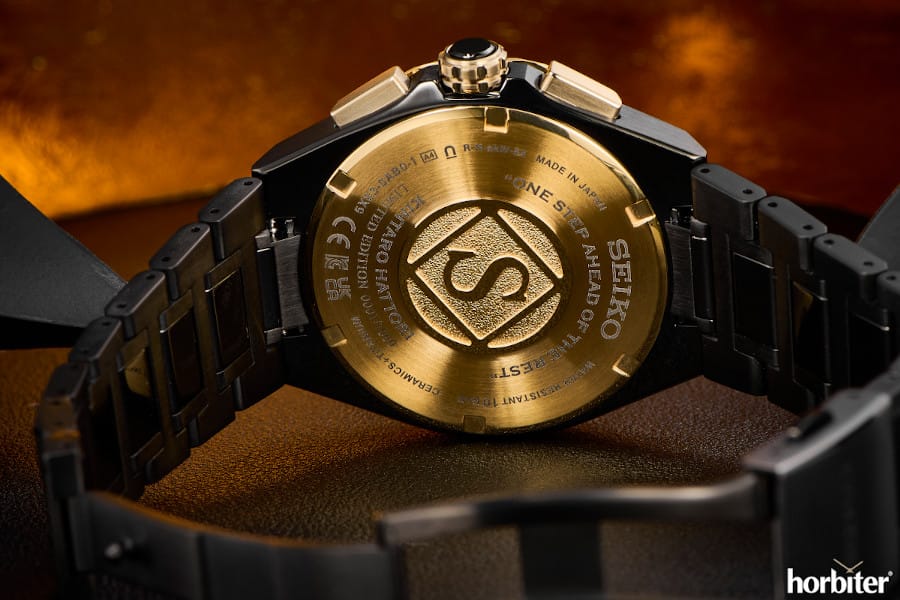
The Seiko Astron GPS Solar collection empowers the brand and holds a primary role among commemorative editions; it epitomizes the ultimate embodiment of the brand’s “One step ahead of the rest” motto. The association with Kintaro Hattori led to the Astron Kintaro Hattori 160th Anniversary Limited Edition SSH073J1 in 2020 and the Astron Kintaro Hattori Limited Edition SSH156J1 in 2024.
The project kicked off with the 7X series, and the most challenging feat was to miniaturize the parts and optimize the energy balance from the source, the sun, down to the latest technical function.
From left: Yoshio Mishima (design series 8X and following ones), Atsushi Kobayashi (design series 5X and 3X), Shuichi Tamura (movements’ development) – Source: Seiko – Photo: Yu Mitamura.
In terms of size, a 7X round antenna measured 38 mm across, downsized to a 2014 8X series’ 35.5 and a 10 x 10 mm squared plate in 2018, when the 5X series hit the market. First to the last edition, like for like, the antenna’s performance has increased by 50%, according to official statements.
The Seiko Astron GPS Solar 5X83 Kintaro Hattori Limited Edition SSH156J1 watch
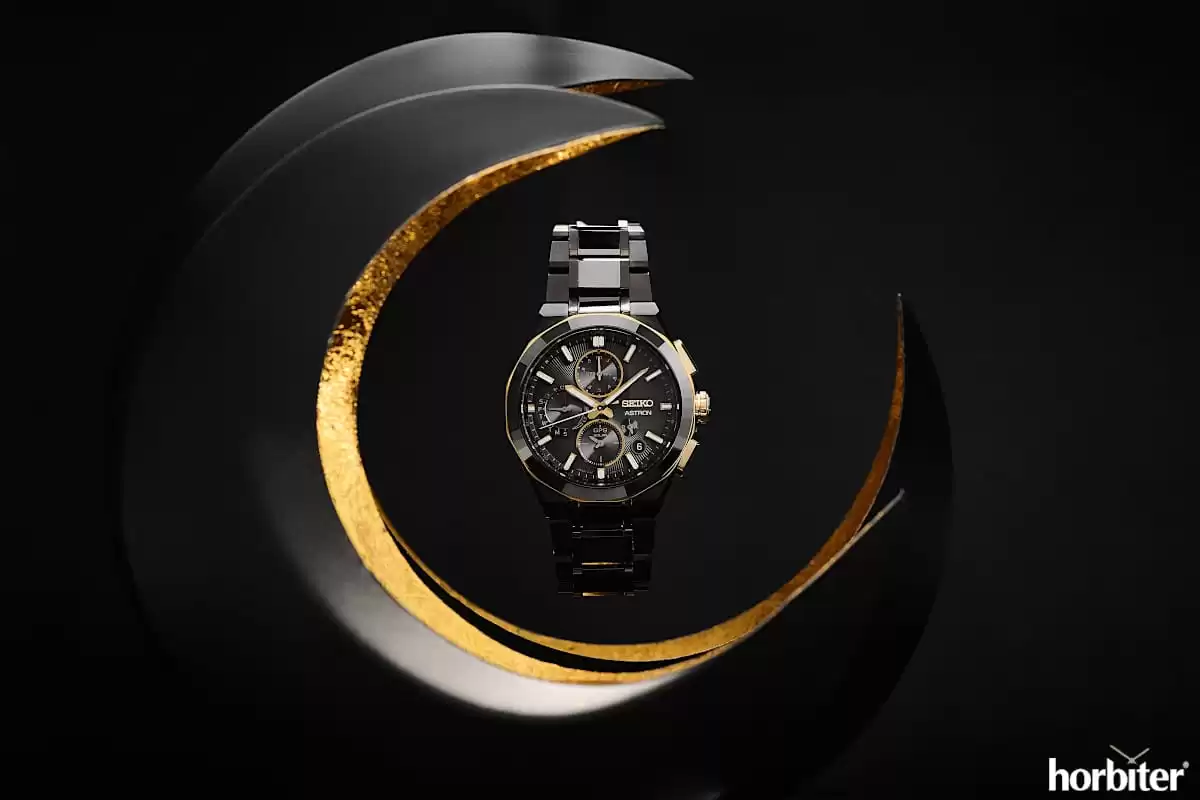
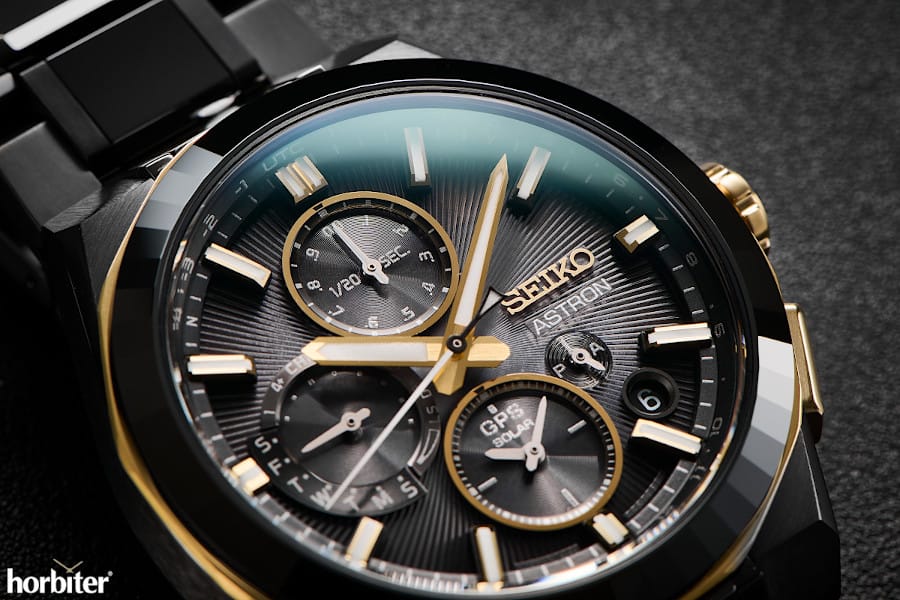
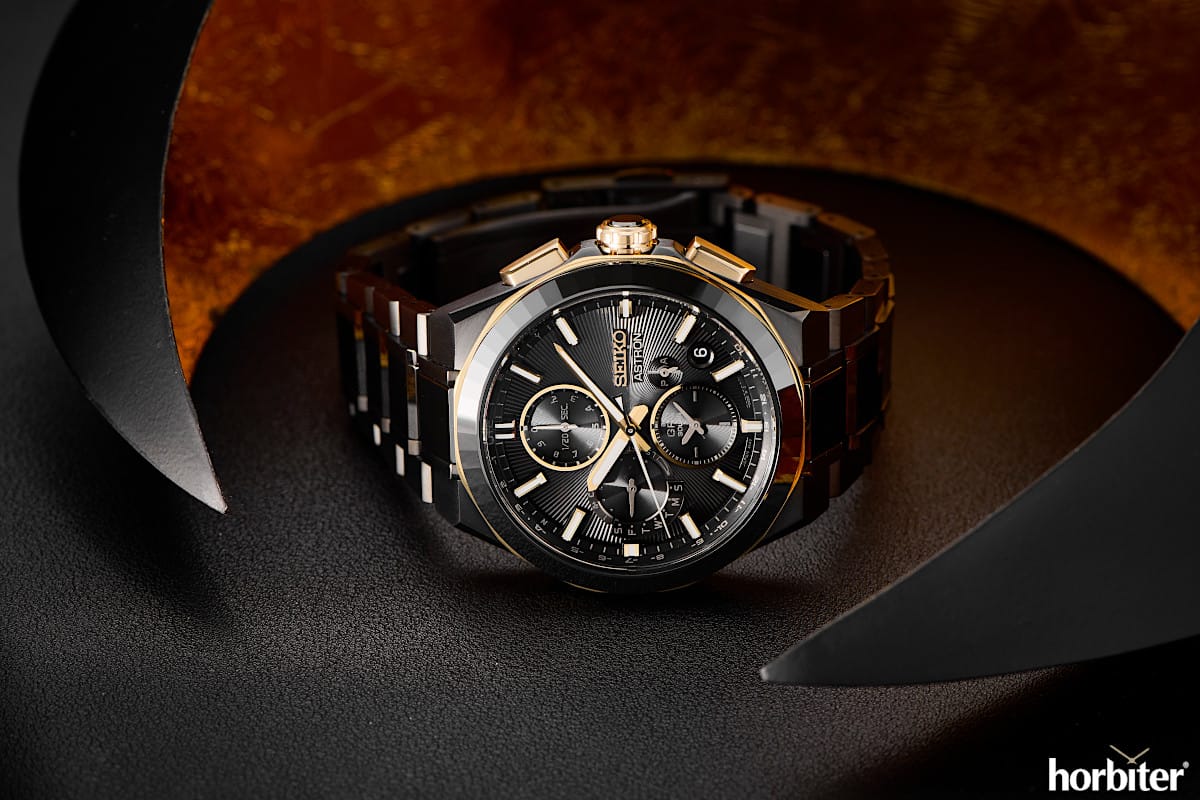
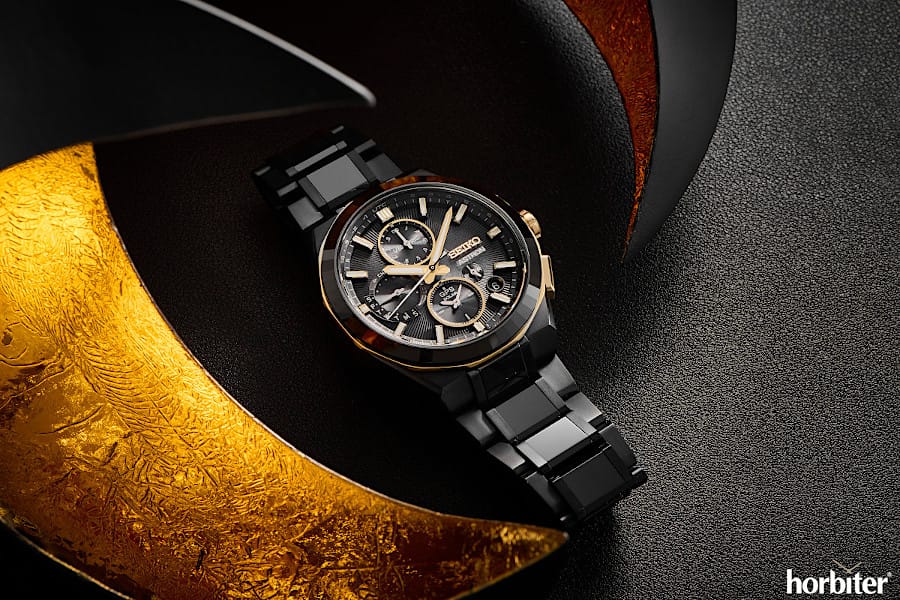
The SSH156J1, the latest limited-edition model, is a testament to Seiko’s 10-year-long expertise and a celebration of Kintaro Hattori’s 160th birth anniversary. Its black-gold livery, reminiscent of the Planet Earth as seen from a satellite at night, is a nod to the Japanese gold restoration technique known as ‘kintsugi’. This unique design, coupled with a range of advanced functions like the World Time complication, a 1/20 of a second chronograph, and a perpetual calendar, makes the SSH156J1 a practical and exclusive companion for the modern globetrotter.
A rotated V-shape displacement
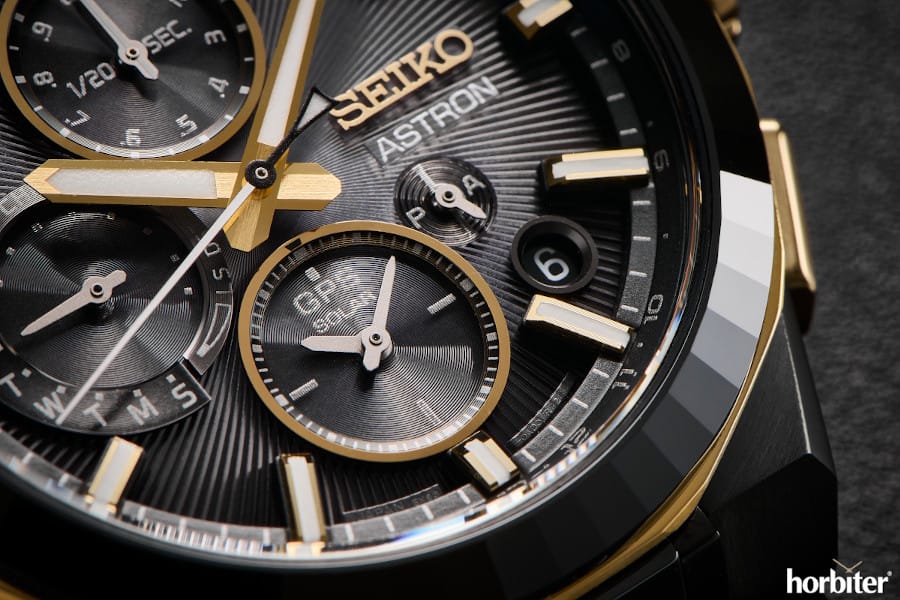
The most outstanding take on the new 5X83-based collection is the rotated three-counter V displacement, made possible by a technical layout that allows more manageable and cost-effective modifications than mechanical movement.
The new SSH156J1 takes exclusivity and cutting-edge materials to new heights while boasting a sleeker, more sophisticated look. It integrates a range of advanced functions like the World Time complication, a 1/20 of a second chronograph, and a perpetual calendar, to name a few.
These features are not just impressive, but they also make the watch a practical companion for the modern globetrotter. The watch is based on a time zone synch system and offers all the features a globetrotter needs when travelling across multiple time zones. It also has a +/-15 seconds per month accuracy and a maximum six-month power reserve, showcasing its advanced technology and precision.
Style and materials
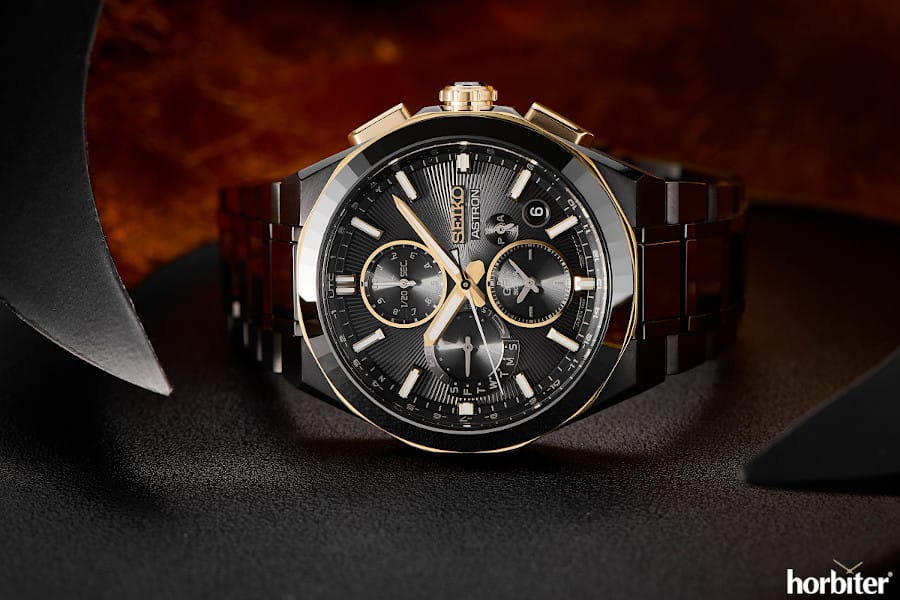
The limited-edition model slightly grows compared to its 5x calibre-powered siblings; its case measures 43.25 mm across and is 13.43 mm thick. Take the specs above as they are since titanium and ceramic make it a different experience from what you would expect.
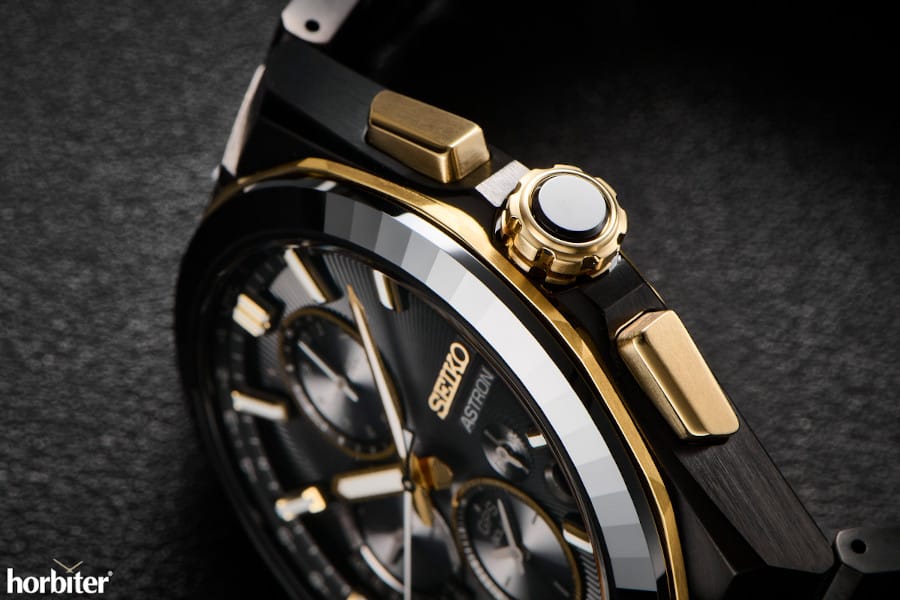
The watch features a glossy black full-ceramic look, with ceramic found exclusively on polished parts, contrasting the black-treated titanium ones.
Mid-core and the bracelet’s outer links are titanium and showcase a matte black surface finish via Seiko’s proprietary Hard Coating treatment. The watch also features yellow gold-coloured finishes on the case and case back, adding a touch of elegance. The polished knurled bezel and the bracelet’s mid-links are in black ceramic, adding a sleek and modern touch to the design.
They took the best on the shelf to craft a commemorative model and finally added a ray finish to set this model apart from anything 5X. The Astron GPS Solar Kintaro Hattori Limited Edition SSH156J1 is, without a doubt, a “halo product”.
Final thoughts
Build quality and finish are next-level. Since it is a black watch, we had to make the most of our lighting performance to enhance the contrast between polished and matte surfaces. As black as it gets, the yellow-gold treatment helps the watch’s details pop out.
The watch comes with a matching bracelet, but you have an option. Seiko offers a replacement soft silicone strap and packages them all into a glossy black box with the Seikosha logo on top and a commemorative lapel pin, as did with the Presage Kintaro Hattori Limited Edition watch. Instead, we would have gone for a pin buckle and a quick-release mechanism to swap bracelets.
Satellite watches have their following and have outperformed radio-controlled timepieces, whose capabilities are restricted to certain areas. In either case, the prospective consumer is usually a die-hard fan of technology and Hi-Fi.
Since its launch, the Astron series’ winning formula has relied on a mechanical sports watch’s look and feel, and it builds on superb build quality, countless features, ease of use, and hassle-free power charge.
An Astron GPS Solar Kintaro Hattori Limited Edition SSH156J1 is also waterproof up to 100 meters. As refined as it gets, it is a luxury mechanical sports watch’s digital counterpart, offering many more features and unmatched accuracy.
The Seiko Astron GPS Solar 5X83 Kintaro Hattori Limited Edition SSH156J1 is a truly exclusive piece. Only 1,000 units are available worldwide. Retailing for 4,000 euros, this watch is a testament to Seiko’s craftsmanship and innovation. For more information, please visit the official Seiko website.
(Photo credit: Horbiter®)
In this article:
Perpetual Calendar
The perpetual calendar is a complication that adjusts the watch's calendar for varying months and leap years. This cycle will end in 2100, and the wearer should apply the first manual correction.
Chronograph
Complication that helps the wearer to measure time intervals without affecting the watch's standard time-telling function.
Complication
The addition of any mechanical complication to a movement that usually displays the time.
Calendar
A feature that shows the day of the month and, in some cases, the day of the week. Some calendar watches show the date on sub-dials, while others display the…
Time zone
Time zones refer to the twenty-four regions of the globe. Milan, Rome or Naples will indicate our time zone here in Italy.
Power Reserve
A mechanical watch feature displays, on the dial or the case back, the remaining power in a watch movement, showing the length of time until the timepiece must be rewound.
Ceramic
Widely used for crafting a watch case and, in recent years, also for the bezels of diving watches and dials. Obtained from zirconia powder (ZrO2), ceramic offers superior scratch resistance…
Case
It encases the mechanical movement and is crafted in one or more parts. It can also be a single piece, as with some professional diving watches, or made of unconventional…
Calibre
A calibre is the type of watch movement encased in an assigned timepiece. Its name is usually associated with the manufacturer's name and a standard code, e.g., ETA 2824.
Case back
It can be screwed in, pressure-fastened, or secured to the case via screws. Occasionally, it comes as a single piece, with the case of specific professional diving watches (for example,…
Bezel
The bezel is particularly useful on diving watches, allowing you to check dive times. In this case, it unidirectionally rotates and usually comes in two parts: a metal (or ceramic,…
Strap
A leather, rubber or other material band that secures the watch to the wearer's wrist.