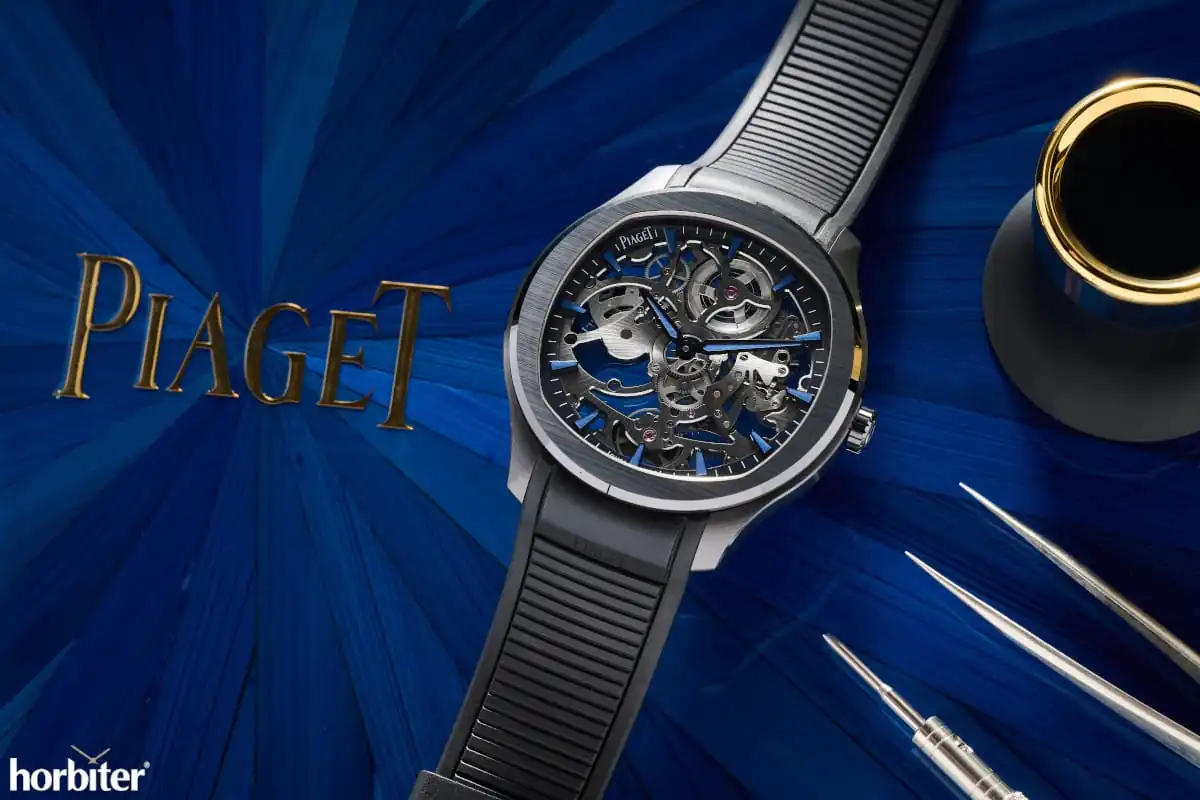
In the end, Piaget finally turned to ceramics. They took longer than expected, which aligns with what competing ultra-traditional fine watchmaking brands have done. The outcome is the new Polo Skeleton Ceramic, and after this review, we hope it won’t be a one-off project.
The Piaget Polo Skeleton is a timepiece we love. Under our loupe in 2021, we liked, and still do, its looks and technical prowess. Here is the best take on a Polo case in decades, sporting a thin bezel we desire will soon appear anywhere across the range, whether a time-only or a chronograph. Meanwhile, let’s stop here and analyze the latest model to mark Piaget’s 150th anniversary.
A Polo Skeleton Ceramic’s layout
Despite being a commodity in the watch industry, a ceramiccase requires a thoughtful design process to minimize risks compared to a steel or gold case. There is no plastic train; unmatched scratch resistance often comes with poor resilience on paper unless an engineer carefully designs the case body.
Making it ultra-thin makes the job harder since oversizing comes standard and has to be combined with case proportions (and a fully skeletonized calibre). This is probably why Piaget took three years of product development; as a boutique brand producing small quantities per year, Piaget has always placed perceived quality first and aims to elevate ownership experience from one iteration to another.
The outcome in specs
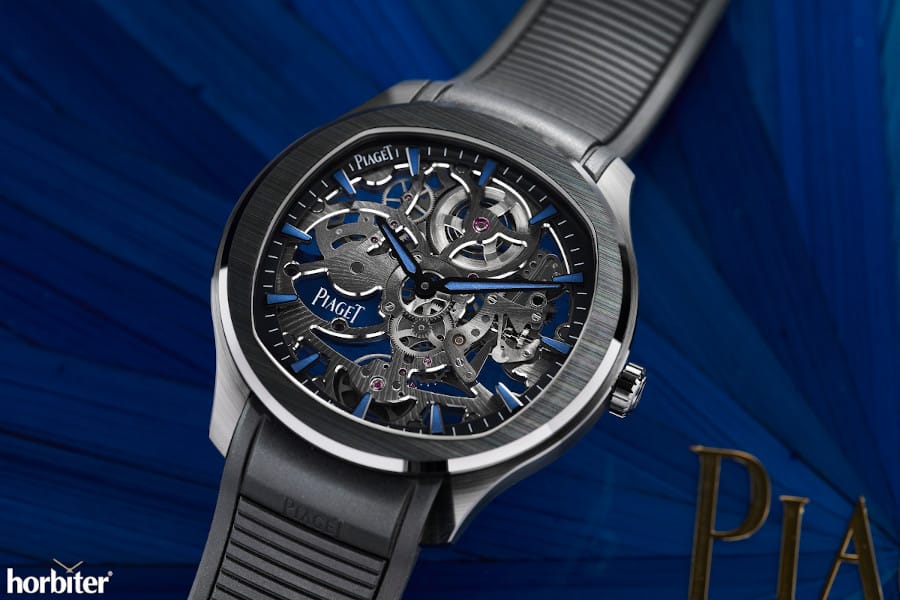
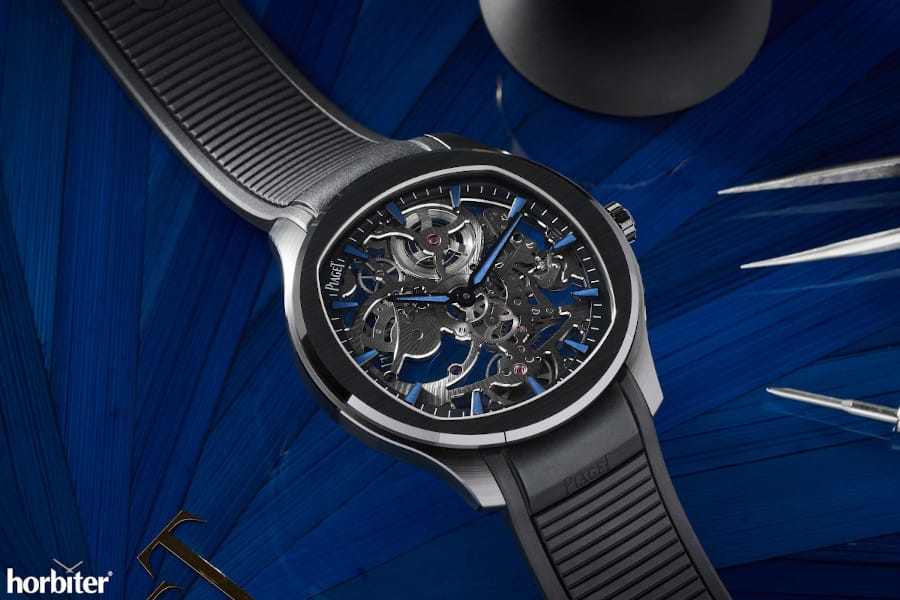
At 42mm in diameter and 7.9mm in thickness, a Piaget Polo Skeleton Ceramic is 1.4mm thicker than its steel sibling, according to the specs sheet. What do we think? Given the black look and the ceramics’ unmatched lightness, you can hardly notice it. They help to slim it down.
With such an iteration, the brand won’t compete for the thinnest ceramic sports watch; leave it to the avant-garde Octo Finissimo. Pure classicism and sleek lines drove the design process and the sturdiness any buyer expects.
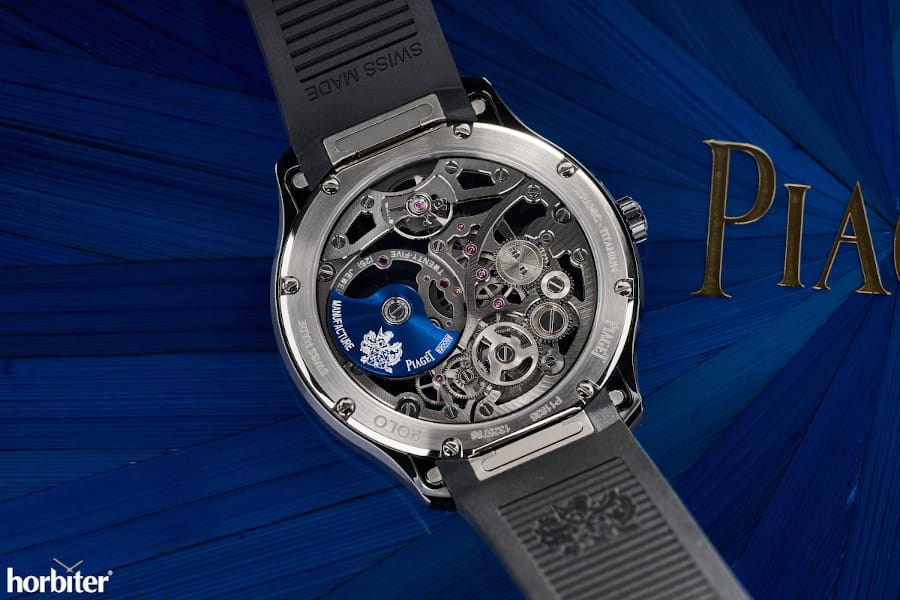
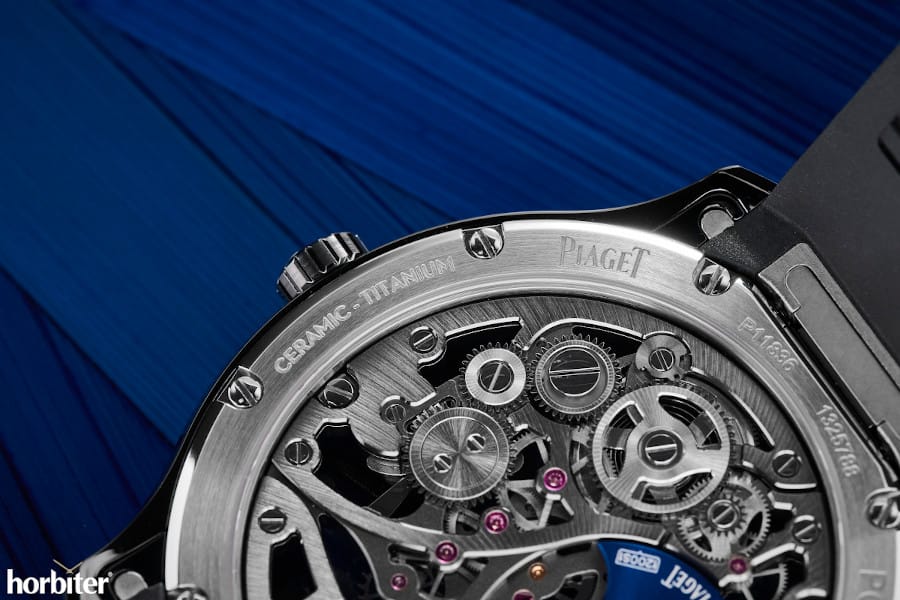
This brings us to the DLC-treated titanium container placed amidst the case body to hold the 1200S1 calibre precisely. Touch and feel are empowered by a “jet black” Pantone whose metallic dark grey highlights the Polo’s signature satin finish on the bezel and lugs, as seen from atop. It is as distinctive as the polished treatment on the bezel, case side, and crown.
The Piaget caliber 1200S1
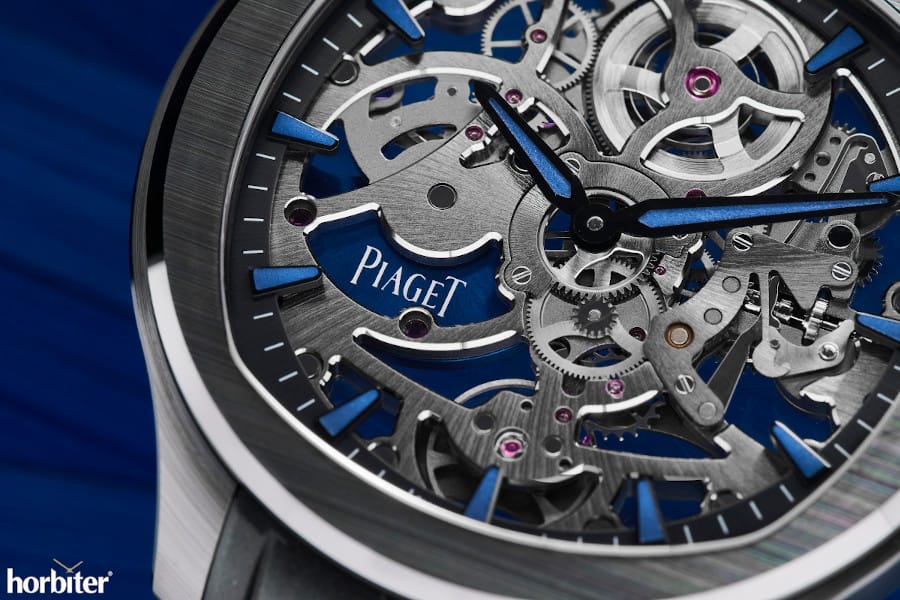
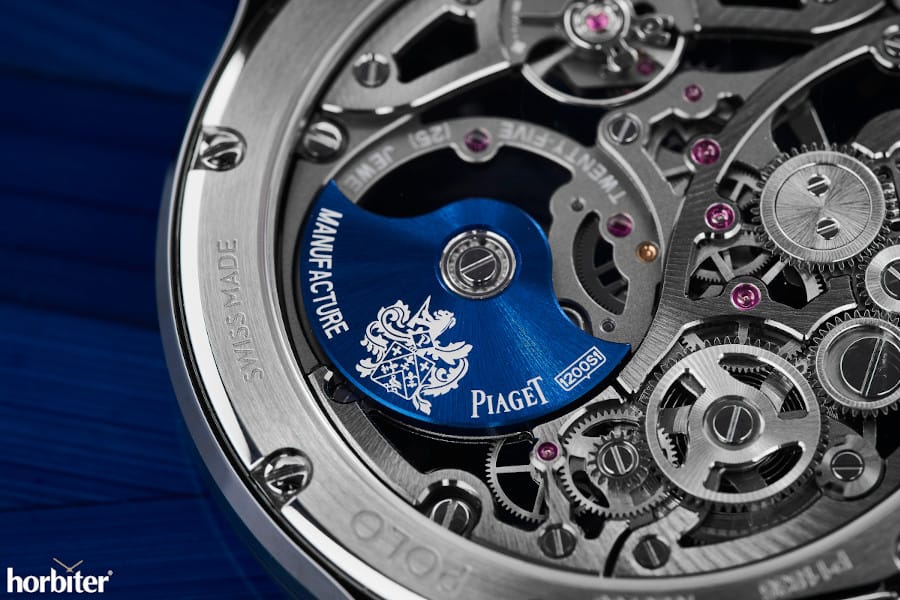
Skeletonization raises new heights; blue is replaced by dark grey on the bridges, except for the floating indexes and micro-rotor in classic “Piaget Blue.” The grey finish highlights bevelling and polishing, and the contrasting snail finish on the wheels makes the whole dial more refined than ever before. The blue tungsten-made micro-rotor significantly and powerfully contrasts the grey layout.
Compared to other ones, the 1200S1 stands out, and it is easier to read, revealing a sportier look than steel, more appealing than a blue dial or the toned-down grey one we have never liked when matched to steel. Unfortunately, the case is waterproof up to 5 atm, so please think before wearing it during water sports activities.
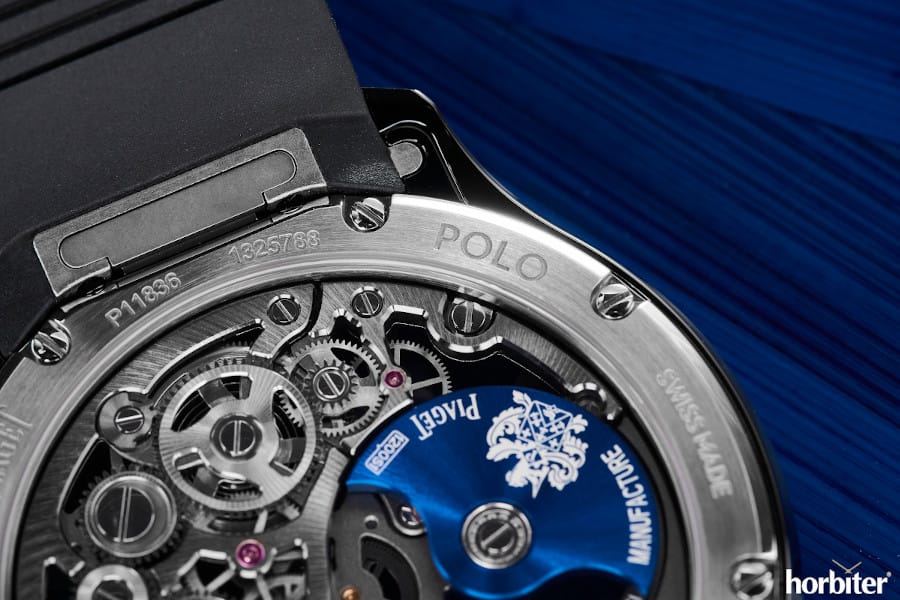
The Piaget inscription on the winding mass, placed on the dial side, is filled with luminescent material and glows in the dark with the applied indexes. A see-through titanium ring, often seen on a ceramiccase, secures the case back. You can admire the back of the micro-rotor carrying the Piaget coat of arms through the sapphire crystal.
Final thoughts
Watch brands like Piaget have the advantage of taking their time to analyze each new proposition. Time to market doesn’t hold a front-row seat, even more so when the first ceramic watch is at stake. We appreciate how designers preserved Polo’s DNA. It is not hard to replicate steel finishes on a ceramiccase. Zirconia oxide allows watchmakers to perform anything, and the brand successfully placed Polo’s premium feel on a different product.
However, the Polo Skeleton Ceramic is possibly a polarizing watch since black watches are not everybody’s cup of tea. Yet, Piaget crafted an attractive colour combination on a luxury watch this dark. At 7.9 mm in thickness, we would have explored a more ingenious technical solution to guarantee at least 100 meters of water resistance; it feels like a missed opportunity for such a sporty-looking watch with two rubber straps available. The retail price is 45,200 euros.
(Photo credit: Horbiter®)
Giovanni Maria Di Biase @Horbiter®
In this article:
Ceramic
Widely used for crafting a watch case and, in recent years, also for the bezels of diving watches and dials. Obtained from zirconia powder (ZrO2), ceramic offers superior scratch resistance…
Chronograph
Complication that helps the wearer to measure time intervals without affecting the watch's standard time-telling function.
Case
It encases the mechanical movement and is crafted in one or more parts. It can also be a single piece, as with some professional diving watches, or made of unconventional…
Bezel
The bezel is particularly useful on diving watches, allowing you to check dive times. In this case, it unidirectionally rotates and usually comes in two parts: a metal (or ceramic,…
Calibre
A calibre is the type of watch movement encased in an assigned timepiece. Its name is usually associated with the manufacturer's name and a standard code, e.g., ETA 2824.
Crown
Placed on the case side, it winds the mainspring. When pulled out, it also sets the time and the date. A screw-down crown increases water resistance and protects the movement…
Rotor
Part of an automatic watch that winds the mainspring by constantly rotating. Depending on the watch's winding capability, movement design, and value, it comes in various geometries, sizes, and materials.…
Case back
It can be screwed in, pressure-fastened, or secured to the case via screws. Occasionally, it comes as a single piece, with the case of specific professional diving watches (for example,…