The primary function of any watch is time display via hours, minutes and seconds. As far as the historical terminology is concerned, every additional feature is synonymous with mechanical complication, and that’s what makes watchmaking so appealing and intriguing. Watch complications represent, therefore, that extra plus, even more so as technical prowess and refinement increase.
Some complications are long-established; others result from the industry’s latest technological developments, decoration and ingenuity, and equally, grow in prowess and price as we scale up. However, according to the watch community, some are mechanical complications, but some aren’t.
Let’s try and introduce the main watch complications. We’ll recurrently update this article whatsoever.
Timekeeping complications
Let’s kick off this guide by listing those connected to a watch’s essential function: timekeeping. Despite most offering the same base functions, they are intriguing esthetic and technical takes on the base template.
Retrograde hours and minutes
Here, hours and minutes have no circular displacement but hold a 180° arc instead, with the corresponding scale set 60 for the minutes and 24 for hours.
When the hour (or minute) hand has elapsed the entire arc, it instantaneously jumps back and begins elapsing hours (and minutes) again.
Jumping hours
The jumping hour complication turns the analogue time display into full digital.
The disk displaying hours thus “resets” once it crosses midnight and adopts a base principle common to date display (which we’ll talk about in a minute).
Date display complication
When trying to figure out “What time is it?” we sometimes ask ourselves: “what day of the week is it?” as well. Here is why the date display was among the first to appear.
Date display offers several analogue or digital options, from a standard window display to more intricate pointer-date or Big Date displays.
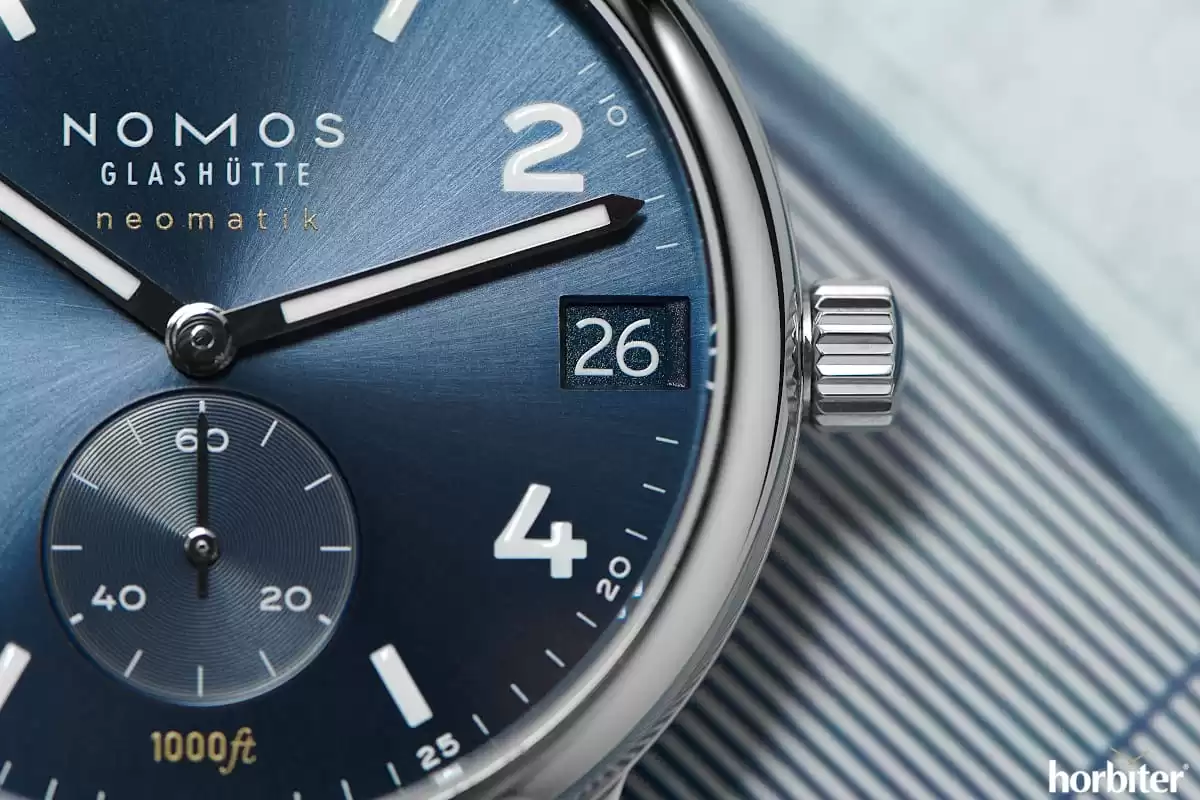
Simple calendar or date
The truth is we can barely regard it as an actual “complication”, to modern standards at least. However, the date display is the most straightforward and wanted feature, something most people consider a “must-have” when purchasing a new watch. The simple calendar complication comes as a tiny window placed somewhere on the dial, housing a rotating disc.
While the date display offers a valuable piece of information at a glance, it ends up adding the task of manually adjusting the disc when a month is less than 31-day long since the mechanism cannot identify whether it’s January, February or June, for instance.
The disc is set to 31 days as standard, thus requiring manual adjustment during the year.
Big Date
The Big Date or Oversized Date complication outperforms the ordinary date display. The mechanism adopts two superimposed rotating discs, one for the tenths and the other for the simple digit.
In brief, it is not adding any new information while being far more refined from a technical perspective instead and provides superior legibility given its large two-digit display.
Once restricted to premium brands, it is becoming ubiquitous across accessible luxury watch manufacturers, as exemplified by the ultra-classic Mido Baroncelli Grande Data Caliber 80 as an example. Moving upmarket, Saxon brands like A.Lange & Söhne and Glashütte Original are the best purveyors of such a mechanical complication.
Retrograde date
At first sight, the retrograde date display is a marvellous and somehow weird-looking day of the month display.
It cleans up the dial by turning the digital display into a single hand elapsing 180 degrees, usually placed between three and nine o’clock. As with the Jumping Hours display, the hand jumps back at midnight once you’re entering a new month and the cycle starts. Pictured here is a timepiece offering retrograde day and hour display accordingly.
For instance, you can usually spot it on products as refined as the Vacheron Constantin Patrimony, paired with a moon phase complication in this example.
Day-date
The Day and date complication pairs day of the week with date, in one go.
However, each brand comes with a specific take on this template. The day display comes either in whole or shortened (as seen on the Blancpain Fifty Fathoms Bathyscaphe) and is placed anywhere on the dial, the most common displacements being at noon or 9 o’clock.
The day-date complication was introduced by Rolex in the second half of the 1950s and became ever since a trend in luxury watchmaking.
Complete calendar
This complication tracks the date, the month, and the day of the week.
While it comes with an automatic adjustment for 31-day lasting months, you need to adjust the calendar for shorter months, of course, manually.
Annual calendar
The annual calendar adds the moon phase display to the day of the week, month, and date.
The mechanism is designed to display 30-day and 31-day months, requiring manual adjustment for February, hence once per year. Adjustment is set via small push-buttons or tiny correctors.
Perpetual calendar
Once set, it is the ultimate mechanical complication if you’re eager to run a “set and forget” adjustment. A perpetual calendar cleverly tracks each day, date, and month alongside the moon phase, during leap years or not. The current leap year cycle will end in 2100 when you need to make the first correction.
There are plenty of perpetual calendars, depending on the price and algorithm chosen. You can learn more by surfing our section dedicated to Perpetual Calendar watches.
Power reserve
The power reserve is a not-to-be-missed feature if you’re tracking the remaining power reserve, even more so on any hand-wound timepiece. The display usually comes in days to get an idea of how long the watch will be running before winding it up.
As previously seen, there are several outtakes: the display comes as analogue or digital.
GMT
The acronym stands for Greenwich Mean Time (Greenwich Mean Time). The GMT complication offers an additional time zone display along with local time.
Its simple mechanism houses two separately-adjustable hour hands, representing local and home time. The GMT hand adopts a 24-hour inner or outer bezel (thus offering day and night display).
You can set the GMT hand by unscrewing the winding crown to the assigned position.
Moon phase
The moon phase counter displays the natural lunar cycle. It is among the most loved watch complications, adding a piece of romance to any watch’s dial. It also proves the brand’s decoration and technical refinement expertise on most luxurious models.
Please head to our Moon phase watches post if you want to get more.
World time
The standard variant provides a glimpse of the local time across the 24 chosen standard time zones.
It works by showcasing the 24 cities’ increment-of-an-hour time zones. An additional ring houses the 24 hours alongside day and night halves. The mechanism usually adopts the crown to set local and home time accordingly.
Chronograph
Its primary function is to time the duration of an event. The standard chronograph options come with two push-buttons – usually placed at two and four – to start, stop, and reset the Chrono hand.
For instance, the chronograph is functional when measuring how long a journey takes. A chronograph can also work as a speedometer for any object travelling from point A to point B by housing a tachymeter scale.
We dedicated a special section to the chronograph recently.
The “Grande Complication”
Rather than a single complication, the term refers as standard to a specific combo of Haute-Horlogerie mechanical complications. A “Grande Complication” usually houses a minute repeater, a chronograph, and a perpetual calendar.
However, there is some controversy regarding the Grande Complication; brands do not always abide by the standard rules and offer their take, as seen on the glorious Vacheron Constantin housing a tourbillon, for example, and not a chronograph.
The Vacheron Constantin Traditionnelle Grande Complication, pictured above, summarizes the brand’s established expertise in mastering such complications.
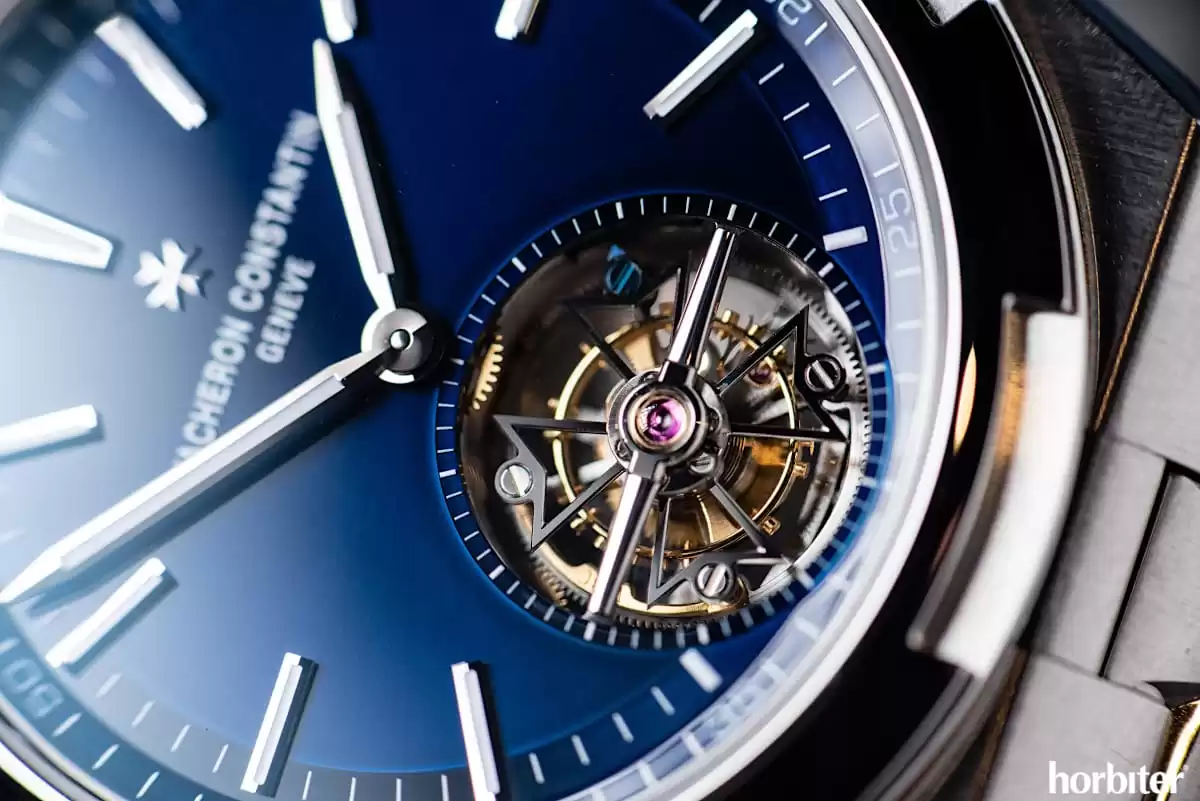
Tourbillon
It looks like there’s some controversy here, too. Some consider it a watchmaking complication; others regard it as a refined assembly of components instead, since it’s not adding any “function” unless counterbalancing the gravity force effect on timing accuracy cannot be regarded as such.
Whatever your opinion, the tourbillon offers superior refinement despite being extended to more accessible yet premium brands in the last years.
Breguet invented the tourbillon to minimize the force of gravity’s effects on rate accuracy. The gravity force was one of the primary reasons a timepiece couldn’t match the designed timing accuracy.
We have explored this complication in many articles throughout the years.
Minute repeater
The Minute Repeater is widely regarded as the most prestigious watch complication. The movement is designed to audibly mark hours, minutes and seconds by using a set of tiny hammers within the case.
Construction, refinement, sound notes and striking logic depend on brand, technique, expertise. A few brands can master this complication to the highest possible standards, and their price and approach place them in the realm of Haute Horlogerie.
Equation of time
The equation of time is a rare bird. It marks the difference between solar and standard-measured time.
Each brand has its take on the complication; for example, the Audemars Piguet Jules Audemars Equation of Time adopts an additional minute hand, while the Panerai Luminor GMT Equation of Time expresses this difference through a graduated scale.
Some years ago, we got our hands on the Breguet Marine Equation Marchante 5887.
Tommaso Sabia @Horbiter®