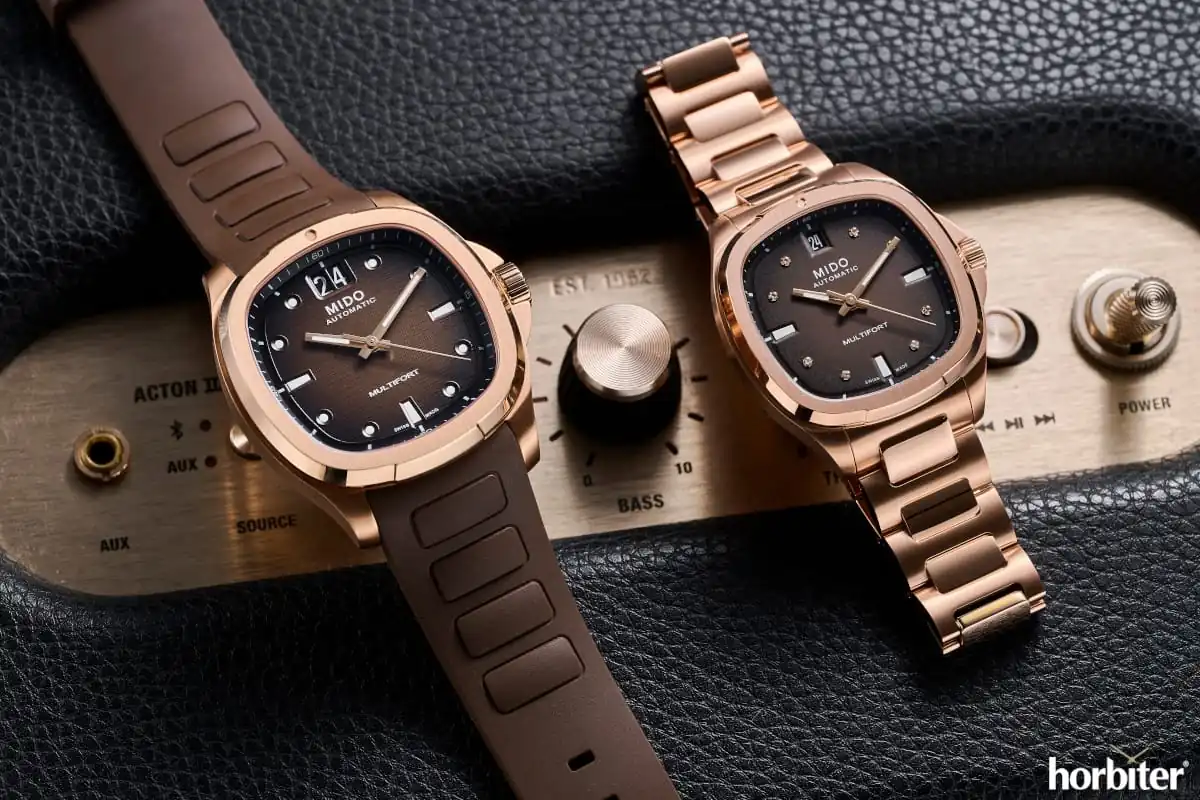
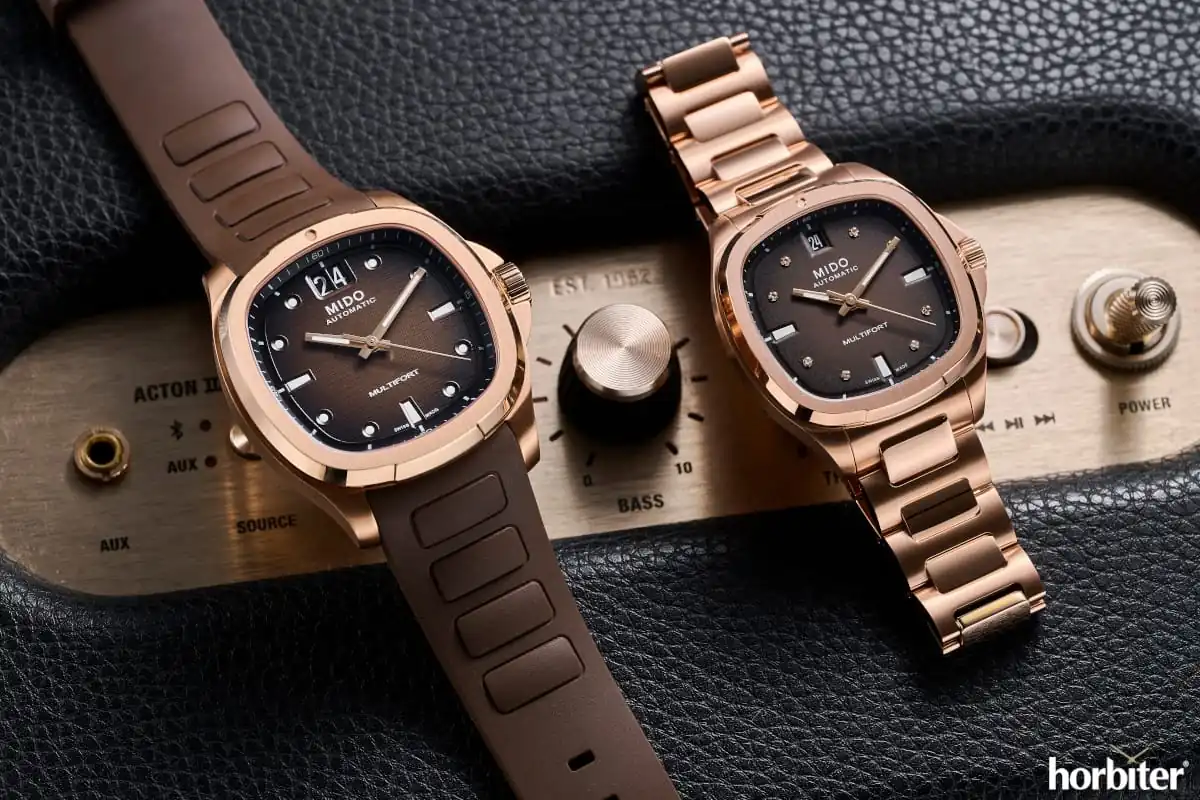
After extending the TV Big Date collection to include the Limited Edition Monoscope model, Mido recently revealed a range extender and an entirely new collection. The latest one shares a rose gold PVD-treated case and a smoked brown dial with its Big Date sibling. The headline news is a smaller TV, 35.0 mm by 34.2 mm, conceived for global markets and smaller wrists.
Up close, the new sub-collection is a simplified version of the TV Big Date, with the Big Date display replaced by a simplified technical layout and an array of models that include options in steel alongside the PVD gold one pictured here.
The Mido Multifort TV 35
Did Mido expect such a massive success for its Big Date TV? We’ll never know. However, if you read our first review, you will learn that we have believed in the collection’s success since day one. It builds on the brand’s square-shaped case’s pedigree. Also, we appreciate that vague Glashütte Original feel to it, despite most “haters” saying the primary source of inspiration is the Aquanaut.
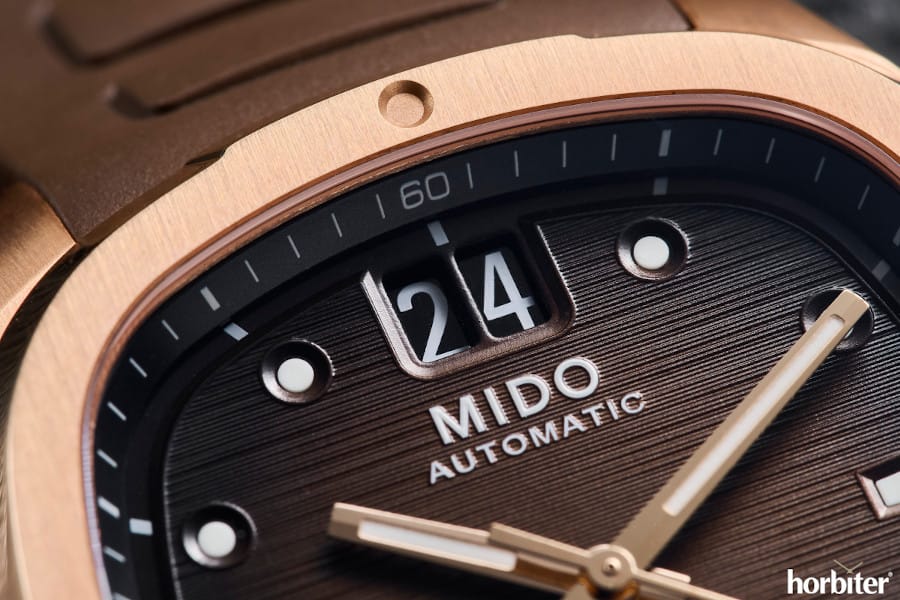
First, any resemblance to such an iconic sports watch is not upsetting; the Multifort TV Big Date quickly found its space across Mido’s collections. The 35.0 mm model lacks the most distinctive feature: the Big Date. It houses an elongated, narrow date window that mimics the baton-shaped index on the opposite side and is also recessed.
How the dial has changed (on this specific variant)
The second big difference between a TV Big Date and a Multifort TV 35 in PVD gold is a simplified dial finish. When you place a Multifort TV 35 and TV Big Date side by side, you’ll notice the signature smoked finish has lost the original horizontal pattern to welcome a fine-grained one instead.
However, the Big Date’s dial should be compared to its TV 35 counterpart since the designers inserted eight diamonds instead of round indexes. The standard versions keep the dial finish of their larger and more complicated brothers intact.
The Multifort TV 35 wins hands-down on the case back’s design. Forget the see-through glass; replace it with a solid piece of steel. If you are familiar with our reviews, you know we firmly support the idea that any affordable three-hander should have its case back closed regardless of performance. It concerns the finish you can achieve on an industrial-based mechanical movement.
The caliber 72
The case’s downsize has not affected overall performance. Mido committed to offering a close-to-eighty-hour power reserve, totalling three full days of charge from a 3.5 Hertz architecture. Also, it mimics Caliber 80 by adopting a Nivachron™ hairspring, confirming the brand’s aim to improve accuracy across the board.
The caliber 72 replaces the caliber 80 (pictured above)
Covering the movement is, as said, a solid case backfastened via four screws. The 35 mils case is waterproof up to 100 meters, thus confirming the brand did not double down on specs.
Odd one out
This review shows that a Multifort TV Big Date Chocolate sits close to the new TV 35. Along with the least known full-black model, this is the only one featuring a gold PVD treatment. However, unlike its smaller sibling, it can only be had on a brown rubber strap.
Despite the gold-like treatment not being my cup of tea, the collection deserves a Limited Edition gold execution on a strap. It works, in my opinion. Considering the brand’s average price point, it is an unlikely event, but an attempt would be welcomed.
Final thoughts
When launching the Multifort TV 35 collection, we took our hands on PVD full-gold, which is the most eccentric execution and the most precious, with an eight-diamond dial design geared towards women. You can buy a Multifort TV 35 on a steel case and several dial options. The edition pictured here retails for 1,400 Euros, thus outpricing a similar TV Big Date costing as much as 1,300 Euros.
The final price includes a more extended PVD-treatedcase, bracelet, and luxurious dial. Mido designers preserved the collection’s DNA but lacked its most distinctive trait, the Big Date display, making the watch less appealing and unique.
A closed case back would be a great addition and something we would welcome across the whole Multifort TV collection, but it won’t happen.
(Photo credit: Horbiter®)
Giovanni Maria Di Biase @Horbiter®
In this article:
Date
It indicates the date of the month. There are different types of display: via a window or a pointer, where an additional hand is usually placed centrally or on a…
Case
It encases the mechanical movement and is crafted in one or more parts. It can also be a single piece, as with some professional diving watches, or made of unconventional…
Case back
It can be screwed in, pressure-fastened, or secured to the case via screws. Occasionally, it comes as a single piece, with the case of specific professional diving watches (for example,…
Power Reserve
A mechanical watch feature displays, on the dial or the case back, the remaining power in a watch movement, showing the length of time until the timepiece must be rewound.
Strap
A leather, rubber or other material band that secures the watch to the wearer's wrist.