First things first, I give a thumbs up to Laco for fostering the legacy of B-Uhr watches. It represents the brand’s founding pillar, which Laco keeps evolving to engineer less specialized models. As far as I’m concerned, Dortmund is my favourite Laco. Still, a wider audience looks for a military-inspired timepiece rather than its faithful re-edition, and that is what Laco did when they extended the Type A and Type B historical models to multiple, smaller sizes.
The Laco Polar 39
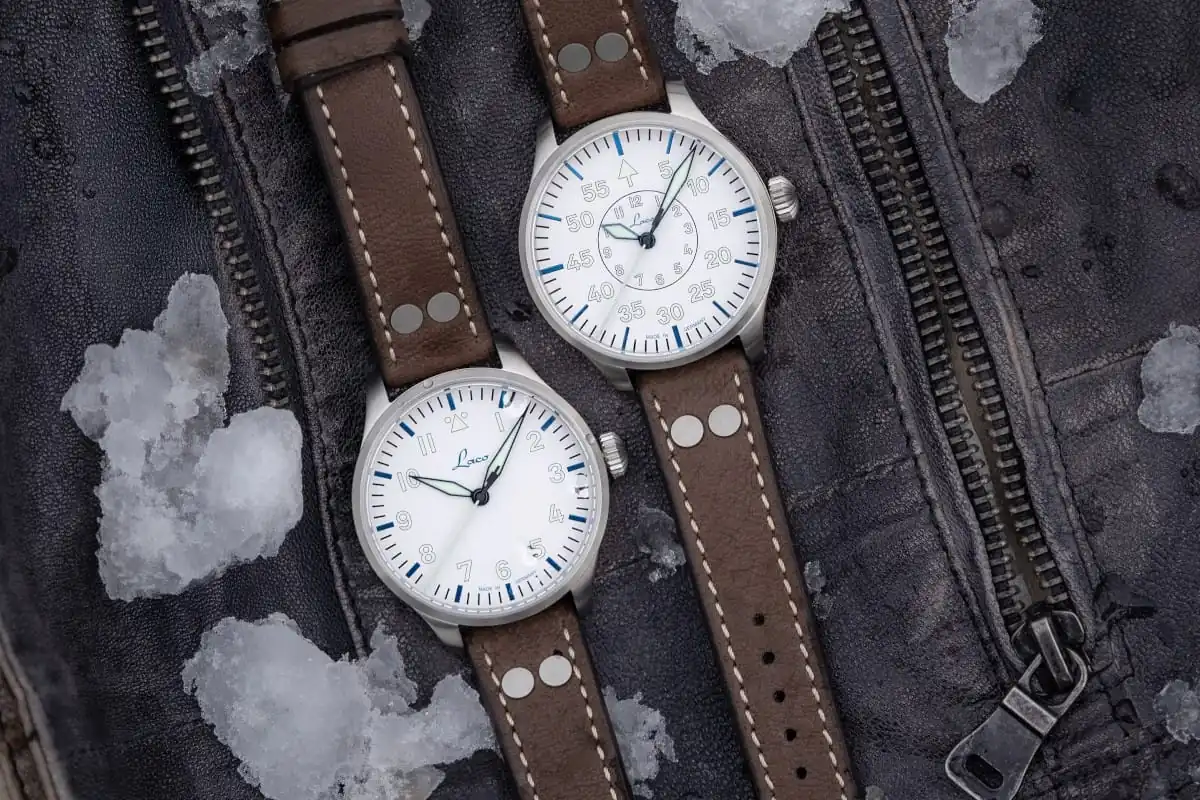
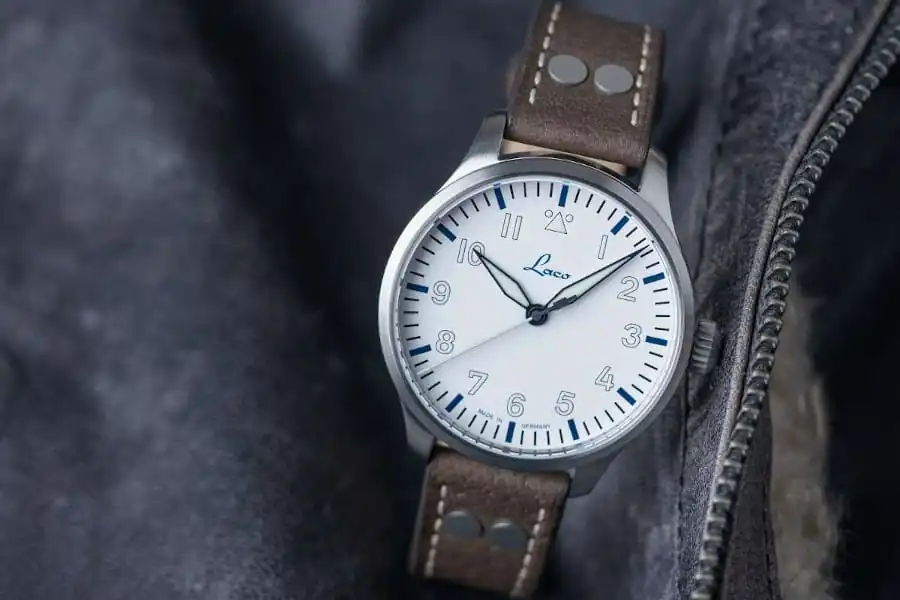
While downsizing is a common practice in watchmaking to boost sales and reach a larger audience, a 39-millimetre contemporary B-Uhr might be a risk in terms of credibility and pedigree. However, the two new Laco Augsburg and Aachen Polar 39 turn heads with their new polar white dial, blue metallic indexes, and matching blue brand logo.
The Arabic numerals and the triangle (or arrow-shaped index) at twelve glow turquoise in the dark, thanks to Super-LumiNova C3, to enhance a Type A or B dial’s layout, whose essential requirement is readability.
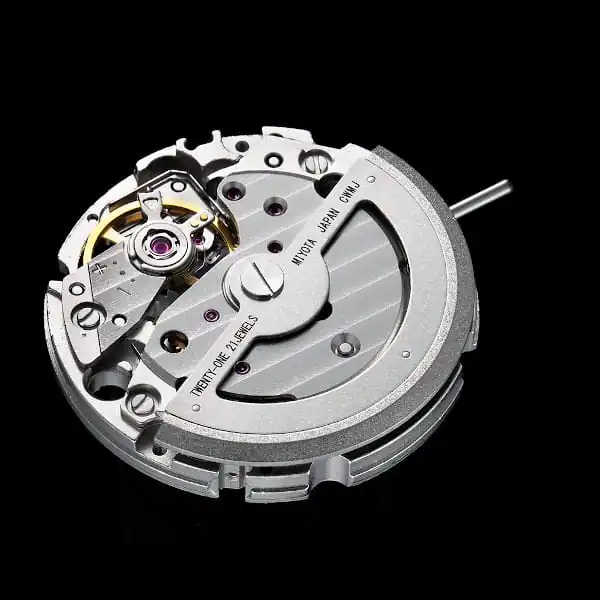
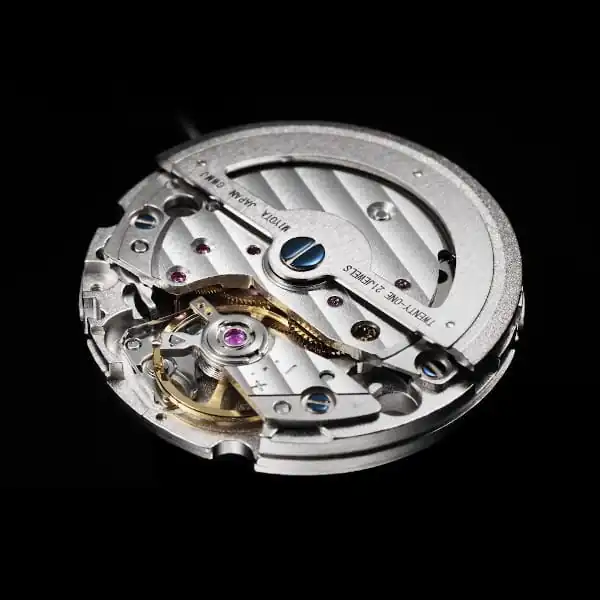
Interestingly, the crown has a vague onion-like design; it has a hybrid silhouette, i.e., a standard circular base with an onion on top. Both models have the same case diameter, are 11.55 mm thick, and showcase an extensive satin finish. Through the transparent case back, you can see the calibre Laco 2S, a Miyota 82S0-sourced movement capable of guaranteeing a -20 to +40 seconds per day accuracy and a 42-hour power reserve.
As an option, Laco can equip both watches with a Miyota 8315 movement belonging to the same category (a 3 Hz base) with up to 60 hours of power reserve and a quick date-setting mechanism, which is useless here. At first sight, it also comes with blued screws. Both watches adopt a leather strap with rivets and a classic pin buckle.
Final thoughts
Laco will produce two lots of 250 pieces for each Polar 39, whose deliveries began last February. The 440€ listed price makes them ultra-accessible Laco watches and offers the chance to upgrade them per a customer’s needs technically.
The 39 mm size works; we might argue they’re not hand-wound, yet they deliver an original Flieger’s feel and adopt a tried-and-tested self-winding movement from a respected large-volume supplier. Still, I would have gone for a closed case back.
(Photo credit: Laco)
Giovanni Maria Di Biase @Horbiter®
In this article:
Power Reserve
A mechanical watch feature displays, on the dial or the case back, the remaining power in a watch movement, showing the length of time until the timepiece must be rewound.
Crown
Placed on the case side, it winds the mainspring. When pulled out, it also sets the time and the date. A screw-down crown increases water resistance and protects the movement…
Case back
It can be screwed in, pressure-fastened, or secured to the case via screws. Occasionally, it comes as a single piece, with the case of specific professional diving watches (for example,…
Case
It encases the mechanical movement and is crafted in one or more parts. It can also be a single piece, as with some professional diving watches, or made of unconventional…
Calibre
A calibre is the type of watch movement encased in an assigned timepiece. Its name is usually associated with the manufacturer's name and a standard code, e.g., ETA 2824.
Strap
A leather, rubber or other material band that secures the watch to the wearer's wrist.
Date
It indicates the date of the month. There are different types of display: via a window or a pointer, where an additional hand is usually placed centrally or on a…