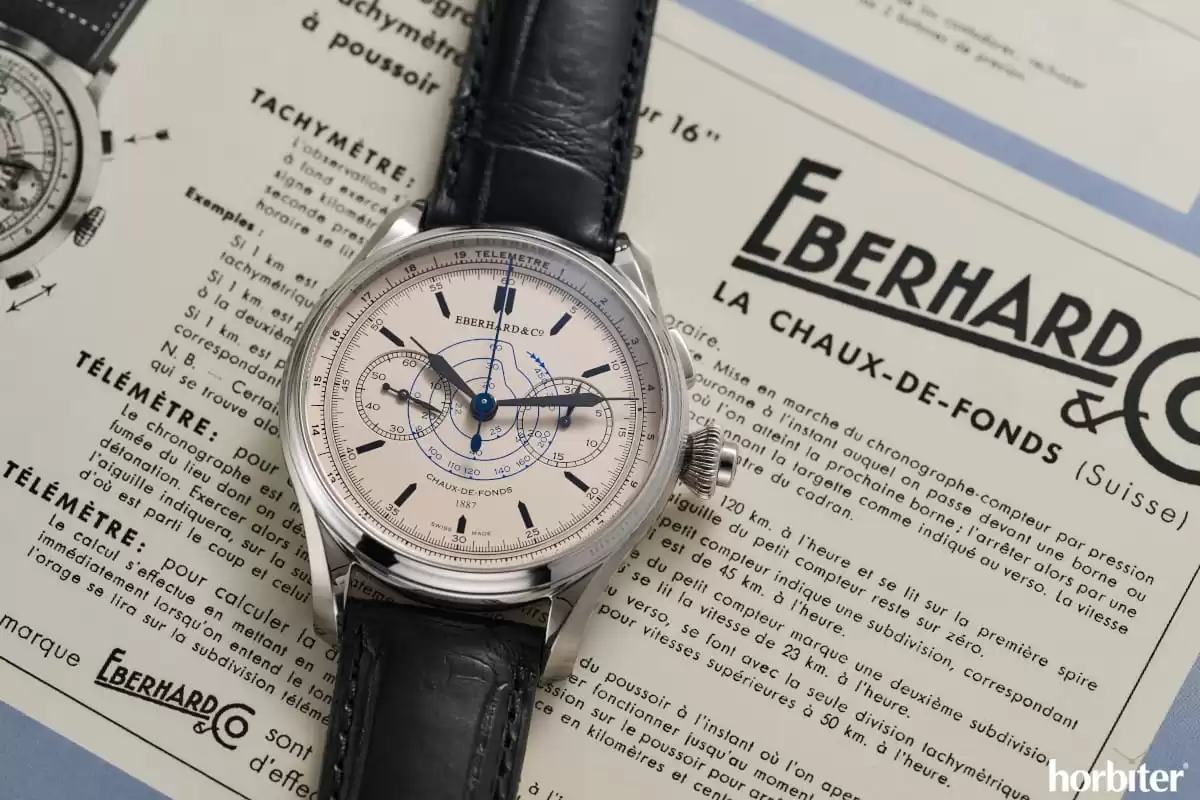
This article has a special meaning since it introduces our first-ever video review of an Eberhard & Co. watch on YouTube. Also, we discuss not any Eberhard but the Chronographe 1887 Édition Limitée 31081, a limited series introduced at Watches and Wonders 2024.
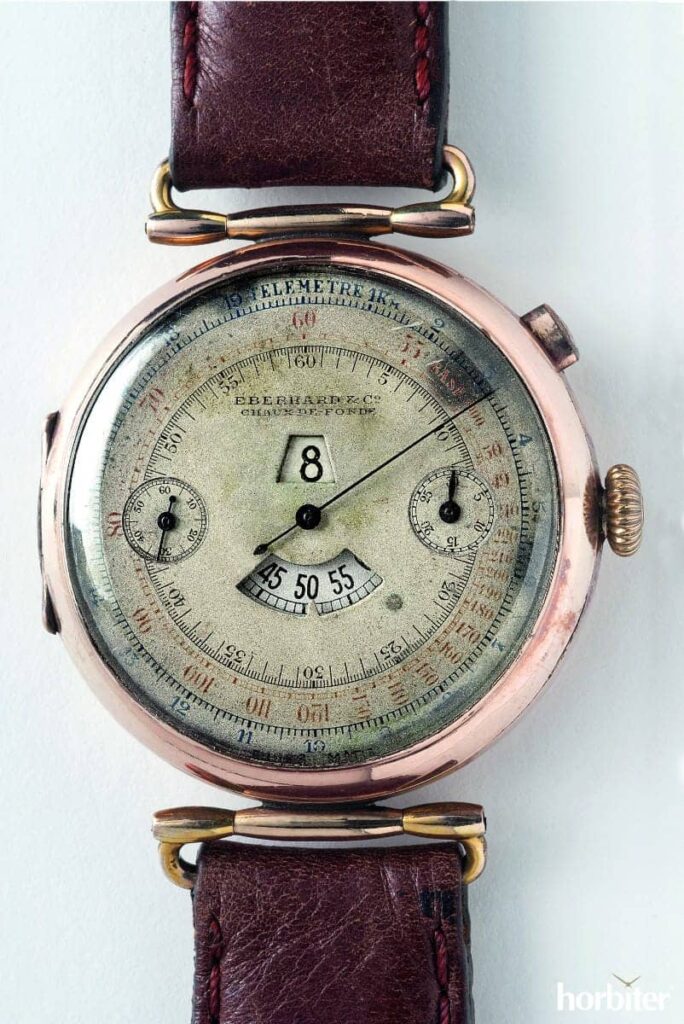
At first glance, you will notice a nod to many historic chronographs from the brand, some of them fetching first-class hammer prices at important watch auctions. Finally, it is worth reminding that Eberhard & Co. is an Italian success case history since it combines a classic Swiss-made pedigree with Italian ownership and leadership.
A long-lasting series of chronographs and a timeless design
If you browse our magazine, you will discover that our related brand page is among the most detailed ever. When we edited it some years ago, we carefully selected as many details about history and watches as possible. Scroll it down, and you will be pleased with an impressive list of beautiful models, most of which house a chronograph.
Several timepieces inspire the new 31081, such as reference 196402 from 1919 or 308540 from 1920. We could continue with countless other models from the thirties and forties. The timepieces showcased on our website are collected at the brand’s La Chaux de Fonds museum.
Many design traits and technical features from the past inspired the 1887 Édition Limitée 31081. From this perspective, we perceive that Eberhard & Co. might soon launch an array of vintage-inspired timepieces.
Here is a lovely case with a strap on a pin buckle.
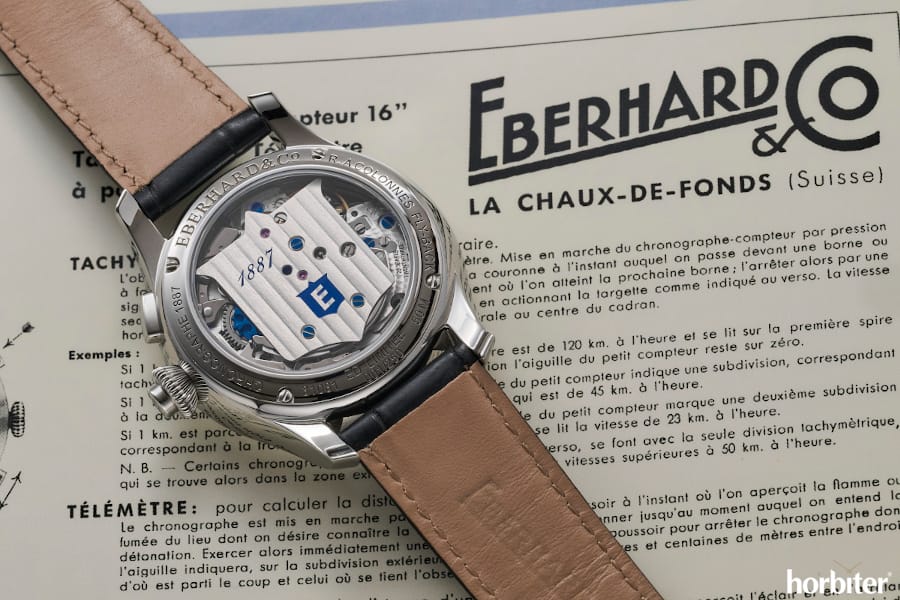
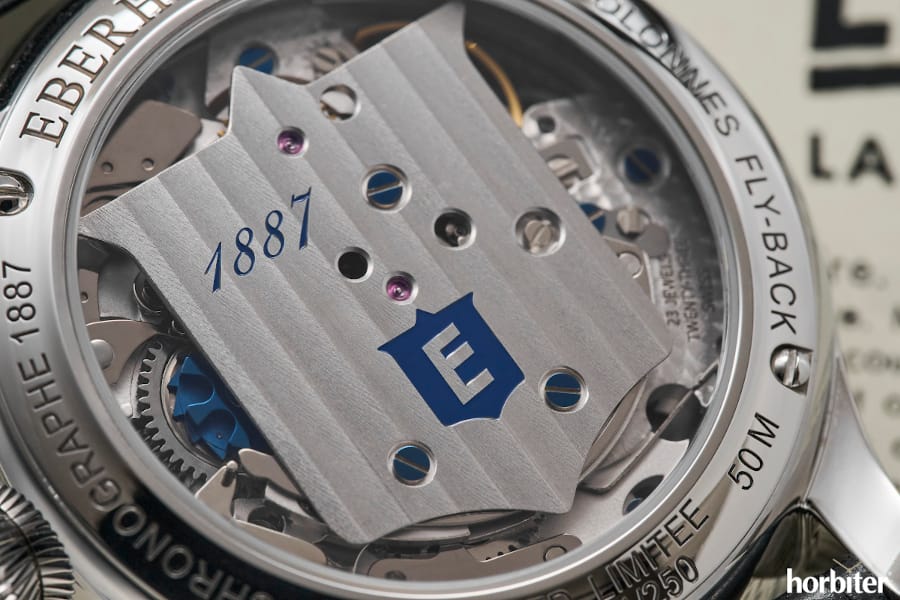
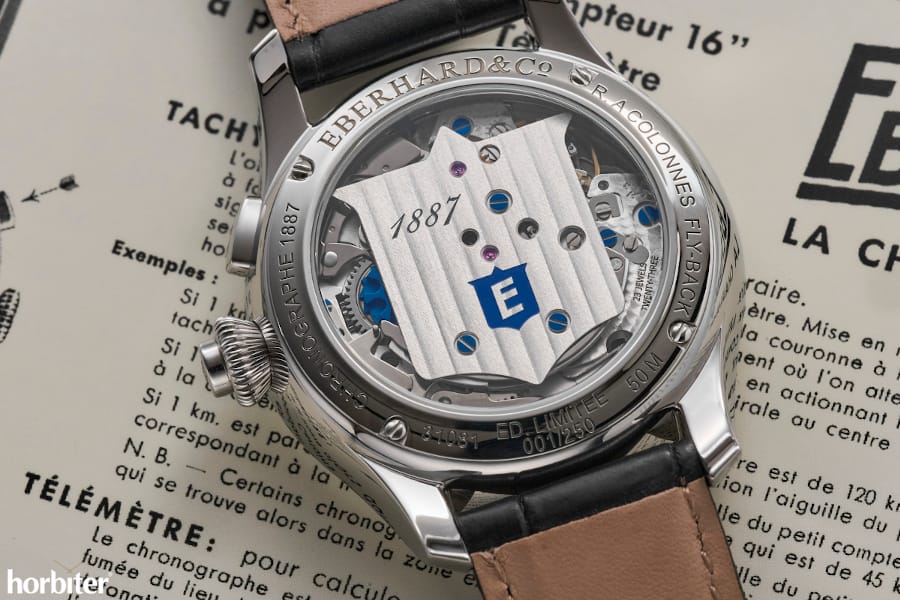
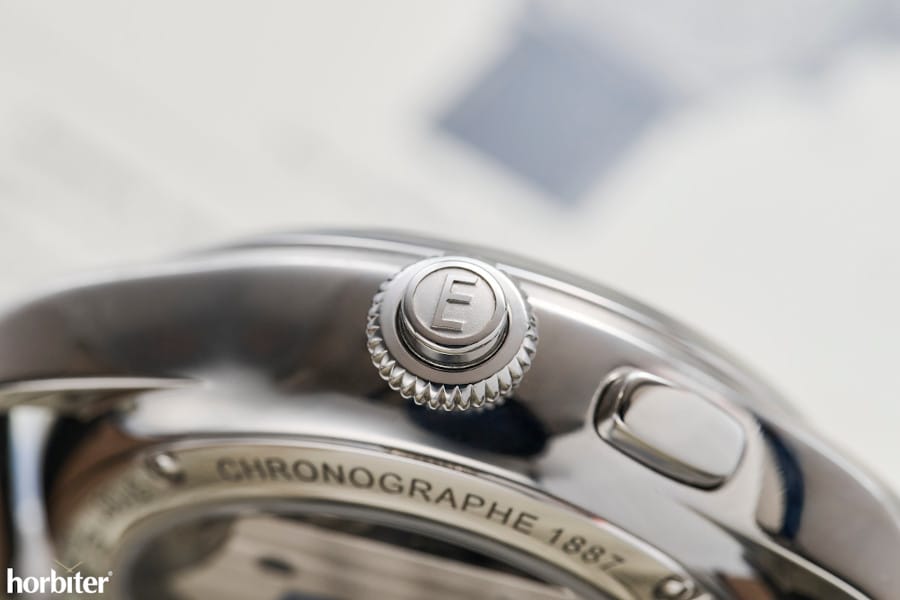
41.50 mm and 13.90 mm (and a 20-mm distance between the lugs) are the key specs, yet they barely describe the intricate lines of the new chronograph. The case showcases curvy lines and consists primarily of three parts; a midsection, a mirror-polished bezel surrounding a slightly curved sapphire crystal, and a case back ring fastened by four screws with a see-through crystal on a hand-wind movement.
Also, the case side narrows towards the case back to fit the calibre, while the lugs are curved on the inside. The designers worked hard to reproduce a slightly vintage feel on a two-push-piece, two-counter chronograph with a contemporary overall finish.
A reset and flyback single push-piece
At two o’clock stands the chronograph’s start and stop button while a second “E” engraved pusher at three resets it or triggers the flyback function.
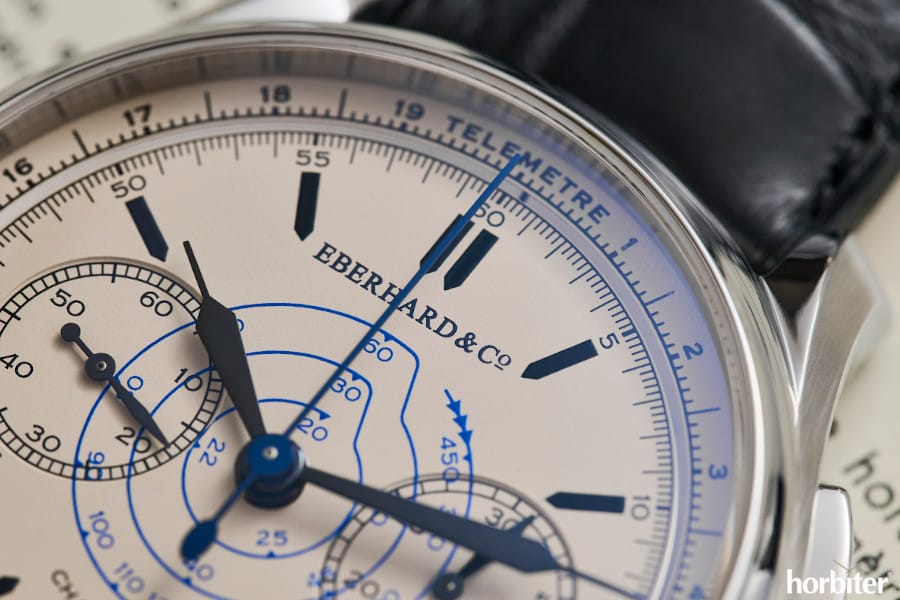
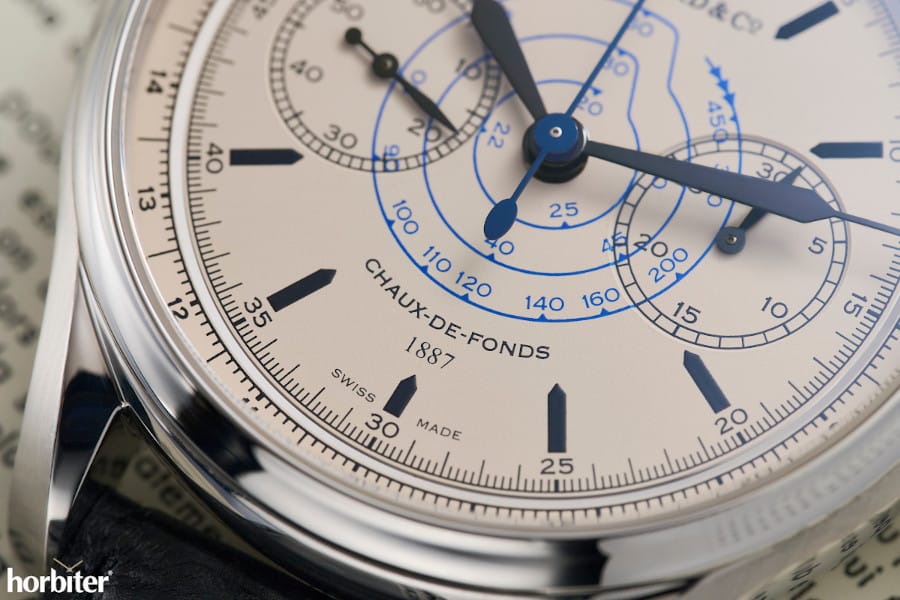
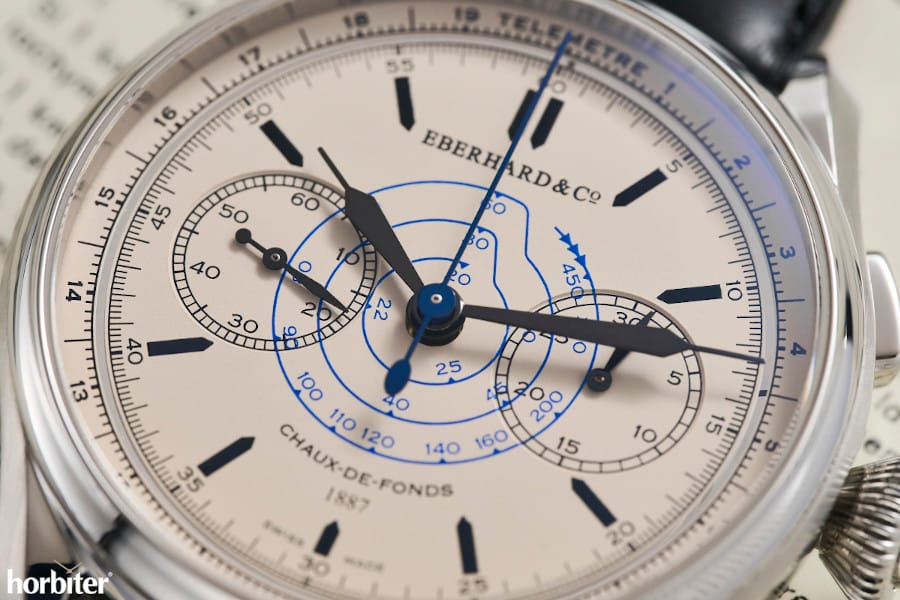
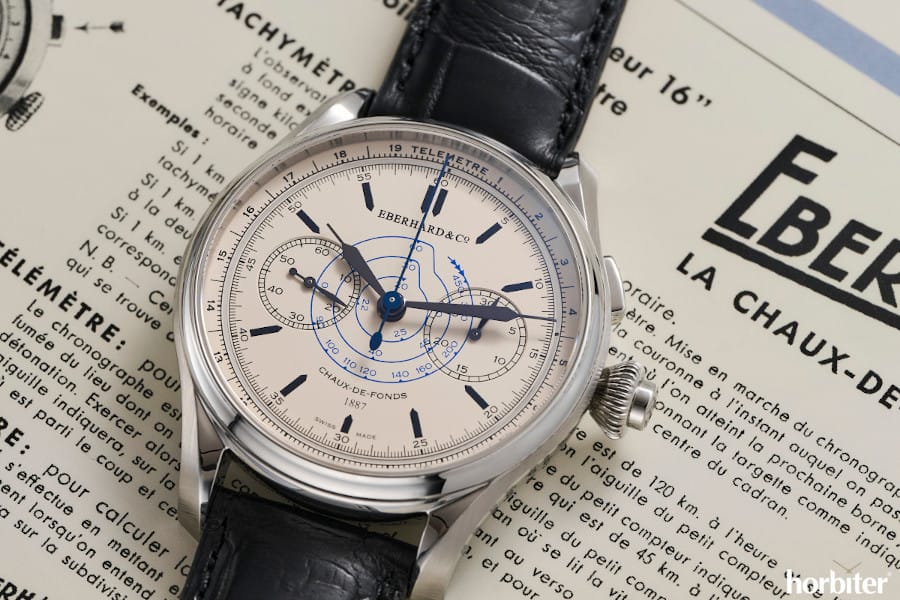
The Chronographe 1887 Édition Limitée 31081 sports the romantic yet less purposeful “Retour en vol” function, complemented by two equally romantic scales on the dial: a tachymeter and a telemeter. The central chrono hand matches the thirty-minute totalizer at three, while the standard running seconds sweep on the opposite side. Blued are the central chrono hand and the matching central Tachy scale.
The product reference pictured here is white with a“coquille d’oeuf” finish; you can barely spot it unless you close up with a macro lens. The spiral-shaped tachymetric scale is as blue as the Chrono hands, while all the remaining indications, including indexes and counters, are deep black.
In this layout, the telemeter scale is located on the outer ring, and a circular ring sets it apart from the dial’s midsection. Question mark: what powers this hand-wound flyback chronograph?
The EB 280 caliber
Coded as EB 280, the hand-wound Flyback chronograph powering the 31081 is an AMT 5100 movement customized to E&Co. ‘s specifications. However, to most people such a caliber is unkown.
You will find little information about AMT around. Sellita’s sub-brand AMT manufactures the most high-end complicated movements, including the 5100, a 4 Hz hand-winding chronograph with a blued column wheel visible through the case back. A large bridge in the shape of the Eberhard & Co. shield and Côtes de Genève, as well as a perlage decoration on the main plate tops it.
It comes standard with a 58-hour power reserve, but the brand did not disclose any specs. From atop, you can see it is an industrial yet nicely finished movement, as exemplified by the blued screws.
Functionally flawless, it pleases the wearer with a smooth pusher start-and-stop operation, as you will not see any often in most column-wheel-operated chronographs out there.
Final thoughts
The Chronographe 1887 Édition Limitée 31081 costs €6,960 and will be limited to 250 examples, available from November. It is a lovely chronograph echoing the vintage chronographs we love. It is priced in line with the watches in the benchmark, although I think a limited edition series should never exceed the one-hundred-piece threshold.
We would also have added a replacement steel bracelet to the box. Eberhard & Co prides itself on engineering excellent bracelets, and it would be a helpful range extender.
The new reference opens new scenarios since it suggests we might expect similar iterations in the future. We hope that Eberhard & Co. will equally equip them with an in-house movement anytime soon.
(Photo credit: Horbiter®)
Giovanni Maria Di Biase @Horbiter®
In this article:
Case
It encases the mechanical movement and is crafted in one or more parts. It can also be a single piece, as with some professional diving watches, or made of unconventional…
Chronograph
Complication that helps the wearer to measure time intervals without affecting the watch's standard time-telling function.
Case back
It can be screwed in, pressure-fastened, or secured to the case via screws. Occasionally, it comes as a single piece, with the case of specific professional diving watches (for example,…
Bezel
The bezel is particularly useful on diving watches, allowing you to check dive times. In this case, it unidirectionally rotates and usually comes in two parts: a metal (or ceramic,…
Calibre
A calibre is the type of watch movement encased in an assigned timepiece. Its name is usually associated with the manufacturer's name and a standard code, e.g., ETA 2824.
Power Reserve
A mechanical watch feature displays, on the dial or the case back, the remaining power in a watch movement, showing the length of time until the timepiece must be rewound.
Line
It is the measurement unit that identifies the size of a movement. According to this measurement system, one line corresponds to 2,255mm.