The ATTESA watch product line was once available in Japan and the United States as Citizen’s most exclusive collection.
Citizen then decided to market it globally, equipping it with state-of-the-art technologies, including the latest satellite GPS platforms and Super Titanium variants.
Over the past five years, Citizen has flexed its muscles by introducing new products to promote its latest-generation F950 movement and explore new designs, with the best example being the 50th anniversary model.
Building on the edgy design heritage of their F100 and F900, whose philosophy eventually inspired the Series 8, Citizen unveiled a new take to celebrate the brand’s first-ever titanium watch’s 55th anniversary and organized an exhibition tour from Tokyo to Paris via New York.
Ten years in the making, here comes the first Satellite Wave GPS F950 model equipped with an octagonal ceramicbezel.
Kaizen meets Europe
Citizen is a large-volume watch manufacturer and continues to explore new trends; it is therefore no surprise that it revived one of the most popular designs in the industry, following the likes of some Swiss and Japanese brands.
Genta’s heritage lives on, as seen through the lens of Credor, which adopted a hexagonal case shape and likely attracted Citizen in its pursuit of new customers, elevating its satellite Eco-Drive movements.
It is a two-way process: for example, some Swiss brands have introduced solar-powered technology to the premium luxury market.
In contrast, Japanese brands promote more popular designs paired with their proprietary high-tech modules to appeal to a broader European audience. Here is where the ATTESA collection dials in.
Matching an analogue layout with the most advanced Eco-Drive technology and tons of features, ATTESA and Satellite Wave GPS F950 join forces to appeal to design and tech-savvy watch enthusiasts.
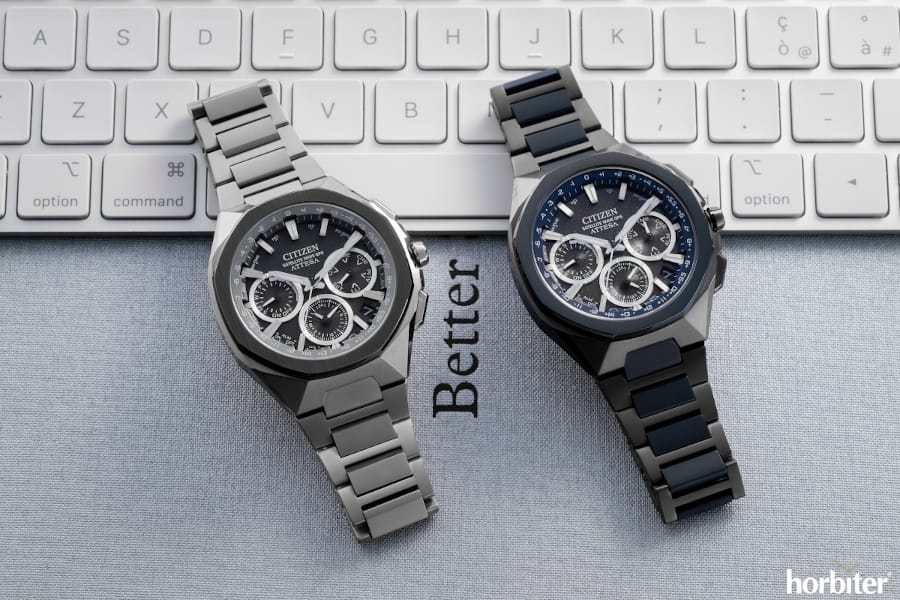
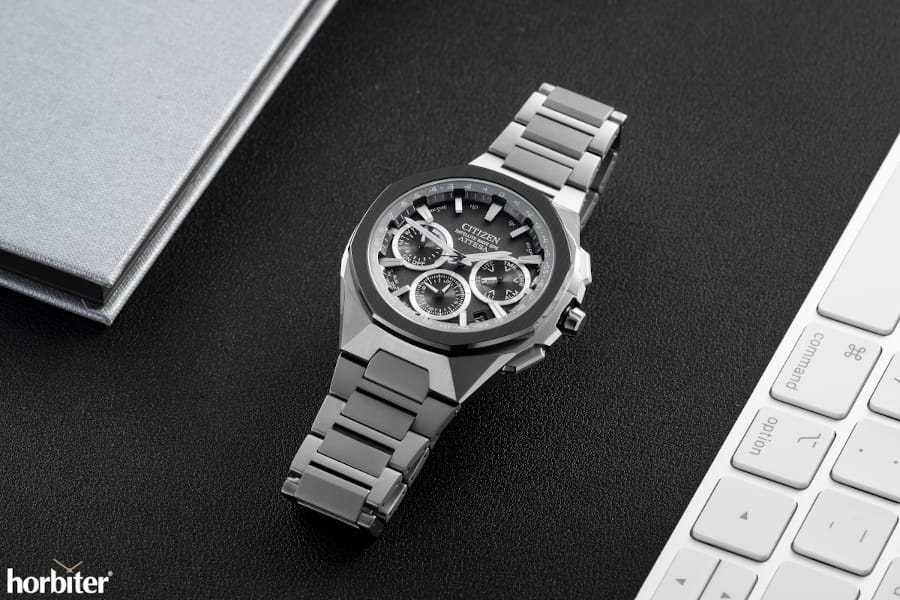
The first-ever black ceramicbezel adds to a sophisticated design, whose three-register platform is based on the F950 ATTESA, encapsulated in a quintessentially Citizen edgy silhouette.
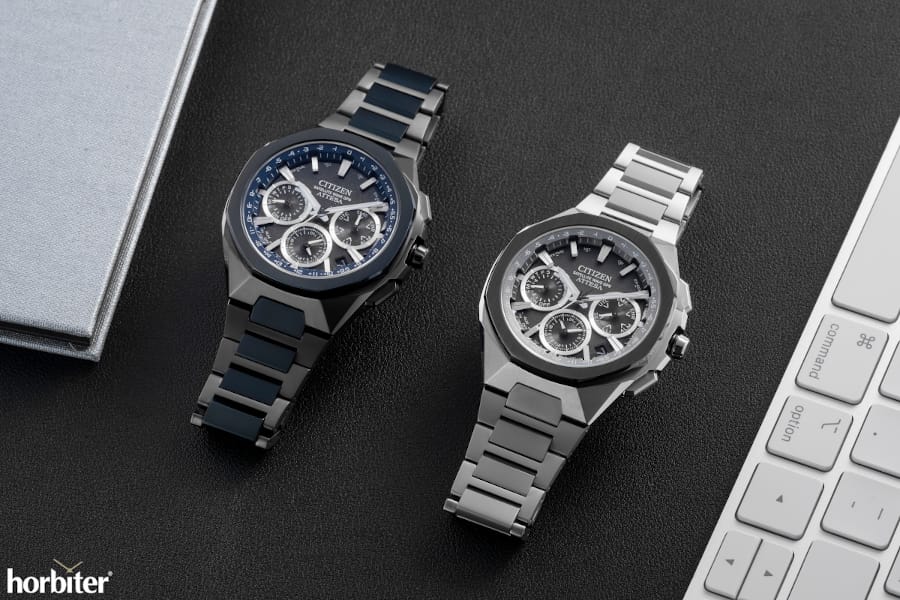
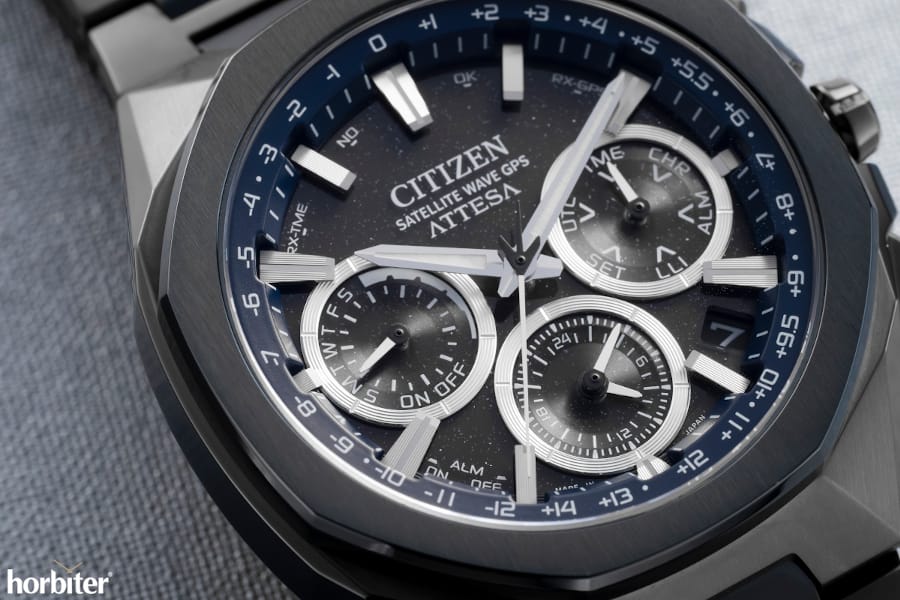
Please welcome the two non-limited models coded as CC4104-53E and CC4105-69E (not available for our photo shoot). The first uses Super Titanium with Duratect™ Titanium Carbide treatment; the other uses Duratect™ DLC treatment. Pictured here is the reference CC4106-74E featuring a Blue DLC treatment on the ceramicbezel and central bracelet links, instead.
This 2000-piece limited edition is the ATTESA Spaceship, whose alias refers to a model-exclusive star-patterned dial.
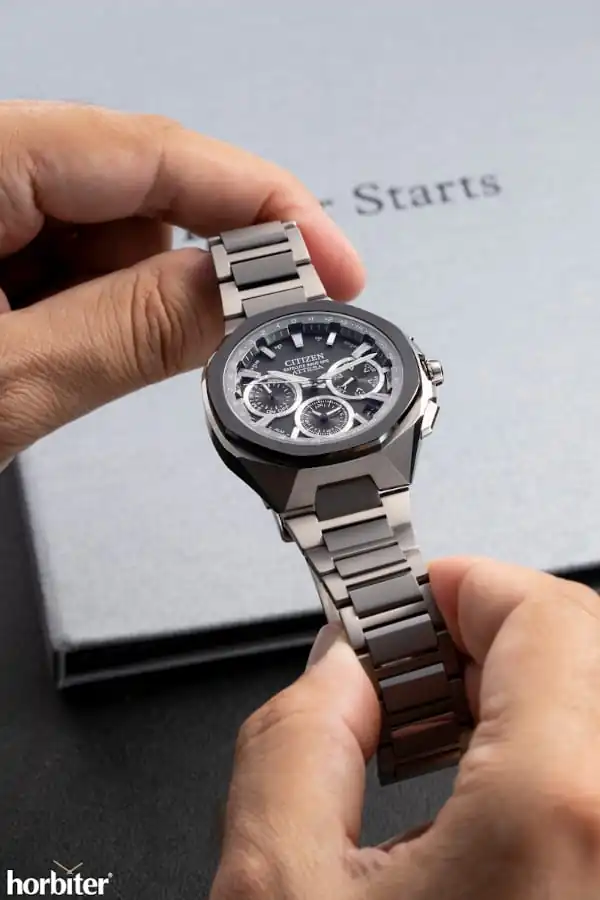
All products are 44.0 mm in diameter and 13.7 mm thick, weighing just 115.0 grams. Let’s now review some key features of the Attesa Satellite Wave GPS F950.
A Satellite Wave GPS F950 CC4104-53E’s endless capabilities
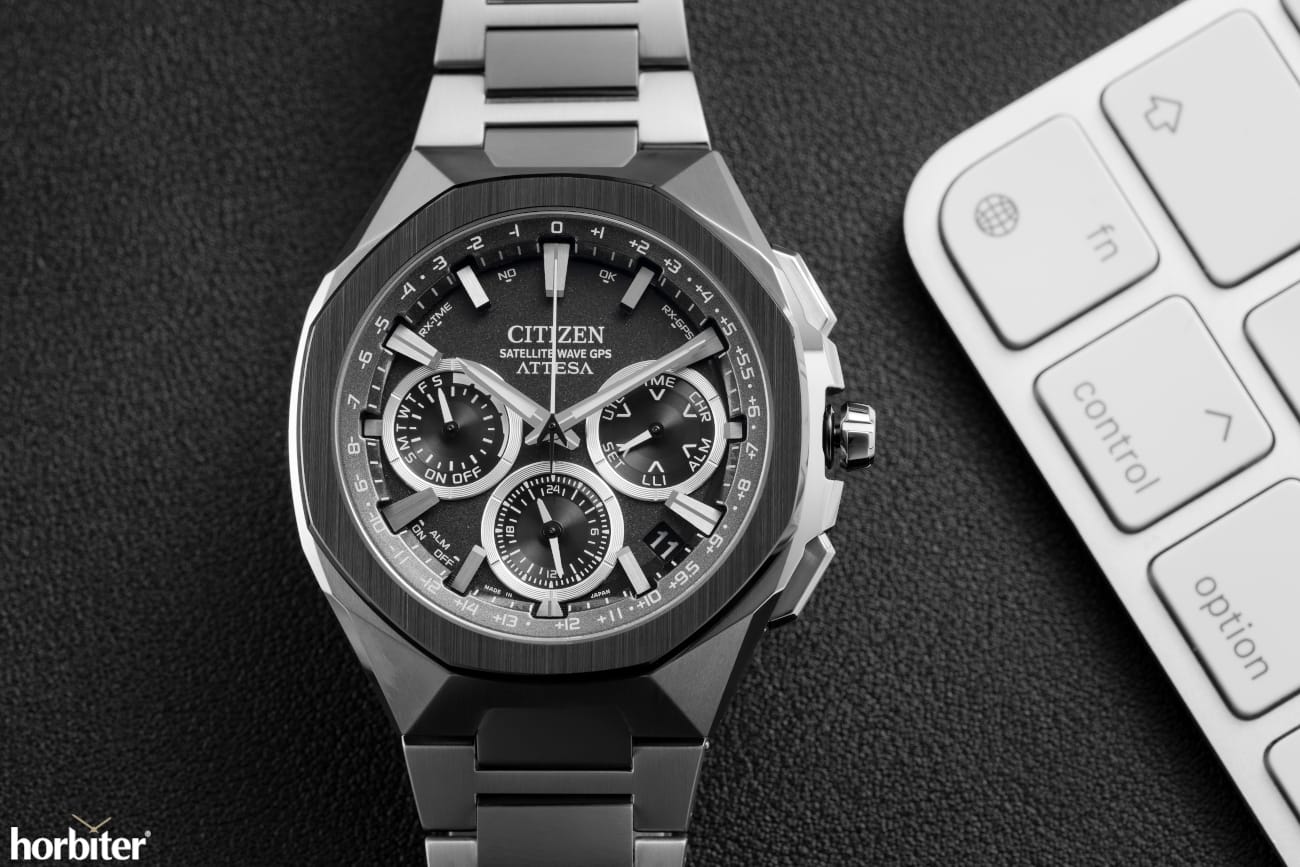
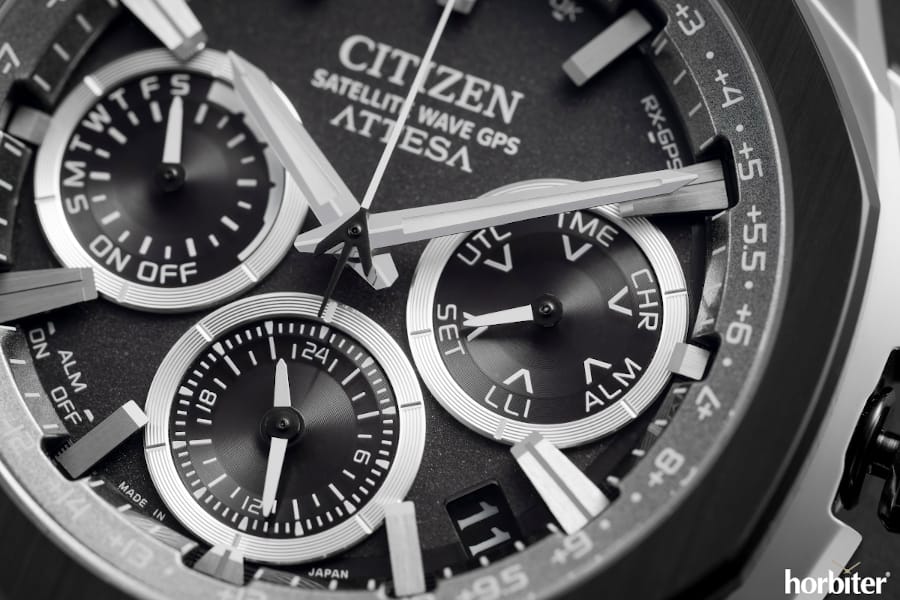
A standard three-counter two-pusher layout mimics a sports chronograph, but the crown-and-pushpiece combination allows several functions to be activated.
First, Citizen offers peace of mind with their Satellite Wave GPS, which is rated for 100 meters of water resistance. However, be aware that it does not feature a screw-down crown.
According to the brand, any F950 calibre is accurate to +/- 5 seconds per month on average, displays the World Time in 39 time zones, and has dual time zones as standard.
Chronograph and perpetual calendar
The Satellite Wave GPS F950 is a 1/20th-of-a-second chronograph with a 24-hour totalizer and a perpetual calendar programmed until February 28, 2100.
Thanks to GPS signal reception, an Attesa Satellite Wave GPS F950 watch can quickly connect to a GPS signal (3 seconds, according to Citizen) and automatically update the time based on where you are. Once fully charged, the watch could run for up to five years in “power saving” mode.
How to access each function: the Selector
The crown works as a function enabler, allowing the wearer to access multiple functions as listed in the register at three, paired with an additional sub-function register at nine.
On the dial’s outermost ring is the complete list of time zones. You can read the day of the week, power reserve status, and DST activation (ON/OFF) at nine. Look up at twelve and you’ll see the GPS signal reception status (OK/NO).
Breaking down the primary functions
For example, by moving the Selector to TME mode, you’ll combine a centrally displayed Home time with Local time at six; in CHR mode, the central hand turns into the chronograph seconds-elapsed hand, and the second time zone display turns into the minute and hour totalizer.
The counter at nine, once the chrono stops, displays the 1/20th-of-a-second reading. Set the UTC mode, and the dual-time display will use UTC.
I need to stop, and that’s what makes this watch both attractive and somewhat complicated to use: the wearer is offered countless features, but be ready to carefully read the user’s manual to explore the watch’s full potential.
Final Thoughts
The Citizen Attesa Satellite Wave GPS F950 embodies what Citizen’s satellite technology stands for in the watch industry, showcasing the relevance of the product portfolio and the most advanced technologies, including Duratect™.
I’m loving the new style, and I see it as more distinctive than any round Attesa case; such angular lines are deeply rooted in the brand’s design philosophy.
Titanium Carbide is a winner.
My favourite model uses Super Titanium with a carbide-titanium treatment; I’m not into blackened watches and never will be, despite the enhanced Vickers hardness.
Any blackened case only makes sense when adopting ceramic, for instance.
However, the first-ever ceramicbezel opens the door to a possible ceramiccase and bracelet in the foreseeable future. In case, it would represent a game-changing process for the Japanese brand.
The bracelet needs improvement.
Back to the above-reviewed references, a larger, longer bracelet clasp would be welcome to counterbalance a light yet massive case body and to fasten it securely to each wrist.
The current one comes standard with a micro-adjustment mechanism; however, it still needs a consistent design.
Last but not least, the retail price: Citizen has dramatically improved the value of its offering through unbeatable performance and a finish-to-price ratio, which is a significant takeaway given today’s inflated price list. In figures, the price list ranges from €1,290 to €1,490.
(Photo credit: Horbiter®)
Gaetano C @Horbiter®
In this article:
Line
It is the measurement unit that identifies the size of a movement. According to this measurement system, one line corresponds to 2,255mm.
Ceramic
Widely used for crafting a watch case and, in recent years, also for the bezels of diving watches and dials. Obtained from zirconia powder (ZrO2), ceramic offers superior scratch resistance…
Bezel
The bezel is particularly useful on diving watches, allowing you to check dive times. In this case, it unidirectionally rotates and usually comes in two parts: a metal (or ceramic,…
Case
It encases the mechanical movement and is crafted in one or more parts. It can also be a single piece, as with some professional diving watches, or made of unconventional…
Chronograph
Complication that helps the wearer to measure time intervals without affecting the watch's standard time-telling function.
Crown
Placed on the case side, it winds the mainspring. When pulled out, it also sets the time and the date. A screw-down crown increases water resistance and protects the movement…
Calibre
A calibre is the type of watch movement encased in an assigned timepiece. Its name is usually associated with the manufacturer's name and a standard code, e.g., ETA 2824.
Perpetual Calendar
The perpetual calendar is a complication that adjusts the watch's calendar for varying months and leap years. This cycle will end in 2100, and the wearer should apply the first manual correction.
Calendar
A feature that shows the day of the month and, in some cases, the day of the week. Some calendar watches show the date on sub-dials, while others display the…
Power Reserve
A mechanical watch feature displays, on the dial or the case back, the remaining power in a watch movement, showing the length of time until the timepiece must be rewound.
Time zone
Time zones refer to the twenty-four regions of the globe. Milan, Rome or Naples will indicate our time zone here in Italy.
The new Citizen Attesa Satellite Wave GPS 950 models are the category’s benchmark and the GPS-powered watches with the best quality-to-list-price ratio. The case design, with its octagonal ceramic bezel on a sharp-edged case, dating back to the F100 series, is as contemporary as ever before, and geared towards a more European audience. The watch is appealing, well-built, and offers plenty of features while looking like a traditional analogue sports chronograph. The areas for improvement include the clasp, which needs to be longer to ensure a better fit on the wrist and counterbalance a thick (yet light) case. From an after-sales perspective, it is surprising that such quality comes with an ordinary 24-month warranty.