The Baume & Mercier Clifton Club GMT watch hands-on
Giovanni Di Biase25 March 2021
0 Comments
GMT watches are trending, and new products keep hitting the stores over and over again. Frequent travelers have perhaps increased yet joking apart and whatever the reason is, the offering of this kind of timepieces has sky-rocketed over the past two years.
Baume & Mercier is among the brands to have joined this party late; nonetheless, it has a longstanding tradition in making Dual Time watches for instance as with the Classima Dual Time, that combines a two-time zone display along with a day and night indication. Regarding luxury sports watches, the Clifton Club is the brand’s offering of accessible luxury sports watch, and the Clifton Club GMT is the most relevant new product along with the Clifton Club Bronze.
Being second, third, fourth in joining this specific market segment is not a drama, it is essential instead to offer the right product at the right price and this new Clifton Club GMT aims at ticking first and foremost these two boxes; the GMTcomplication is no big news too, and seems to be as desirable as ever, what is key to success here is always to introduce something original.
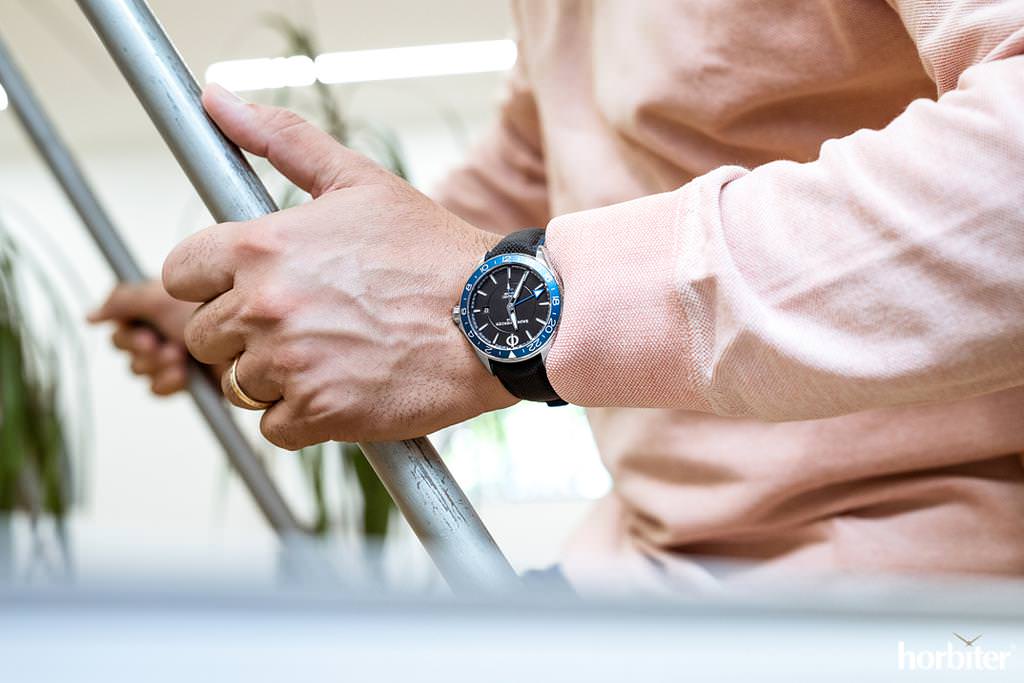
If we draw our attention to the Baume & Mercier Clifton Club collection throughout, for a while, I reckon it has abandoned that original millennials oriented luxury watch feel in an effort to attract a younger audience, to become more mature instead; the new Clifton Club GMT exemplifies this change: it looks perfect on the wrist of a young professional that once was a student at the university.
The brand has introduced the Clifton Club GMT in two versions, that differ from each other by the strap option. Sharing the same stainless steel case, that is 42mm wide and less than 11mm (10.6mm) thick, these two options offer quite different sensations when wrapped around the wrist, but can be easily swapped, given the quick-change device system: the strap, a leather one covered with sailcloth on the outside and a rubber layer on the inside is sportier; the second one is classic, sporting a traditional three-row link steel bracelet that adds weight, without providing any wow effect, to be honest. They also share the same triple folding buckle.
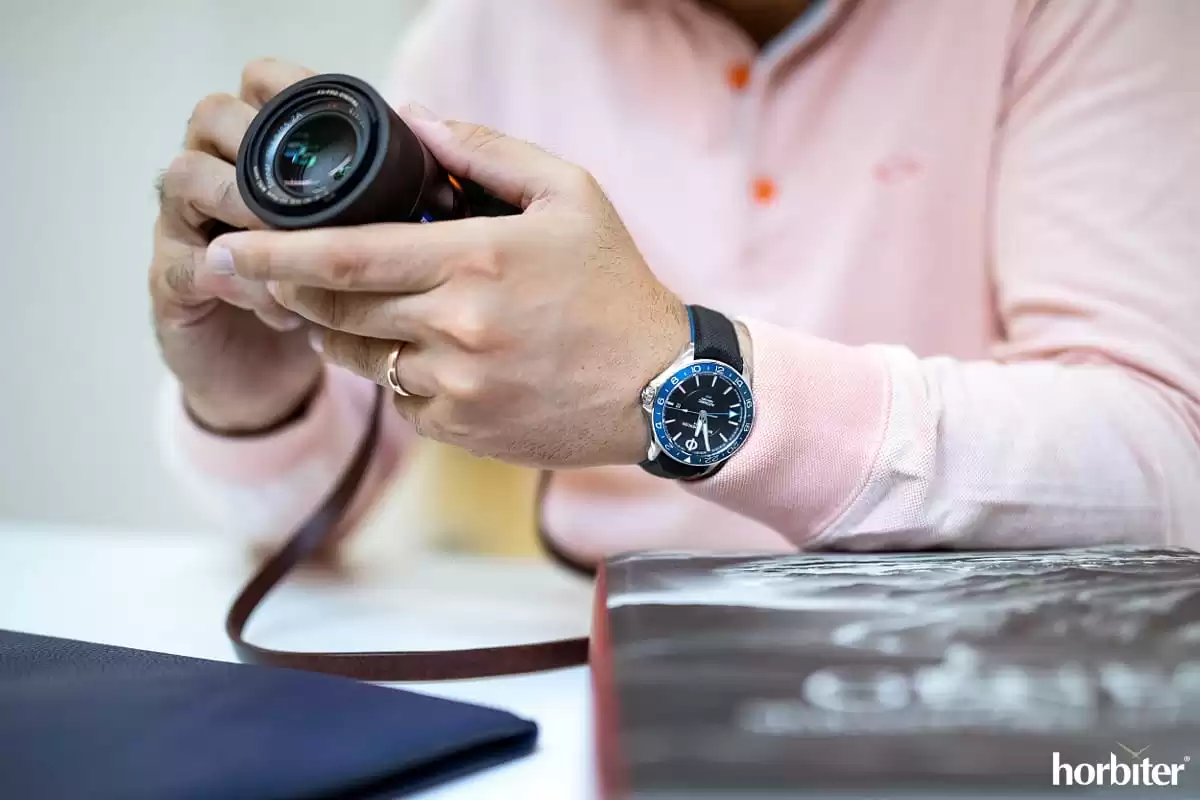
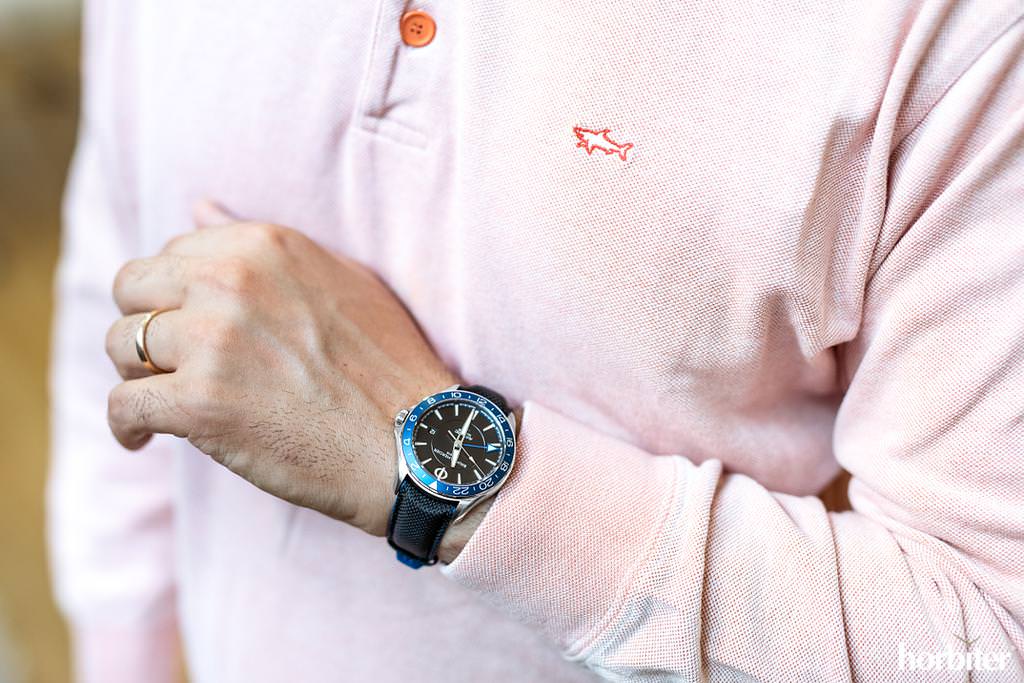
Aesthetically streamlined, the Clifton Club GMT showcases a two-color combination: black is the dial while blue is the 24-hour stamped bezel. The bezel is therefore old-school, meaning that it has a 24-hour numbered aluminum-made inlay; I hardly understand why is the bezel not made of ceramics, bearing in made the ceramicbezel is widely adopted on less than € 2,000 priced timepieces, even if they’re not sporting a logo as powerful as the Baume & Mercier‘s on their dial.
Additionally, the bezel is fixed; it is not possible to use it as a means to read an additional time zone if needed. Mechanically, the Clifton Club GMT comes equipped with a Sellita sourced base mechanical movement capable of offering a 42–hourmaximum power reserve, with the addition of a GMTcomplication, that can be adjusted via the crown and is visible thanks to a long blue arrow-shaped end, filled with plenty of SuperLuminova®. Reassuring, reliable and “no-frills,” the Baume & Mercier Clifton Club GMT retails for € 2,100 with the strap option, and € 2,250 when paired to the steel bracelet.
It is the acronym for Greenwich Mean Time and identifies a complication capable of displaying two or more time zones on the dial. The complication usually couples a 24-hour rotating…
Time zone
Time zones refer to the twenty-four regions of the globe. Milan, Rome or Naples will indicate our time zone here in Italy.
Complication
The addition of any mechanical complication to a movement that usually displays the time.
Strap
A leather, rubber or other material band that secures the watch to the wearer's wrist.
Case
It encases the mechanical movement and is crafted in one or more parts. It can also be a single piece, as with some professional diving watches, or made of unconventional…
Ceramic
Widely used for crafting a watch case and, in recent years, also for the bezels of diving watches and dials. Obtained from zirconia powder (ZrO2), ceramic offers superior scratch resistance…
Bezel
The bezel is particularly useful on diving watches, allowing you to check dive times. In this case, it unidirectionally rotates and usually comes in two parts: a metal (or ceramic,…
Power Reserve
A mechanical watch feature displays, on the dial or the case back, the remaining power in a watch movement, showing the length of time until the timepiece must be rewound.
Crown
Placed on the case side, it winds the mainspring. When pulled out, it also sets the time and the date. A screw-down crown increases water resistance and protects the movement…




 If we draw our attention to the
 Aesthetically streamlined, the Clifton Club


