The Audemars Piguet Royal Oak watches unveiled at SIHH 2015
Giovanni Di Biase17 March 2021
0 Comments
It is a maison which could easily rest on its laurels, yet Audemars Piguet continues to invest a lot of money and resources in Research and Development, and to offer state-of-the-art timepieces, to improve collections that already look perfect to me, to introduce new advanced materials that no other brand has even taken into consideration.
In terms of mission statement, we might apply to the maison from Le Brassus the sentence pronounced by Enzo Ferrari when asked by a journalist which was the best Ferrari he had ever created: “The best Ferrari I’ve done, is the one which I have not yet achieved…”
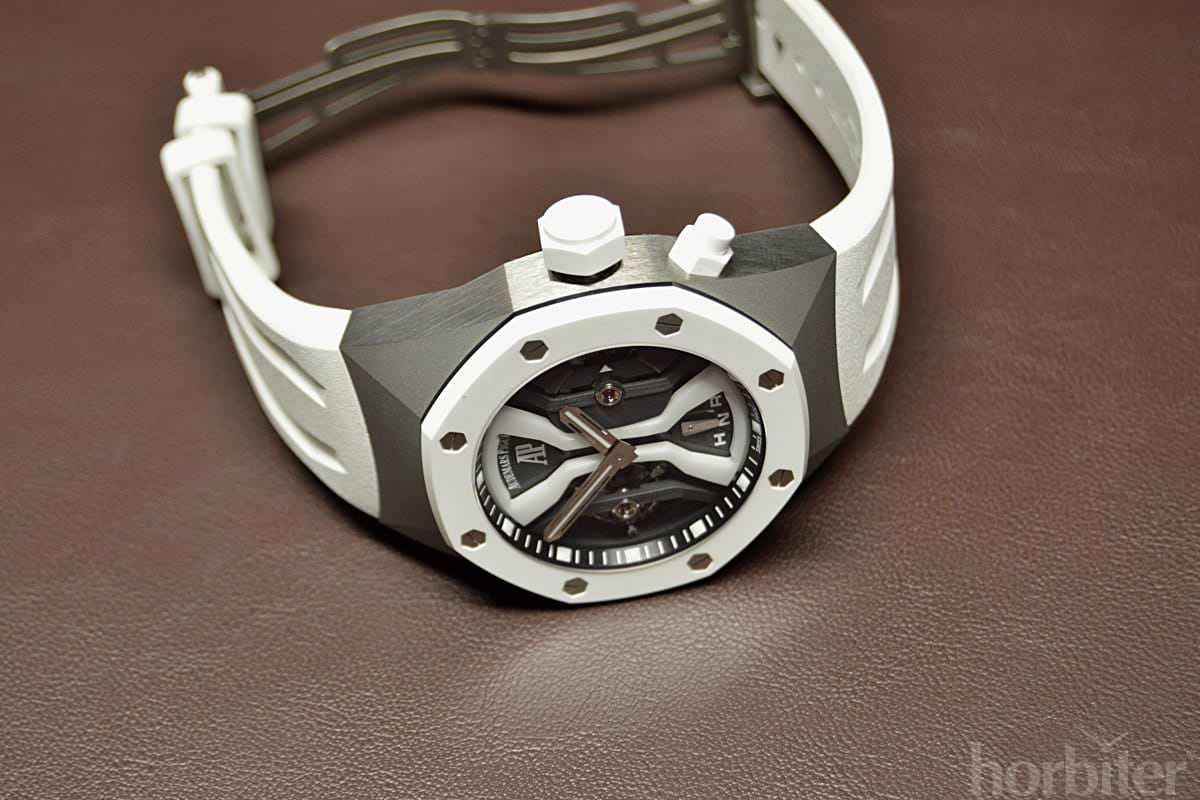
When it comes to raising the bar in watchmaking even higher, Audemars Piguet refers to its flagship collection, the Royal Oak and last week, while at the SIHH, it officially presented its eagerly awaited Royal Oak Concept RD #1, ideally casting back to pre-history, at least on paper, any other Minute Repeater currently existing.
I believe the brand has been very brave in rethinking one of the most refined complications, together with the tourbillon, beloved by enthusiasts all over the world and, at the same time, to challenge itself, since it boasts at least 140 years of experience in minute repeater watchmaking.
Audemars Piguet has inserted into the Royal Oak Concept’s titanium case a minute repeater that has needed 8 years to develop, and which has involved the EPFL (École Polytechnique Fédérale de Lausanne) and a team of experts that included a musician and string producer, a consultant from the Geneva’s conservatory, as well as an acoustic engineer.
Their goal was to make a timepiece with a strong and neat sound, which would also be able to overcome one of the biggest constraints when it comes to making a timepiece with such complications: to ensure that the watch is water resistant, without affecting its sound quality.
It set up a dedicated area within its SIHH’s booth, where journalists and enthusiasts have been allowed to test the results of this project, for which three patent requests have already been registered. Believe me when I say that it has been a unique experience, especially if you listen to the Concept RD #1’s chime immediately after having listened to a conventional minute repeater, so that we look forward to the second prototype to be released and to share, with video, such an experience with you.
I have a few doubts about the brand’s claim that it is something to share with others: if I had a minute repeater, I honestly would not want to share the experience of its chime with anyone else.
In brief, the developing team has redefined the chime’s quality, in terms of tones and harmony, by setting measurable targets and by solving, as mentioned above, one of the biggest constraints when it comes to making a minute repeater: the sound damping caused by a water resistantcase, that did not appear on the first pocket watches with a minute repeater, which featured a clear and appealing chime, and that still represent a benchmark.
True to the philosophy of exclusively adopting exceptional calibers for its Royal Oak Conceptline, the brand has coupled the Minute Repeater with a Tourbillon and a Chrono featuring a central seconds hand, whose 30 minute counter has been placed at 3. The titanium case is 44mm wide, the crown and pushers are made of ceramics, and the movement vibrates at 3Hz and has at least 40 hours of Power Reserve.
GMT-Tourbillon-for-Horbiter.jpg" rel="prettyPhoto">I draw inspiration from this project, to talk about the Concept collection in a broader sense: I think it deserves an entirely new collection equal to that of the Royal Oak. The Concept range is clearly a “laboratory” collection, in which Audemars Piguet is testing its future, via new ideas and a new design, in my opinion joining a niche that is occupied by brands such as Richard Mille.
What if tomorrow you could buy a three hands Royal Oak Concept? The Concept does not impose on the Royal Oak, the latter being a classic flat watch, whereas the Concept is a cutting-edge3Dwatch: these two collections would be complementary, and the Concept would attract those customers (I’ve met some of them) that consider the Royal Oak to be too classic and with an outdated design, while they could easily find the Concept attractive.
Chronograph-Automatic-SIHH-2015.jpg" rel="prettyPhoto">Audemars Piguet has unveiled other new products from the Royal Oakline during the SIHH, such as the Royal Oak Offshore Tourbillon Chronograph Automatic, equipped with a 2897 caliber, featuring a chrono tourbillon, a column-wheel mechanism and a 950 Platinum winding rotor.
If, when taking a closer look at the case back, you think you’re looking at a manual wind caliber, look again: the winding rotor, mounted on tiny ball bearings, is peripheral and placed on the dial’s side.
Chronograph-Automatic-caliber-2897-SIHH-2015.jpg" rel="prettyPhoto">This technical solution is not only far more efficient, but definitely more attractive than the traditional one and I do hope to see it more and more often on automatic watches. The case is made of forged carbon fiber, and the bezel, the crown and pushers are made of ceramic: it is the top offering of the Offshore collection but its dial, a mixture between the Mega Tapisserie motif and other complications, is a bit too crowded.
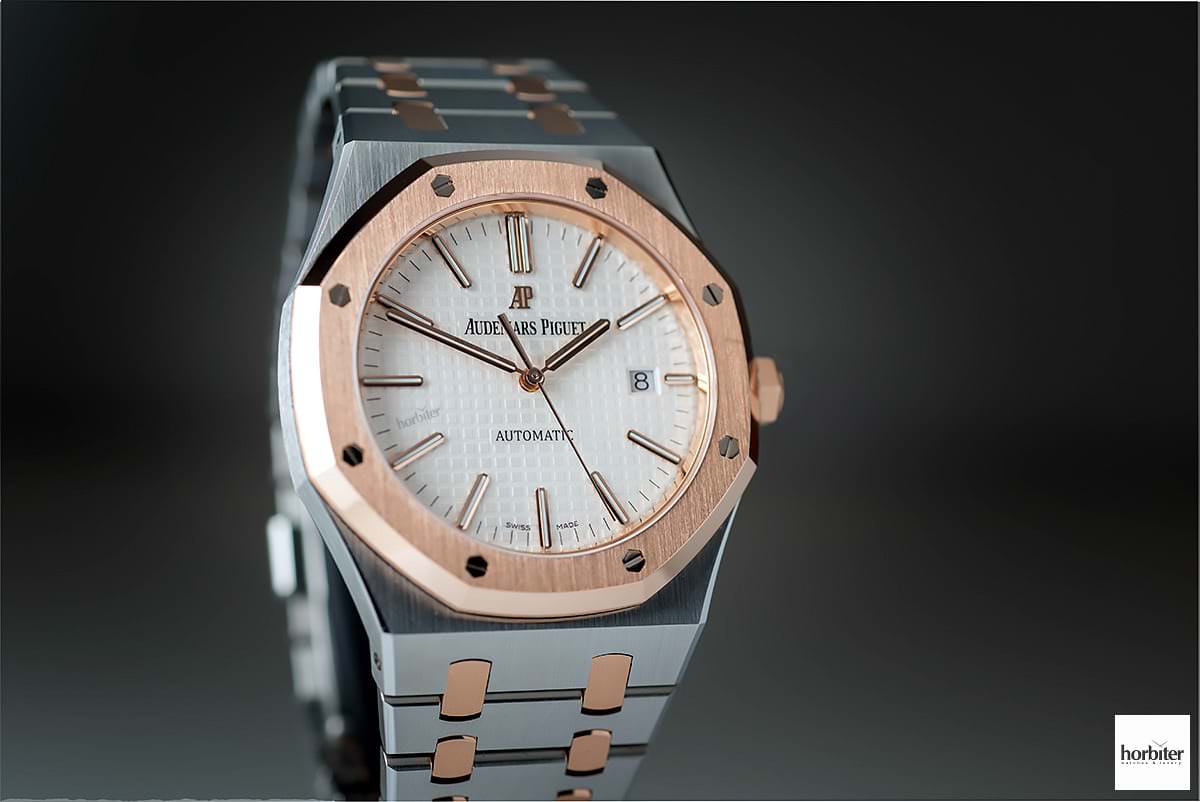
Speaking of new versions, especially nice is the new Royal Oak Bicolor, that brings us back at the early ‘80s, a time when the gold and steel sports watch was extremely sought-after.
For this model Audemars Piguet has gone for rose gold, which is definitely more elegant, and is today far more widespread than yellow gold, as its tones have a warmer quality; this has been coupled with a silver dial, so that the outcome is a very poised Royal Oak, highly recommended for European customers, especially the Italian ones.
No information has yet been released about the retail price, with the Concept RD #1 not even being in the pipeline of retailing but, as soon as we will get our hands on them, we will run an in-depth review.
It encases the mechanical movement and is crafted in one or more parts. It can also be a single piece, as with some professional diving watches, or made of unconventional…
Water Resistant
A watch is water resistant when it can withstand splashes of water. It indicates the depth to which a watch can be worn underwater.
Power Reserve
A mechanical watch feature displays, on the dial or the case back, the remaining power in a watch movement, showing the length of time until the timepiece must be rewound.
Line
It is the measurement unit that identifies the size of a movement. According to this measurement system, one line corresponds to 2,255mm.
Crown
Placed on the case side, it winds the mainspring. When pulled out, it also sets the time and the date. A screw-down crown increases water resistance and protects the movement…
GMT
It is the acronym for Greenwich Mean Time and identifies a complication capable of displaying two or more time zones on the dial. The complication usually couples a 24-hour rotating…
Rotor
Part of an automatic watch that winds the mainspring by constantly rotating. Depending on the watch's winding capability, movement design, and value, it comes in various geometries, sizes, and materials.…
Chronograph
Complication that helps the wearer to measure time intervals without affecting the watch's standard time-telling function.
Case back
It can be screwed in, pressure-fastened, or secured to the case via screws. Occasionally, it comes as a single piece, with the case of specific professional diving watches (for example,…
Ceramic
Widely used for crafting a watch case and, in recent years, also for the bezels of diving watches and dials. Obtained from zirconia powder (ZrO2), ceramic offers superior scratch resistance…
Bezel
The bezel is particularly useful on diving watches, allowing you to check dive times. In this case, it unidirectionally rotates and usually comes in two parts: a metal (or ceramic,…