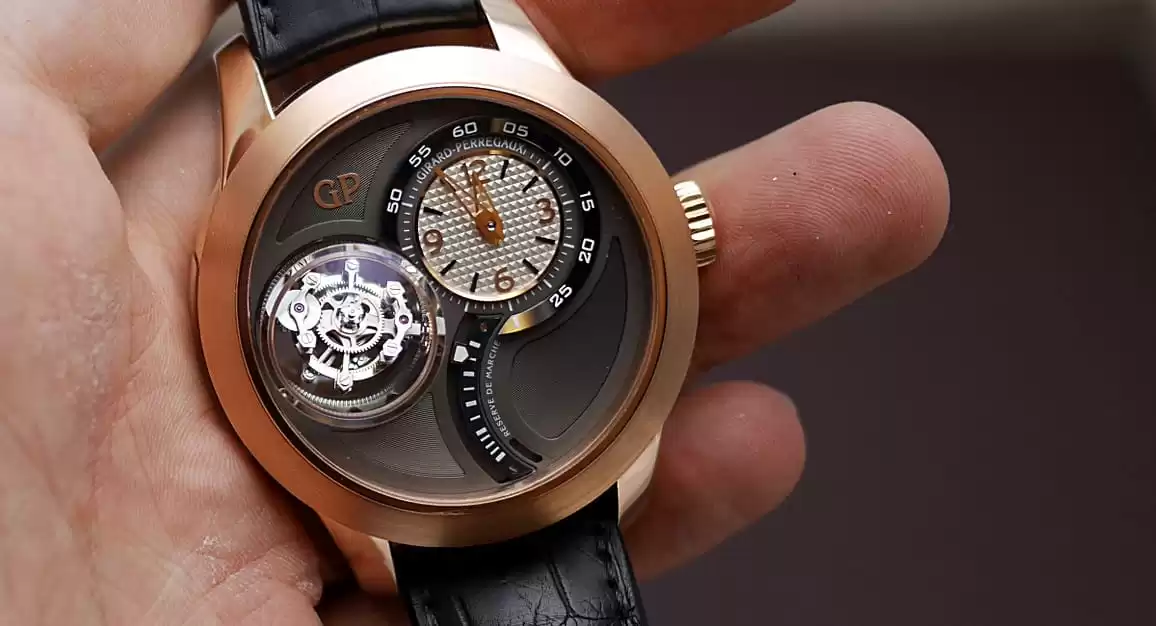
The Girard-Perregaux Tri-Axial Tourbillon is a stunner
Giovanni Di Biase18 March 2021
0 Comments
It’s inaccurate to include a novelty such as the Girard-Perregaux Tri-Axial Tourbillon among the many unveiled at Baselworld 2014, if you were just to scroll down to the letter G on the list. Baselworld 2014 was indeed the occasion to see this timepiece up close, if we could describe it merely as such, and it has a place in the sitting room of haute horologerie.
Connoisseurs, when reading the word “Tourbillon” in a model’s name, already know they are looking at one of the most prestigious technical complications in high-end watchmaking. To those people who are, instead, just now approaching the world of fine watchmaking,
I can say that the word “Tourbillon” is a synonym for one of the greatest achievements in the history of watchmaking and maybe for the most famous watchmaker ever: Abraham Louis Breguet.
Girard-Perregaux, which was founded back in 1791, has been among the very first manufactures to adopt and develop this complication patented in 1801. It consists of encasing the entire regulating system of a mechanical timepiece in a tiny cage: balance wheel-anchor-escapement-seconds’ wheel. Its aim is to reduce the negative effect that gravitational force has on a watch’s accuracy, which truly represents one of the biggest challenges in watchmaking.
Still today the tourbillon represents one of watch enthusiasts’ most appreciated complications the world over, and a challenging ground for manufacturers.
The “easiest” way to make a tourbillon is by creating a “one-minute” tourbillon: a single cage rotates along a single axis, making a 360 rotations in just one minute. Girard-Perregaux already has many tourbillons in its product portfolio (including a Bi-Axial Tourbillon). It is therefore obvious that if, by launching the Constant Escapement LM, the maison has paved the road for future watchmaking (with an award), with the Tri–AxialTourbillon, instead, it was willing to prove its expertise in traditional high-end watchmaking.
One of the most amazing moments at Baselworld 2014 was when I learned all the steps from the concept phase to the making of this masterpiece from Stefano and Massimo Macaluso.
So, why Tri-Axial? Here is the explanation: the first cage completes a rotation in one minute. It is then encased in a second structure which completes another rotation along a second axis in just 30 seconds. Both are finally encased in a third system which rotates along a third axis in two minutes.
The entire device is just 13,78mm wide. But it is more than enough to include 16 micro screws, three cages, and a balance wheel which vibrates at 3Hz. These few numbers tell us about the skills needed to create, build and, on top of that, fine tune this tiny beating heart.
Watchmakers at Girard-Perregaux have encased this device in a sapphire crystal bubble, placed at 9 o’ clock. Describing the finish of the Girard-Perregaux Tri-Axial Tourbillon is like reading through the entire dictionary of haute horologerie craftmanship: surfaces, even those that seem hidden, mirror polished, anglage worked gearings, and a case back as attractive as the dial:
The eagle, which is Girard-Perregaux’s trademark since 1897, is engraved on the Girard-Perregaux Tri-Axial Tourbillon’s caseback along with a small plaque with a progressive number engraved on it: just 10 Girard-Perregaux Tri-Axial Tourbillon will leave the manufacture at La Chaux de Fonds. The caliber is the GP09300, which consists of 317 parts and has a 52 hourpower reserve.
What astonished me of this wonder was the dial: the sleek, balanced design, the Japanese zen gardens, and the 1:30 hour dial create a somewhat hypnotic combination. The applied pink gold GP logo is the icing on the cake, and, in terms of design, brand equity, and pronunciation it is one of the most successful brands you may find around. Does the Girard-Perregaux Tri-Axial Tourbillon have any defect? Yes it does have one: the price tag of 450.000€. But I guess we are all envious of those selected few who can afford one of the ten Girard-Perregaux Tri-Axial Tourbillon.
(Photo credit: Girard-Perregaux; Horbiter®)
Gaetano C. @Horbiter®
In this article:
Complication
The addition of any mechanical complication to a movement that usually displays the time.
Balance wheel
A part of a mechanical watch that oscillates, dividing time into equal portions.
Anchor
It is one of the parts of the escapement. Depending on the type of escapement, it has slightly different shapes. Its name comes from a ship's anchor-like design.
Case back
It can be screwed in, pressure-fastened, or secured to the case via screws. Occasionally, it comes as a single piece, with the case of specific professional diving watches (for example,…
Case
It encases the mechanical movement and is crafted in one or more parts. It can also be a single piece, as with some professional diving watches, or made of unconventional…
Power Reserve
A mechanical watch feature displays, on the dial or the case back, the remaining power in a watch movement, showing the length of time until the timepiece must be rewound.