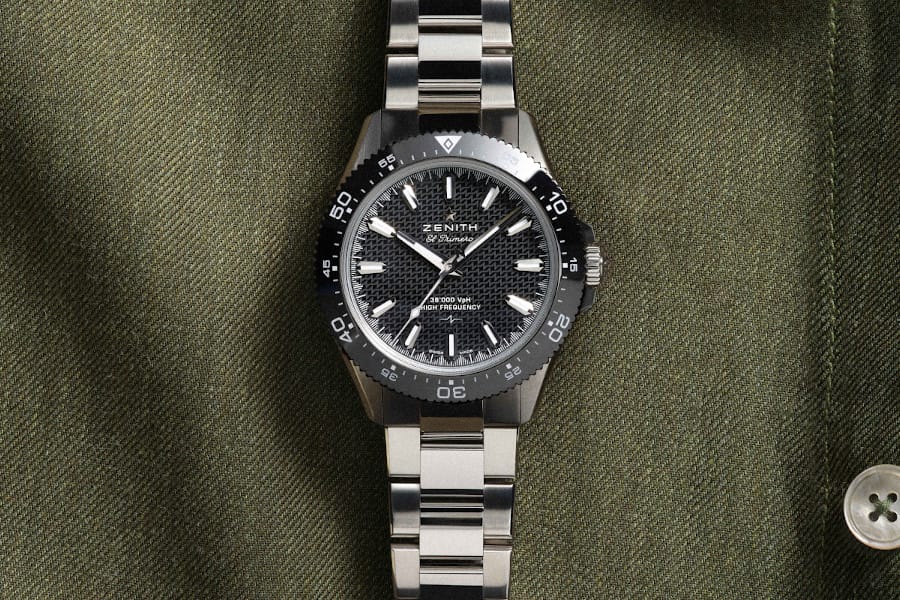
For the first time in the collection’s history, Zenith’s Chronomaster has abandoned the chronographcomplication.
The new Chronomaster Solo Sport brings El Primero‘s high-frequency technology to a three-hand Chronomaster, removing the chrono registers and pushers to create a symmetrical case available in four executions.
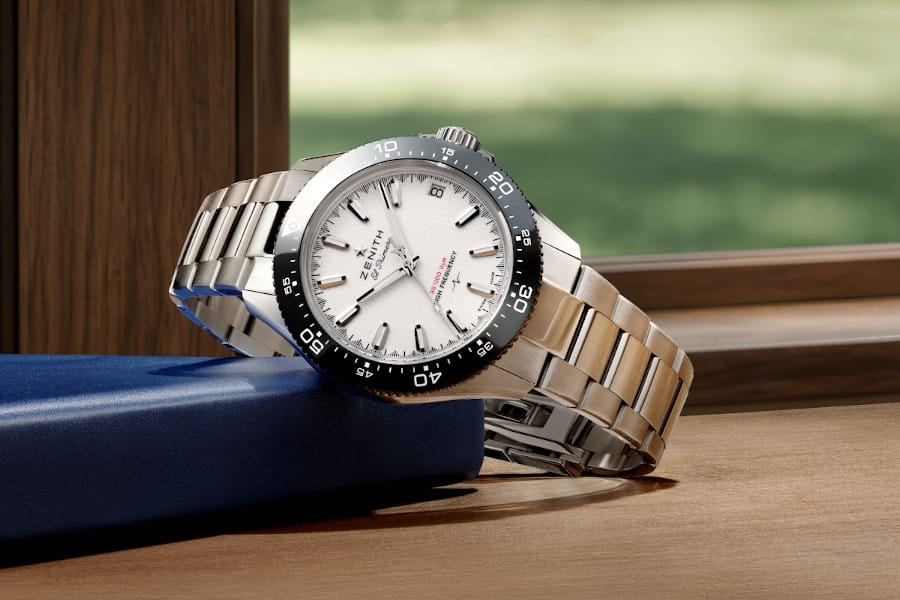
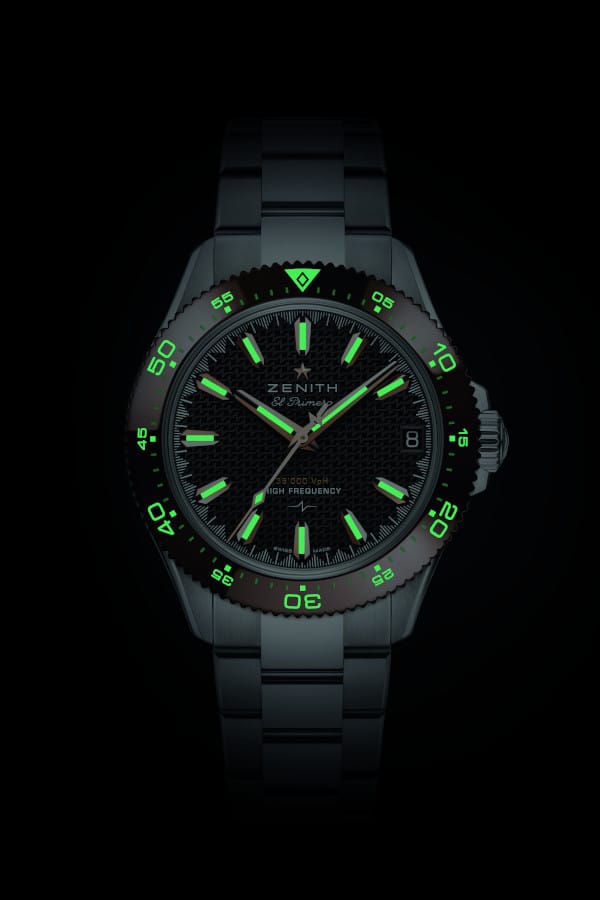
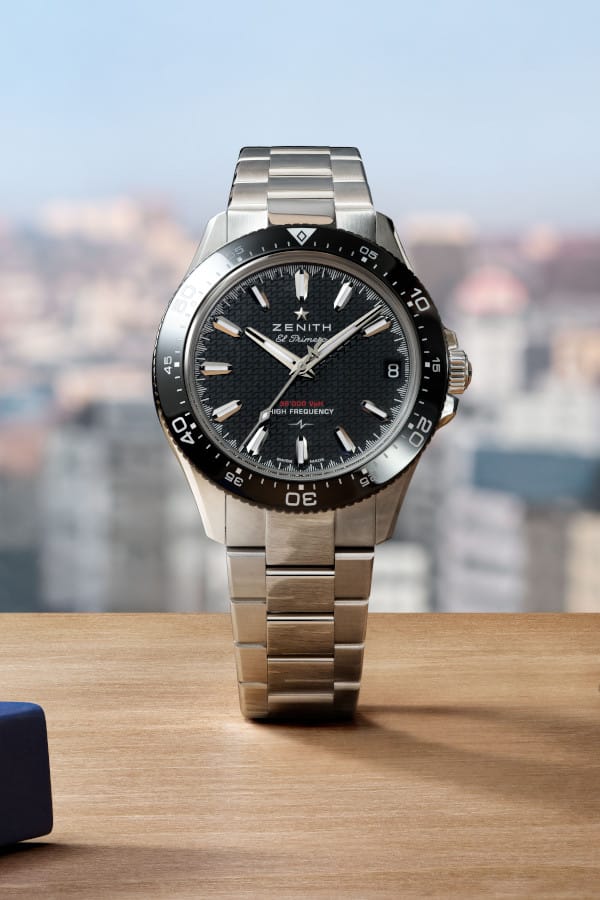
Launched at Geneva Watch Days 2026, Zenith’s new Chronomaster Solo Sport combines a 40.0mm stainless-steel case, 13.1mm in height, with a unidirectional ceramicbezel—without an outer steel ring—200 metres of water resistance, and the manufacture’s 5Hz El Primero 3620 calibre.
It is a compelling move, removing what, in today’s collective imagination at least, may be the Chronomaster’s most inseparable feat: the chronograph.
Zenith abandons the chronograph, not El Primero’s DNA.
The Solo Sport starts with El Primero, Zenith’s integrated high-frequency automatic chronographcalibre, first introduced in 1969. Its defining technical signature has always been—and still is—its 5Hz operating frequency, or 36,000 vibrations per hour.
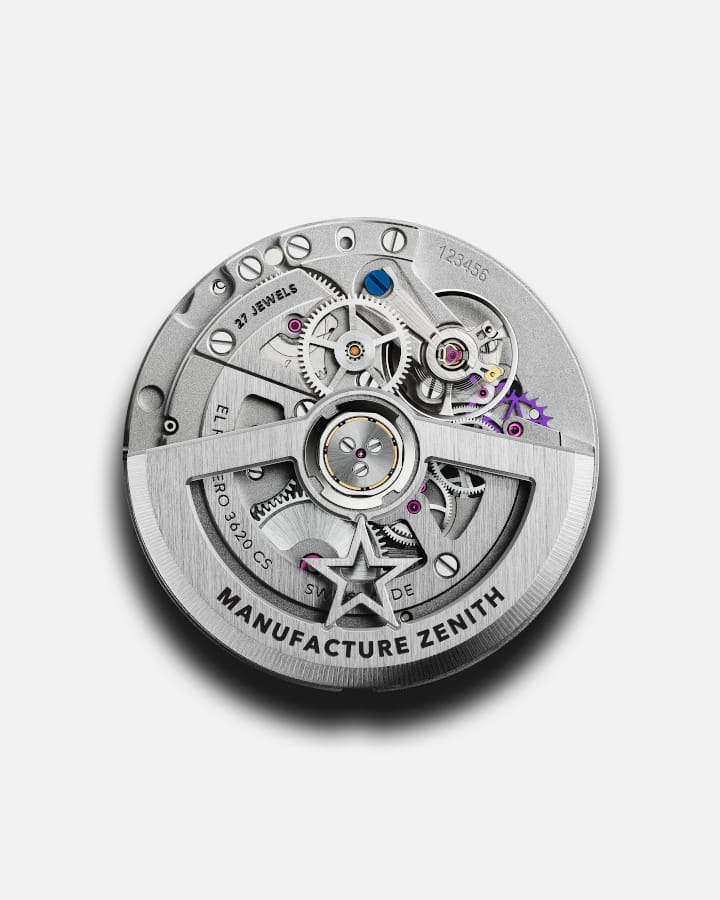
That original beat rate survives in the Solo Sport; the chronograph function does not. Zenith has adapted the El Primero 3600 into the El Primero 3620, turning to a considerably cleaner, more elemental display.
In doing so, Zenith also expands the Chronomaster collection’s offering. Until now, the name has been synonymous with chronographs; Solo Sport introduces a notably refined three-hand model to the family for the first time.
40mm in steel, and 200 metres of water resistance
The Chronomaster Solo Sport is housed in a 40mm steel case, as said—a size that places it firmly in the sweet spot for a versatile contemporary sports watch. A screw-down crown and unidirectional ceramic rotating bezel complete the watch.
Its 20 ATM rating leaves little doubt about how serious its sporting credentials are. Zenith has given the watch specifications for genuinely all-around use: equally at home as a steel-bracelet sports watch or in the water, a versatility that sets it apart from much of the competition.
The bezel clearly departs from the conventional Chronomaster formula. In place of a tachymeter scale, the Solo Sport has a unidirectional rotating bezel, placing it squarely among contemporary sports watches with authentic diver-oriented capability.
This deliberate two-face identity is paramount to the value proposition. Zenith positions it as neither a dedicated sports watch nor a dressier alternative, but as an all-purpose timepiece.
A ceramic dial that screams high frequency from any angle
Although the movement is the project’s main topic, the dial announces its high-frequency theme at first glance.
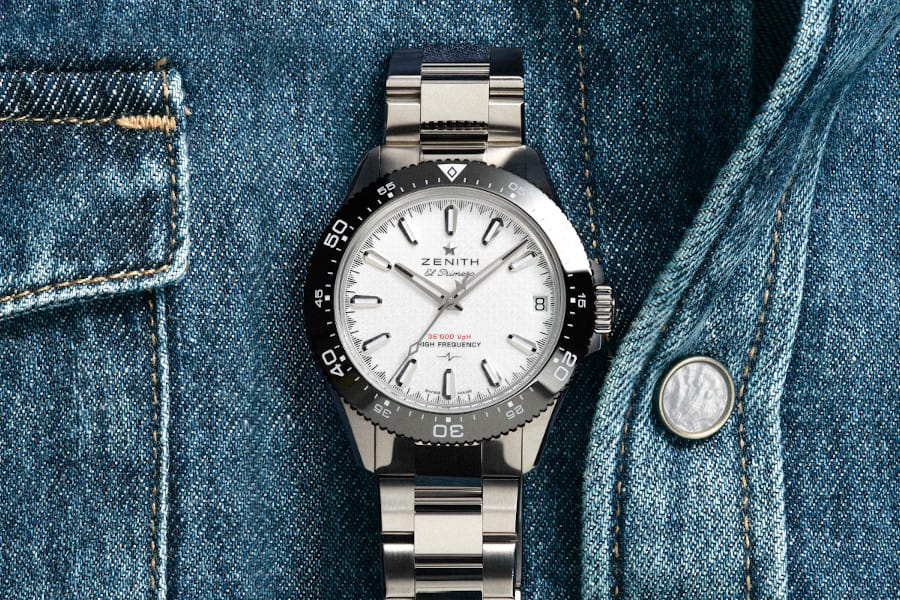
Zenith created a ceramic dial for the Chronomaster Solo Sport, with a repeating Z pattern set at 45 degrees and finished with a sunray effect. In the brand’s words, the pattern translates a technical specification into a distinctive visual code.
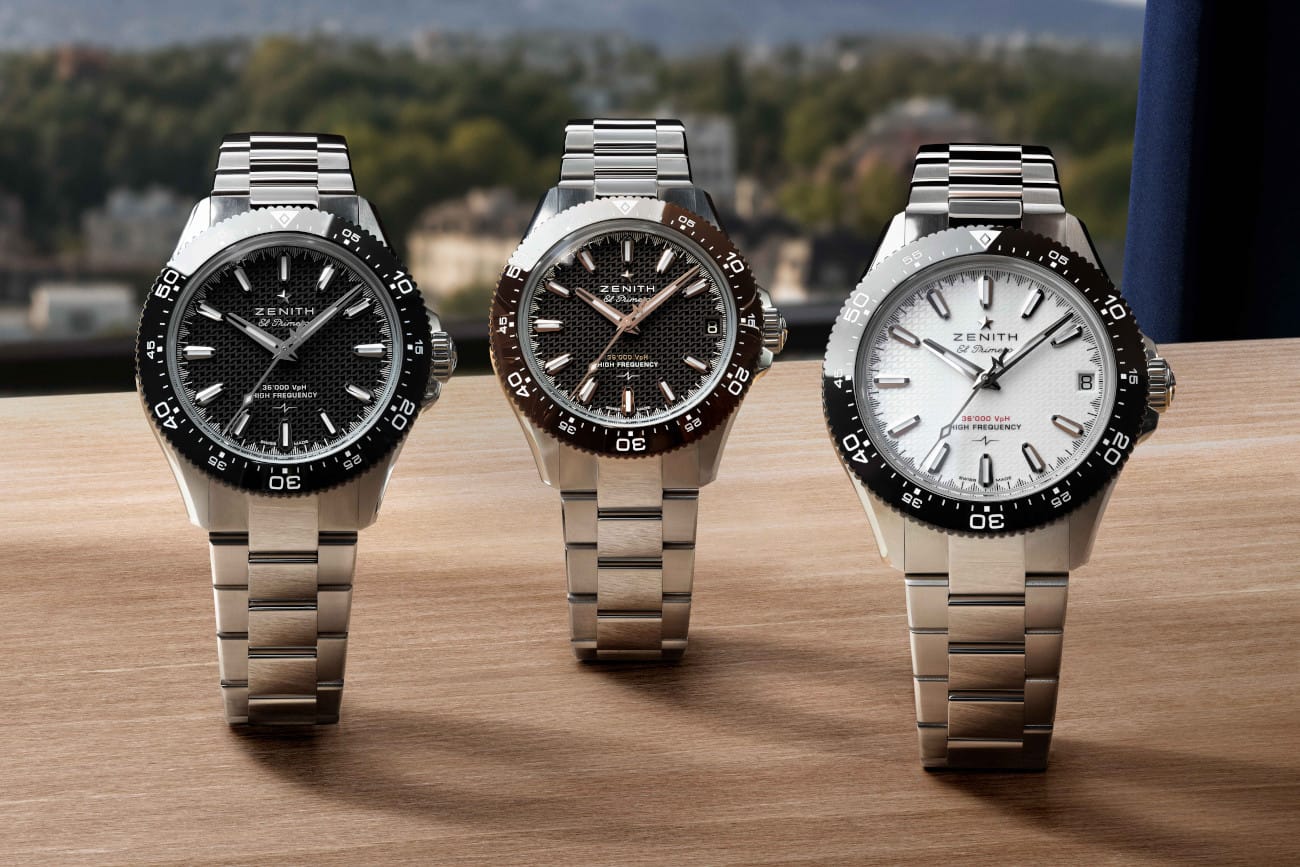
The surface treatment varies between versions. The white dial is sunray-brushed, whereas the black and brown versions have a glossy finish.
Even the seconds hand’s counterweight carries this visual language through. The so-called shark-tooth minute track frames the dial, a sharply segmented scale inspired by historical references.
The El Primero 3620 SC is not breaking news.
El Primero 3620 SC is no headline news: the same base movement already powers the Defy Skyline (without a 1/10 of a second display). Its modern technical architecture includes a silicon escapement, a hacking-seconds function and bidirectional automatic winding.
An openworked rotor charges up to a 60-hour power reserve and offers a clear view of the movement through the exhibition caseback.
Four references, including a no-date option
The Chronomaster Solo Sport range comprises four references. Three feature a date display at 3 o’clock and share identical core specifications: a 40mm steel case, El Primero 3620 SC calibre, 60-hour power reserve, ceramicbezel and steel bracelet. They are offered with white, black or brown dials.
The fourth keeps the black dial with no-date display. It is the line’s most attractive execution, and its official price is significantly lower: €9,500, versus €10,500.
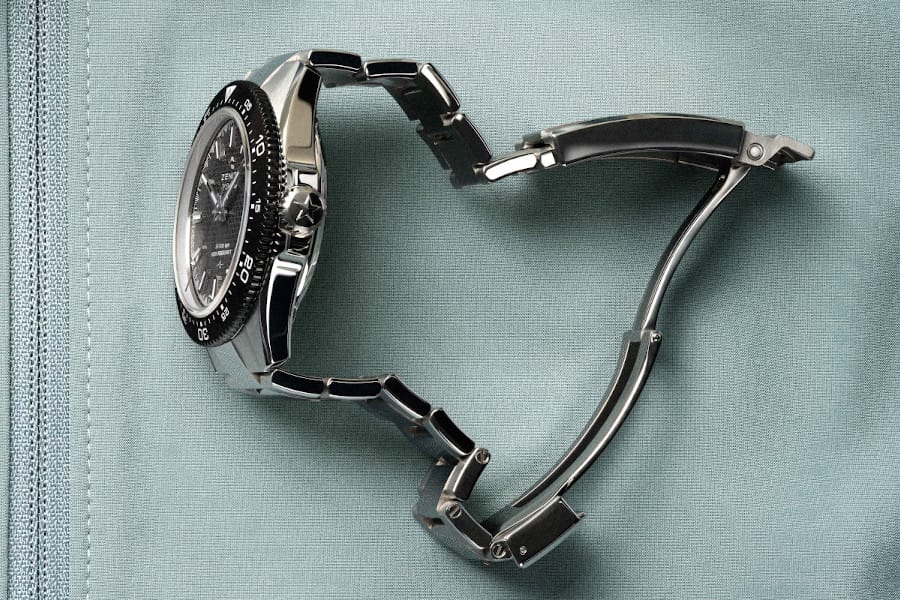
ZENCLASP™ is genuinely ingenious
The three-link steel bracelet is paired with ZENCLASP™, Zenith’s newly developed clasp, unveiled at Watches and Wonders.
Its integrated, tool-free micro-adjustment mechanism lets you adjust the bracelet length in 2.5mm steps across a 10mm range.
What looks like a simple solution conceals substantial development. Zenith cites three years of research and around 1,800 hours of engineering and optimisation.
Made up of 41 parts, the clasp has been tested to cover more than ten years’ use, logging over 600,000 opening-and-closing cycles.
For anyone who wears a metal bracelet daily, it is, in my view, among the new model’s most significant features.
How much does the Zenith Chronomaster Solo Sport cost?
Zenith lists the three date-equipped references at €10,500 and the black no-date version at €9,500. The Chronomaster Solo Sport has been available since 2 September 2026 through Zenith boutiques, the Maison’s online store and authorised retailers.
It enters the fiercely competitive three-hand sports-watch market.
Its most fitting rivals are not necessarily the category’s established three-hand sports watches. I see other high-frequency models as direct competitors: Zenith’s own Defy, which houses the same movement, and the latest Grand Seiko Evolution 9 models, for instance, whose self-winding calibres operate at the same frequency.
Let the complication alone, the Chronomaster Solo Sport packs those credentials into a time-only sports watch with 200 metres of water resistance, an excellent 5Hz calibre, and finishing that matches the standard of Zenith’s most recent releases.
(Photo credit: Zenith)
In this article:
Chronograph
Complication that helps the wearer to measure time intervals without affecting the watch's standard time-telling function.
Complication
The addition of any mechanical complication to a movement that usually displays the time.
Frequency
It is the number of oscillations of the regulating organ. It is divided into hours, mechanical watches, and quartz watches.
Case
It encases the mechanical movement and is crafted in one or more parts. It can also be a single piece, as with some professional diving watches, or made of unconventional…
Ceramic
Widely used for crafting a watch case and, in recent years, also for the bezels of diving watches and dials. Obtained from zirconia powder (ZrO2), ceramic offers superior scratch resistance…
Calibre
A calibre is the type of watch movement encased in an assigned timepiece. Its name is usually associated with the manufacturer's name and a standard code, e.g., ETA 2824.
Bezel
The bezel is particularly useful on diving watches, allowing you to check dive times. In this case, it unidirectionally rotates and usually comes in two parts: a metal (or ceramic,…
Crown
Placed on the case side, it winds the mainspring. When pulled out, it also sets the time and the date. A screw-down crown increases water resistance and protects the movement…
Rotor
Part of an automatic watch that winds the mainspring by constantly rotating. Depending on the watch's winding capability, movement design, and value, it comes in various geometries, sizes, and materials.…
Power Reserve
A mechanical watch feature displays, on the dial or the case back, the remaining power in a watch movement, showing the length of time until the timepiece must be rewound.
Date
It indicates the date of the month. There are different types of display: via a window or a pointer, where an additional hand is usually placed centrally or on a…
Line
It is the measurement unit that identifies the size of a movement. According to this measurement system, one line corresponds to 2,255mm.