Axopar 38 XC Cross Cabin and Sun Top: Evolution of the Species
Giovanni Di Biase12 July 2026
0 Comments
The new Axopar 38 is more than a marginally enlarged version of the 37 and, at least for now, is not meant to replace it.
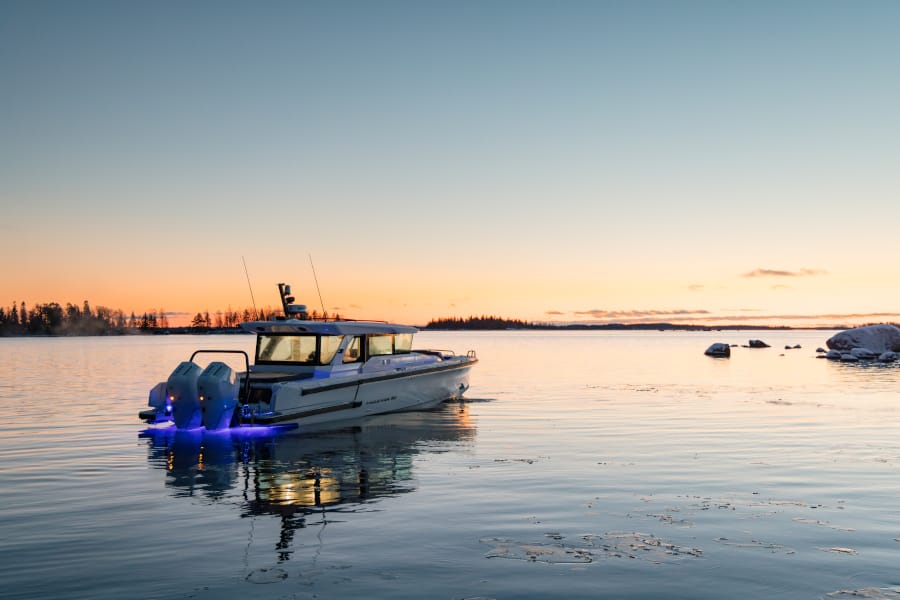
First unveiled in XC Cross Cabin form at Boot Düsseldorf 2026, and later introduced in Sun Top guise, the 38 marks the arrival of a new platform positioned alongside one of the Finnish builder’s best-selling models.
The range retains Axopar’s signature walkaround concept, but introduces an all-new hull shaped by the experience gained with the 45. It delivers more onboard space and an almost limitless degree of configuration.
The Axopar 38 is aimed at owners seeking greater comfort and accommodation, stronger performance, and more versatility —yet who are not ready to step up to the size—or cost—of an Axopar 45.
The Axopar 38 complements the 37; it does not replace it—at least not yet.
With more than 3,000 boats sold worldwide, the Axopar 37 remains one of the brand’s cornerstone models. In the United States, it was the best-selling outboard boat in the 35- to 40-foot segment in both 2024 and 2025, according to consolidated registration and sales figures cited by Axopar.
Demand for the 37 therefore remains strong, which is why it will continue to be offered alongside the new 38.
The two models share much of the same design ethos, but they do not address precisely the same market niche.
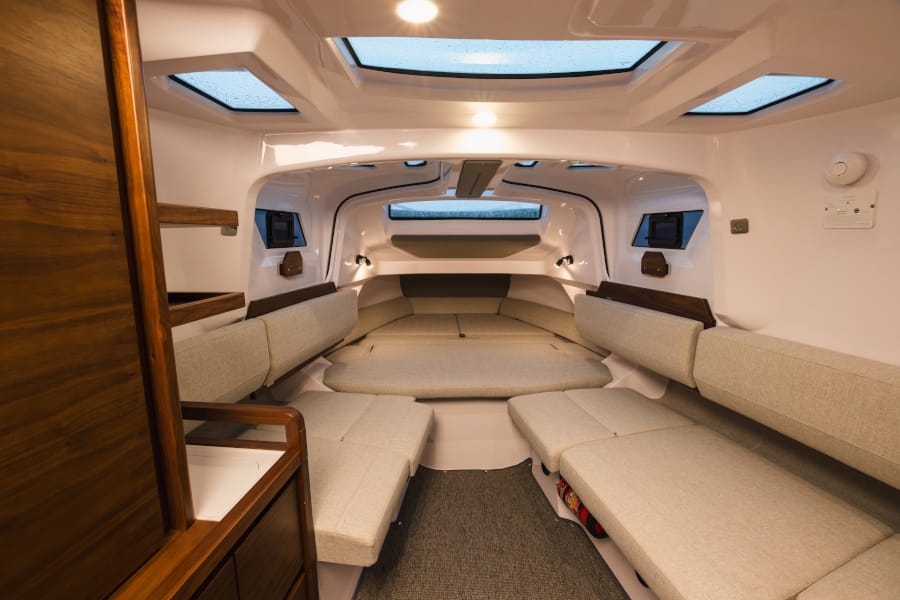
The 38 raises the bar in accommodation, beam, fuel capacity, equipment, and customisation. It also offers a noticeably more substantial cabin for offshore trips. Yet its appeal goes well beyond those improvements.
Why Axopar has moved from 37 to 38 feet
The Axopar 37 measures 11.50 metres in length and 3.35 metres in beam. The new 38 is 11.85 metres overall (excluding engines) and has a notably broader 3.53-metre beam.
The length increase is modest, but the added beam and usable volume transform the feel of the boat’s interior and exterior spaces.
At a quoted length of 38 feet 11 inches, the Axopar 38 is, in practical terms, a boat edging towards 39 feet. The change in designation, however, does not appear to have been driven by any particular certification advantage.
Both models are CE-certified in Category B (Offshore) and Category C (Coastal). They are approved to carry up to ten people in Category B, and twelve in Category C.
Category B applies to craft intended for offshore operation within the limits set by European regulations. In contrast, Category C is primarily intended for coastal cruising.
Moving to the 38 therefore neither increases passenger capacity nor raises the design category.
The real advantage is architectural: more volume without moving materially beyond the 37’s overall size bracket, combined with a redesigned hull intended to improve both outright performance and NVH characteristics—noise, vibration and harshness.
In several respects, the 38 feels more like a scaled-down Axopar 45 than a stretched and widened 37. It focuses on sociable onboard living, extensive configurability, and a more heavily engineered hull structure.
A thoroughly reworked hull
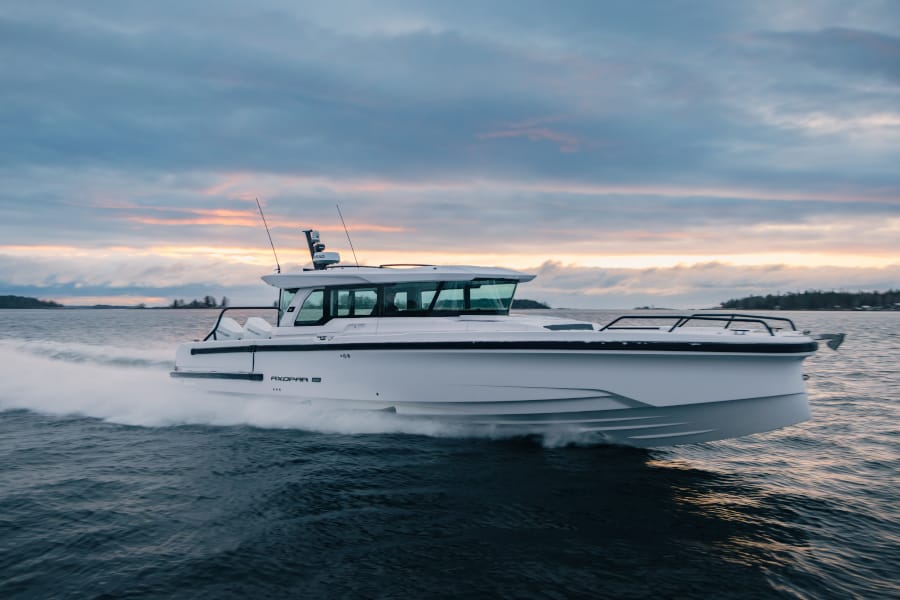
The new hull features a 20-degree deadrise, a fine bow entry and twin steps. Axopar says it has revised the bow geometry, hull profile, hydrodynamics and weight distribution to achieve more predictable handling across a wider range of speeds.
Most importantly, the boat adopts a different weight distribution. This is especially relevant for a hull concept originally designed to be highly efficient in relatively calm water, where the bow’s tendency to dig in can become more apparent in demanding sea conditions.
The update is significant given how earlier Axopar models have behaved in rough conditions.
The brand’s hulls are widely appreciated for getting onto the plane quickly, maintaining a relatively level running attitude and delivering low fuel consumption at sustained speeds, while still being capable of top speeds well beyond 50 knots.
That said, the slim bow entry and limited bow rise under acceleration demand greater care when the sea turns to choppy waves.
Footage filmed at demanding inlets such as Miami’s Haulover Inlet showed the challenges such a hull faces compared with a conventional deep-V design.
These circumstances also depend heavily on the skipper’s seamanship, assessment of the conditions, and management of onboard weight distribution.
Haulover combines strong currents, headwinds, short-period waves and heavy traffic, making it an exceedingly demanding channel.
According to Axopar, the 38 has been engineered to improve on previous models in these conditions, and includes transverse structural reinforcements to stiffen the hull.
The forward sections have been reshaped to shed water and deflect spray more effectively, while the boat’s mass distribution has also been comprehensively rebalanced.
A stiffer, more substantial structure
Excluding engines, the XC Cross Cabin is estimated to weigh around 5.1 tonnes in average specification, while the Sun Top comes in at approximately 5.3 tonnes.
The increase over the 37 is not simply due to the larger dimensions. It also reflects higher equipment levels, more interior volume and additional structural reinforcement.
Axopar says these measures reduce flex, vibration and resonance, while improving perceived solidity, acoustic comfort and steering precision.
Axopar 38 engines, performance and fuel consumption
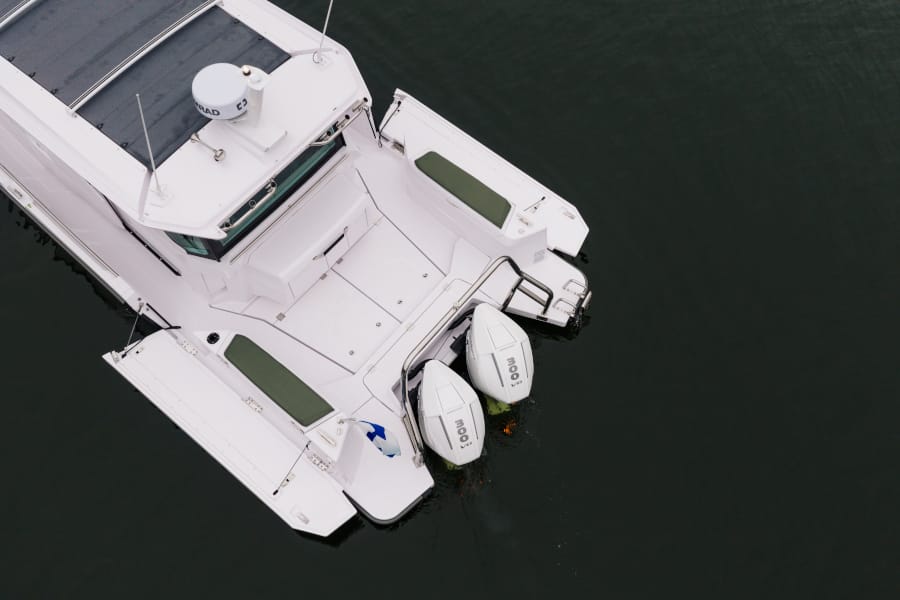
The Axopar 38 is offered with twin Mercury outboards rated at either 300 or 350hp each, for total outputs of 600hp and 700hp respectively. Axopar quotes a top speed in excess of 45 knots, although online test footage has shown the boat comfortably exceeding 50 knots.
In XC Cross Cabin form with twin 300hp Mercury V8s, the builder quotes fuel consumption of around 3 litres per nautical mile at cruising speed. The standard tank holds 830 litres, giving a claimed range of approximately 250 nautical miles under good conditions.
One of the new hull’s key objectives is to keep fuel consumption relatively even over a broader speed range. Axopar identifies 20 to 30 knots as its most efficient operating window and states that a fast cruise of close to 38 knots can be achieved with only a modest fuel increase.
The Sun Top is also available with an optional 1,000-litre fuel tank. In that configuration, Axopar estimates a maximum range of around 330 nautical miles. Real-world range will naturally vary depending on engine choice, load, sea state, hull condition, and driving style.
XC Cross Cabin and Sun Top: a modular platform
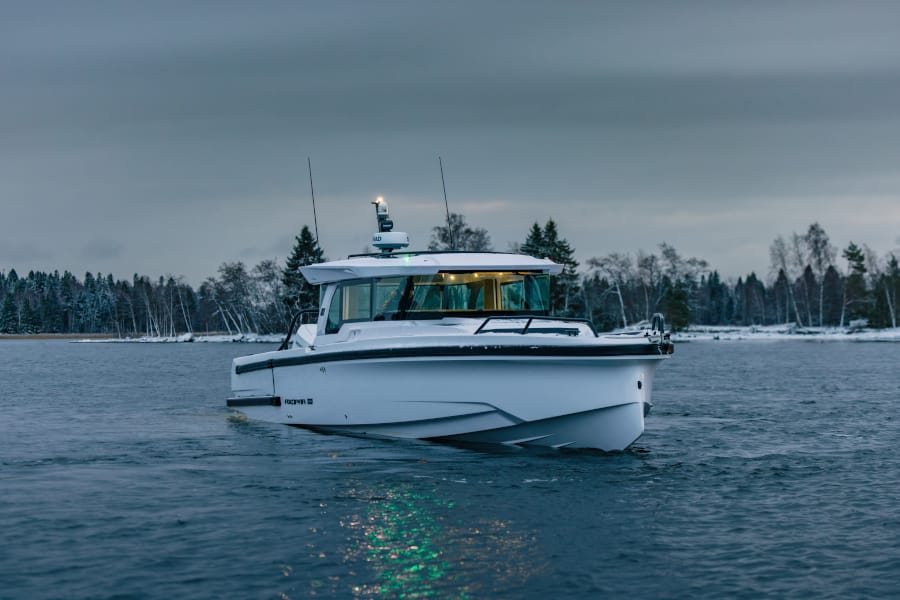
The Axopar 38 XC Cross Cabin was the first version of the range to be revealed. Its defining feature is a fully enclosed helm station with extensive glazing, sliding side doors, an opening aft window and a sliding canvas roof.
It is the most reasonable choice for owners planning to use the boat year-round, including in colder, windier regions or areas prone to rapid weather changes. The helm environment can quickly shift from a protected wheelhouse to a more open, naturally ventilated space.
The Axopar 38 Sun Top shares the same technical platform but replaces the enclosed helm with an open layout sheltered by a hardtop and a large central sliding canvas section.
By removing barriers between the helm, cockpit and aft deck, it places greater emphasis on sociability and a direct connection with the outdoors.
The Sun Top is naturally suited to mild climates and predominantly summer boating. Even so, it retains a forward cabin, a convertible berth, and the option of a galley and an enclosed shower compartment.
The range will later be completed by the Cross Top, an intermediate option offering more protection than the Sun Top without the XC’s fully enclosed wheelhouse.
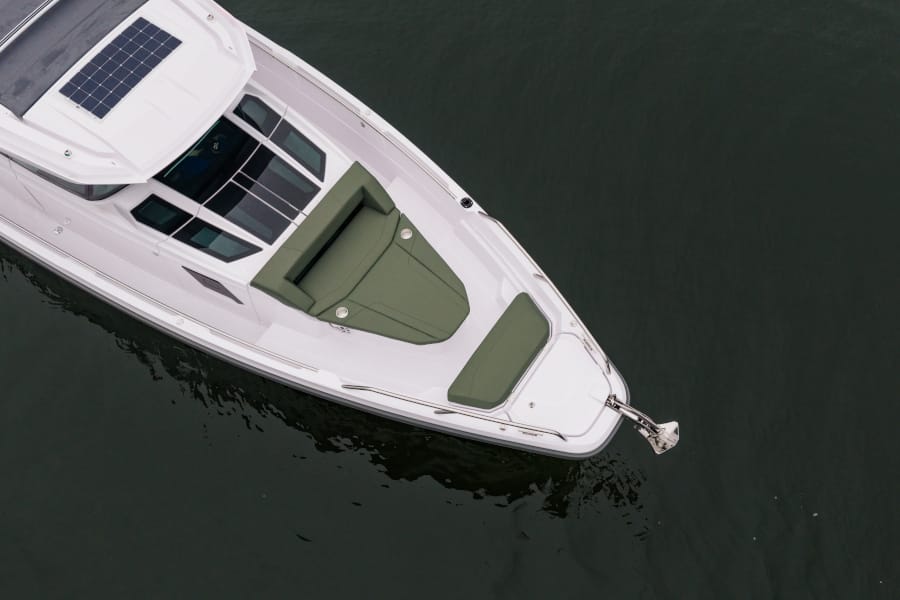
The aft deck can be left open or equipped with a sofa, wet bar, additional cabin or storage module. Fold-down side platforms extend the usable area at water level, while the bow can be arranged with forward-facing seating, a U-shaped lounge or an extended sunpad.
This modularity allows the same platform to serve as a day cruiser, family boat, watersports boat, chase boat or tender for a larger yacht.
Axopar 38 pricing
The official starting price for the Axopar 38 XC Cross Cabin is €195,925 with twin 300hp Mercury V8 Verados, rising to €210,800 with twin 350hp V10 Verados.
The Sun Top starts at €190,425 with the 600hp package and €205,300 with the 700hp option.
All quoted prices exclude VAT, transport, preparation, commissioning, local taxes and optional equipment. A comprehensively specified boat can therefore cost substantially more than the entry-level list price.
The boat follows a clear functional philosophy: understated, with practicality as the top priority, even as Axopar is investing to raise perceived quality.
The brand won’t replicate the interiors of a conventional yacht. Instead, it focuses on dynamics, adaptable spaces, weather protection and ease of ownership.
Who is the new Axopar 38 for?
The Axopar 38 will appeal to owners who value the 37’s practicality and performance but want more volume, comfort, customisation and a more compliant hull.
The XC Cross Cabin is the stronger proposition for year-round boating and longer passages. At the same time, the Sun Top is better suited to open-air cruising, watersports and relaxed social occasions.
The 37 nonetheless retains several compelling advantages: it is lighter, more compact, less expensive and supported by a large, well-established owner community.
Choosing between an Axopar 37 and 38 is therefore not a choice between old and new, even if the latter represents a considerable step forward.
More broadly, the new range reflects how the 11- to 12-metre powerboat category is changing. Performance, weather protection, modularity and overnight capability are increasingly expected from a single platform, steadily blurring the line between the day boat and the compact cruiser.
The real test for the Axopar 38 will be to prove that its additional complexity, weight and volume have not diluted the efficiency that made the 37 so successful.
Axopar argues the opposite: the new model delivers greater structural integrity, a better ride, and a more refined life on board. Those are precisely the qualities the brand is highlighting in its launch campaign and sea trials.