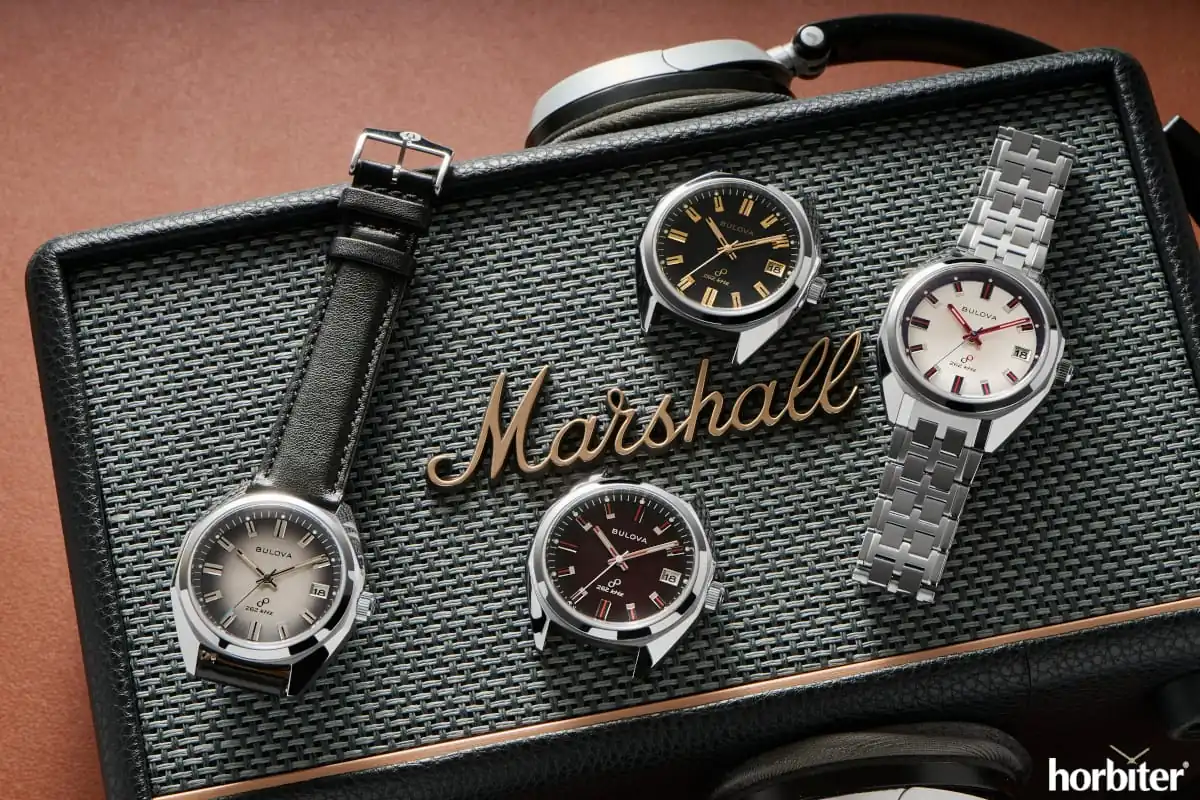
The Bulova Jet Star is not unknown to watch enthusiasts; if you grew up in the seventies and you love watches, the above topic will soon trigger a new conversation. You won’t find as many comments and threads as with an Oceanographer on the internet, yet the Jet Star moniker ranked among Bulova’s best creations back then.
The Jet Star surfaces from the archives.
The new Bulova Jet Star collection ideally draws inspiration from a historical collection and a specific variant: a 1973 turtle-shaped case with no lugs, mechanical movement and day-date display.
Interestingly, the American brand opted here for its proprietary high-frequency technology and a new design that takes on vintage inspiration to mimic the seventies as faithfully and cleverly as possible, yet with a contemporary twist and ultra-modern technology.
An octagonal layout with mirror-polished treatment is topped by a circular, equally polished bezel on a brushed base and a sapphire crystal to protect the dial. The inspiration continues with smoky dials (including a “gold” variant not available in Italy) except for a limited edition model, all paired with applied baton indexes and matching hands.
The outcome is sleek and has no frills, yet it’s distinctive and ends up with a three-hand 40.0 mm large and 12.5 mm thick watch, ensuring comfort and weighing no more than 152.0 grams, on the bracelet. Bulova aims to offer an all-around, easy-to-use (and ultra-precise) timepiece whose only letdown is a 30-metre water resistance.
The bracelet isn’t as original as its forerunner, showcasing a signature hexagonal mid-link, but the double H design is consistent, offering remarkable build quality for the price.
You can swap between bracelet and strap anytime by quickly releasing them, but opt for the integrated bracelet whose design seamlessly complements the Jet Star.
The Bulova High Precision Quartz caliber
As anticipated, Bulova opted for their high-frequencycalibre. Therefore, the Jet Star is powered by the proprietary 262 kHz movement seen across different models. It’s surprising since we expect such a technology to be more familiar with a Lunar Pilot or a Precisionist X, now available in the Italian market, too, from 2023.
Comparing the Jet Star with the Precisionist X, you’ll spot a kind of family feeling exemplified by the case’s octagonal shape.
According to Bulova, the movement (which runs at 16 beats per second) offers a +/- 5 seconds per month. The outcome is also a sweeping-moving seconds hand providing a high-frequency mechanical movement feel but quartz precision.
However, it is quartz, but not any. Precision is among Jet Star’s main takeouts and complements its vintage factor.
It makes sense. The seventies were paramount for the analogue-to-digital transition in music and across the whole industry. In brief, such a choice sounds like a contemporary tribute to the Jet Star’s age rather than the timepiece itself.
Final thoughts
The offering includes three models with a smoked dial. We confirm the red dial is our favourite choice, thanks to the lovely and lively contrast between the dial and the full-steel case and bracelet.
On top is a limited series model on a white dial, and a replacement strap is included in the package. Retail prices start from €429 and stop at €499 if you opt for the limited edition model.
Our verdict is that the Bulova Jet Star collection equally pleases watch nostalgics and techno fans. The case and dial are a tribute to the seventies while offering by far the most precise quartz technology available in the mid-500 Euro range. The outcome is a well-built watch whose matching bracelet confirms the improvements carried out by Bulova.
Nonetheless, we’d add a flagship full-mechanical model as a tribute to the 1973 original timepiece, adopting that same bracelet. For further information, please visit the official Bulova website.
(Photo credit: Horbiter®)
Giovanni Di Biase @Horbiter®
In this article:
Day-date
A watch that indicates the day of the week and the date.
Date
It indicates the date of the month. There are different types of display: via a window or a pointer, where an additional hand is usually placed centrally or on a…
Case
It encases the mechanical movement and is crafted in one or more parts. It can also be a single piece, as with some professional diving watches, or made of unconventional…
Frequency
It is the number of oscillations of the regulating organ. It is divided into hours, mechanical watches, and quartz watches.
Bezel
The bezel is particularly useful on diving watches, allowing you to check dive times. In this case, it unidirectionally rotates and usually comes in two parts: a metal (or ceramic,…
Strap
A leather, rubber or other material band that secures the watch to the wearer's wrist.
Calibre
A calibre is the type of watch movement encased in an assigned timepiece. Its name is usually associated with the manufacturer's name and a standard code, e.g., ETA 2824.